


Turkey’s Erdogan Faces Uphill Battle to Curb ‘Exorbitant Prices’

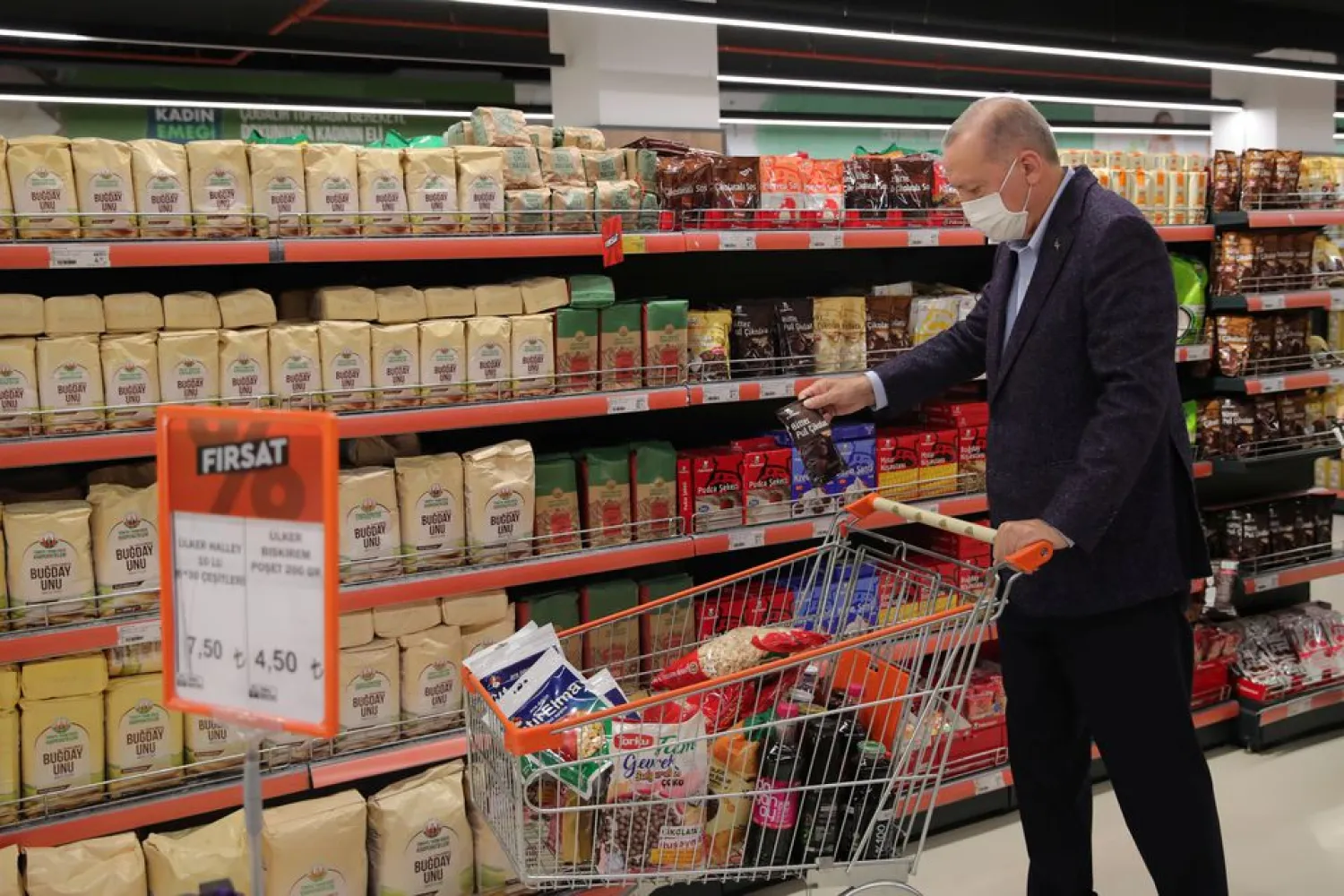
Turkish President Recep Tayyip Erdogan shops at a grocery store of the Agricultural Credit Cooperatives of Turkey, in Istanbul, Turkey October 3, 2021. Presidential Press Office/Handout via Reuters
TT

Turkey’s Erdogan Faces Uphill Battle to Curb ‘Exorbitant Prices’

Turkish President Recep Tayyip Erdogan shops at a grocery store of the Agricultural Credit Cooperatives of Turkey, in Istanbul, Turkey October 3, 2021. Presidential Press Office/Handout via Reuters

President Recep Tayyip Erdogan has wheeled a trolley around one of the new grocery stores he hopes will bring Turkey’s “exorbitant” prices under control, but his unorthodox effort to combat inflation is failing to impress shoppers and retailers.

Accompanied by his wife and daughter, Erdogan went shopping near his Istanbul home earlier this month, telling assembled media that the expanding chain of Agricultural Credit Cooperatives will help curb price rises.

Frustrated by inflation running near 20% and sliding opinion polls ahead of elections set for 2023, Erdogan has instructed the retail chain to open 1,000 stores to provide cheap, quality products and “balance the market”.

His government has also pointed the finger at major retailers and investigated potential exploitative pricing in the battle to curb prices.

But as many Turks struggle with the rising cost of living, shoppers at one such cooperative store in Istanbul were skeptical.

“This is just for show, to give the impression that there’s a solution. But it’s just a lie. I looked at the prices and they’re not different from other supermarkets,” said businessman Ozgur, 45, as he left the store after purchasing a fruit juice.

Another customer leaving the store in central Istanbul’s Sisli district, Gultekin Bora, was also not convinced it was cheaper and criticized the government’s response to economic woes.

“They’ve made a chain of mistakes. The leap in the exchange rate and inflation shows the economy caught a fever due to their economic practices,” said public sector employee Bora, 64.

Annual inflation hit 19.6% in September, its highest in two-and-a-half years, with food inflation near 29%. Efforts to lower it now face a fresh challenge as a lira slide driven by monetary easing fuels import prices.

Erdogan said last week Ankara was monitoring “opportunists” who were exploiting the situation to hike prices for profit.

Retailers ‘saddened’
Food retailers have hit back, denying excessive price rises and insisting they were competitive.

“Retail operators are sacrificing profitability and meeting consumers’ needs at prices close to cost to minimize consumer reaction,” Food Retailers Association chairman Galip Aykac, who is also a board member of major retailer BIM, said at an event on Tuesday.

Such efforts to curb inflation have been tried previously. Turkey opened state markets to sell cheap vegetables in 2019 ahead of local elections, and last month the trade ministry sent inspectors to check supermarkets for excessive pricing.

But analysts say rising prices are primarily the result of the central bank’s depleted credibility. Erdogan has fired the last three bank governors and last week sacked three central bankers.

Adeline Van Houtte, European analyst at The Economist Intelligence Unit, said pressuring supermarkets and inspecting prices “has little chance of success and ... further undermines confidence in the government´s economic policies.”

Cooperative stores general manager Bayram Ali Yildirim said his company could afford to price products 5% cheaper than other retail chains because they were supplied directly by farmers.

“We are trying to regulate the market. Because we don’t lift our prices, other retailers can’t raise theirs,” he told state-owned Anadolu news agency. His chain aims to open 700 stores by year-end and to reach Erdogan’s target of 1,000 stores in the first half of 2022.

Retired 53-year-old Ayten Kar praised the cooperative store as she emerged from it with packets of coffee, describing it as “wallet friendly”. But she had little sympathy for a government which she said needed to support poorer people, or go.

“I’m finding it hard to get by. The bills are very high. The pension that we get is inadequate. Rents have surged. The last five years have been really bad,” she said.




Taiwan Says Chinese Ships Entered Waters of Disputed South China Sea Island

A Taiwan Coast Guard boat patrols, as seen from a boat with Chinese tourists, to observe Taiwan's Kinmen Islands, off Xiamen, in China's southeastern Fujian province on May 25, 2026. (Photo by Hector RETAMAL / AFP)
TT

Taiwan Says Chinese Ships Entered Waters of Disputed South China Sea Island

A Taiwan Coast Guard boat patrols, as seen from a boat with Chinese tourists, to observe Taiwan's Kinmen Islands, off Xiamen, in China's southeastern Fujian province on May 25, 2026. (Photo by Hector RETAMAL / AFP)

Taiwan said Chinese ships entered the "prohibited" waters off a disputed island in the South China Sea for the first time on Thursday, condemning escalating "harassment" by Beijing.

The two Chinese vessels "openly intruded" into the waters around the Taiwan-controlled Taiping Island and stayed for 15 minutes before the Taiwanese coast guard expelled them, the force said in a statement.

The island, also known as Itu Aba, is the largest in the Spratly archipelago claimed by Taiwan, China, the Philippines and Vietnam, said AFP.

The Taiwanese coast guard expressed its "strongest condemnation of this incident", saying it "once again maliciously escalates grey-zone harassment in an attempt to create a false impression of jurisdiction".

China claims Taiwan is part of its territory and in recent years has ramped up military pressure on the island democracy.

Beijing also claims most of the South China Sea.

Taiping's "prohibited" waters extend four kilometers (2.5 miles) from shore, Taiwan's coast guard said.

"China is systematically harassing Taiwan," the Ocean Affairs Council, which is responsible for the coast guard, said on X.

The latest in a series of Chinese activities in waters around Taiwan and islands under its control follows an operation to Taiwan's east, which Beijing said was in response to talks between Japan and the Philippines to draw a maritime boundary there.

The Ocean Affairs Council said Thursday's incident "also proves that what China did in the waters east of Taiwan should be dealt with as a challenge to international order; Japan-Philippines talks were just an excuse."

China called the Japan-Philippines talks "illegal" and has claimed exclusive control over the affected waters.

Taiwan has branded the Chinese operation in recent days as "provocative" and "expansionism in disguise".

Taipei has also accused the Chinese ships of "harassment" after they requested information from three passing commercial cargo ships, including their port of destination.

Meanwhile, Taiwan's coast guard said Saturday that a Chinese survey vessel had joined a coast guard ship in waters around Pratas Island in the northern part of the South China Sea.

It was "the first observed instance of Chinese coast guard and survey vessels acting in coordination to provoke Taiwan", the coast guard said.

Taiwan controls Pratas but Beijing also claims the island, along with most of the strategic waterway.


Iran Says US Strikes Render Ceasefire 'Meaningless,' Talks on Funds Mechanism Still on Track

A banner with a picture of Iran's Supreme Leader, Mojtaba Khamenei and the late senior Iranian military commander, General Qassem Soleimani, on a building in Tehran, Iran, June 11, 2026. Majid Asgaripour/WANA (West Asia News Agency) via REUTERS
TT

Iran Says US Strikes Render Ceasefire 'Meaningless,' Talks on Funds Mechanism Still on Track

A banner with a picture of Iran's Supreme Leader, Mojtaba Khamenei and the late senior Iranian military commander, General Qassem Soleimani, on a building in Tehran, Iran, June 11, 2026. Majid Asgaripour/WANA (West Asia News Agency) via REUTERS

Iran's foreign ministry condemned on Thursday the latest US strikes on the country, saying the attacks rendered the nearly two-month ceasefire "practically meaningless.”

In a statement, the ministry said "the illegal and criminal attacks perpetrated by the United States in recent hours not only constitute a flagrant violation... but also render the ceasefire practically meaningless.”

It added that the "responsibility for the extremely serious consequences of this criminal act lies with the leaders of the United States.”

Despite the foreign ministry statement, three Iranian sources told ⁠Reuters that efforts to reach a preliminary deal between Iran and the ⁠US have intensified, as they discuss a ⁠mechanism ⁠over releasing frozen Iranian funds.

The sources said Iran and the US were still exchanging ⁠messages over details ⁠of a memorandum of understanding.

The Iranian sources said a political understanding had been reached, but some issues remained to ⁠be discussed in detail, including a mechanism for the release of tens of billions of dollars of Iranian oil revenues frozen in foreign banks.

"Iran wants $6 billion to $12 billion of its frozen funds to be released to Tehran, while Washington wants to release funds in stages for ⁠humanitarian ⁠goods and rejects returning funds to Iran outright," said one of the Iranian sources.

CNN also reported, citing a ⁠diplomatic source, that talks to reach a deal are still on track after overnight negotiations.

The US and Iran traded air attacks for a second straight day on Thursday, with President Donald Trump vowing ⁠further strikes ⁠if Tehran does not immediately agree to a peace deal.

Qatari negotiators have departed Tehran following discussions on the war, a diplomat told AFP on Thursday.

"The Qatari delegation departed from Tehran this morning following talks with Iranian officials... that lasted into the early hours of this morning," the diplomat said on condition of anonymity, adding the discussions were "conducted in coordination with the United States.”

The US strikes overnight Thursday on Iran wounded at least three people at sites in Tehran province, Iranian media reported.

"Three people were injured in incidents related to the brutal US attacks in Tehran province," said head of the province's emergency services Mohammad Esmail Tavakoli, according to the Fars news agency.

The strikes were largely focused on southern Iran but the country's Revolutionary Guards said other sites near the capital were hit including in Karaj, Nazarabad and Pishva.


Iran and Ukraine Loom over G7 as France Accommodates Trump

FILE PHOTO: A drone views shows the Evian Resort hotel overlooking Lake Geneva (Leman) where the 2026 G7 summit will take place in Evian-les-Bains, France, September 12, 2025. REUTERS/Denis Balibouse/File Photo
TT

Iran and Ukraine Loom over G7 as France Accommodates Trump

FILE PHOTO: A drone views shows the Evian Resort hotel overlooking Lake Geneva (Leman) where the 2026 G7 summit will take place in Evian-les-Bains, France, September 12, 2025. REUTERS/Denis Balibouse/File Photo

Wars in the Middle East and Ukraine are set to dominate next week’s Group of Seven summit, as host France crafts an agenda aimed at projecting unity and avoiding confrontation with US President Donald Trump.

The June 15–17 gathering in Evian-les-Bains, on the shore of Lake Geneva, brings together the leaders of France, Britain, Canada, Germany, Italy, Japan and the United States, alongside the European Union, Reuters said.

With Trump struggling to end a war that has disrupted the global economy, and frustrated with European allies he deems to have failed him in the Gulf and grown over-reliant on the US for their security needs, diplomats say crisis management will be the focus.

No breakthrough decisions are thus expected on key issues, which also include tackling global economic imbalances and sourcing critical minerals outside China.

The grouping, founded half a century ago, has traditionally addressed economic and geopolitical challenges with broad consensus. But that cohesion has frayed since Trump returned to the White House in 2025.

Having already shifted the dates to accommodate Trump's birthday plans for cage fighting on the White House lawn, French officials, like other recent summit hosts, have set ‌the bar low, suggesting it ‌will be a success if Trump just stays for the whole event, having left the 2025 ‌version ⁠early.

"Macron has gone ⁠out of his way to have an agenda that is designed to appeal to the sort of things President Trump wants," said Josh Lipsky, chair of international economics at the Atlantic Council.

TRUMP'S MOOD MAY DEPEND ON IRAN

The tempo may be dictated by events in the Middle East. A fragile ceasefire between the US and Iran is under strain, and securing even an interim accord that delays tackling harder issues such as Iran's nuclear program is proving arduous.

Trump wants Iran to reopen the Strait of Hormuz, a choke point for global oil and gas shipments. Tehran is demanding that the US end its blockade on Iranian ports and release frozen Iranian assets, and that Israel cease its attack on the Iranian-backed Hezbollah militia in Lebanon.

Diplomats say Trump’s mood may hinge on ⁠whether he can get an accord done before the summit. In recent months, he has lashed out at ‌some of the US's closest allies in NATO for their unwillingness to support his Gulf ‌campaign.

One senior diplomat from a G7 member said an accord might allow the group to put months of tension with the US behind them.

France has invited ‌Saudi Arabia, the United Arab Emirates and Qatar, all directly harmed by the war, to the summit along with Egypt, a key player ‌in mediation efforts.

EUROPEANS SEEK US RESET ON UKRAINE

Also invited is Ukrainian President Volodymyr Zelenskiy.

Negotiations to end Russia’s war in Ukraine have stalled and Zelenskiy wants a fresh push and is pressing for Europe to play a bigger role.

Zelenskiy frets that the conflict in Iran has diverted US attention. Meanwhile, dynamics on the battlefield have shifted, with Ukrainian drones striking deeper into Russian territory to cut battlefield supply lines and hobble energy infrastructure.

European diplomats see the summit as an opportunity to convince Trump ‌that US proposals for a deal have been too favorable to Moscow. European nations also want to signal that they are willing to engage Moscow while tightening sanctions and boosting military support for Ukraine, ⁠emphasizing that they believe Russia, not ⁠Kyiv, is blocking progress.

"What we are increasingly seeing is Europeans beginning to think about a life with less America,” said Victor Cha, head of geopolitics and foreign policy at Washington's Center for Strategic and International Studies.

GLOBAL IMBALANCES PUT SPOTLIGHT ON CHINA

French officials have dropped plans for a sweeping final communique, opting instead for narrower joint statements on areas such as critical minerals, migration and drug trafficking.

Asuka Tatebayashi, senior analyst at Mizuho Bank in Tokyo, said the Japanese government and its major companies had for more than a decade built up stockpiles of critical minerals and shown they could weather supply shocks.

“It's one of the few fields that the US actually comes to Japan for advice on,” Tatebayashi said.

She urged the G7 to agree to a substantive initiative on critical minerals such as minimum pricing, sharing of stockpiles or joint development projects, but said the differences among them were still wide.

Paris has used its presidency to push for action on global macroeconomic imbalances, a longstanding US concern, before Washington takes the chair of the G20 this year and the G7 next.

France has framed the issue as a shared responsibility in that China overproduces, the United States overconsumes and Europe underinvests.

Brazil, India, Kenya and South Korea have been invited to the G7 to join the discussion, while Macron has urged China to boost its own consumption.

"None of that solves the problem, but the first step is recognizing that you have one,” Lipsky said. “This has been discussed for years, but not collectively within the G7."