

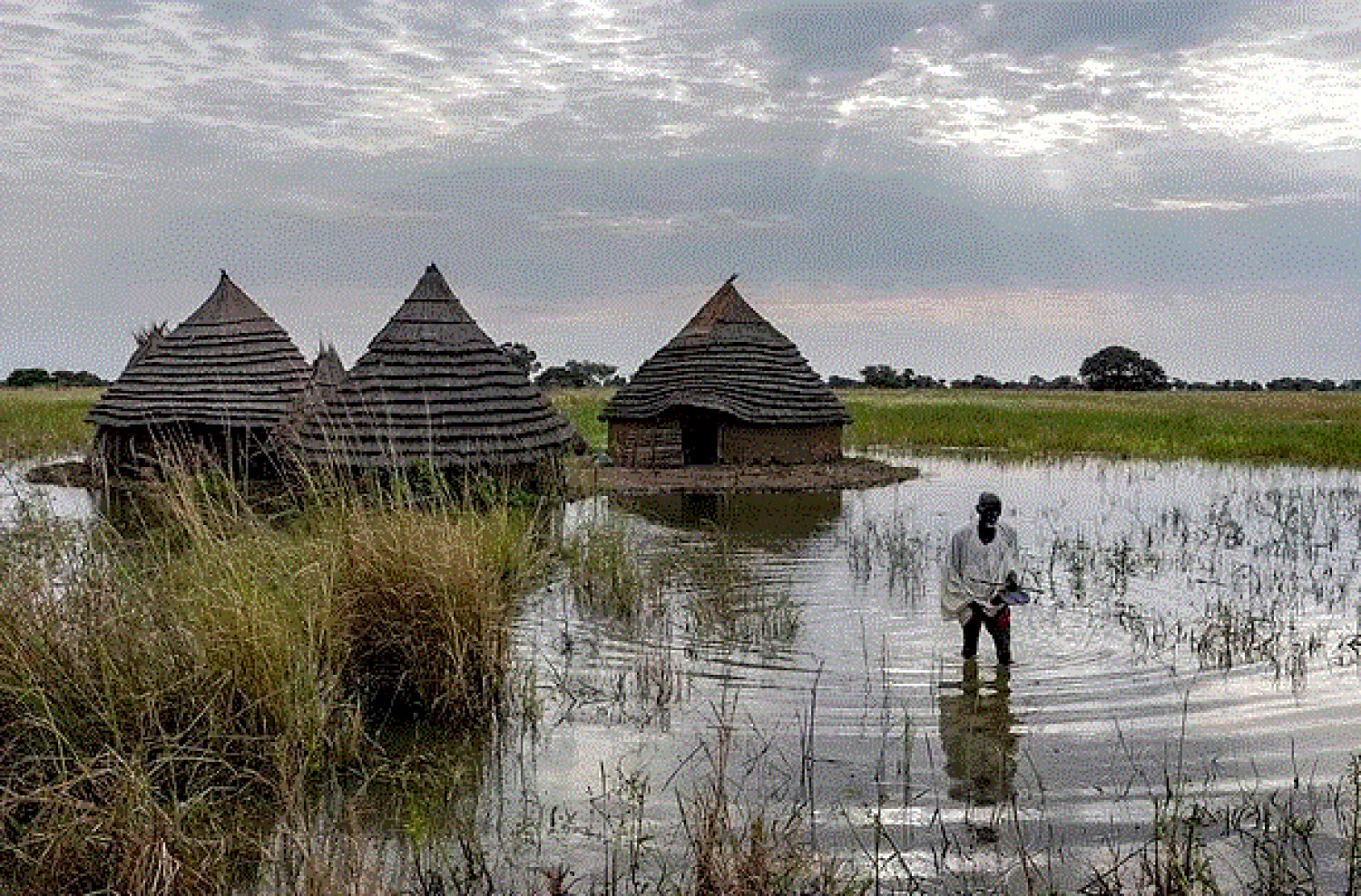

In South Sudan, Flooding Called ‘Worst Thing in My Lifetime’

Yel Aguer Deng, who does not know his age, walks through water from his compound to the Wanyhok-Akon road, near Malualkon in Northern Bahr el Ghazal State, South Sudan, Wednesday, Oct. 20, 2021. (AP Photo/Adrienne Surprenant)
TT

In South Sudan, Flooding Called ‘Worst Thing in My Lifetime’

Yel Aguer Deng, who does not know his age, walks through water from his compound to the Wanyhok-Akon road, near Malualkon in Northern Bahr el Ghazal State, South Sudan, Wednesday, Oct. 20, 2021. (AP Photo/Adrienne Surprenant)

He feels like a man who has drowned.

The worst flooding that parts of South Sudan have seen in 60 years now surrounds his home of mud and grass. His field of sorghum, which fed his family, is under water. Surrounding mud dykes have collapsed.

Other people have fled. Only Yel Aguer Deng´s family and a few neighbors remain.

This is the third straight year of extreme flooding in South Sudan, further imperiling livelihoods of many of the 11 million people in the world´s youngest country. A five-year civil war, hunger and corruption have all challenged the nation. Now climate change, which the United Nations has blamed on the flooding, is impossible to ignore, The Associated Press reported.

As he empties a fishing net, Daniel Deng, a 50-year-old father of seven, recalls a life of being forced to flee again and again because of insecurity. "But this one event (the flood) is too much," he said. "It is the worst thing that happened in my lifetime."

The UN says the flooding has affected almost a half-million people across South Sudan since May. Here in Northern Bahr el Ghazal state, the Lol river has burst its banks.

This state is usually spared from extreme flooding that plagues the South Sudan states of Jonglei and Unity that border the White Nile and the Sudd marshlands. But now, houses and crops have been swamped.

A new report this week coordinated by the World Meteorological Organization warned of increasing such climate shocks to come across much of Africa, the continent that contributes the least to global warming but will suffer from it most.

In these rural South Sudan communities, shelters of braided grass put up a fragile resistance in a land of seemingly endless water.

In Langic village, Ajou Bol Yel´s family of seven hosted nine neighbors who had lost their homes. The elders sleep outside on beds protected by mosquito nets, while the children share the floor.

In Majak Awar, some 100 families have been displaced twice, in June when homes were flooded and again in August when their shelters were ruined, too.

"I want to leave for Sudan," whispered Nyibol Arop, a 27-year-old mother of five, as she boiled her morning tea just steps away from the stagnant water that threatens her current shelter.

It is hard to see a stable future when constantly on the move, a lesson learned during the civil war that displaced millions of people before a peace agreement in 2018.

"Floods are not constant. Some people will stay, and some will go," said Thomas Mapol, a 45-year-old father of nine, as he showed off the destroyed houses of his village near Majak Awar. "But me, I cannot move anywhere. There is no other place that I know."



US Judge Blocks Deportation of Columbia University Palestinian Activist

Mohsen Mahdawi at a press conference in Vermont last year - Photo by Alex Driehaus/AP
TT

US Judge Blocks Deportation of Columbia University Palestinian Activist

Mohsen Mahdawi at a press conference in Vermont last year - Photo by Alex Driehaus/AP

A US immigration judge has blocked the deportation of a Palestinian graduate student who helped organize protests at Columbia University against Israel's war in Gaza, according to US media reports.

Mohsen Mahdawi was arrested by immigration agents last year as he was attending an interview to become a US citizen.

Mahdawi had been involved in a wave of demonstrations that gripped several major US university campuses since Israel began a massive military campaign in the Gaza Strip.

A Palestinian born in the occupied West Bank, Mahdawi has been a legal US permanent resident since 2015 and graduated from the prestigious New York university in May. He has been free from federal custody since April.

In an order made public on Tuesday, Judge Nina Froes said that President Donald Trump's administration did not provide sufficient evidence that Mahdawi could be legally removed from the United States, multiple media outlets reported.

Froes reportedly questioned the authenticity of a copy of a document purportedly signed by Secretary of State Marco Rubio that said Mahdawi's activism "could undermine the Middle East peace process by reinforcing antisemitic sentiment," according to the New York Times.

Rubio has argued that federal law grants him the authority to summarily revoke visas and deport migrants who pose threats to US foreign policy.

The Trump administration can still appeal the decision, which marked a setback in the Republican president's efforts to crack down on pro-Palestinian campus activists.

The administration has also attempted to deport Mahmoud Khalil, another student activist who co-founded a Palestinian student group at Columbia, alongside Mahdawi.

"I am grateful to the court for honoring the rule of law and holding the line against the government's attempts to trample on due process," Mahdawi said in a statement released by his attorneys and published Tuesday by several media outlets.

"This decision is an important step towards upholding what fear tried to destroy: the right to speak for peace and justice."


Fire Breaks out Near Iran's Capital Tehran, State Media Says

Smoke rises from a fire caused by an explosion in Tehran (File photo - Reuters)
TT

Fire Breaks out Near Iran's Capital Tehran, State Media Says

Smoke rises from a fire caused by an explosion in Tehran (File photo - Reuters)

A fire broke out in Iran's Parand near the capital city Tehran, state media reported on Wednesday, publishing videos of smoke rising over the area which is close to several military and strategic sites in the country's Tehran province, Reuters reported.

"The black smoke seen near the city of Parand is the result of a fire in the reeds around the Parand river bank... fire fighters are on site and the fire extinguishing operation is underway", state media cited the Parand fire department as saying.


Pakistan PM Sharif to Seek Clarity on Troops for Gaza in US Visit

US President Donald Trump looks at Pakistan's Prime Minister Shehbaz Sharif speaking following the official signing of the first phase of the Gaza ceasefire agreement between Israel and Hamas, during a world leaders' summit on ending the Gaza war, in Sharm El-Sheikh, Egypt, October 13, 2025. REUTERS/Evelyn Hockstein/File Photo
TT

Pakistan PM Sharif to Seek Clarity on Troops for Gaza in US Visit

US President Donald Trump looks at Pakistan's Prime Minister Shehbaz Sharif speaking following the official signing of the first phase of the Gaza ceasefire agreement between Israel and Hamas, during a world leaders' summit on ending the Gaza war, in Sharm El-Sheikh, Egypt, October 13, 2025. REUTERS/Evelyn Hockstein/File Photo

Before Pakistan commits to sending troops to Gaza as part of the International Stabilization Force it wants assurances from the United States that it will be a peacekeeping mission rather than tasked with disarming Hamas, three sources told Reuters.

Pakistan's Prime Minister Shehbaz Sharif is set to attend the first formal meeting of President Donald Trump's Board of Peace in Washington on Thursday, alongside delegations from at least 20 countries.

Trump, who will chair the meeting, is expected to announce a multi-billion dollar reconstruction plan for Gaza and detail plans for a UN-authorized stabilization force for the Palestinian enclave.

Three government sources said during the Washington visit Sharif wanted to better understand the goal of the ISF, what authority they were operating under and what the chain of command was before making a decision on deploying troops.

"We are ready to send troops. Let me make it clear that our troops could only be part of a peace mission in Gaza," said one of the sources, a close aide of Sharif.

"We will not be part of any other role, such as disarming Hamas. It is out of the question," he said.

Analysts say Pakistan would be an asset to the multinational force, with its experienced military that has gone to war with arch-rival India and tackled insurgencies.

"We can send initially a couple of thousand troops anytime, but we need to know what role they are going to play," the source added.

Two of the sources said it was likely Sharif, who has met Trump earlier this year in Davos and late last year at the White House, would either have an audience with him on the sidelines of the meeting or the following day at the White House.

Initially designed to cement Gaza's ceasefire, Trump sees the Board of Peace, launched in late January, taking a wider role in resolving global conflicts. Some countries have reacted cautiously, fearing it could become a rival to the United Nations.

While Pakistan has supported the establishment of the board, it has voiced concerns against the mission to demilitarize Gaza's militant group Hamas.