


Vaccine Reluctance in Eastern Europe Brings High COVID Cost

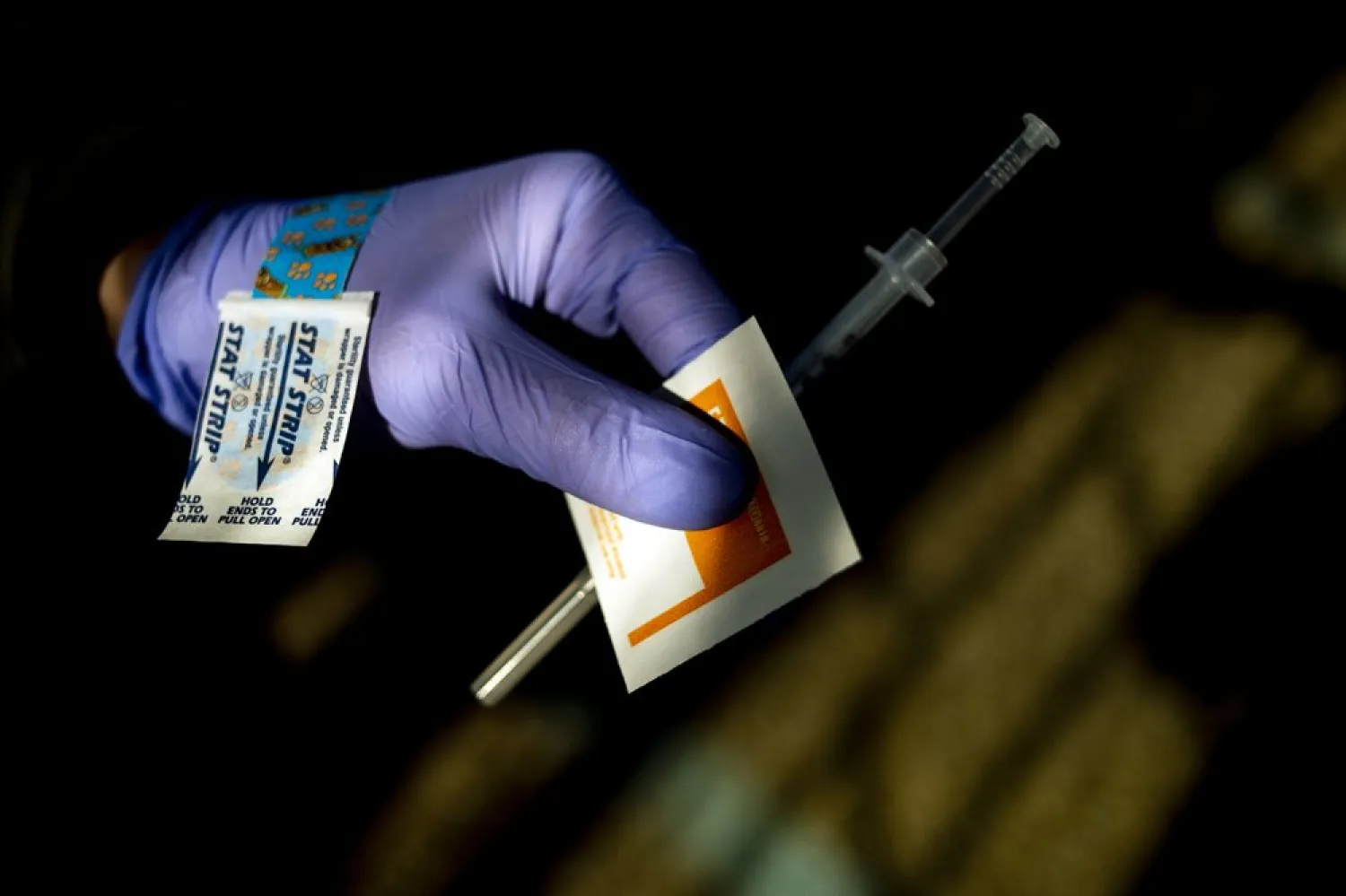
FILE - In this March 29, 2021, file photo, UM-Flint nursing student Michaela Dimello helps administer the first dose of the Moderna COVID-19 vaccine to Genesee County residents at Bishop Airport in Flint, Mich. (Jake May/The Flint Journal via AP, File)
TT

Vaccine Reluctance in Eastern Europe Brings High COVID Cost

FILE - In this March 29, 2021, file photo, UM-Flint nursing student Michaela Dimello helps administer the first dose of the Moderna COVID-19 vaccine to Genesee County residents at Bishop Airport in Flint, Mich. (Jake May/The Flint Journal via AP, File)

Truck driver Andriy Melnik never took the coronavirus seriously. With a friend, he bought a fake vaccination certificate so his travel documents would appear in order when he hauled cargo to other parts of Europe.

His view changed after the friend caught COVID-19 and ended up in an intensive care unit on a ventilator, said The Associated Press.

“It's not a tall tale. I see that this disease kills, and strong immunity wouldn't be enough -- only a vaccine can offer protection,” said Melnik, 42, as he waited in Kyiv to get his shot. “I'm really scared and I'm pleading with doctors to help me correct my mistake."

He added: "Death from coronavirus appears much closer than I imagined."

Ukraine is suffering through a surge in coronavirus infections, along with other parts of Eastern Europe and Russia. While vaccines are plentiful, there is a widespread reluctance to get them in many countries — though notable exceptions include the Baltic nations, Poland, the Czech Republic, Slovenia and Hungary.

The slow pace of vaccinations in Eastern Europe is rooted in several factors, including public distrust and past experience with other vaccines, said Catherine Smallwood, WHO Europe COVID-19 incident manager.

“At the end of the day, we’re seeing low vaccine uptake in a whole swath of countries across that part of the region,” she told The Associated Press. “Historical issues around vaccines come into play. In some countries, the whole vaccine issue is politicized, in any case."

Russia on Thursday recorded 1,159 deaths in 24 hours — its largest daily toll since the pandemic began — with only about a third of the country’s nearly 146 million people fully vaccinated. The Kremlin ordered a national nonworking period starting this week and lasting until Nov. 7.

In Ukraine, only 16% of the adult population is fully vaccinated — the second-lowest share in Europe after Armenia's rate of slightly over 7%.

Authorities in Ukraine are requiring teachers, government employees and other workers to get fully vaccinated by Nov. 8 or face a suspension of their pay. In addition, proof of vaccination or a negative test is now needed to board planes, trains and long-distance buses.

This has created a booming black market in counterfeit documents. Fake vaccination certificates sell for the equivalent of $100-$300. There's even a phony version of the government's digital app, with bogus certificates already installed, said Mykhailo Fedorov, minister for digital transformation.

Last week, President Volodymyr Zelenskyy chaired a meeting on how to combat the counterfeits. Police said they suspect workers at 15 hospitals of being involved in issuing false vaccination documents.

Police have opened 800 criminal cases into such fakes and deployed 100 mobile units to track down their holders, said Interior Minister Denys Monastyrsky. They even caught a former lawmaker who had produced a fake vaccination document upon returning to Ukraine last week.

The low vaccination rate has led to the rapid spread of COVID-19, putting new stress on the country's already overworked health care system.

The surgical ward of a hospital in the town of Biliaivka, near the Black Sea port of Odesa, is now treating only coronavirus patients, with 50 of its 52 beds filled. Drugs and oxygen are in short supply, and some hospital personnel are leaving their jobs.

“We are on the verge of catastrophe, pushed by aggressive opponents of vaccination and the lack of funds,” said Dr. Serhiy Shvets, the head of the ward. “Regrettably, five workers of my ward have quit over the past week.”

The situation looks similar at a 120-bed hospital in the western city of Chernivtsi, where Dr. Olha Kobevko says she has 126 patients in grave condition.

“I’m weeping in despair when I see that 99% of patients in serious condition with COVID-19 are unvaccinated, and those people could have protected themselves,” the infectious disease specialist told AP. “We are left struggling to save them without sufficient amount of drugs and resources.”

The current surge seems especially lethal, Kobevko said, with 10-23 patients dying daily at her hospital, compared with fewer than six per day last spring. The share of patients in their 30s and 40s has grown considerably, she added.

She blames widespread vaccine skepticism, influenced by social media and religious beliefs.

“Fake stories have spread widely, making people believe in microchips and genetic mutations,” Kobevko said. “Some Orthodox priests have openly and aggressively urged people not to get vaccinated, and social networks have been filled with the most absurd rumors. Ukrainians have learned to distrust any authorities' initiatives, and vaccination isn't an exclusion.”

Lidia Buiko, 72, chose to get the Chinese Sinovac shot, citing a falsehood that the Western vaccines contained microchips to control the population.

“Priests have urged us to think twice about getting immunized — it would be impossible to get rid of the chip,” she said as she waited in Kyiv.

Vaccine hesitancy exists even among medical workers. Shvets said 30% of the employees at his hospital in Biliaivka have refused the shots, and Health Minister Viktor Lyashko admitted that about half of Ukrainian medical workers are still reluctant to get them.

Murat Sahin, UNICEF representative in Ukraine, said false and misleading information about COVID-19 poses a growing threat.

“The risks of misinformation to vaccination have never been higher — nor have the stakes," he said.

Similar skepticism has been seen elsewhere in Eastern Europe, fueled by online misinformation, religious beliefs, distrust of government officials, and reliance on nontraditional treatments.

In Romania, where about 35% of adults are fully immunized, tighter restrictions took effect this week requiring vaccination certificates for many daily activities, such as going to the gym, the movies or shopping malls. There's a 10 p.m. curfew, shops close at 9 p.m., bars and clubs will close for 30 days, and masks are mandatory in public.

So many are “afraid of the vaccines because of the immense (amount of) fake information that has flooded social media and TV,” said Dr. Dragos Zaharia of Bucharest’s Marius Nasta Institute of Pneumology.

“Every day, we see people arriving with shortness of breath and most of them are feeling sorry for not being vaccinated,” he told AP. “Every day we see people dying in our ward. We see scared people.”

Bulgaria, with only a quarter of the adult population fully vaccinated, also reported record infections and deaths this week. According to official data, Bulgaria has had the highest COVID-19 mortality rate in the 27-nation European Union in the past two weeks, and 94% of those deaths were of unvaccinated people.

Only 33% of Georgia's population has been fully vaccinated, and authorities launched a lottery with cash prizes for those getting shots. Still, Dr. Bidzina Kulumbegov bemoaned the slow pace of vaccinations.

The government's information campaign "was not designed according to the peculiarities of our country. The emphasis should have been done, for instance, on the Georgian Orthodox Church, because we have many instances when priests are saying that vaccination is a sin,” Kulumbegov said in televised remarks.

For Melnik, the Ukrainian truck driver, the fear of getting COVID-19 outweighed all his other concerns.

“You can't cheat this illness,” he said. “You can buy a counterfeit certificate, but you can't buy antibodies. Ukrainians are slowly starting to realize that there is no alternative to vaccination.”



Trump Warns of 'Bad Things' if Iran Doesn't Make a Deal, as Second US Carrier Nears Mideast

The US Navy's Nimitz-class aircraft carrier USS Abraham Lincoln leads its strike group during a photo exercise in the Arabian Sea, February 6, 2026.  US Navy/Mass Communication Specialist 1st Class Jesse Monford/Handout via REUTERS
The US Navy's Nimitz-class aircraft carrier USS Abraham Lincoln leads its strike group during a photo exercise in the Arabian Sea, February 6, 2026. US Navy/Mass Communication Specialist 1st Class Jesse Monford/Handout via REUTERS
TT

Trump Warns of 'Bad Things' if Iran Doesn't Make a Deal, as Second US Carrier Nears Mideast

The US Navy's Nimitz-class aircraft carrier USS Abraham Lincoln leads its strike group during a photo exercise in the Arabian Sea, February 6, 2026.  US Navy/Mass Communication Specialist 1st Class Jesse Monford/Handout via REUTERS
The US Navy's Nimitz-class aircraft carrier USS Abraham Lincoln leads its strike group during a photo exercise in the Arabian Sea, February 6, 2026. US Navy/Mass Communication Specialist 1st Class Jesse Monford/Handout via REUTERS

Iran held annual military drills with Russia on Thursday as a second American aircraft carrier drew closer to the Middle East, with both the United States and Iran signaling they are prepared for war if talks on Tehran's nuclear program fizzle out.

President Donald Trump said Thursday he believes 10 to 15 days is “enough time” for Iran to reach a deal. But the talks have been deadlocked for years, and Iran has refused to discuss wider US and Israeli demands that it scales back its missile program and sever ties to armed groups. Indirect talks held in recent weeks made little visible progress, and one or both sides could be buying time for final war preparations.

Iran’s theocracy is more vulnerable than ever following 12 days of Israeli and US strikes on its nuclear sites and military last year, as well as mass protests in January that were violently suppressed.

In a letter to the UN Security Council on Thursday, Amir Saeid Iravani, the Iranian ambassador to the UN, said that while Iran does not seek “tension or war and will not initiate a war,” any US aggression will be responded to “decisively and proportionately.”

“In such circumstances, all bases, facilities, and assets of the hostile force in the region would constitute legitimate targets in the context of Iran’s defensive response,” Iravani said.

Earlier this week, Iran conducted a drill that involved live-fire in the Strait of Hormuz, the narrow opening of the Arabian Gulf through which a fifth of the world's traded oil passes.

Tensions are also rising inside Iran, as mourners hold ceremonies honoring slain protesters 40 days after their killing by security forces. Some gatherings have seen anti-government chants despite threats from authorities.

Trump again threatens Iran

The movements of additional American warships and airplanes, with the USS Gerald R. Ford aircraft carrier near the mouth of the Mediterranean Sea, don't guarantee a US strike on Iran — but they bolster Trump's ability to carry out one should he choose to do so.

He has so far held off on striking Iran after setting red lines over the killing of peaceful protesters and mass executions, while reengaging in nuclear talks that were disrupted by the war in June.

Iran has agreed to draw up a written proposal to address US concerns raised during this week’s indirect nuclear talks in Geneva, according to a senior US official who was not authorized to comment publicly and spoke on the condition of anonymity.

The official said top national security officials gathered Wednesday to discuss Iran, and were briefed that the “full forces” needed to carry out potential military action are expected to be in place by mid-March. The official did not provide a timeline for when Iran is expected to deliver its written response.

“It’s proven to be, over the years, not easy to make a meaningful deal with Iran, and we have to make a meaningful deal. Otherwise, bad things happen,” Trump said Thursday.

With the US military presence in the region mounting, one senior regional government official said he has stressed to Iranian officials in private conversations that Trump has proven that his rhetoric should be taken at face value and that he’s serious about his threat to carry out a strike if Iran doesn’t offer adequate concessions.

The official, who spoke on the condition of anonymity to discuss delicate diplomatic conversations, said he has advised the Iranians to look to how Trump has dealt with other international issues and draw lessons on how it should move forward.

The official added that he’s made to case to the Trump administration it could draw concessions from Iran in the near-term if it focuses on nuclear issues and leaves the push on Tehran to scale back its ballistic missile program and support for proxy group for later.

The official also said that Trump ordering a limited strike aimed at pressuring Iran could backfire and lead to Supreme Leader Ali Khamenei withdrawing Iran from the talks.

Growing international concern Polish Prime Minister Donald Tusk urged his nation's citizens to immediately leave Iran as “within a few, a dozen, or even a few dozen hours, the possibility of evacuation will be out of the question.” He did not elaborate, and the Polish Embassy in Tehran did not appear to be drawing down its staff.

The German military said that it had moved “a mid-two digit number of non-mission critical personnel” out of a base in northern Iraq because of the current situation in the region and in line with its partners’ actions. It said that some troops remain to help keep the multinational camp running in Irbil, where they train Iraqi forces.

Iran holds drill with Russia Iranian forces and Russian sailors conducted the annual drills in the Gulf of Oman and the Indian Ocean aimed at “upgrading operational coordination as well as exchange of military experiences,” Iran's state-run IRNA news agency reported.

Footage released by Iran showed members of the paramilitary Revolutionary Guard's naval special forces board a vessel in the exercise. Those forces are believed to have been used in the past to seize vessels in key international waterways.

Iran also issued a rocket-fire warning to pilots in the region, suggesting it planned to launch anti-ship missiles in the exercise.

Meanwhile, tracking data showed the Ford off the coast of Morocco in the Atlantic Ocean midday Wednesday, meaning the carrier could transit through Gibraltar and potentially station in the eastern Mediterranean with its supporting guided-missile destroyers.

It would likely take more than a week for the Ford to be off the coast of Iran.

Netanyahu warns Iran Israel is making its own preparations for possible Iranian missile strikes in response to any US action.

“We are prepared for any scenario,” Israeli Prime Minister Benjamin Netanyahu said Thursday, adding that if Iran attacks Israel, “they will experience a response they cannot even imagine.”

Netanyahu, who met with Trump last week, has long pushed for tougher US action against Iran and says any deal should not only end its nuclear program but curb its missile arsenal and force it to cut ties with militant groups like Hamas and Hezbollah.

Iran has said the current talks should only focus on its nuclear program, and that it hasn't been enriching uranium since the US and Israeli strikes last summer. Trump said at the time that the strikes had “obliterated” Iran's nuclear sites, but the exact damage is unknown as Tehran has barred international inspectors.

Iran has always insisted its nuclear program is peaceful. The US and others suspect it is aimed at eventually developing weapons. Israel is widely believed to have nuclear weapons but has neither confirmed nor denied that.


US Pays $160 Million of More than $4 Billion Owed to UN

US President Donald Trump during the Board of Peace meeting at the Donald J. Trump US Institute of Peace in Washington, USA, 19 February 2026. EPA/ALESSANDRO DI MEO
TT

US Pays $160 Million of More than $4 Billion Owed to UN

US President Donald Trump during the Board of Peace meeting at the Donald J. Trump US Institute of Peace in Washington, USA, 19 February 2026. EPA/ALESSANDRO DI MEO

The United States has paid about $160 million of the more than $4 billion it owes to the UN, a United Nations spokesperson said on Thursday as President Donald Trump hosted the first meeting of his "Board of Peace" initiative that experts say could undermine the United Nations.

"Last week, we received about $160 million from the United States as a partial payment of its past dues for the UN regular budget," the UN spokesperson said ‌in a ‌statement.

Trump said during his comments at the opening "Board of Peace" ‌meeting ⁠that Washington would ⁠give the United Nations money to strengthen it.

The US is the biggest contributor to the UN budget, but under the Trump administration it has refused to make mandatory payments to regular and peacekeeping budgets, and slashed voluntary funding to UN agencies with their own budgets.

Washington has withdrawn from dozens of UN agencies.

UN officials say the US owed $2.19 billion to the regular UN budget as of the start ⁠of February, more than 95% of the total owed by ‌countries globally. The US also owes another $2.4 billion ‌for current and past peacekeeping missions and $43.6 million for UN tribunals.

"We're going to help ‌them (UN) money-wise, and we're going to make sure the United Nations is viable," ‌Trump said.

"I think the United Nations has great potential, really great potential. It has not lived up to (that) potential."

Countries, including major powers of the Global South and key US allies in the West, have been reluctant to join Trump's "Board of Peace" where ‌Trump himself is the chair. Many experts have said such an initiative undermines the United Nations.

Trump launched the board ⁠last month ⁠and proposed it late last year as part of his plan to end Israel's war in Gaza.

A UN Security Council resolution recognized the board late last year through 2027, limiting its scope to Gaza, the Palestinian territory it was meant to oversee following Israel's devastating more than two-year assault. Under Trump's plan to end Israel's war in Gaza, the board was meant to oversee Gaza's temporary governance. Trump subsequently said the board will tackle global conflicts and look beyond Gaza as well.

UN experts say that Trump's oversight of a board to supervise a foreign territory's affairs resembles a colonial structure and criticized the board for not having Palestinian representation. There was no UN representative at the "Board of Peace" meeting on Thursday.


Türkiye Says Greece-Chevron Activity off Crete Unlawful 

A Chevron gas station sign is pictured at one of their retain gas stations in Cardiff, California October 9, 2013. REUTERS/Mike Blake/File Photo
TT

Türkiye Says Greece-Chevron Activity off Crete Unlawful 

A Chevron gas station sign is pictured at one of their retain gas stations in Cardiff, California October 9, 2013. REUTERS/Mike Blake/File Photo

Türkiye said on Thursday it opposed Greece's "unilateral activities" in energy fields south of Crete with a consortium led by US major Chevron as a violation of international law and good neighbourly relations.

Athens responded that its policies abide international law.

The Chevron-led consortium signed exclusive lease agreements on Monday to look for natural gas off southern Greece, expanding US presence in the eastern Mediterranean.

"We oppose this unlawful activity, which is being attempted in violation of the 2019 Memorandum of Understanding on Maritime Jurisdiction between Libya and our country," the Turkish Defense Ministry said at a press briefing.

It said the activity, while not directly impacting Türkiye's continental shelf, also violated Libya's maritime jurisdiction that was declared to the United Nations in May last year.

"We continue to provide the necessary support to the Libyan authorities to take action against these unilateral and unlawful activities by Greece," the ministry said.

A 2019 agreement signed by Türkiye and Libya set out maritime boundaries in the Mediterranean Sea. It was rejected by Greece as it ignored the presence of the Greek island of Crete between the coasts of Türkiye and Libya. The Chevron deal doubles the amount of Greek maritime acreage available for exploration and is the second in months involving a US energy major, as the European Union seeks to phase out supplies from Russia and the US seeks to replace them.

Asked about the Turkish objections later on Thursday, Greek government spokesman Pavlos Marinakis told a press briefing that Athens followed an "active policy" and "exercises its rights in accordance with international law and respects international law steadfastly - and I think no one questions that, period."

There was no immediate comment from Chevron.

Neighbors and NATO members Türkiye and Greece have been at odds over a range of issues for decades, primarily maritime boundaries and rights in the Aegean, an area widely believed to hold energy resources and with key implications for airspace and military activity.

A 2023 declaration on friendly relations prompted a thaw between the sides and leaders have voiced a desire to address remaining issues.