

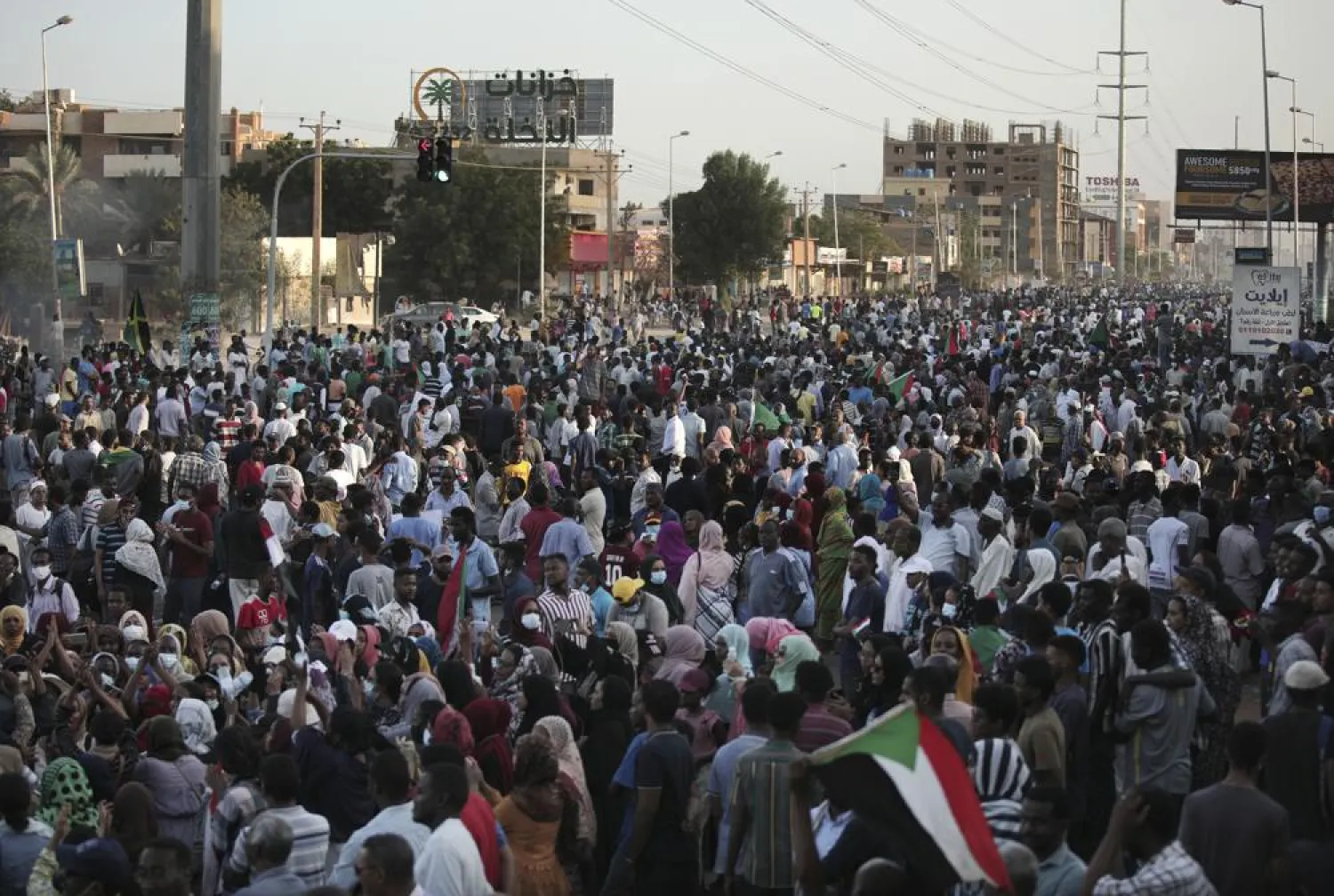

Two People Shot Dead During Huge Protests against Sudan Coup, Doctors Say

People chant slogans during a protest in Khartoum, Sudan, Saturday, Oct. 30, 2021. (AP)
TT

Two People Shot Dead During Huge Protests against Sudan Coup, Doctors Say

People chant slogans during a protest in Khartoum, Sudan, Saturday, Oct. 30, 2021. (AP)

Military forces shot dead two people during nationwide protests in Sudan on Saturday, a doctors committee said, as hundreds of thousands of people demanded the restoration of a civilian-led government after a military coup.

In Khartoum, security forces used tear gas and gunfire to try to disperse a huge crowd after protesters had been setting up a stage and discussing the possibility of a sit-in, said a Reuters witness.

The Central Committee of Sudanese Doctors said two protesters were shot dead by troops in the capital Khartoum’s twin city of Omdurman during demonstrations. It said 38 people were injured, including some by gunfire.

An eyewitness in Omdurman said they heard gunshots and saw people being carried away bleeding from the direction of the parliament building.

A representative of Sudan’s military was not immediately available to comment on the reports of deaths in one of the country’s largest demonstrations.

Protesters carried Sudanese flags and chanted “Military rule can’t be praised” and “This country is ours, and our government is civilian” as they marched in neighborhoods across Khartoum.

People also took to the streets in cities in central, eastern, northern and western Sudan. Crowds swelled to the hundreds of thousands in Khartoum, said a Reuters witness.

“The people have delivered their message, that retreat is impossible and power belongs to the people,” said protester Haitham Mohamed.

The demonstrations marked the biggest challenge to General Abdel Fattah al-Burhan since he ousted Prime Minister Abdalla Hamdok’s cabinet on Monday.

“This has been a miscalculation from the start and misunderstanding of the level of commitment, bravery, and concern the street has about the future of Sudan,” said Jonas Horner of the International Crisis Group.

The United States and the World Bank have frozen assistance to Sudan, where an economic crisis has seen shortages of food and medicine and where nearly a third of the population are in need of urgent humanitarian support.

Civilian-appointed cabinet ministers supported the protests in a statement, and said the military “will not find free Sudanese or true democratic revolutionary forces to be their partners in power.”

In central Khartoum there was a heavy military deployment of armed troops that included the army and the paramilitary Rapid Support Forces.

Security forces had blocked roads leading to the defense ministry complex and the airport.

At least 13 protesters have been killed in clashes with security forces this week, raising fears of a full-blown crackdown.

In local neighborhoods, protest groups blocked roads overnight with stones, bricks, tree branches and plastic pipes to try to keep the security forces out.

Neighborhood resistance committees
Unlike in previous protests, many people carried pictures of Hamdok, who remains popular despite an economic crisis that had worsened under his rule. “Hamdok is supported by the people. If Hamdok takes the country that’s okay,” said Mohamed, a member of a neighborhood resistance committee.

With internet and phone lines restricted by the authorities, opponents of the coup mobilized for the protest using fliers, SMS messages, graffiti, and neighborhood rallies.

Neighborhood-based resistance committees, active since the uprising against deposed President Omar al-Bashir that began in December 2018, have been central to organizing despite the arrests of key politicians.

Protesters carried pictures of Burhan, his deputy General Mohamed Hamdan Dagalo, and Bashir covered in red.

“Close a street, close a bridge, Burhan we’re coming straight to you,” they chanted.

Burhan has said he removed the cabinet to avert civil war after civilian politicians stoked hostility to the armed forces.

He says he is still committed to a democratic transition, including elections in July 2023.

“Rule is based on a combination of consent and coercion,” said Sudanese analyst Magdi El Gizouli. “Burhan has no consent and is unable to coerce the multitudes on the street into submission.”



China Confirms Invited to Join Trump’s ‘Board of Peace’

 Displaced Palestinians shelter in a tent camp in Deir al-Balah, central Gaza Strip, January 19, 2026. (Reuters)
Displaced Palestinians shelter in a tent camp in Deir al-Balah, central Gaza Strip, January 19, 2026. (Reuters)
TT

China Confirms Invited to Join Trump’s ‘Board of Peace’

 Displaced Palestinians shelter in a tent camp in Deir al-Balah, central Gaza Strip, January 19, 2026. (Reuters)
Displaced Palestinians shelter in a tent camp in Deir al-Balah, central Gaza Strip, January 19, 2026. (Reuters)

Beijing confirmed on Tuesday that China had been invited to join US President Donald Trump's "Board of Peace".

"China has received the United States' invitation," foreign ministry spokesman Guo Jiakun told a regular news briefing, without specifying whether Beijing would accept the invitation.

The board was originally conceived to oversee the rebuilding of war-torn Gaza, but the charter does not appear to limit its role to the occupied Palestinian territory.

Washington has asked various leaders to sit on the board, chaired by Trump, including Russian President Vladimir Putin, Hungarian premier Viktor Orban and Canadian Prime Minister Mark Carney.

Guo said China-US relations had achieved overall stability in the past year, despite a trade war that saw both countries impose tit-for-tat tariffs on each others' products.

"Over the past year, China-US relations have experienced ups and downs, but have maintained overall dynamic stability," Guo told reporters.

"Cooperation between China and the US benefits both sides, while confrontation harms both," he added.


UN: More Than 8 Million Sudanese Need Food in 2026

Famine spreads in North Darfur and South Kordofan in Sudan (AP) 
TT

UN: More Than 8 Million Sudanese Need Food in 2026

Famine spreads in North Darfur and South Kordofan in Sudan (AP) 

Sudan continues to face critical gaps in humanitarian nutrition services, exacerbated by ongoing conflict, displacement, and limited access to health and nutrition services, the UN and its partners said on Monday.

According to the Office for the Coordination of Humanitarian Affairs (OCHA), an estimated 8.4 million people in Sudan will require nutrition assistance in 2026.

This includes approximately 5 million children under the age of five and 3.4 million pregnant and breastfeeding women.

Of the 8.4 million in need, OCHA estimated that 4.2 million children and pregnant and breastfeeding women are projected to be acutely malnourished across Sudan, including over 824,000 cases of children under five suffering from Severe Acute Malnutrition (SAM).

Recent SMART surveys show further deterioration in the nutrition situation, with 31 out of the 61 validated SMART surveys reporting global acute malnutrition (GAM) prevalence of 15% and above the WHO emergency threshold, out of which one survey recorded GAM of 34.2 %, which is the famine threshold.

Kordofan and Darfur Battles

At the field level, military pressure is significantly escalating in the Kordofan and Darfur regions.

Earlier this month, the UN said road blockades and siege-like conditions have exasperated the delivery of food and health care to several areas, including the city of Kadugli and the city of Dilling in south Kordofan.

For months, the RSF and its ally, the Sudan People's Liberation Movement, have imposed a harsh siege on the two cities, with recurring artillery and drone strikes that led to 800,000 internally displaced people.

Military operations have targeted markets and troop concentrations, including an attack that killed 12 people and left tens of injuries, according to local reports.

Also, fierce battles took place in Habila and Kertala.

Meanwhile, the use of drones in combat zones in Sudan constitutes to play a leading role in the fighting between the two warrying parties.

This month, drones have been heavily documented in El-Obeid, the capital of North Kordofan, and surrounding areas in Sudan, as part of the ongoing conflict between the Sudanese Army and the RSF.

More than 13 people, including children and women, were reportedly killed by drone attacks in and around El-Obeid, amid widespread targeting of vital facilities in the city.

Local reports said violent clashes happened in axes linking North Kordofan to strategic areas, increasing the risk of limiting access to supplies and the movement of civilians.

The UN said gaps in humanitarian nutrition is projected to further deteriorate in 2026 due to expanding conflict, food security decline, compromised health and water services, and prolonged and recent displacements.

It warned that the actual number of malnourished individuals, particularly among IDPs, returnees, and non-displaced communities, are expected to exceed the current projected People in Need (PIN) figures as the situation worsens.

Turk’s Warnings

UN Human Rights commissioner Volker Turk said on Sunday he is alarmed by the increasing militarization of society by all parties to the conflict in Sudan, also expressing his worries that the atrocity crimes committed during and after the takeover of El Fasher would be repeated in the Kordofan region.

Speaking at a press conference in Port Sudan, where the government had been operating as a temporary capital since the conflict began, the UN envoy said the proliferation of advanced military equipment, in particular drones, across Sudan has enhanced the military capabilities of both the Sudanese army and the RSF, prolonging hostilities and deepening the crisis for civilians.

Turk said the international community must ensure that the perpetrators of the horrific violations in Sudan face justice, regardless of their affiliation.


Lebanese Army Chief to Make Pivotal Visit to Washington Next Month

Lebanese army chief General Rodolphe Haykal. Photo: Army command
TT

Lebanese Army Chief to Make Pivotal Visit to Washington Next Month

Lebanese army chief General Rodolphe Haykal. Photo: Army command

Lebanese army chief General Rodolphe Haykal is gearing up for an official visit to Washington in early February, after the US cancelled meetings with him in November.

The visit comes at a sensitive time, preceding the Paris conference to supporting the Lebanese army in March.

Ministerial sources told Asharq Al-Awsat that Haykal’s visit to Washington has been set for between February 3 and 5, saying the army’s needs, cooperation between the US and Lebanese militaries, and continued American support for the Lebanese army will be high on the agenda of the talks.

Military sources said that the visit’s postponement in November has not frozen contacts between the two sides. On the contrary, intense contacts have since been made to reschedule the visit, resulting in setting a new date next month.

The army’s plan to confiscate all unauthorized arms and extend state authority over all Lebanese territory will most likely top the agenda of the visit. This plan has drawn broad international attention.

A statement issued by the army command on January 8 regarding the achievement of the objectives of the first phase of the weapons-control plan will constitute a key component of Haykal’s briefing to US officials.

The army said in that statement that it had achieved the initial goal to clear non-state weaponry from the southern area near the Israeli border by the end of 2025.

It said it secured areas south of the Litani River, excluding positions still held by Israeli forces, though there was more work to be done clearing unexploded ordnance and tunnels.

Haykal’s briefing will most likely refer to the challenges hindering the full implementation of the plan, foremost among them ongoing Israeli attacks and the occupation of a number of sites inside Lebanese territory, in addition to the establishment of buffer zones that restrict freedom of movement, as well as the daily violations of the ceasefire agreement of November 27, 2024.

The army chief will also stress continued close cooperation with the United Nations Interim Force in Lebanon (UNIFIL) and with the ceasefire monitoring committee known as the mechanism, which held its last meeting on January 7 at the military level in the absence of civilians.

Ministerial sources told Asharq Al-Awsat that the mechanism will not hold meetings this month. “We are awaiting the return of the US general who is abroad, as well as the appointment of a civilian representative to replace US envoy Morgan Ortagus, who has been relieved of her duties,” they said.

Meanwhile, Lebanon continues its preparations for the Paris conference to support the army, scheduled for March 5.

Lebanese President Joseph Aoun told a recent security meeting that the army and security forces should prepare accurate reports on their needs and brief the conferees to secure the required assistance for their institutions.