

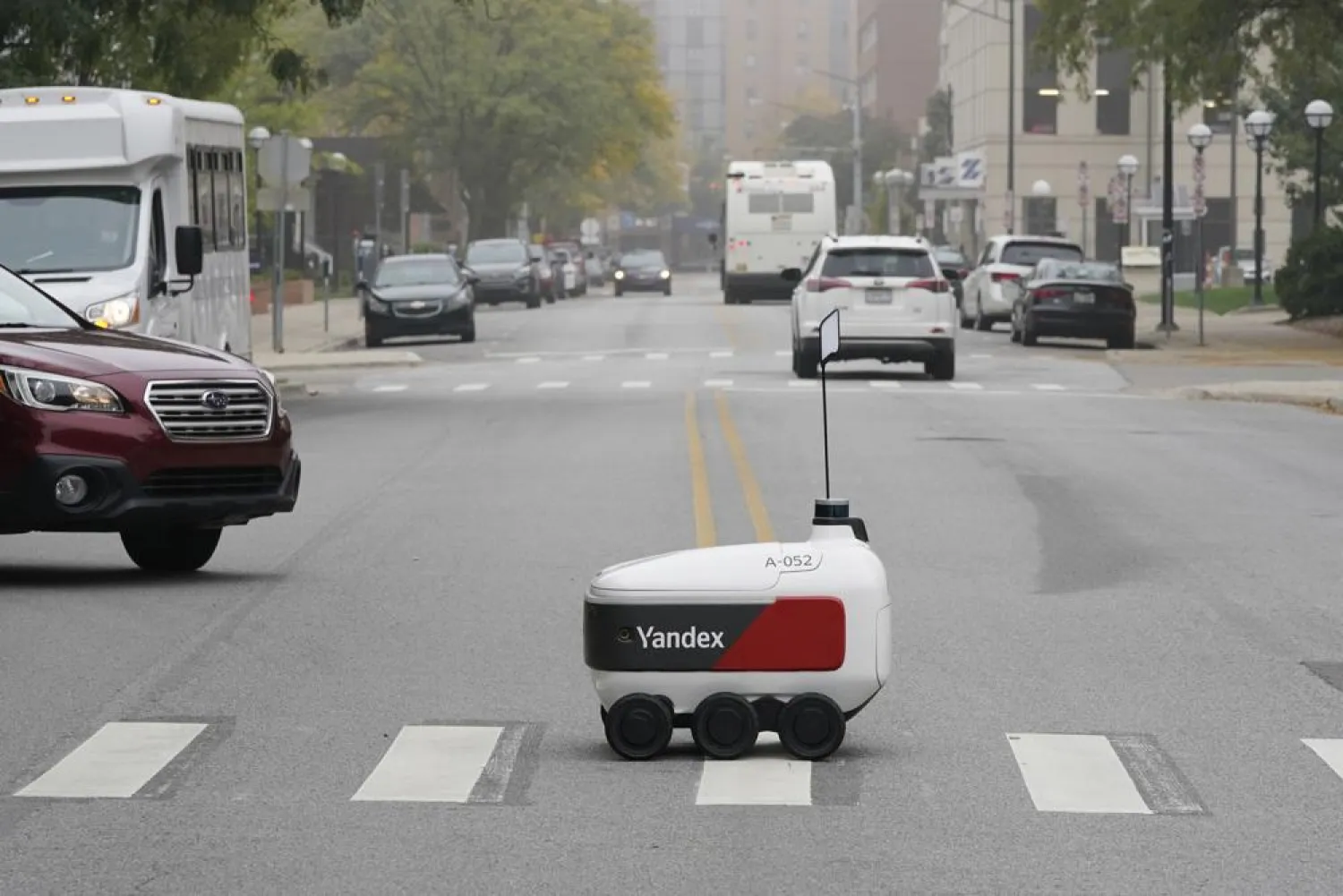

Robots Hit the Streets as Demand for Food Delivery Grows

A food delivery robot crosses a street in Ann Arbor, Mich. on Thursday, Oct. 7, 2021. (AP Photo/Carlos Osorio)
TT

Robots Hit the Streets as Demand for Food Delivery Grows

A food delivery robot crosses a street in Ann Arbor, Mich. on Thursday, Oct. 7, 2021. (AP Photo/Carlos Osorio)

Robot food delivery is no longer the stuff of science fiction. But you may not see it in your neighborhood anytime soon.

Hundreds of little robots __ knee-high and able to hold around four large pizzas __ are now navigating college campuses and even some city sidewalks in the US, the UK and elsewhere. While robots were being tested in limited numbers before the coronavirus hit, the companies building them say pandemic-related labor shortages and a growing preference for contactless delivery have accelerated their deployment.

“We saw demand for robot usage just go through the ceiling,” said Alastair Westgarth, the CEO of Starship Technologies, which recently completed its 2 millionth delivery. “I think demand was always there, but it was brought forward by the pandemic effect."

Starship has more than 1,000 robots in its fleet, up from just 250 in 2019. Hundreds more will be deployed soon. They're delivering food on 20 US campuses; 25 more will be added soon. They're also operating on sidewalks in Milton Keynes, England; Modesto, California; and the company’s hometown of Tallin, Estonia.

Robot designs vary; some have four wheels and some have six, for example. But generally, they use cameras, sensors, GPS and sometimes laser scanners to navigate sidewalks and even cross streets autonomously. They move around 5 mph.

Remote operators keep tabs on multiple robots at a time but they say they rarely need to hit the brakes or steer around an obstacle. When a robot arrives at its destination, customers type a code into their phones to open the lid and retrieve their food.

The robots have drawbacks that limit their usefulness for now. They’re electric, so they must recharge regularly. They're slow, and they generally stay within a small, pre-mapped radius.

They’re also inflexible. A customer can’t tell a robot to leave the food outside the door, for example. And some big cities with crowded sidewalks, like New York, Beijing and San Francisco, aren’t welcoming them.

But Bill Ray, an analyst with the consulting firm Gartner, says the robots make a lot of sense on corporate or college campuses, or in newer communities with wide sidewalks.

“In the places where you can deploy it, robot delivery will grow very quickly,” Ray said.

Ray said there have been few reports of problems with the robots, other than an occasional gaggle of kids who surround one and try to confuse it. Starship briefly halted service at the University of Pittsburgh in 2019 after a wheelchair user said a robot blocked her access to a ramp. But the university said deliveries resumed once Starship addressed the issue.

Patrick Sheck, a junior at Bowling Green State University in Bowling Green, Ohio, gets deliveries from a Starship robot three or four times a week as he’s leaving class.
“The robot pulls up just in time for me to get some lunch,” Sheck said. Bowling Green and Starship charge $1.99 plus a service fee for each robot delivery.

Rival Kiwibot, with headquarters in Los Angeles and Medellin, Columbia, says it now has 400 robots making deliveries on college campuses and in downtown Miami.

Delivery companies are also jumping into the market. Grubhub recently partnered with Russian robot maker Yandex to deploy 50 robots on the campus of Ohio State University in Columbus, Ohio. Grubhub plans to add more campuses soon, although the company stresses that the service won’t go beyond colleges for now.

US delivery orders jumped 66% in the year ending in June, according to NPD, a data and consulting firm. And delivery demand could remain elevated even after the pandemic eases because customers have gotten used to the convenience.

Ji Hye Kim, chef and managing partner of the Ann Arbor, Michigan, restaurant Miss Kim, relied heavily on robot delivery when her dining room was closed last year. Kim had partnered with a local robot company, Refraction AI, shortly before the pandemic began.

Kim prefers robots to third-party delivery companies like DoorDash, which charge significantly more and sometimes cancel orders if they didn’t have enough drivers. Delivery companies also bundle multiple orders per trip, she said, so food sometimes arrives cold. Robots take just one order at a time.

Kim said the robots also excite customers, who often post videos of their interactions.

“It’s very cute and novel, and it didn’t have to come face to face with people. It was a comfort,” Kim said. Delivery demand has dropped off since her dining room reopened, but robots still deliver around 10 orders per day.

While Kim managed to hang on to her staff throughout the pandemic, other restaurants are struggling to find workers. In a recent survey, 75% of US. restaurant owners told the National Restaurant Association that recruiting and retaining employees is their biggest challenge.

That has many restaurants looking to fill the void with robot delivery.

“There is no store in the country right now with enough delivery drivers,” said Dennis Maloney, senior vice president and chief digital officer at Domino’s Pizza.

Domino’s is partnering with Nuro, a California startup whose 6-foot-tall self-driving pods go at a maximum speed of 25 mph on streets, not sidewalks. Nuro is testing grocery and food delivery in Houston, Phoenix and Mountain View, California.

Maloney said it's not a question of if, but of when, robots will start doing more deliveries. He thinks companies like Domino's will eventually use a mix of robots and drivers depending on location. Sidewalk robots could work on a military base, for example, while Nuro is ideal for suburbs. Highway driving would be left to human workers.

Maloney said Nuro delivery is more expensive than using human drivers for now, but as the technology scales up and gets more refined, the costs will go down.

For cheaper sidewalk robots __ which cost an estimated $5,000 or less __ it's even easier to undercut human delivery costs. The average Grubhub driver in Ohio makes $47,650 per year, according to the job site Indeed.com.

But robots don’t always cost delivery jobs. In some cases, they help create them. Before Starship’s robots arrived, Bowling Green didn’t offer delivery from campus dining spots. Since then, it has hired more than 30 people to serve as runners between kitchens and robots, Bowling Green dining spokesman Jon Zachrich said.

Brendan Witcher, a technology analyst with the consulting firm Forrester, says it’s easy to get excited about the Jetsons-like possibility of robot delivery. But ultimately, robots will have to prove they create an advantage in some way.

“It’s possible that we see this emerge into something else,” he said. “But it’s the right time and place for companies considering robots to test them and learn from them and do their own evaluation.”




Swiss Interior Minister Open to Social Media Ban for Children

A teenager poses holding a mobile phone displaying a message from TikTok as law banning social media for users under 16 in Australia takes effect, in Sydney, Australia, December 10, 2025. (Reuters)
TT

Swiss Interior Minister Open to Social Media Ban for Children

A teenager poses holding a mobile phone displaying a message from TikTok as law banning social media for users under 16 in Australia takes effect, in Sydney, Australia, December 10, 2025. (Reuters)

Switzerland must do more to shield children from social media risks, Interior Minister Elisabeth Baume-Schneider was quoted as saying on Sunday, signaling she was open to a potential ban on the platforms for youngsters.

Following Australia's recent ban on social media for under-16s, Baume-Schneider told SonntagsBlick newspaper that Switzerland should examine similar measures.

"The debate in Australia and the ‌EU is ‌important. It must also ‌be ⁠conducted in Switzerland. ‌I am open to a social media ban," said the minister, a member of the center-left Social Democrats. "We must better protect our children."

She said authorities needed to look at what should be restricted, listing options ⁠such as banning social media use by children, ‌curbing harmful content, and addressing ‍algorithms that prey on ‍young people's vulnerabilities.

Detailed discussions will begin ‍in the new year, supported by a report on the issue, Baume-Schneider said, adding: "We mustn't forget social media platforms themselves: they must take responsibility for what children and young people consume."

Australia's ban has won praise ⁠from many parents and groups advocating for the welfare of children, and drawn criticism from major technology companies and defenders of free speech.

Earlier this month, the parliament of the Swiss canton of Fribourg voted to prohibit children from using mobile phones at school until they are about 15, the latest step taken at ‌a local level in Switzerland to curb their use in schools.


Google Warns Staff with US Visas against International Travel

FILE PHOTO: The Google logo is displayed during a press conference in Berlin, Germany, November 11, 2025. REUTERS/Lisi Niesner/File Photo
TT

Google Warns Staff with US Visas against International Travel

FILE PHOTO: The Google logo is displayed during a press conference in Berlin, Germany, November 11, 2025. REUTERS/Lisi Niesner/File Photo

Alphabet's Google has advised some employees on US visas to avoid international travel due to delays at embassies, Business Insider reported on Friday, citing an internal email.

The email, sent by the company's outside counsel BAL Immigration Law on Thursday, warned staff who need a visa ⁠stamp to re-enter the United States not to leave the country because visa processing times have lengthened, the report said.

Google did not immediately respond to a Reuters request for comment.

Some US embassies and consulates face visa ⁠appointment delays of up to 12 months, the memo said, warning that international travel will "risk an extended stay outside the US", according to the report.

The administration of President Donald Trump this month announced increased vetting of applicants for H-1B visas for highly skilled workers, including screening social media accounts.

The H-1B visa program, widely used by the US ⁠technology sector to hire skilled workers from India and China, has been under the spotlight after the Trump administration imposed a $100,000 fee for new applications this year.

In September, Google's parent company Alphabet had strongly advised its employees to avoid international travel and urged H-1B visa holders to remain in the US, according to an email seen by Reuters.


AI Boom Drives Data-Center Dealmaking to Record High, Says Report

AI (Artificial Intelligence) letters and robot hand are placed on computer motherboard in this illustration created on June 23, 2023. REUTERS/Dado Ruvic/Illustration/File Photo
TT

AI Boom Drives Data-Center Dealmaking to Record High, Says Report

AI (Artificial Intelligence) letters and robot hand are placed on computer motherboard in this illustration created on June 23, 2023. REUTERS/Dado Ruvic/Illustration/File Photo

Global data-center dealmaking surged to a record high through November this year, driven by an insatiable demand for ​computing infrastructure to meet the boom in artificial intelligence usage.

Data from S&P Global Market Intelligence showed that there were more than 100 data center transactions during the period, with the total value sitting just under $61 billion.

WHY ‌IT'S IMPORTANT

Interest ‌in data centers ‌has ⁠swelled ​this ‌year as tech giants and AI hyperscalers have planned billions of dollars in spending to scale up infrastructure.

AI-related companies have powered much of the gains in US stocks this year, but concerns over lofty ⁠valuations and debt-fueled spending have also sparked worries ‌over how quickly corporates can ‍turn the investments ‍into profits.

BY THE NUMBERS

Including M&As, asset ‍sales and equity investments, data center investments hit nearly $61 billion through the end of November, already surpassing 2024's record high $60.81 billion.

Since ​2019, data center dealmaking in the US and Canada totaled about $160 billion, ⁠with Asia-Pacific reaching nearly $40 billion and Europe $24.2 billion.

GRAPHIC KEY QUOTE

"High interest comes from financial sponsors, which are attracted by the risk/reward profile of such assets. Private equity firms are eager buyers but are generally reluctant sellers, creating an environment where availability for sale of high-quality data center assets is scarce," said Iuri ‌Struta, TMT analyst at S&P Global Market Intelligence.