


Yahoo Pulls Out of China, Citing 'Challenging' Environment

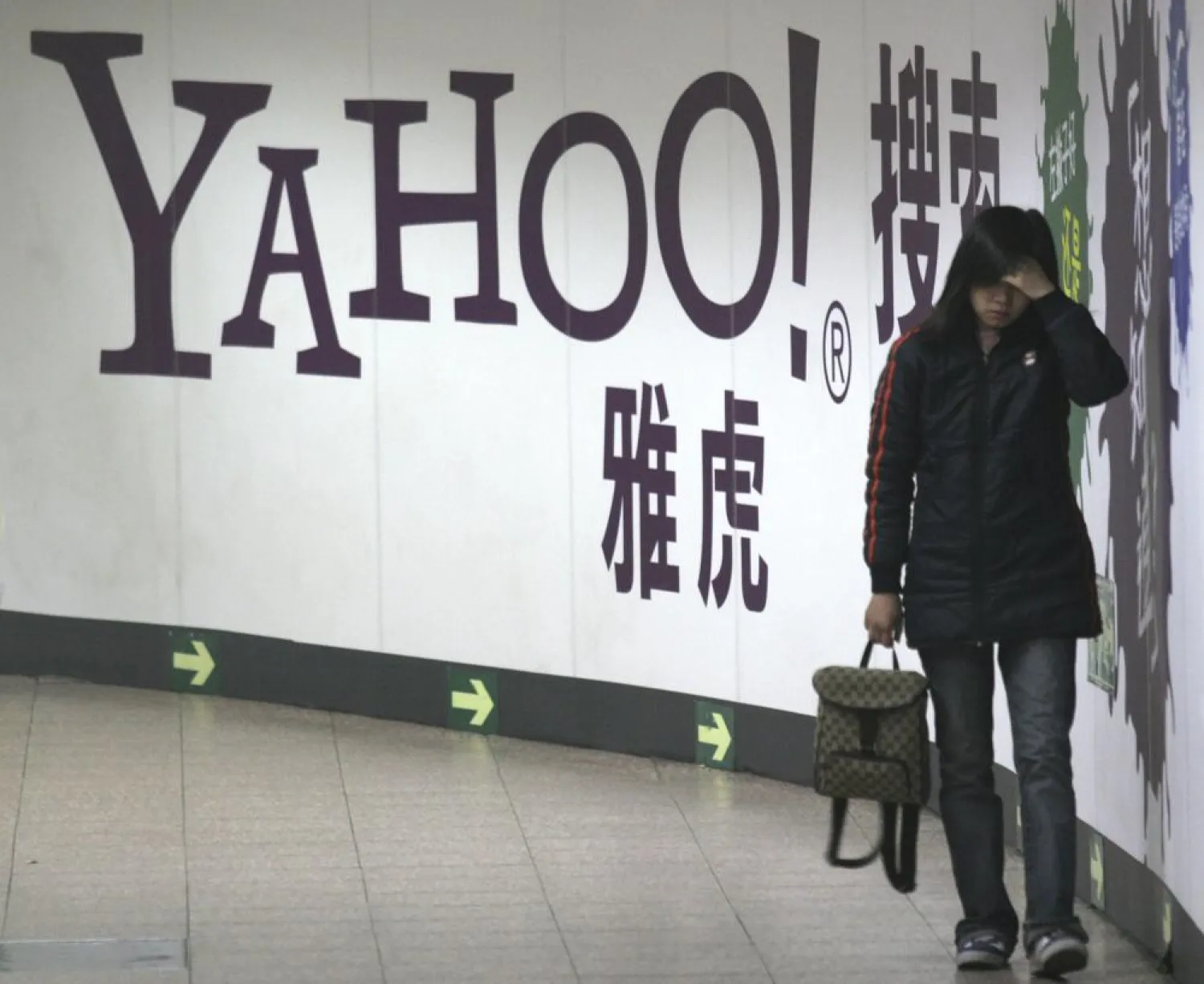
FILE - A woman walks past a Yahoo billboard in a Beijing subway in this March 17, 2006.  (AP Photo, File)
FILE - A woman walks past a Yahoo billboard in a Beijing subway in this March 17, 2006. (AP Photo, File)
TT

Yahoo Pulls Out of China, Citing 'Challenging' Environment

FILE - A woman walks past a Yahoo billboard in a Beijing subway in this March 17, 2006.  (AP Photo, File)
FILE - A woman walks past a Yahoo billboard in a Beijing subway in this March 17, 2006. (AP Photo, File)

Yahoo Inc. said Tuesday it has pulled out of China, citing an increasingly challenging operating environment, The Associated Press reported.

The withdrawal was largely symbolic, as many of the company's services were already blocked by China's digital censorship. But recent government moves to expand its control over tech companies generally, including its domestic giants, may have tipped the scales for Yahoo.

“In recognition of the increasingly challenging business and legal environment in China, Yahoo’s suite of services will no longer be accessible from mainland China as of November 1,” the company said in a statement. It said it “remains committed to the rights of our users and a free and open internet.”

The company’s move comes as the American and Chinese governments feud over technology and trade. The US has put restrictions on telecom giant Huawei and other Chinese tech companies, alleging that they have ties with China’s government, military or both. China says the US is unfairly suppressing competition and trying to block China’s technological rise.

Yahoo is the latest foreign tech company to exit China. Google gave up several years ago, and Microsoft’s professional networking platform LinkedIn said last month it would shutter its Chinese site, replacing it with a jobs board instead. The departures illustrate the choices internet companies face in a huge potential market, but one where the government requires them to censor content and keywords deemed politically sensitive or inappropriate.

In their place, Chinese companies have filled the void, creating an alternative internet with its own digital giants. The Baidu search engine has largely replaced Yahoo and Google in China, and WeChat and Weibo are the leading social media platforms.

Yahoo's departure coincided with the implementation of China's Personal Information Protection Law, which limits what information companies can gather and sets standards for how it must be stored.

Chinese laws also stipulate that companies operating in the country must hand over data if requested by authorities, making it difficult for Western firms to operate in China as they may also face pressure back home over giving in to China's demands.

Yahoo was harshly criticized by lawmakers in the US in 2007 after it handed over data on two Chinese dissidents to Beijing, eventually leading to their imprisonment.

Yahoo had previously downsized its operations in China, dropping a music and email service in the early 2010s and shuttering its Beijing office in 2015. Anyone who tried to access Engadget China, a tech news site that it had continued to operate, was greeted Tuesday with a popup saying the site would no longer publish content.

China has also blocked most international social media sites and search engines, such as Facebook and Google. Some users in China circumvent the block by using a virtual private network (VPN) that masks who you are and where you are logging in from.

Verizon Communications Inc. acquired Yahoo in 2017 and merged it with AOL, but later sold the entity off to private equity firm Apollo Global Management in a $5 billion deal. Apollo announced in September that its acquisition of Yahoo was complete.



Sony Says to Stop Releasing PlayStation Games on Discs

French PlayStation' collector Cyril, poses with a PlayStaion 1, at his home in Vraiville, on November 20, 2024. (AFP)
TT

Sony Says to Stop Releasing PlayStation Games on Discs

French PlayStation' collector Cyril, poses with a PlayStaion 1, at his home in Vraiville, on November 20, 2024. (AFP)

Sony said Wednesday that it would stop releasing new video games for the PlayStation on disc in January 2028 following a shift in consumer preferences.

"Following this date, new games will be available on PlayStation Store and at retailers in digital formats only," the company said on its official PlayStation blog.

Sony said the upcoming shift "has no impact on games that already released, or will be releasing, prior to January 2028 in disc format."

The announcement comes as the upcoming exclusively digital release of "Grand Theft Auto VI", which is predicted to become the biggest-selling cultural product of all time, has caused some consternation among gamers.

There was grumbling on social media that the lack of a physical disc would eliminate any second-hand market for the title.

"This is a natural direction for Sony Interactive Entertainment to adapt to consumer trends as the general preference for digital media significantly outpaces physical discs," the company said.

"We remain committed to delivering a world-class gaming experience to our fans," it added.


Fear and Anger Brew Inside Meta amid AI Frenzy

The word "Hack" is seen in this aerial view of Meta's corporate headquarter offices in Menlo Park, California. JOSH EDELSON / AFP
TT

Fear and Anger Brew Inside Meta amid AI Frenzy

The word "Hack" is seen in this aerial view of Meta's corporate headquarter offices in Menlo Park, California. JOSH EDELSON / AFP

A frenzied push for artificial intelligence dominance comes with a different kind of cost for Meta, where massive layoffs, employee surveillance and departures have fueled reports of a heated internal climate.

As Meta spends billions annually to build out its AI capabilities, employees at Facebook, Instagram and WhatsApp are increasingly unhappy with their Mark Zuckerberg-led parent company, AFP reported.

Meta employees have weathered frequent layoffs since early 2025, including this spring when the company cut 10 percent of its workforce -- some 8,000 jobs -- and reshuffled another 7,000 employees.

For those who remain, an internal AI training initiative has drawn accusations of surveillance.

The company also underwent a major reorganization of its AI research division, into which Zuckerberg, Meta's founder and chief executive, has poured billions of dollars.

The malaise stands in stark contrast to Meta's robust finances -- driven by advertising, which makes up nearly 98 percent of its revenue. In the first three months of 2026, Meta's net income rose to more than $26 billion.

However, the bill for its AI investments is also exploding, prompting Zuckerberg, who has near-absolute power over the company, to impose sweeping cuts and increased monitoring of employees in the name of efficiency and savings.

The cuts are funding a massive race for infrastructure: Meta plans to spend up to $145 billion on AI investments this year, nearly twice last year's figure.

Harvesting data

After thousands of employees were reassigned to Meta's AI division, some, speaking anonymously to US media, have complained of "mind-numbing" tasks designed to train machines, or even automate away their own jobs.

That controversial program, called the Model Capability Initiative, was rolled out in April and suspended on June 22. It captured clicks, keystrokes and browsing activity of US employees to train AI agents -- software capable of independently performing tasks.

Zuckerberg, who has made AI the company's North Star, defended the program during an internal meeting: "AI models learn by watching really smart people do things," he said, according to Wired.

But the tool sparked a revolt. More than 1,600 employees signed a petition calling for it to end, with some likening the company to a "data extraction factory," according to media reports.

The pause came after private conversations, and performance data inadvertently became accessible to all staff. The system risked drawing the attention of European regulators, since it captured exchanges between employees on both continents.

In a statement to AFP Tuesday, a Meta spokesperson said the program was designed with privacy safeguards.

"While we have no indication at this time that any data was improperly accessed by Meta employees, we're pausing it while we investigate," the statement said.

One employee summed up the mood with a meme from "The Office," posted on an internal company forum, reading: "0 days since our last nonsense."

'Dead end quest'

All of these efforts aim to make up for a persistent lag behind Google, OpenAI and Anthropic, which dominate the race for cutting-edge AI models. Meta's own models, repeatedly delayed, have proved disappointing even internally.

To regain ground, Zuckerberg invested over $14 billion last year into Scale AI, a San Francisco-based startup, and poached its CEO Alexandr Wang -- who was 28 years old at the time -- to run a "superintelligence" lab inside Meta.

The expensive bet has yet to win people over. Several key figures have since walked out, among them Yann LeCun, considered one of the "godfathers" of modern AI, who had led Meta's AI research since 2013.

LeCun suddenly found himself reporting to Wang, more than 35 years his junior. He left Meta at the end of 2025 to launch his own startup.

In an interview with the Financial Times, the Turing Award winner lamented that, although "he learns fast," Wang has "no experience with research" and was on "a dead end" quest.

The stakes for Meta go beyond its social networks now. The company is also doubling down on consumer electronics with smart glasses and is considering a new prediction-market app called Arena, potentially in partnership with Polymarket and Kalshi, according to The New York Times.

Lawsuits also threaten to consume time and resources.

For the first time, a Los Angeles jury in March found Meta liable for the effects of social media addiction, just one day after a separate ruling in New Mexico said Meta had failed to protect minors.

Meta has appealed, but more lawsuits are expected this year.


South Korean Trade Watchdog Alleges Google Abused Its Position in Android App Store

A pedestrian walks past the Google offices in London, Britain, August 14, 2025. (Reuters)
TT

South Korean Trade Watchdog Alleges Google Abused Its Position in Android App Store

A pedestrian walks past the Google offices in London, Britain, August 14, 2025. (Reuters)

South Korea's antitrust regulator alleged on Wednesday that Alphabet's Google abused its dominant position in the Android app marketplace to hinder competition and will recommend corrective measures and a financial penalty.

The Korea Fair Trade Commission's (KFTC) Market Surveillance Bureau found Google's alleged abuse of market dominance in the Android app marketplace affected 14.16 trillion won ($9.1 billion) in revenue, the bureau said in a media briefing where it released its examiner's report on the matter.

From July ‌2019 to March ‌2026, Google's Games/Google Velocity Program, which it ‌internally ⁠called "Project Hug", offered domestic ⁠and overseas game developers financial support for using Google services such as Cloud, Ads and YouTube, provided that they launched games on Google's app store on terms at least as favorable as rival app marketplaces, the report said.

The contracts were also structured so that Google's financial ⁠support increased progressively as developers generated more ‌revenue through Google Play, creating ‌stronger incentives to prioritize Google's marketplace.

The program significantly reduced developers' ‌incentives to distribute games through competing app stores, including South ‌Korea's OneStore, blocking rivals' business activities and forcing developers into de facto exclusive dealing with Google, according to the report.

"Google Play competes fairly with other app stores and delivers numerous benefits ‌to developers and consumers in Korea.

"We have cooperated diligently with the KFTC's investigation, and ⁠we will ⁠continue to show the Commissioners that there has been no violation of the law,” Google said in a statement to Reuters.

If the commission ultimately concludes that Google abused its market dominance, it may impose a fine of up to 6% of the relevant affected revenue of $9.1 billion.

Google has eight weeks from receiving the examiner's report to submit a written response and review the evidence.

The bureau said it plans to convene the full commission and issue a final ruling promptly once Google's due process rights have been fully observed.