

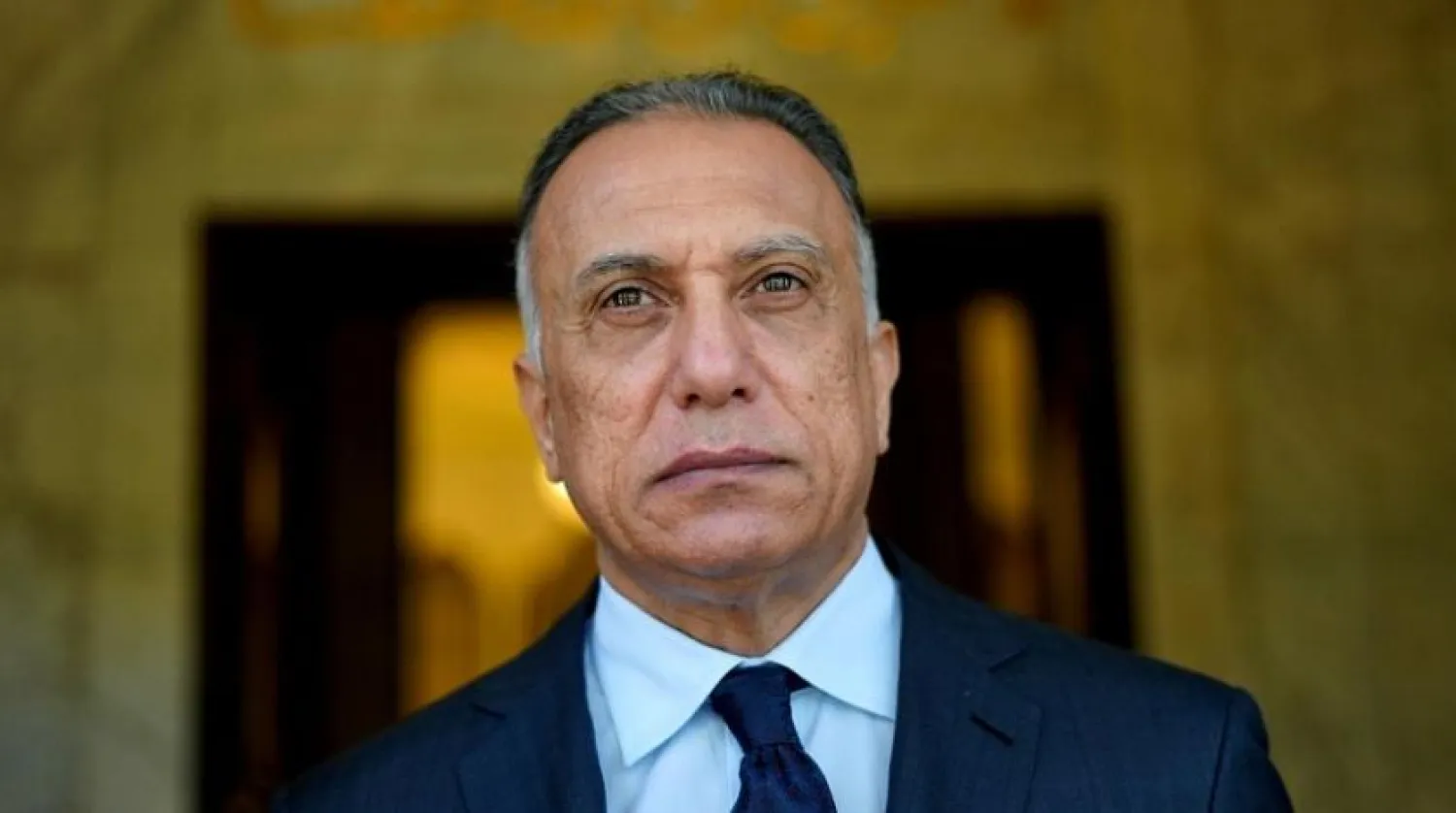

Iraqi Prime Minister Survives Assassination Bid with Drones

Iraqi Prime Minister Mustafa al-Kadhimi at his office in Baghdad on June 4, 2020. (Reuters)
TT

Iraqi Prime Minister Survives Assassination Bid with Drones

Iraqi Prime Minister Mustafa al-Kadhimi at his office in Baghdad on June 4, 2020. (Reuters)

Iraq's Prime Minister Mustafa al-Kadhimi survived an assassination attempt with armed drones that targeted his residence early Sunday and officials said he was unharmed. The attack was a major escalation amid tensions sparked by the refusal of Iran-backed militias to accept last month's parliamentary election results.

Two Iraqi officials told The Associated Press that seven of al-Kadhimi's security guards were injured in the attack with two armed drones which occurred in Baghdad's heavily fortified Green Zone area. They spoke on condition of anonymity because they were not authorized to give official statements.

"I am fine and among my people. Thank God," the prime minister tweeted shortly after the attack. He called for calm and restraint, “for the sake of Iraq.”

He later appeared on Iraqi television, seated behind a desk in a white shirt, looking calm and composed. “Cowardly rocket and drone attacks don’t build homelands and don’t build a future,” he said.

In a statement, the government said an explosives-laden drone tried to hit al-Kadhimi’s home. Residents of Baghdad heard the sound of an explosion followed by heavy gunfire from the direction of the Green Zone, which houses foreign embassies and government offices.

The statement released by state-run media said security forces were “taking the necessary measures in connection with this failed attempt.”

There was no immediate claim for the attack. It comes amid a stand-off between security forces and pro-Iran Shiite militias whose supporters have been camped outside the Green Zone for nearly a month after they rejected the results of Iraq’s parliamentary elections in which they lost around two-thirds of their seats.

“The assassination attempt is a dramatic escalation, crossing a line in unprecedented fashion that may have violent reverberations,” wrote Ranj Alaaldin, a nonresident fellow at the Brookings Institution, in a post on Twitter.

Protests turned deadly Friday when the demonstrators tried to enter the Green Zone. Security forces used tear gas and live ammunition. There was an exchange of fire in which one protester affiliated with the militias was killed. Dozens of security forces were injured. Al-Khadimi ordered an investigation to determine what sparked the clashes and who violated orders not to open fire.

Some of the leaders of the most powerful militia factions loyal to Iran openly blamed al-Kadhimi for Friday's clashes and the protester's death.

“The blood of martyrs is to hold you accountable,” said Qais al-Khazali, leader of the Asaib Ahl al-Haq militia, addressing al-Kadhimi at a funeral held for the protester Saturday. “The protesters only had one demand against fraud in elections. Responding like this (with live fire) means you are the first responsible for this fraud.”

The funeral was attended by leaders of the mostly Shiite Iran-backed factions who together are known as the Popular Mobilization Forces, or Hashd al-Shaabi in Arabic.
Abu Alaa al-Walae, commander of Kataib Sayyid al-Shuhada, in a tweet apparently addressed to al-Kadhimi that did not name him told him to forget about another term.

Al-Kadhimi, 54, was Iraq's former intelligence chief before becoming prime minister in May last year. He is considered by the militias to be close to the US, and has tried to balance between Iraq's alliances with both the US and Iran.

The US strongly denounced the attack.

“This apparent act of terrorism, which we strongly condemn, was directed at the heart of the Iraqi state,” said State Department spokesperson Ned Price.
“We are in close touch with the Iraqi security forces charged with upholding Iraq’s sovereignty and independence and have offered our assistance as they investigate this attack,” he added.

The United States, the UN Security Council and others have praised the Oct. 10 election, which was mostly violence-free and without major technical glitches.
But following the vote, militia supporters pitched tents near the Green Zone, rejecting the election results and threatening violence unless their demands for a recount were met.

The unsubstantiated claims of voter fraud have cast a shadow over the vote. The standoff with the militia supporters has also increased tensions among rival Shiite factions that could spill into violence and threaten Iraq’s newfound relative stability.

The election was held months ahead of schedule in response to mass protests in late 2019, which saw tens of thousands in Baghdad and predominantly Shiite southern provinces rally against endemic corruption, poor services and unemployment. They also protested against the heavy-handed interference of neighboring Iran in Iraq’s affairs through Iran-backed militias.

The militias lost some popularity since the 2018 vote, when they made big election gains. Many hold them responsible for suppressing the 2019 protests, and for challenging the state’s authority.

The biggest gains were made by influential Shiite cleric Muqtada al-Sadr, who won the largest number of parliament seats, 73 out of 329. While he maintains good relations with Iran, al-Sadr publicly opposes external interference in Iraq’s affairs.



Israel Military Says Soldier Killed in Gaza 

A drone view shows the destruction in a residential neighborhood, after the withdrawal of the Israeli forces from the area, amid a ceasefire between Israel and Hamas in Gaza, in Gaza City, October 21, 2025. (Reuters)
TT

Israel Military Says Soldier Killed in Gaza 

A drone view shows the destruction in a residential neighborhood, after the withdrawal of the Israeli forces from the area, amid a ceasefire between Israel and Hamas in Gaza, in Gaza City, October 21, 2025. (Reuters)

The Israeli military announced that one of its soldiers had been killed in combat in southern Gaza on Wednesday, but a security source said the death appeared to have been caused by "friendly fire".

"Staff Sergeant Ofri Yafe, aged 21, from HaYogev, a soldier in the Paratroopers Reconnaissance Unit, fell during combat in the southern Gaza Strip," the military said in a statement.

A security source, however, told AFP that the soldier appeared to have been "killed by friendly fire", without providing further details.

"The incident is still under investigation," the source added.

The death brings to five the number of Israeli soldiers killed in Gaza since a ceasefire took effect on October 10.


Syria: SDF’s Mazloum Abdi Says Implementation of Integration Deal May Take Time

People sit outdoors surrounded by nature, with the Tigris river flowing in the background, following a long atmospheric depression, near the Syrian-Turkish border in Derik, Syria, February 16, 2026 REUTERS/Orhan Qereman
TT

Syria: SDF’s Mazloum Abdi Says Implementation of Integration Deal May Take Time

People sit outdoors surrounded by nature, with the Tigris river flowing in the background, following a long atmospheric depression, near the Syrian-Turkish border in Derik, Syria, February 16, 2026 REUTERS/Orhan Qereman

Mazloum Abdi, commander of the Syrian Democratic Forces, said the process of merging the SDF with Syrian government forces “may take some time,” despite expressing confidence in the eventual success of the agreement.

His remarks came after earlier comments in which he acknowledged differences with Damascus over the concept of “decentralization.”

Speaking at a tribal conference in the northeastern city of Hasakah on Tuesday, Abdi said the issue of integration would not be resolved quickly, but stressed that the agreement remains on track.

He said the deal reached last month stipulates that three Syrian army brigades will be created out of the SDF.

Abdi added that all SDF military units have withdrawn to their barracks in an effort to preserve stability and continue implementing the announced integration agreement with the Syrian state.

He also emphasized the need for armed forces to withdraw from the vicinity of the city of Ayn al-Arab (Kobani), to be replaced by security forces tasked with maintaining order.


Israeli Far-Right Minister to Push for ‘Migration’ of West Bank, Gaza Palestinians 

A Palestinian man checks leather belts as people prepare for Ramadan, in the old city of Hebron in the Israeli-occupied West Bank, February 17,2026. (Reuters)
TT

Israeli Far-Right Minister to Push for ‘Migration’ of West Bank, Gaza Palestinians 

A Palestinian man checks leather belts as people prepare for Ramadan, in the old city of Hebron in the Israeli-occupied West Bank, February 17,2026. (Reuters)

Israel's far-right Finance Minister Bezalel Smotrich said he would pursue a policy of "encouraging the migration" of Palestinians from the occupied West Bank and Gaza Strip, Israeli media reported Wednesday.

"We will eliminate the idea of an Arab terror state," said Smotrich, speaking at an event organized by his Religious Zionism Party late on Tuesday.

"We will finally, formally, and in practical terms nullify the cursed Oslo Accords and embark on a path toward sovereignty, while encouraging emigration from both Gaza and Judea and Samaria.

"There is no other long-term solution," added Smotrich, who himself lives in a settlement in the West Bank.

Since last week, Israel has approved a series of measures backed by far-right ministers to tighten control over the West Bank, including in areas administered by the Palestinian Authority under the Oslo Accords, in place since the 1990s.

The measures include a process to register land in the West Bank as "state property" and facilitate direct purchases of land by Jewish Israelis.

The measures have triggered widespread international outrage.

On Tuesday, the UN missions of 85 countries condemned the measures, which critics say amount to de facto annexation of the Palestinian territory.

"We strongly condemn unilateral Israeli decisions and measures aimed at expanding Israel's unlawful presence in the West Bank," they said in a statement.

"Such decisions are contrary to Israel's obligations under international law and must be immediately reversed.

"We underline in this regard our strong opposition to any form of annexation."

UN Secretary-General Antonio Guterres on Monday called on Israel to reverse its land registration policy, calling it "destabilizing" and "unlawful".

The West Bank would form the largest part of any future Palestinian state. Many on Israel's religious right view it as Israeli land.

Israeli NGOs have also raised the alarm over a settlement plan signed by the government which they say would mark the first expansion of Jerusalem's borders into the occupied West Bank since 1967.

The planned development, announced by Israel's Ministry of Construction and Housing, is formally a westward expansion of the Geva Binyamin, or Adam, settlement situated northeast of Jerusalem in the West Bank.

The current Israeli government has fast-tracked settlement expansion, approving a record 52 settlements in 2025.

Excluding Israeli-annexed east Jerusalem, more than 500,000 Israelis live in West Bank settlements and outposts, which are illegal under international law.