

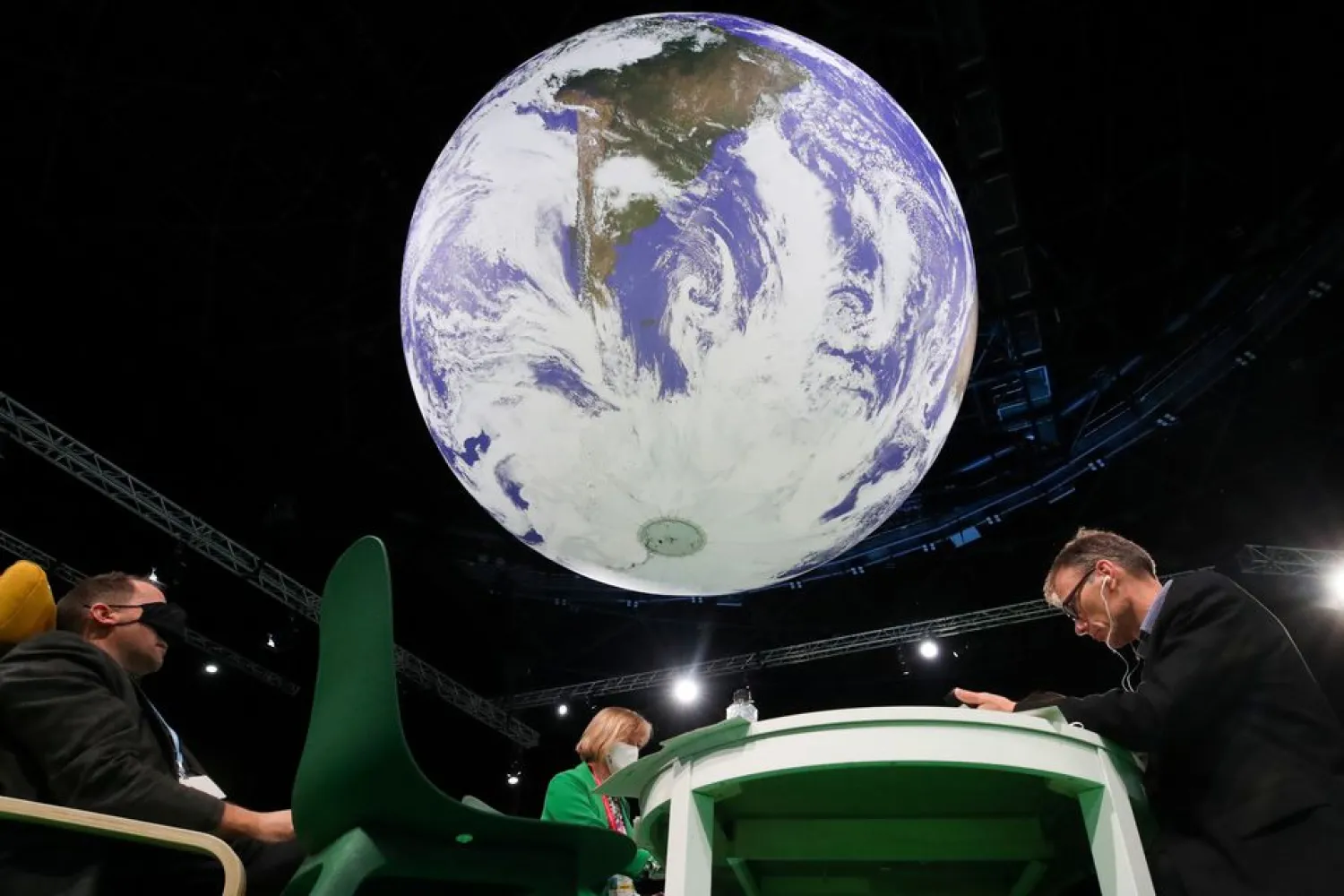

UN Climate Conference Heads Tentatively Towards a Deal

UN climate talks in Scotland appeared to be tentatively heading for a deal on Saturday that conference host Britain said would keep alive a goal of capping global warming at 1.5 degrees Celsius. (Reuters)
TT

UN Climate Conference Heads Tentatively Towards a Deal

UN climate talks in Scotland appeared to be tentatively heading for a deal on Saturday that conference host Britain said would keep alive a goal of capping global warming at 1.5 degrees Celsius. (Reuters)

UN climate talks in Scotland appeared to be tentatively heading for a deal on Saturday that conference host Britain said would keep alive a goal of capping global warming at 1.5 degrees Celsius to maintain a realistic chance of avoiding catastrophe.

Alok Sharma, the conference chairman, urged the almost 200 national delegations present in Glasgow to accept a deal that seeks to balance the demands of climate-vulnerable nations, big industrial powers, and those whose consumption or exports of fossil fuels are vital to their economic development.

"Please don't ask yourself what more you can seek but ask instead what is enough," he told them, in the closing hours of a two-week conference that has already overrun by a day. "Is this package balanced? Does it provide enough for all of us?"

"Most importantly - please ask yourselves whether ultimately these texts deliver for all our people and our planet."

The final agreement will require the unanimous consent of the countries present, ranging from coal- and gas-fuelled superpowers to oil producers and Pacific islands being swallowed by the rise in sea levels.

The meeting's overarching aim is to keep within reach the 2015 Paris Agreement's target to cap global warming at 1.5 degrees Celsius (2.7 Fahrenheit) above pre-industrial levels.

US climate envoy John Kerry said the conference was poised to make a "remarkable step".

A draft deal circulated early on Saturday in effect acknowledged that existing commitments to cut emissions of planet-heating greenhouse gases are nowhere near enough, and asked nations to set tougher climate pledges next year, rather than every five years, as they are currently required to do.

In a public check-in round with key delegations, there was encouragement for Sharma from China, the world's biggest producer and consumer of the dirtiest fossil fuel, coal, but also a country yet to develop its full economic potential.

"We noted that there are still differences on some issues and currently this text is by no means perfect, but we have no intention to open the text again," Chinese negotiator Zhao Yingmin told the conference hall.

‘Don’t kill this moment'

The West African state of Guinea, which had pressed hard on behalf of the G77 group of developing countries for greater commitments from rich countries to compensate them for "loss and damage" from unpredictable climate disasters, also indicated that the group would accept what had been achieved.

However, India, whose energy needs are heavily dependent on its own cheap and plentiful coal, signaled unhappiness.

"I am afraid ... the consensus remained elusive," Environment and Climate Minister Bhupender Yadav told the forum, without spelling out whether or not India would block a vote on the package.

EU Climate Commissioner Frans Timmermans, speaking after Yadav, asked if the marathon conference was at risk of stumbling just before the finish line and urged fellow delegates:

"Don't kill this moment by asking for more texts, different texts, deleting this, deleting that."

Scientists say that to go beyond a rise of 1.5C would unleash extreme sea level rise and catastrophes including crippling droughts, monstrous storms and wildfires far worse than those the world is already suffering.

But national pledges made so far to cut greenhouse emissions - mostly carbon dioxide from burning coal, oil and gas - would only cap the average global temperature rise at 2.4 Celsius.

However, Saturday's draft, published by the United Nations, called for efforts to reduce the huge subsidies that governments around the world give to the oil, coal and gas that power factories and heat homes.

Previous UN climate conferences have failed to single out fossil fuels for their harm to the climate.

Britain tried to unblock the issue of climate finance, one of the thorniest, by proposing mechanisms to make sure the poorest nations finally get more of the financial help they have been promised.

Developing countries argue that rich nations, whose historical emissions are largely responsible for heating up the planet, must pay more to help them adapt to its consequences as well as reducing their carbon footprints.

More money?
The draft urged rich countries to double finance for climate adaptation by 2025 from 2019 levels, offering funding that has been a key demand of small island nations at the conference.

Adaptation funds primarily go to the very poorest countries and currently take up only a small fraction of climate funding.

Britain also said a UN committee should report next year on progress towards delivering the $100 billion per year in overall annual climate funding that rich nations had promised by 2020 but failed to deliver. And it said governments should meet in 2022, 2024 and 2026 to discuss climate finance.

Even $100 billion a year is far short of poorer countries' actual needs, which could hit $300 billion by 2030 in adaptation costs alone, according to the United Nations, in addition to economic losses from crop failure or climate-related disasters.

Vulnerable nations have argued for decades that rich countries owe them compensation for the "loss and damage" from climate events that cannot be avoided.

But wealthy countries fear being found liable for such disasters and opening the door to bottomless payments.

As a result, no UN climate conference has yet yielded any funding under this heading for the countries most affected - and Saturday's Glasgow draft also made no firm commitment.

Negotiators were, however, closing in on a deal to settle rules for carbon markets - mechanisms that put a price on emissions to allow countries or companies to buy and sell "permits to pollute", or credits for absorbing emissions.



Türkiye Says Greece-Chevron Activity off Crete Unlawful 

A Chevron gas station sign is pictured at one of their retain gas stations in Cardiff, California October 9, 2013. REUTERS/Mike Blake/File Photo
TT

Türkiye Says Greece-Chevron Activity off Crete Unlawful 

A Chevron gas station sign is pictured at one of their retain gas stations in Cardiff, California October 9, 2013. REUTERS/Mike Blake/File Photo

Türkiye said on Thursday it opposed Greece's "unilateral activities" in energy fields south of Crete with a consortium led by US major Chevron as a violation of international law and good neighbourly relations.

Athens responded that its policies abide international law.

The Chevron-led consortium signed exclusive lease agreements on Monday to look for natural gas off southern Greece, expanding US presence in the eastern Mediterranean.

"We oppose this unlawful activity, which is being attempted in violation of the 2019 Memorandum of Understanding on Maritime Jurisdiction between Libya and our country," the Turkish Defense Ministry said at a press briefing.

It said the activity, while not directly impacting Türkiye's continental shelf, also violated Libya's maritime jurisdiction that was declared to the United Nations in May last year.

"We continue to provide the necessary support to the Libyan authorities to take action against these unilateral and unlawful activities by Greece," the ministry said.

A 2019 agreement signed by Türkiye and Libya set out maritime boundaries in the Mediterranean Sea. It was rejected by Greece as it ignored the presence of the Greek island of Crete between the coasts of Türkiye and Libya. The Chevron deal doubles the amount of Greek maritime acreage available for exploration and is the second in months involving a US energy major, as the European Union seeks to phase out supplies from Russia and the US seeks to replace them.

Asked about the Turkish objections later on Thursday, Greek government spokesman Pavlos Marinakis told a press briefing that Athens followed an "active policy" and "exercises its rights in accordance with international law and respects international law steadfastly - and I think no one questions that, period."

There was no immediate comment from Chevron.

Neighbors and NATO members Türkiye and Greece have been at odds over a range of issues for decades, primarily maritime boundaries and rights in the Aegean, an area widely believed to hold energy resources and with key implications for airspace and military activity.

A 2023 declaration on friendly relations prompted a thaw between the sides and leaders have voiced a desire to address remaining issues.


Andrew Mountbatten-Windsor Arrested on Suspicion of Misconduct in Public Office

FILE - Britain’s Andrew Mountbatten-Windsor, formerly known as Prince Andrew, looks round as he leaves after attending the Easter Matins Service at St. George's Chapel, Windsor Castle, England, April 20, 2025. (AP Photo/Kirsty Wigglesworth, File)
TT

Andrew Mountbatten-Windsor Arrested on Suspicion of Misconduct in Public Office

FILE - Britain’s Andrew Mountbatten-Windsor, formerly known as Prince Andrew, looks round as he leaves after attending the Easter Matins Service at St. George's Chapel, Windsor Castle, England, April 20, 2025. (AP Photo/Kirsty Wigglesworth, File)

UK police arrested Andrew Mountbatten-Windsor on Thursday on suspicion of misconduct in public office.

The Thames Valley Police, an agency that covers areas west of London, including Mountbatten-Windsor’s former home, said it was “assessing” reports that the former Prince Andrew sent trade reports to convicted sex offender Jeffrey Epstein in 2010. The assessment followed the release of millions of pages of documents connected to a US investigation of Epstein.

The police force did not name Mountbatten-Windsor, as is normal under UK law. But when asked if he had been arrested, the force pointed to a statement saying that they had arrested a man in his 60s. Mountbatten-Windsor is 66.

“Following a thorough assessment, we have now opened an investigation into this allegation of misconduct in public office,’’ the statement said. “It is important that we protect the integrity and objectivity of our investigation as we work with our partners to investigate this alleged offence."

“We understand the significant public interest in this case, and we will provide updates at the appropriate time,” the statement added.

Pictures circulated online appearing to show unmarked police cars at Wood Farm on the Sandringham Estate in Norfolk, with plainclothes officers appearing to gather outside the home of Mountbatten-Windsor.


Georgia Arrests Two Foreigners Trying to Purchase Uranium

FILE PHOTO: A block with the symbol, atomic number and mass number of Uranium (U) element, in this illustration taken January 21, 2026. REUTERS/Dado Ruvic/Illustration/File Photo
TT

Georgia Arrests Two Foreigners Trying to Purchase Uranium

FILE PHOTO: A block with the symbol, atomic number and mass number of Uranium (U) element, in this illustration taken January 21, 2026. REUTERS/Dado Ruvic/Illustration/File Photo

Georgia has ‌detained two people who attempted to purchase $3 million worth of uranium and a cache of a radioactive isotope found in nuclear weapons testing programs, the national security service said on Thursday.

Two foreign nationals from unspecified countries were arrested in the city of Kutaisi, the State Security Service said in a statement.

"They were planning to ‌illegally purchase ‌nuclear material uranium and radioactive ‌substance ⁠Cesium 137 for $3 ⁠million and illegally transport it to the territory of another country," Reuters quoted it as saying.

It said other foreigners had been arriving in Georgia in recent weeks with the aim of purchasing and transporting the nuclear and ⁠radioactive materials, without elaborating further.

The ‌statement did ‌not specify the quantity of materials the individuals were ‌attempting to procure. There were ‌no details on the substances' origin or potential destination.

Cesium 137 is a radioactive isotope present primarily in the aftermath of nuclear weapons testing ‌and nuclear power plant accidents such as the Chernobyl disaster in ⁠then-Soviet ⁠Ukraine in 1986.

The security of nuclear materials was one of the biggest concerns after the 1991 fall of the Soviet Union, of which Georgia was part. There have been several serious incidents involving the illicit trade in nuclear materials in Georgia over recent decades.

Most recently, three Chinese citizens were arrested in the capital Tbilisi for attempting to purchase two kilograms of "nuclear material" uranium.