

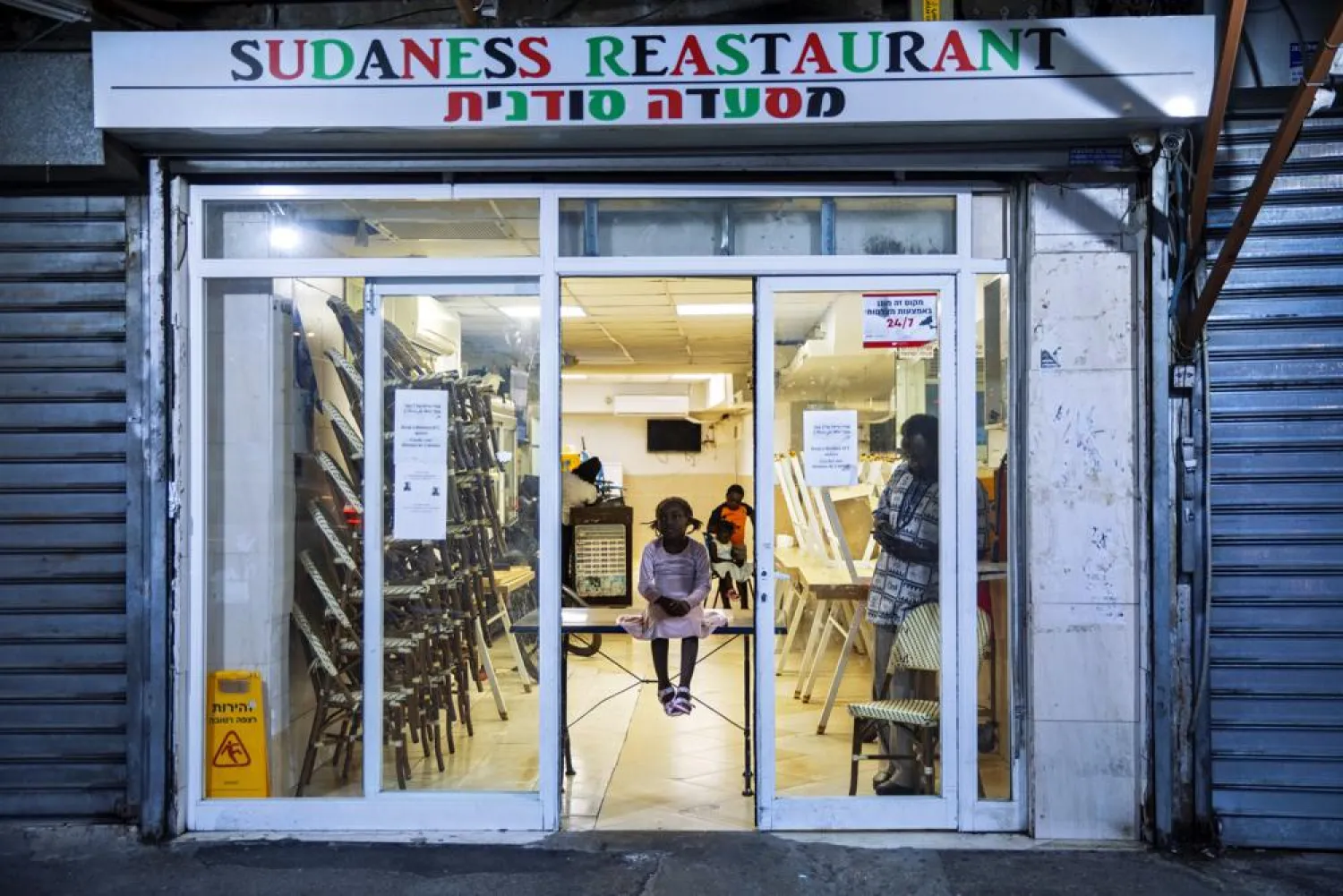

Sudanese Migrants in Israel Fear Deportation after Coup

FILE - A Sudanese migrant family are seen in a closed Sudanese restaurant in south Tel Aviv, Israel, Oct. 27, 2020. (AP Photo/Oded Balilty, File)
TT

Sudanese Migrants in Israel Fear Deportation after Coup

FILE - A Sudanese migrant family are seen in a closed Sudanese restaurant in south Tel Aviv, Israel, Oct. 27, 2020. (AP Photo/Oded Balilty, File)

For nearly 10 years, Monim Haroon has only known one home: Israel. Like thousands of Sudanese migrants, he lives and works without legal status, fearing that a return to his native land would be a death sentence.

Israel's normalization of ties with Sudan, announced last year, had raised fears among the migrants that they would lose their migrant status and be forced to return. Now, weeks after a military coup derailed Sudan's transition to democracy, they dread being forcibly returned to a country under the full control of generals blamed for past atrocities, The Associated Press said.

“I am not against normalization," said Haroon. "But the normalization should be through the civilian Sudanese government, not the military powers that now control Sudan.”

The asylum-seekers' plight points to one of the less savory aspects of the so-called Abraham Accords, a series of deals reached between Israel and four Arab countries last year.

Sudan's military leaders, the driving force behind the agreement, secured the country's removal from the US list of terrorism sponsors, unlocking vital international aid and commerce.

But then last month, Sudan's top military leader, Gen. Abdel-Fattah Burhan, disbanded the transitional government and ordered the arrest of civilian leaders, quashing hopes of a democratic transition after the 2019 overthrow of longtime autocrat Omar al-Bashir.

The coup, which has been condemned by the United States and other Western nations, has left Israel in a potentially awkward situation.

Israel has been silent on the coup and its aftermath, indicating it intends to maintain normalized ties. A report on the Israeli news site Walla that an Israeli delegation had secretly visited Sudan to meet with the coup leaders deepened migrant fears that they could soon be deported. The Israeli Foreign Ministry and Sudanese officials did not respond to requests for comment.

Sudanese and Eritrean migrants began arriving in Israel in 2005, with many of the Sudanese fleeing persecution in the western Darfur region and the country's south. Seeking safety and opportunity in Israel, they made often dangerous journeys across Egypt's rugged Sinai Peninsula.

Israel initially did little to stop the influx, but as more migrants arrived, the authorities began detaining thousands in remote desert prisons. And in 2013, Israel completed construction of a fenced barrier along its border with Egypt that mostly halted the migration.

The migrants' presence has sparked a backlash among many Israelis who associate them with the crime and poverty in south Tel Aviv, where most of them settled. Right-wing governments in recent years have made various attempts to expel them.

Ayelet Shaked, a prominent right-wing politician, has described Sudanese migrants as “infiltrators” and said they should be sent back since ties have been normalized. She is now the interior minister in Israel's new government, a position that oversees immigration policies.

“We are worried because she has always been against asylum-seekers,” Haroon said.

The Interior Ministry said the status of Sudanese migrants has not changed following the coup but declined to answer further questions.

Israel has resolved only a small fraction of the thousands of Eritrean and Sudanese asylum claims, deeming the vast majority to be economic migrants. Under international law, Israel cannot deport migrants back to countries where their life or basic freedoms are seriously threatened.

Sudan's incarcerated former president al-Bashir was charged with genocide by the International Criminal Court for mass killings that took place in Darfur during the 2000s. The region remains unstable, with deadly tribal clashes are still common. Since the October coup, at least 23 Sudanese protesters have been killed in confrontations between pro-democracy demonstrators and military forces.

“Although Israel does not send migrants back, consecutive decrees have purposefully made life unbearable for African refugees,” said Sigal Rozen, public policy director at the Israeli Hotline for Refugees and Migrants, an advocacy group that assists the Africans.

Most of the estimated 28,000 Sudanese and Eritrean migrants work in menial jobs and struggle to make ends meet. Their numbers have dwindled by half since the 2000s, with most traveling onward to third countries, considering it unsafe to return home.

In 2012, Israel ordered the deportation of over 1,000 migrants back to South Sudan after it gained independence, arguing that it was safe for them to go home. Those who voluntarily returned were given a cash incentive of about $1,000. The move was criticized by rights groups following South Sudan’s descent into civil war in 2013.

Stuck in Israeli legislative limbo, most African migrants are barred from basic social rights such as sick pay and driving licenses and are also subject to financial penalties. Among the most controversial of these was the “Deposit Law,” which limited asylum seekers to accessing only 80% of their salaries while they remained in Israel. The law, which returned the remainder of their salaries only if they left the country, was later reversed in 2020.

In April, Israel's Supreme Court ordered the Interior Ministry to resolve thousands of the unanswered Sudanese asylum claims by the end of the year or grant them temporary residency.

Sudan was noticeably absent from anniversary commemorations of the Abraham Accords earlier this fall. As Israel and the other three nations trumpeted high-level visits and opened embassies, there has been little on the Sudan front beyond a surprise meeting between Israeli and Sudanese officials in the UAE weeks before the coup.

Sudan also said in September that it would seize the assets of companies linked to Hamas, the Palestinian militant group that rules Gaza.

Haim Koren, former Israeli ambassador to Egypt and South Sudan, attributed the delays to concerns by Sudanese officials over whether Israel's new government and the Biden administration would follow through on the promises of the normalization agreement. Both have expressed strong support for deepening and expanding the Abraham Accords.

“There remain areas that still require negotiation, but I expect full relations to be established,” said Koren. “Maybe not today, but it will happen.”



US Says Gaza ‘Phase Two’ Beginning with Goal of Hamas Demilitarization

 A tent camp for displaced Palestinians stretches across the Zeitoun neighborhood of Gaza City, Wednesday, Jan. 14, 2026. (AP)
A tent camp for displaced Palestinians stretches across the Zeitoun neighborhood of Gaza City, Wednesday, Jan. 14, 2026. (AP)
TT

US Says Gaza ‘Phase Two’ Beginning with Goal of Hamas Demilitarization

 A tent camp for displaced Palestinians stretches across the Zeitoun neighborhood of Gaza City, Wednesday, Jan. 14, 2026. (AP)
A tent camp for displaced Palestinians stretches across the Zeitoun neighborhood of Gaza City, Wednesday, Jan. 14, 2026. (AP)

President Donald Trump's envoy said Wednesday that a plan to end the Gaza war was now moving to Phase Two with a goal of disarming Hamas, despite a number of Israeli strikes during the ceasefire.

"We are announcing the launch of Phase Two of the President's 20-Point Plan to End the Gaza Conflict, moving from ceasefire to demilitarization, technocratic governance, and reconstruction," envoy Steve Witkoff wrote on X.

The second phase will also include the setup of a 15-person Palestinian technocratic committee to administer post-war Gaza. Its formation was announced earlier Wednesday by Egypt, a mediator.

Phase Two "begins the full demilitarization and reconstruction of Gaza, primarily the disarmament of all unauthorized personnel."

"The US expects Hamas to comply fully with its obligations, including the immediate return of the final deceased hostage. Failure to do so will bring serious consequences," he said.


Lebanon Arrests Syrian Citizen Suspected of Funding Pro-Assad Fighters

A damaged portrait of Syria's ousted President Bashar al-Assad lies on the ground in the western Syrian port city of Latakia on Dec. 15, 2024. (AFP via Getty Images)
TT

Lebanon Arrests Syrian Citizen Suspected of Funding Pro-Assad Fighters

A damaged portrait of Syria's ousted President Bashar al-Assad lies on the ground in the western Syrian port city of Latakia on Dec. 15, 2024. (AFP via Getty Images)

Lebanese authorities have arrested a Syrian citizen who is suspected of sending money to fighters loyal to former Syrian President Bashar al-Assad in Syria, judicial officials said Wednesday.

Ahmad Dunia was detained in recent days in Lebanon’s region of Jbeil north of Beirut and is being questioned over alleged links to Assad’s maternal cousin Rami Makhlouf as well as a former Syrian army general who left the country after Assad’s fall in December 2024, the officials said.

The officials described Dunia as the “financial arm” of the wealthy Makhlouf, saying he had been sending money to former Assad supporters in Syria who work under the command of ousted Syrian general Suheil al-Hassan who is believed to be in Russia.

The officials said the money was mostly sent to pro-Assad fighters who are active in Syria’s coastal region, where many members of his Alawite minority sect live.

Allegations that Dunia was financing Assad allies was first reported by Qatar’s Al Jazeera TV. He was then arrested by Lebanese security forces, according to officials who spoke on condition of anonymity because they were not authorized to speak to the media.

The arrest came a week after a Syrian security delegation visited Beirut and handed over to officials in Lebanon lists of dozens of names of former members of Assad’s security agencies whom they said are directing anti-government operations in Syria from Lebanon. Dunia’s name was one of those on the list, the officials said.

Since Assad’s fall, there have been several skirmishes between his supporters and the country’s new authorities.

In March last year, violence that began with clashes between armed groups aligned with Assad and the new government’s security forces spiraled into sectarian revenge attacks and massacres that killed hundreds of civilians from the Alawite minority.


Sudan Peace Talks Resume in Cairo as War Nears 3-Year Mark

Displaced women fill water at displaced persons camp in El Obeid, North Kordofan State, Sudan, January 12, 2026. (Reuters)
TT

Sudan Peace Talks Resume in Cairo as War Nears 3-Year Mark

Displaced women fill water at displaced persons camp in El Obeid, North Kordofan State, Sudan, January 12, 2026. (Reuters)

Sudan peace efforts resumed in Cairo on Wednesday as Egypt, the United Nations and the United States called for the warring parties to agree to a nationwide humanitarian truce, as the war between the army and its rival paramilitary nears the three-year mark.

Egyptian Foreign Minister Badr Abdelatty told reporters that Egypt wouldn't accept the collapse of Sudan or its institutions, or any attempt to undermine its unity or divide its territory, describing such scenarios as “red lines.”

Abdelatty said during a joint news conference with Ramtane Lamamra, the UN secretary‑general’s personal envoy for Sudan, that Egypt won't stand idly and won't hesitate to take the necessary measures to help preserve Sudan’s unity.

″There is absolutely no room for recognizing parallel entities or any militias. Under no circumstances can we equate Sudanese state institutions, including the Sudanese army, with any other militias,” he said on the sidelines of the fifth meeting of the Consultative Mechanism to Enhance and Coordinate Peace Efforts.

Lamamra said that the fifth such meeting demonstrated that diplomacy remains a viable path toward peace.

The paramilitary Rapid Support Forces, or RSF, and the military have been at war since April 2023. The conflict that has seen multiple atrocities and pushed Sudan into one of the world’s worst humanitarian crises.

Although repeated attempts at peace talks have failed to end the war, Abdelatty said that there's a regional agreement to secure an immediate humanitarian truce, including certain withdrawals and the establishment of safe humanitarian corridors.

Humanitarian aid Massad Boulos, the US senior adviser for Arab and African Affairs, said Wednesday that more than 1.3 metric tons of humanitarian supplies entered el-Fasher, the capital of North Darfur, on Wednesday, with the help of American-led negotiations, marking the first such delivery since the city was besieged 18 months ago.

“As we press the warring parties for a nationwide humanitarian truce, we will continue to support mechanisms to facilitate the unhindered delivery of assistance to areas suffering from famine, malnutrition, and conflict-driven displacement,” Boulos posted on X.

Egyptian President Abdel Fattah al-Sisi discussed with Boulos the need to increase coordination between both countries to achieve stability in Sudan, with Sisi expressing appreciation to US President Donald Trump’s efforts to end the war.

US and key mediators Saudi Arabia, Egypt and the United Arab Emirates, known as the Quad, proposed a humanitarian truce, which both sides reportedly agreed to, but the conflict has persisted.

“The President emphasized that Egypt will not allow such actions, given the deep connection between the national security of both brotherly countries,” the Egyptian president’s office said in a statement.

The United States has accused the RSF of committing genocide in Darfur during the war, and rights groups said that the paramilitary group committed war crimes during the siege and takeover of el-Fasher, as well as in the capture of other cities in Darfur. The military has also been accused of human rights violations.

Latest wave of violence

The UN Office for the Coordination of Humanitarian Affairs, OCHA, said on Tuesday that at least 19 civilians were killed during ground operations in Jarjira in North Darfur on Monday.

A military-allied Darfur rebel group said that it carried out a joint military operation with the army in Jarjira, saying that the operation liberated the area and its surroundings and forced RSF fighters to flee south.

At least 10 others were killed and nine others injured, also on Monday, in a drone attack that hit Sinja, the capital city of Sennar province, according to OCHA and the Sudan Doctors Network.

Sudan Doctors Network said in a statement that the drone strike was launched by the RSF and hit several areas in the city, describing the attack as the latest crime added “to the long list of grave violations against civilians.”

The group said that civilians are being deliberately targeted in a “full-fledged war crime.”

The Sudan Doctors Network also said that it “holds the Rapid Support Forces fully responsible for this crime and demands an end to their targeting of civilians and the protection of civilian infrastructure.”

Recent violence displaced more than 8,000 people from villages in North Darfur, with some fleeing to safer areas within the province and others crossing into Chad, according to the latest estimate by the International Organization for Migration.