


Review: The Sunny, Shaggy ‘Licorice Pizza’ Soaks up the ’70s

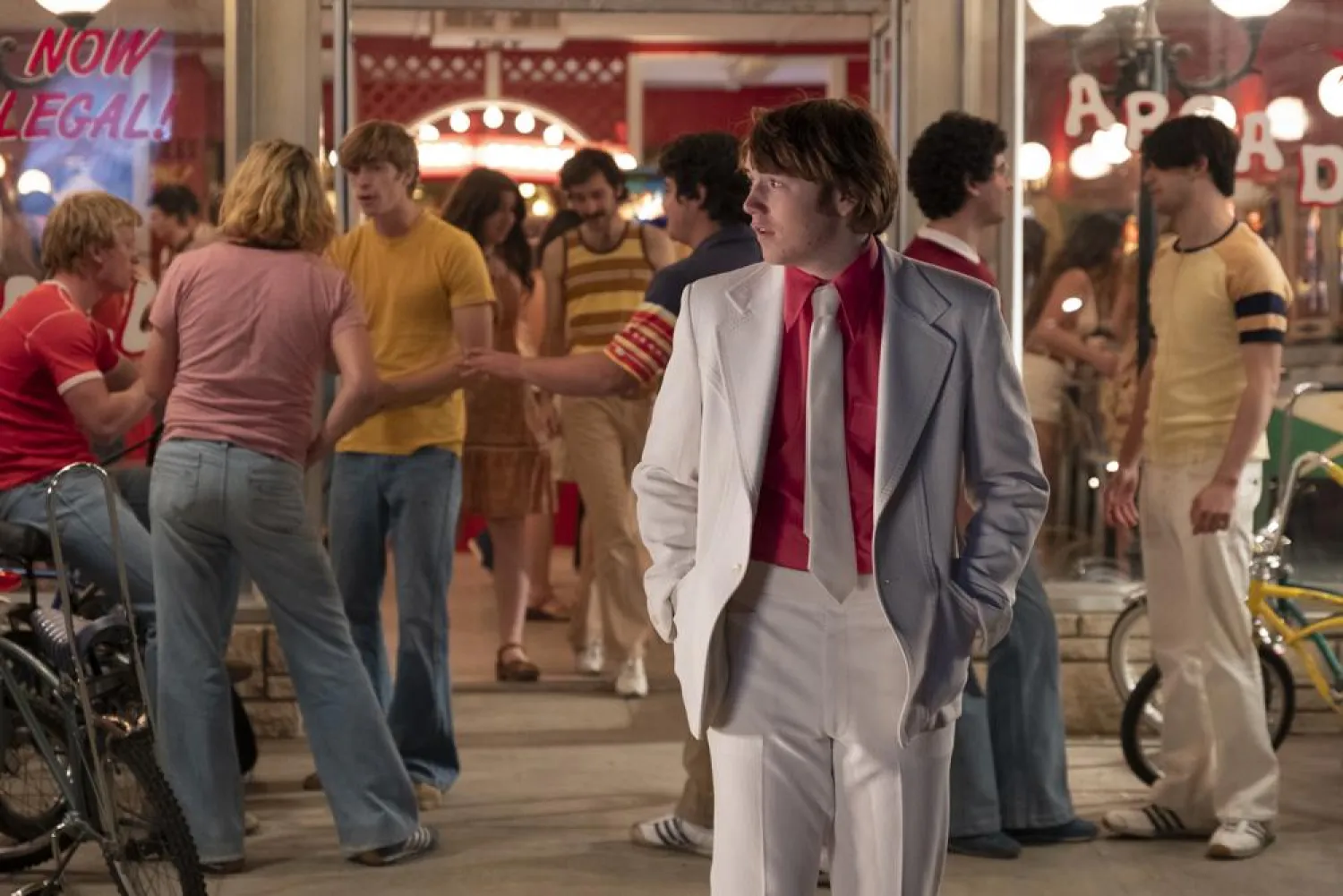
This image released by MGM shows Cooper Hoffman in a scene from "Licorice Pizza." (MGM via AP)
TT

Review: The Sunny, Shaggy ‘Licorice Pizza’ Soaks up the ’70s

This image released by MGM shows Cooper Hoffman in a scene from "Licorice Pizza." (MGM via AP)

It’s school picture day at a high school in Southern California’s San Fernando Valley in the opening scene of Paul Thomas Anderson’s 1970s-set “Licorice Pizza.”

The photographer’s assistant, Alana (Alana Haim), strides up and down a long line of students waiting in the sunshine outside a gymnasium. She’s barely looking at any of them, but one makes himself noticed. Gary Valentine (Cooper Hoffman) locks eyes with her and doesn’t let go, even as she does all she can to ignore him. He’s a 15-year-old actor, she’s in her 20s, but his attempted pick-up — sweetly direct, with a not entirely put-on maturity — makes her smile begrudgingly.

“You’re like a little Robert Goulet or Dean Martin,” she says.

Anderson’s camera circles them as they walk, and though few moments quite match the magic of that opening, “Licorice Pizza” never stops pinballing to a sunny, infectious groove. Anderson’s ninth film, his shaggiest, most affectionate and maybe the one I most wanted to watch again immediately after it was over, is a charmingly loose love letter to the Valley of his youth, an ode to a bygone, pre-digital era, and a complete hoot.

“Licorice Pizza” takes its name from a regional record store from the time which never actually appears in the film. But the vinyl store’s absence only enhances the feeling that the light air of Anderson’s film belongs to a disappeared time. It was fairly recent, I think, that the ’70s didn’t seem so very long ago. But that decade is now almost half a century removed from today — the same distance from the ’70s to the flappers and speakeasies of the ’20s.

With lush detail, oodles of verve and a soundtrack featuring David Bowie and Blood, Sweat & Tears, “Licorice Pizza” conjures a gentler, more shambolic time. It’s nostalgic, for sure, but laced with reminders of that era’s shortcomings, too. The spell of that opening shot, for example, is broken with a butt slap from an older man.

Against hallmark events of the era, like the gas crisis and the dawn of the water bed, Anderson follows the crisscrossing relationship between Gary and Alana. Alana refuses to accept Gary as a boyfriend but they have a hard-to-articulate bond — friends, business partners, maybe soul mates — that keeps them circling back to one another despite the awkward gap in age. In such a richly ’70s specific film, their romance, like any love, exists out of time.

The whole film, shot in 35mm, feels like an assortment of memories and old, probably embellished tales. “Licorice Pizza,” full of comic set pieces and digressions, is based on the anecdotes of Gary Goetzman, a producer and actor best known as Tom Hanks’ producing partner. That Hollywood is just over the hill is a constant source of intrigue and farce. Sean Penn pops up as a stand-in for William Holden. A wonderfully over-the-top Bradley Cooper feverishly plays a Jon Peters, boyfriend to Barbra Streisand. Benny Safdie joins later as a local politician Alana volunteers for. As portraits of older men to Alana, they make Gary seem only more of a sweet, genuine exception.

As an amiable, sometimes satirical odyssey populated with outsized characters, “Licorice Pizza” reminded me of an Elaine May film. It’s a golden detour for Anderson, who rarely strays outside California but whose attraction to a subject, mood and tone is endlessly unpredictable. As a love story, it’s not too different from his previous film, “Phantom Thread,” or the earlier “Punch Drunk Love” (which featured Cooper’s late father, Philip Seymour Hoffman, an Anderson regular, selling mattresses — a tender connection to the water beds hawked by his son in “Licorice Pizza”). The self-promoting Gary, too, could be a junior version to some of the hucksters of Anderson’s past films: Philip Baker Hall’s gambler in “Hard Eight”; Mark Wahlberg’s porn star in “Boogie Nights”; Daniel Day-Lewis’ oilman in “There Will Be Blood.”

But “Licorice Pizza” feels like something different, like the culmination of a deconstructionist phase for Anderson — a virtuoso filmmaker who since his most sprawling epics (“Boogie Nights,” “Magnolia,” “There Will Be Blood,” “The Master”) has moved increasingly toward humble, organic little movies. Always a personal filmmaker, Anderson has seemed to steadily pare away. His fingerprints on his films are less emphatic but more ubiquitous. (As he did on “Phantom Thread,” Anderson here serves as his own cinematographer, this time alongside Michael Bauman.) “Licorice Pizza,” which includes cameos from Maya Rudolph (Anderson’s wife), John C. Reilly and others, may derive from Goetzman’s tales but it feels almost like a home movie for Anderson, made with friends and family.

“Is this lines or this real?” asks a dazed Tom Waits, as filmmaker Rex Blau, after an impromptu stunt outside the Tail o’ the Cock bar-restaurant in Encino.

But it’s the performances of Haim and Hoffman that most lend “Licorice Pizza” its authenticity. Neither has acted in a film before and their fresh-faced presences electrify the film. There’s obvious poignancy to Hoffman, 18, starring in a film by Anderson, but he has a sincerity all his own. Even more of a revelation is Haim, the youngest of the three San Fernando Valley sisters who make up the band Haim. (Anderson, a fan, has shot several music videos for them.) Gary already knows himself, but Alana is figuring it out. Just what Haim is capable of — including steering a daring backwards escape in a moving van — seems to only expand as “Licorice Pizza” winds its joyful way home.



Taylor Swift Bags Best-selling Artist of 2025 Award

FILE PHOTO: Taylor Swift poses at the red carpet during the 67th Annual Grammy Awards in Los Angeles, California, US, February 2, 2025. REUTERS/Daniel Cole/File Photo
TT

Taylor Swift Bags Best-selling Artist of 2025 Award

FILE PHOTO: Taylor Swift poses at the red carpet during the 67th Annual Grammy Awards in Los Angeles, California, US, February 2, 2025. REUTERS/Daniel Cole/File Photo

US pop star Taylor Swift was crowned the biggest-selling global artist of 2025, industry body IFPI announced Wednesday, the fourth consecutive year and sixth time she has claimed its annual prize.

The 36-year-old's success was turbo-charged by the October release of her latest album, "The Life of a Showgirl", which set several streaming records, as well as the release of a docuseries about her record-breaking The Eras tour.

"2025 was another landmark year (for Swift), driven by exceptional worldwide engagement across streaming, physical and digital formats with the release of her 12th album ... and the documentary of her tour," IFPI said.

The body, which represents the recorded music industry worldwide, noted Swift had now won its top annual artist prize as many times as all other artists combined over the past 10 years, AFP.

IFPI hands out the Global Artist of the Year Award after calculating an artist's or group's worldwide sales across streaming, downloads and physical music formats during the calendar year and covers their entire body of work.

Swift beat out Korean group Stray Kids, which came in second -- its highest-ever ranking and the third consecutive year in the global top five.

Fresh from his Super Bowl halftime show, Puerto Rican artist Bad Bunny placed fifth in the rankings, his sixth consecutive year in the chart.

American rapper Tyler, The Creator marked his first appearance on the chart, in 12th place, with IFPI noting he had "continued to generate strong vinyl sales across his catalogue".

Meanwhile Japanese rock band Mrs. Green Apple entered the rankings for the first time one place below him, following what IFPI called "the success of their anniversary album '10'".


Berlin Film Festival Rejects Accusation of Censorship on Gaza

Berlinale Festival Director Tricia Tuttle speaks during the Berlinale Camera award ceremony honoring British composer Max Richter during the 76th Berlin International Film Festival, in Berlin, Germany, 18 February 2026. (EPA)
TT

Berlin Film Festival Rejects Accusation of Censorship on Gaza

Berlinale Festival Director Tricia Tuttle speaks during the Berlinale Camera award ceremony honoring British composer Max Richter during the 76th Berlin International Film Festival, in Berlin, Germany, 18 February 2026. (EPA)

The director of the Berlin Film Festival on Wednesday rejected accusations from more than 80 film industry figures that the festival had helped censor artists who oppose Israel's actions in Gaza.

In an open letter published on Tuesday, Oscar-winning actors Javier Bardem and Tilda Swinton were among dozens who criticized the Berlinale's "silence" on the issue and said they were "dismayed" at its "involvement in censoring artists who oppose Israel's ongoing genocide against Palestinians in Gaza".

In an interview with Screen Daily, the Berlinale's director, Tricia Tuttle, said the festival backs "free speech within the bounds of German law".

She said she recognized that the letter came from "the depth of anger and frustration about the suffering of people in Gaza".

However, she rejected accusations of censorship, saying that the letter contained "misinformation" and "inaccurate claims about the Berlinale" made without evidence or anonymously.

The row over Gaza has dogged this year's edition of the festival since jury president Wim Wenders answered a question on the conflict by saying: "We cannot really enter the field of politics."

The comments prompted award-winning novelist Arundhati Roy, who had been due to present a restored version of a film she wrote, to withdraw from the festival.

Tuttle said the festival represents "lots of people who have different views, including lots of people who live in Germany who want a more complex understanding of Israel's positionality than maybe the rest of the world has right now".

German politicians have been largely supportive of Israel as Germany seeks to atone for the legacy of the Holocaust.

However, German public opinion has been more critical of Israeli actions in Gaza.

Commenting on the row to the Welt TV channel, German Culture Minister Wolfram Weimer defended Wenders and Tuttle from criticism, saying they were running the festival "in a very balanced way, very sensitively".

"Artists should not be told what to do when it comes to politics. The Berlinale is not an NGO with a camera and directors," Weimer said.

Gaza has frequently been a topic of controversy at the Berlinale in recent years.

In 2024, the festival's documentary award went to "No Other Land", which follows the dispossession of Palestinian communities in the Israeli-occupied West Bank.

German government officials criticized "one-sided" remarks about Gaza by the directors of that film and others at that year's awards ceremony.


Over 80 Berlin Film Festival Alumni Sign Open Letter Urging Organizers to Take Stance on Gaza 

12 February 2026, Berlin: President of the Berlinale jury Wim Wenders waves to the audience on the opening night of the 76th Berlin International Film Festival, before the premiere of the opening film "No Good Men" at the Berlinale Palast. (dpa)
TT

Over 80 Berlin Film Festival Alumni Sign Open Letter Urging Organizers to Take Stance on Gaza 

12 February 2026, Berlin: President of the Berlinale jury Wim Wenders waves to the audience on the opening night of the 76th Berlin International Film Festival, before the premiere of the opening film "No Good Men" at the Berlinale Palast. (dpa)

More than 80 actors, directors and other ‌artists who have taken part in the Berlin Film Festival, including Tilda Swinton and Javier Bardem, signed an open letter to the organizers published on Tuesday calling for them to take a clear stance on Israel's war in Gaza.

"We call on the Berlinale to fulfil its moral duty and clearly state its opposition to Israel's genocide, crimes against humanity and war crimes against Palestinians," said the open letter, which was published in full in entertainment industry magazine Variety.

Multiple human rights experts, scholars and a UN inquiry say Israel's assault on Gaza amounts to genocide. Israel calls its actions self-defense after Hamas' October 2023 attack on Israel.

"We are appalled by Berlinale's institutional silence," ‌said the letter, which ‌was also signed by actors Adam McKay, Alia Shawkat and ‌Brian ⁠Cox, and director ⁠Mike Leigh.

It said organizers had not met demands to issue a statement affirming Palestinians' right to life and committing to uphold artists' right to speak out on the issue.

"This is the least it can - and should - do," the letter said.

The festival did not immediately respond to an emailed request for comment.

THE MOST POLITICAL FESTIVAL

The Berlin Film Festival is considered the most political of its peers, Venice and Cannes, and ⁠prides itself on showing cinema from under-represented communities and young ‌talent. However, it has been repeatedly criticized by pro-Palestinian activists ‌for not taking a stand on Gaza, in contrast to the war in Ukraine ‌and the situation in Iran.

Calls have also previously been made for the ‌entertainment industry to take a stance on Gaza.

Last year, over 5,000 actors, entertainers, and producers, including some Hollywood stars, signed a pledge to not work with Israeli film institutions that they saw as being complicit in the abuse of Palestinians by Israel.

Paramount studio later condemned that ‌pledge and said it did not agree with such efforts.

ROY PULLS OUT

Tuesday's letter also condemned statements by this year's ⁠jury president, German director ⁠Wim Wenders, that filmmakers should stay out of politics, writing: "You cannot separate one from the other."

Wenders' comments prompted Indian novelist Arundhati Roy, winner of the Booker Prize in 1997 for her novel "The God of Small Things", to pull out of the festival earlier this week.

Roy, who had been due to present "In Which Annie Gives It Those Ones", a 1989 film which she wrote, in the Berlinale's Classics section, characterized Wenders' comments as "unconscionable."

In response, festival director Tricia Tuttle issued a note on Saturday defending artists' decision not to comment on political issues.

"People have called for free speech at the Berlinale. Free speech is happening at the Berlinale," she said.

"But increasingly, filmmakers are expected to answer any question put to them," she wrote, and are criticized if they do not answer, or answer "and we do not like what they say."