


Chinese Fashion Photographer in Dior Controversy Apologizes

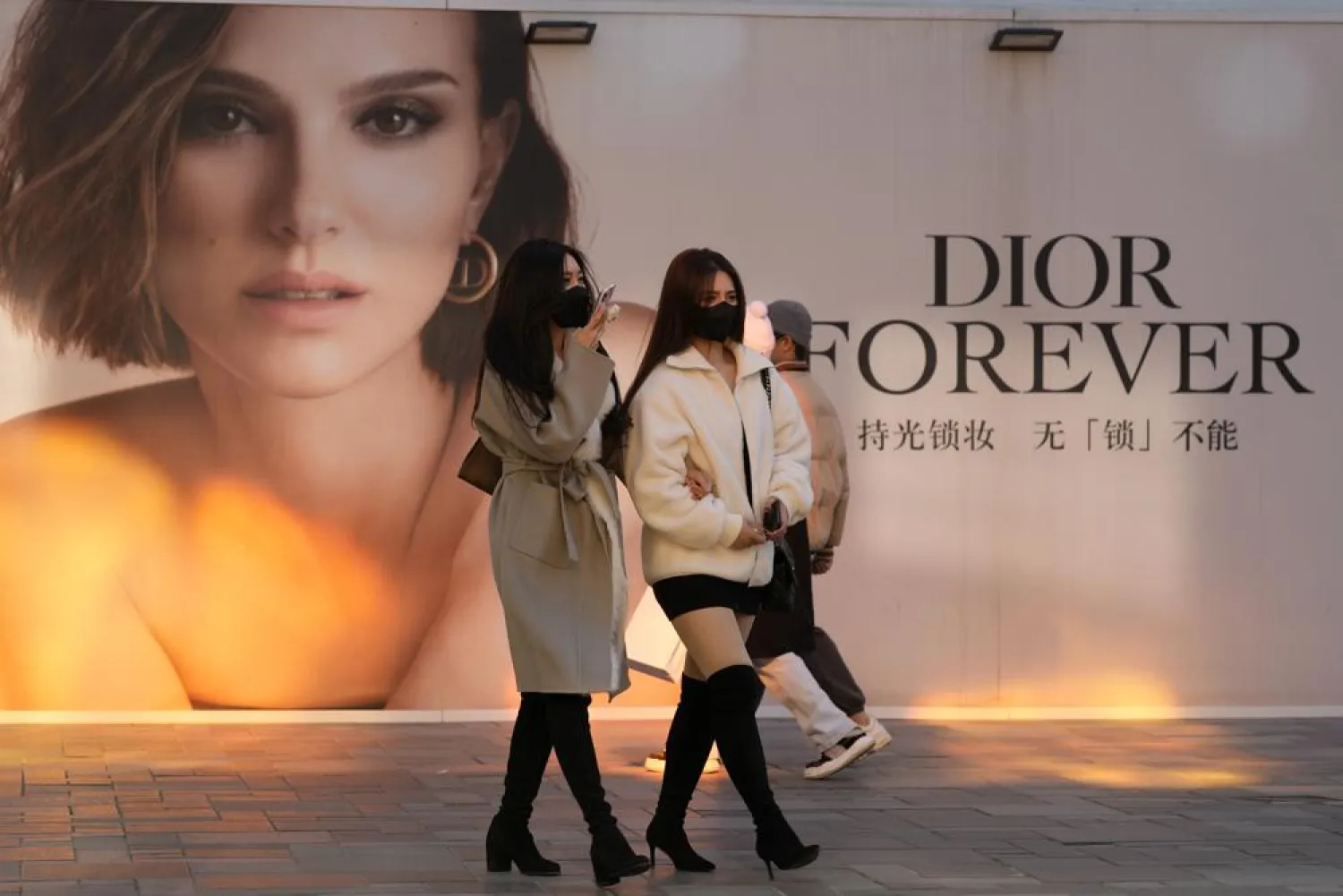
Women wearing masks walk past an ad for Dior at a mall in Beijing, China, Thursday, Nov. 25, 2021.  (AP Photo/Ng Han Guan)
Women wearing masks walk past an ad for Dior at a mall in Beijing, China, Thursday, Nov. 25, 2021. (AP Photo/Ng Han Guan)
TT

Chinese Fashion Photographer in Dior Controversy Apologizes

Women wearing masks walk past an ad for Dior at a mall in Beijing, China, Thursday, Nov. 25, 2021.  (AP Photo/Ng Han Guan)
Women wearing masks walk past an ad for Dior at a mall in Beijing, China, Thursday, Nov. 25, 2021. (AP Photo/Ng Han Guan)

A renowned Chinese fashion photographer has apologized for her past work after online critics called it insulting to the Chinese people and fashion house Dior removed one of her photos from a show in Shanghai.

Chen Man acknowledged the criticism of her earlier work, including “Young Pioneers,” a series of images of a young model with backdrops of major landmarks such as China’s massive Three Gorges Dam or with an image of the country’s first lunar orbiter flying out from under her dress.

The criticism was reported by the state-owned Global Times newspaper, which said that comments on social media had called her work “implicit child pornography and insulting the young pioneers,” the name of a Communist Party-affiliated youth organization, The Associated Press reported.

“I have reflected deeply and blamed myself for my naivety and ignorance at the time. I think that I must still formally apologize to everyone,” Chen wrote this week on her social media account.

“I’m a Chinese person, born and raised, I deeply love my motherland,” she wrote. “And I know, deeply, that as an artist, I have a responsibility to the mission to record and spread the Chinese people’s culture.”

She joins numerous Chinese and foreign celebrities, brands and artists who have made public apologies following criticism of their work in state media. Some have been boycotted for refusing to apologize or if the apology is deemed insufficient.

Chen’s apology came more than a week after Dior was attacked over the photo at its exhibition in Shanghai, which pictured a model of Asian descent with tan, freckled skin and darkened eyelids holding a Dior purse.

Critics deemed the photograph contrary to East Asian beauty standards of fair skin and said it perpetuated Western stereotypes of Asian faces, such as slanted eyes.

At least one photo editor has praised her work in the past for creating an aesthetic that was neither aping Western magazines or Japanese and South Korean ones. And in 2019, the Global Times described Chen as China’s answer to US photographer Annie Leibovitz, calling her a “shining star” with a unique perspective.

Dior removed the photograph, adding that it was part of an art project and not an advertisement. In a statement on its Chinese social media account, Dior said it “respects the feelings of Chinese people” and “strictly abides by Chinese laws and regulations.”

Other luxury brands have previously been embroiled in controversies in China. In 2018, a Dolce & Gabbana advertisement sparked public outrage after the Asian model in the ad was instructed to eat spaghetti, cannolis and pizza with a pair of chopsticks. The videos were later removed.

Chen’s social media post said she accepted criticism of her work including that for a certain brand, but didn’t specify Dior.

The photograph taken down from the Shanghai exhibit was shot in a similar style to a series of covers Chen did for British fashion magazine i-D that featured 12 young Chinese women from different ethnic minorities. Many of the women did not fit what has become a common definition of beauty in China — some had small eyes and others had freckles.

Ding Yining, a photo editor at Sixth Tone, praised Chen’s work in a 2018 article for the state-backed English-language features website.

“From her works, it would seem that Chen prefers female models with narrow, single-lidded eyes and a sense of traditional East Asian elegance,” Ding wrote.

Chen told Sixth Tone that “as a professional visual artist, I believe that I should help more people recognize the face of modern Chinese beauty with greater confidence.”



Global Fashion Brands Shift Orders from Bangladesh to India amid Unrest

Garment workers sew T-shirts at a factory in Dhaka, Bangladesh, in 2009. AFP/Getty Images
TT

Global Fashion Brands Shift Orders from Bangladesh to India amid Unrest

Garment workers sew T-shirts at a factory in Dhaka, Bangladesh, in 2009. AFP/Getty Images

Global fashion retailers including Zara and H&M shifted nearly a tenth of their monthly orders from Bangladesh to other Asian manufacturing hubs in the first half of November, as labor unrest disrupted production and rising costs eroded the country's competitive edge, three factory owners said.

Between November 1 and 18, brands diverted about $254 million worth of orders from Bangladesh, with most moving to neighboring India, the owners said, a shift that represents a major blow to a key pillar of Bangladesh's economy and could extend beyond the current unrest, said Reuters.

Industry leaders have said rising wages, energy shortages and political uncertainty have weakened the low-cost advantage that helped make Bangladesh the world's second apparel exporter after China, prompting global brands to diversify sourcing.

The protests have caused more than $400 million in production losses, according to the Bangladesh Garment Manufacturers and Exporters Association (BGMEA), in an industry that accounts for more than 80% of Bangladesh's export earnings and nearly 40% of its manufacturing ‌jobs.

VIETNAM, CAMBODIA AND INDONESIA ‌ALSO BENEFIT

India has emerged as the biggest beneficiary, while buyers are also looking to Vietnam, ‌Cambodia ⁠and Indonesia to ⁠reduce supply-chain risks and improve delivery reliability, industry leaders said.

Those pressures intensified on Wednesday when Bangladesh approved a 36% increase in the minimum wage for garment workers, the smallest rise in four decades.

The increase fell well short of workers' demands to more than double wages, triggering fresh clashes with police even as Abdur Rahman Tarafder, secretary of the Ministry of Labor and Employment, said the wage increase was "satisfactory" and that he hoped all workers would resume work from Saturday.

Industry leaders said the increase would nevertheless narrow Bangladesh's labor-cost advantage over India, although union groups argue the wages remain low by global industry standards.

Babul Akhter, a union leader and workers' representative on the government-appointed wage board, said brands should not use the unrest to justify ⁠shifting orders out of Bangladesh.

He said retailers already factor political instability and labor unrest into ‌sourcing decisions, making such moves "hard to justify" and raising "serious doubts" whether the unrest was more ‌than an excuse.

Factory owners, speaking on condition of anonymity because of concerns about their relationships with international buyers, said the unrest had prompted Zara, H&M, ‌Marks & Spencer, Celio and other global brands to divert orders, with India receiving the bulk of the business.

Zara owner Inditex declined to ‌comment on Reuters’ questions, while M&S, H&M and Celio did not respond to requests for comment.

Indian textile shares rallied after the Reuters report, with Gokaldas Exports jumping as much as 11% and Trident gaining about 5%. Other potential beneficiaries, including Welspun Living, KPR Mill and Vardhman Textiles rose around 2% each.

M. Mohiuddin Chowdhury, a director of the BGMEA, said higher wages, utility and raw-material costs were adding to pressure on manufacturers "at a time when buyers are demanding lower ‌prices and competition from rival sourcing countries is intensifying".

MORE BUSINESS AT RISK

Factory owners said the bigger concern was that diversions of business could become permanent.

Persistent energy shortages, exacerbated by the Middle East crisis, ⁠have added to production disruptions ⁠and forced some factories to rely on more expensive alternative power sources.

But Chowdhury said that price became secondary when brands were under pressure to meet strict delivery deadlines.

India can offer buyers a delivery advantage of about a week, while Vietnam and Cambodia can cut lead times by as much as 15 days, Chowdhury said.

Rival sourcing hubs can typically complete production and delivery within 60 to 90 days, compared with about 120 days in Bangladesh, he added.

The disruptions have also created production backlogs, with manufacturers around Dhaka losing an estimated 20 to 25 production days. Some are considering overtime and costly air freight to meet delivery commitments.

Khan Monirul Alam, managing director of Alps Apparels Group, which mainly supplies European brands, said the unrest was already hitting new business.

"Since November 1, most of my buyers have stopped placing orders because of the unrest," Alam said. "They are telling us our orders have been shifted, postponed or cancelled and that they have already found alternative solutions."

Political tensions surrounding former prime minister Sheikh Hasina's possible return to Dhaka from India have added to concerns about further disruption.

Industry leaders said restoring stability and uninterrupted production would be critical to retaining international buyers. Chowdhury warned that orders shifted elsewhere during periods of instability might not return even after conditions improved.

"The challenge is restoring buyers' confidence before temporary shifts become long-term sourcing decisions," he said. "Brands have options. They will not wait for us if instability persists."


China’s Premium Puffer Jacket Push Meets Consumer Resistance

Staff members promote discounted jackets at a store in Beijing, China October 18, 2025. (Reuters)
TT

China’s Premium Puffer Jacket Push Meets Consumer Resistance

Staff members promote discounted jackets at a store in Beijing, China October 18, 2025. (Reuters)

Chinese shoppers are snapping up budget down jackets as the cold weather arrives, with products priced below 500 yuan ($69) selling briskly as consumers question the value of premium brands.

A 399-yuan down jacket filled with 90% goose down and produced for Peking University sold out online in mid-November after attracting widespread attention on Chinese social media. At Walmart-owned Sam's Club, a women's down jacket from US brand Rokka&Rolla priced at 499.9 yuan also sold out, the retailer's app showed.

The trend marks a shift towards more cost-conscious spending in a market where people have long been pushed to buy more luxurious and expensive clothing. Research firm iiMedia said the average price of a down jacket in China more than doubled over the past decade and was forecast to exceed 1,000 yuan in 2025. Yet a survey ‌released this month ‌found jackets priced between 401 yuan and 600 yuan were the most popular ‌among consumers.

Bosideng, ⁠China's largest down-jacket ⁠maker, has said the average price of its core products has risen to about 1,500-2,500 yuan.

A prolonged property slump, weak wage growth and concerns over job security have made many middle-class consumers more cautious about discretionary spending, raising questions about how much extra they are willing to pay for premium outerwear.

"I think Sam's has nailed that with its down jackets," said Mark Tanner, founder and managing director of Shanghai-based consultancy China Skinny.

"Many shoppers are not hunting for the cheapest copy. They want comparable design, function or pleasure without paying a large prestige premium," he said.

The challenge is becoming increasingly apparent for brands seeking ⁠to move further upmarket. Bosideng this month launched its third collection from British ‌designer Kim Jones, but some higher-priced items saw limited sales on its ‌flagship store on Tmall, an upmarket online shopping platform.

A blue jacket featured in advertisements with singer, actor and brand ambassador Wang ‌Leehom carried a price tag of about 2,278 yuan but sold just 16 units in the 30 days ‌to November 13, according to figures displayed on the Tmall store.

Bosideng did not respond to a request for comment.

VALUE OVER PRESTIGE

The diverging fortunes suggest consumers are becoming more selective rather than simply trading down.

More than 30 million down jackets were sold during this year's Singles' Day shopping festival, according to e-commerce giant Alibaba, while Uniqlo and Bosideng ranked first and second by sales, ‌retaining their long-held positions at the top of China's down-jacket market.

Uniqlo surpassed 100 million yuan in Tmall sales within 24 minutes of Singles' Day promotions launching on ⁠October 20, Tmall said, and ⁠the platform listed the brand's lightweight down jacket, which typically retails for around 500 yuan in China, among its top-selling products.

Demand also remains resilient at the top end. Canada Goose said Greater China revenue rose 32.5% in the quarter ended September.

"China is a very healthy region for Moncler," Chief Corporate and Supply Officer Luciano Santel said last month, as the premium outerwear brand continued to outperform a broader luxury slowdown in the world's second-largest economy.

"Like every luxury brand, they'll need to work harder than ever to justify the premium price point," Tanner said.

The contrasting performances reflect a broader divergence in Chinese consumption. As economic uncertainty weighs on middle-class households, many consumers are trading down or demanding greater value for money, while wealthier shoppers continue spending on products they believe offer them quality, performance or status.

"I definitely won't buy another down jacket that costs more than 1,000 yuan," said Lv Jiaming, a 27-year-old factory worker in Shanghai. "To me, there isn't much difference between a jacket priced at 500 or 600 yuan and one that costs more than 1,000 yuan. You can't really feel the difference, unless it's exceptionally good."


Shein Europe Sales Sink as New Import Fees Bite

FILED - 29 April 2024, Berlin: FILE PHOTO - The Shein logo can be seen on a smartphone. Photo: Monika Skolimowska/dpa
TT

Shein Europe Sales Sink as New Import Fees Bite

FILED - 29 April 2024, Berlin: FILE PHOTO - The Shein logo can be seen on a smartphone. Photo: Monika Skolimowska/dpa

Online fast-fashion retailer Shein reported a steep decline in European sales on Wednesday, as new fees on ⁠ecommerce imports slammed ⁠the brakes on growth in its biggest market.

Shein's third-quarter revenue in ⁠Europe fell 27.6% to $2.98 billion, highlighting the impact of €3 fees imposed by the European Union on parcels ordered online from July 1, Reuters reported.

The firm reported overall ⁠revenue ⁠of $10.27 billion for the three months ended September, a nearly 6% drop from last year.