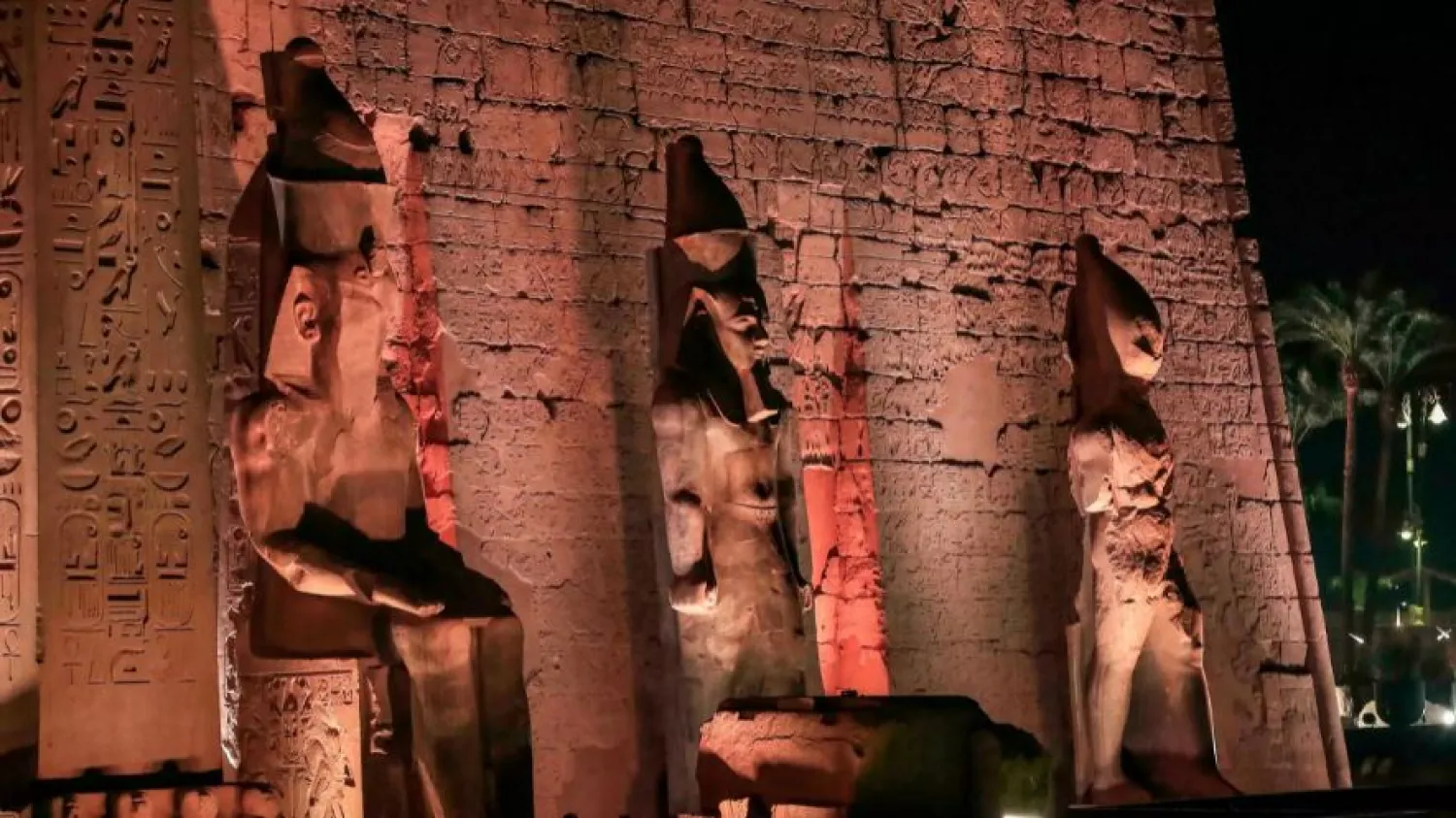
Egypt Unveils Pharaonic ‘Rams Road’ at Karnak Temple

President Sisi walks with Tourism and Antiquities Minister Khaled el-Enany as they enter the pylon at the entrance of the Temple of Luxor Khaled DESOUKI AFP
TT

Egypt Unveils Pharaonic ‘Rams Road’ at Karnak Temple

President Sisi walks with Tourism and Antiquities Minister Khaled el-Enany as they enter the pylon at the entrance of the Temple of Luxor Khaled DESOUKI AFP

Egypt unveiled on Thursday a road lined with hundreds of ram-headed sphinx statues dating back more than 3,000 years, in a grandiose night-time ceremony at Karnak Temple in archaeologically-rich Luxor.

Dubbed the "Rams Road", the sandstone-paved path connecting the temples of Karnak and Luxor in the center of the southern Nile city was officially opened by President Abdel Fattah el-Sisi and a host of senior officials in a spectacular night-time ceremony.

The road is nearly three kilometres (two miles) long and named "The Path of God" in ancient Egyptian mythology, AFP reported.

It is flanked on both sides by statues that were buried for centuries under desert sands before they were revived and restored for display by the country's Egyptologists in recent years.

The ram is an embodiment of the ancient Egyptian deity Amun.

Karnak Temple was built around 2,000 to 4,000 years ago and is dedicated to Amun-Ra, an ancient Sun god. It covers an area of over 100 hectares (250 acres).

Luxor Temple was constructed some 3,400 years ago by Amenhotep III and has been used as a site of continuous religious worship from the ancient Egyptians to Christian Copts and later Muslims.

Egypt's tourism and antiquities ministry has vowed to make the Arab world's most populous country a vaunted destination for tourists by boosting its reputation as "an open air museum".

The tourism sector in Egypt employs two million people and generates more than 10 percent of the country's gross domestic product.

But it has taken a hit in recent years from political turbulence following the 2011 revolution, multiple terror attacks, and more recently the coronavirus pandemic.

In April, a procession of floats carried the mummified remains of 22 pharaohs through Cairo's streets in a parade complete with a 21-cannon salute to the newly opened National Museum of Egyptian Civilisation.

In the coming months, the country is due to inaugurate another new showcase, the Grand Egyptian Museum, near the Giza pyramids in Cairo.


Saudi National Center for Wildlife, Soudah Development Company Release Birds of Prey

The release comes as part of reintroduction programs aimed at enhancing ecological balance and restoring biodiversity in one of the Kingdom’s most prominent mountainous environmental zones - SPA
TT

Saudi National Center for Wildlife, Soudah Development Company Release Birds of Prey

The release comes as part of reintroduction programs aimed at enhancing ecological balance and restoring biodiversity in one of the Kingdom’s most prominent mountainous environmental zones - SPA

Saudi Arabia's National Center for Wildlife (NCW), in cooperation with Soudah Development Company, has released a number of birds of prey in Al-Soudah Park, including three griffon vultures, a black kite, an Arabian scops owl, and an Eurasian sparrowhawk, after rehabilitating them at shelter centers.


The release comes as part of reintroduction programs aimed at enhancing ecological balance and restoring biodiversity in one of the Kingdom’s most prominent mountainous environmental zones, SPA reported.

This release followed the completion of rehabilitation and environmental acclimatization stages to ensure the birds’ readiness and ability to adapt to the nature of the area, contributing to the stability of local species and boosting their ecological roles within mountain ecosystems, particularly in regulating food chains and preserving the health of natural habitats.

The NCW noted that this step falls within its ongoing programs to breed and reintroduce threatened wildlife species, rehabilitate ecosystems, and enrich biodiversity across various regions of the Kingdom, in cooperation with national partners and in line with the objectives of the Saudi Green Initiative and the National Environment Strategy, which support the environmental development goals of the Saudi Vision 2030.

Specialized teams will continue to monitor the released birds and track their movements and ecological behavior using dedicated tools and technologies, supporting the evaluation of the program’s success and the improvement of its outcomes in the future in accordance with the best global environmental practices.


Ariane 6 Lifts Off with 2 European Navigation Satellites

The European Space Agency (ESA) Ariane 6 rocket carrying two Galileo satellites for the the EU's Global Navigation Satellite System (GNSS) launches at the Guiana Space Center in Kourou, on the French overseas department of Guiana, on December 17, 2025. (Photo by Ronan LIETAR / AFP)
TT

Ariane 6 Lifts Off with 2 European Navigation Satellites

The European Space Agency (ESA) Ariane 6 rocket carrying two Galileo satellites for the the EU's Global Navigation Satellite System (GNSS) launches at the Guiana Space Center in Kourou, on the French overseas department of Guiana, on December 17, 2025. (Photo by Ronan LIETAR / AFP)

A European Ariane 6 rocket blasted off from France's Kourou space base in French Guiana early Wednesday, carrying two Galileo global navigation satellites, according to an AFP correspondent.

Lift-off was at 2:01 am local time (0501 GMT) for the fourth commercial flight of the Ariane 6 launch system since the expendable rockets came into service last year.

The rocket was carrying two more satellites of the European Union's Galileo program, a global navigation satellite system that aims to make the bloc less dependent on the US's Global Positioning System (GPS).

The two satellites were set to be placed in orbit nearly four hours after lift-off.

They will bring to 34 the number of Galileo satellites in orbit and "will improve the robustness of the Galileo system by adding spares to the constellation to guarantee the system can provide 24/7 navigation to billions of users. The satellites will join the constellation in medium Earth orbit 23, 222 km (14,429 miles) above Earth’s surface," according to the European Space Agency (ESA) which oversees the program.

Previous Galileo satellites were primarily launched by Ariane 5 and Russian Soyuz rockets from Kourou.

After Russia's invasion of Ukraine, Europe halted space cooperation with Moscow.

Before the Ariane 6 rocket entered into service in July 2024, the EU contracted with Elon Musk's SpaceX to launch two Galileo satellites aboard Falcon 9 rockets in September 2024 from the Kennedy Space Center in Florida.


Delhi Restricts Vehicles, Office Attendance in Bid to Curb Pollution

Children ride a bicycle across a field on smoggy winter morning in New Delhi on December 17, 2025. (Photo by Arun SANKAR / AFP)
TT

Delhi Restricts Vehicles, Office Attendance in Bid to Curb Pollution

Children ride a bicycle across a field on smoggy winter morning in New Delhi on December 17, 2025. (Photo by Arun SANKAR / AFP)

Authorities in India's capital Delhi rolled out strict measures on Wednesday in an attempt to curb pollution, including a ban on vehicles not compliant with latest emission control norms and regulating attendance in private and government offices.

The air quality index (AQI) in the Delhi region, home to 30 million people, has been in the 'severe' category for the past few days, often crossing the 450-mark. In addition, shallow fog in parts of the city worsened visibility that impacted flights and trains.

This prompted the Commission for Air Quality Management to invoke stage four, the highest level, of the Graded Response Action Plan for Delhi and surrounding areas on Saturday.

The curbs ban the entry of older diesel trucks into the city, suspend construction, including on public projects, and impose hybrid schooling, Reuters reported.

Kapil Mishra, a minister in the local government, announced on Wednesday that all private and government offices in the city would operate with 50% attendance, with the remaining working from home.

Additionally, all registered construction workers, many of them earning daily wages, will be given compensation of 10,000 rupees ($110) because of the ban, Mishra said at a press conference in Delhi.

On Tuesday, the government enforced strict anti-pollution measures for vehicles in the city, banning vehicles that are not compliant with the latest emission control standards.

"Our government is committed to providing clean air in Delhi. We will take strict steps to ensure this in the coming days," Delhi's Environment Minister Manjinder Singh Sirsa said late on Tuesday.

Pollution is an annual winter problem in Delhi and its suburbs, when cold, dense air traps emissions from vehicles, construction sites and crop burning in neighboring states, pushing pollution levels to among the highest in the world and exposing residents to severe respiratory risks.

The area, home to 30 million people, gets covered in a thick layer of smog with AQI touching high 450-levels. Readings below 50 are considered good.