Sudan Appoints New Director of General Intelligence

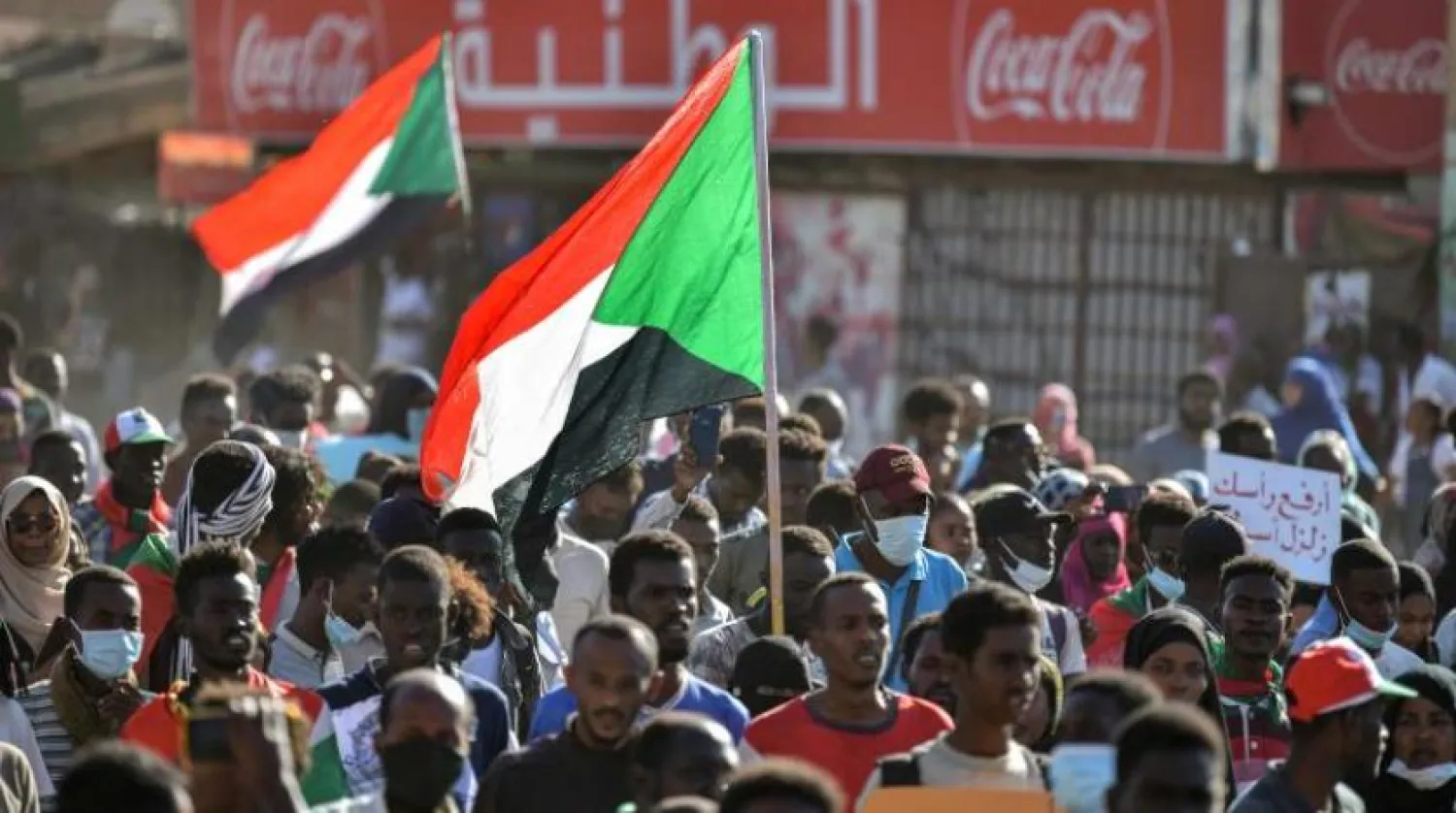
 Sudanese protesters against the military rule in Omdurman. (AFP)
Sudanese protesters against the military rule in Omdurman. (AFP)
TT

Sudan Appoints New Director of General Intelligence

 Sudanese protesters against the military rule in Omdurman. (AFP)
Sudanese protesters against the military rule in Omdurman. (AFP)

Sudans’s sovereign council has appointed Ahmed Mufaddal, formerly deputy director, as the new director of the general intelligence service, official sources told Reuters on Saturday.

This came as Prime Minister Abdalla Hamdok Prime Minister said Saturday he has replaced the country’s police chiefs after at least 42 people were killed in a crackdown on protests following October’s military coup.

Military chief General Abdel Fattah al-Burhan seized power and detained Hamdok on October 25, but after international condemnation and mass protests he reinstated the premier in a November 21 deal.

Hamdok said he had sacked the director general of the police, Khaled Mahdi Ibrahim al-Emam, and his deputy Ali Ibrahim.

In their place, he appointed Anan Hamed Mohamed Omar with Abdelrahman Nasreddine Abdallah as his deputy, the premier said in a statement.

Medics have accused security forces of targeting protesters in the "head, neck and torso" with live ammunition, as well as with rubber-coated bullets and tear gas canisters.

The police have denied reports they opened fire using live bullets.

Dozens of political activists, journalists, protesters and bystanders watching the rallies have been arrested in recent weeks, and remain in custody.

Hamdok has recently stressed he partnered with the military in order to “stop the bloodshed”.


Palestinians Await Eisenkot Govt While Not Expecting Radical Change

Israeli Prime Minister Benjamin Netanyahu (second from left) and Palestinian President Mahmoud Abbas (second from right) at a meeting in New York in 2009. (AFP/Getty Images)
TT

Palestinians Await Eisenkot Govt While Not Expecting Radical Change

Israeli Prime Minister Benjamin Netanyahu (second from left) and Palestinian President Mahmoud Abbas (second from right) at a meeting in New York in 2009. (AFP/Getty Images)

Palestinian leaders are closely watching Israeli Prime Minister-designate Gadi Eisenkot’s efforts to form a government and unseat Benjamin Netanyahu, hoping for a shift in Israeli policy after four years of hostility.

Although the Palestinian Authority (PA) has refrained from commenting publicly on Israel’s election results, officials are scrutinizing Eisenkot’s statements and political moves for signs of a possible change in relations.

The PA has maintained its longstanding position that Israeli elections are an internal matter. Yet few have more at stake in the outcome after four years in which Netanyahu’s government waged an unrelenting campaign against the Palestinian Authority and Palestinians in the West Bank and Gaza Strip.

Palestinian officials, including President Mahmoud Abbas, declared before the elections that they were prepared to engage with any Israeli government. They have stopped short, however, of speaking of a new chapter in relations.

Judging policies, not personalities

Mahmoud al-Habbash, an adviser to Abbas, stressed that the PA would judge any incoming Israeli prime minister by their policies and positions on the Palestinian issue.

“It is too early to judge Eisenkot,” Habbash told Asharq Al-Awsat. “We do not judge individuals. Frankly, the names of those governing Israel do not matter to us.”

“What matters are their actual positions, policies and programs concerning the Palestinian issue, and their commitment to international legitimacy and international law,” he stressed.

These factors will determine the PA’s relationship with any Israeli prime minister or government, he added.

Habbash declined to say whether Eisenkot was the PA’s preferred candidate, reiterating that it was premature to assess him or a government he had yet to form.

Nevertheless, he said: “We hope for a different Israeli leadership that respects international legitimacy and the agreements signed, beginning with Oslo, the Paris Agreement and subsequent accords.”

Such a leadership should have the willingness, determination and political program to put negotiations back on track toward an agreement ending the current situation, he said.

Eisenkot opposes the establishment of a Palestinian state, the PA’s central political objective. However, he has shown greater openness than Netanyahu toward strengthening the PA and transferring withheld Palestinian revenues.

He has also previously argued against Israel directly ruling millions of Palestinians in the West Bank and Gaza as an occupying power.

Habbash stressed that relations between Palestinians and the Israeli government involve interconnected political, economic and administrative issues.

“These range from everyday matters affecting people’s lives and needs to clearance revenues, compliance with signed agreements and, ultimately, Israel’s position on our legitimate national rights,” he explained.

“If Eisenkot translates his words into action, we will respond positively and remain open to dialogue,” Habbash affirmed.

‘Anyone is better than Netanyahu’

Behind closed doors, PA officials said that almost any alternative would be preferable to Netanyahu, whom they accuse of seeking to dismantle the Authority, displace Palestinians and eliminate their national cause.

They have avoided making such views public for fear their statements could be exploited in Israel’s domestic political struggle.

“It is not about Eisenkot. Any Israeli would be better for us than Netanyahu and his current government,” a senior Palestinian official told Asharq Al-Awsat. “This is the most hostile government Palestinians have ever known - a government of extermination.”

During Israel’s 2022 elections, the PA reportedly sought to help defeat Netanyahu, prompting Israel’s domestic security agency, Shin Bet, to warn against interference in the electoral process.

This time, the PA did not seek to intervene, but maintained various channels of communication with Arab party leaders.

Palestinian officials have expressed pride in the number of seats won by Arab parties in the Knesset, whose electoral gains effectively prevented Netanyahu from remaining in power.

Improve conditions

At a minimum, Palestinian officials hope Eisenkot will ease economic pressures and improve security conditions in the occupied territories.

“We are not suggesting that Eisenkot is a savior. We know he will not lead us to statehood,” an informed Palestinian source told Asharq Al-Awsat.

“But many other crucial issues are at stake: the future of the PA, the economy, clearance revenues, the West Bank, security conditions, settler violence, the future of Gaza, reconstruction and governance.”

The source hoped for progress on these issues, describing any improvement as a potential foundation for further engagement. Nevertheless, the Palestinian leadership remains cautious and does not expect a decisive policy shift.

Change in form, not substance

Palestine Liberation Organization Executive Committee member Wasel Abu Yousef was more skeptical, saying that a change in Israeli leadership would affect appearances rather than fundamental policy.

“There may be change, but it will be in form, not substance,” he told Asharq Al-Awsat.

“They agree on legitimizing settlements, preventing the establishment of a Palestinian state, separating the Gaza Strip and rejecting international resolutions. They are pursuing the Greater Israel project and, to varying degrees, denying the rights and existence of the Palestinian people.”

Meaningful change would require recognition of Palestinian self-determination and the establishment of an independent state in the West Bank, Gaza Strip and East Jerusalem, he said.

Habbash similarly reiterated the PA’s willingness to engage while insisting that economic relief alone could not resolve the conflict.

“Our cause is not merely about daily living conditions or improving livelihoods. It is about political rights, foremost among them the establishment of a Palestinian state and an end to the occupation.”


Lebanese Army Chief’s Remarks Spark Political Row

Lebanese President Joseph Aoun, Army Commander Gen. Rodolphe Haykal and security chiefs inspect a State Security building struck by Israel (File photo: Lebanese Presidency). 
TT

Lebanese Army Chief’s Remarks Spark Political Row

Lebanese President Joseph Aoun, Army Commander Gen. Rodolphe Haykal and security chiefs inspect a State Security building struck by Israel (File photo: Lebanese Presidency). 

Remarks by Lebanese Army Commander Gen. Rodolphe Haykal on the military’s role and national policy have sparked a political dispute over the army’s authority, its relationship with the government and who has the right to define patriotism.

Addressing troops, Haykal declared: “The army’s policy is the national policy, and anyone who does not agree with it is on the other side.”

He added: “Anyone who speaks ill of their country’s army is not suited to Lebanon and has no right to be here.”

The comments drew criticism from lawmakers who accused Haykal of overstepping his authority, while supporters defended the military as a pillar of stability and national unity that should remain above political disputes.

Lawmakers Challenge Army Chief

The controversy comes amid accusations that the army leadership has been slow to implement government decisions to place Hezbollah’s weapons under state control.

Supporters of the military command argue that its cautious approach is intended to preserve civil peace and prevent political divisions from undermining the army’s unity.

MP Waddah Sadek questioned whether Lebanon was now “under military rule” in which the army determined who was patriotic.

“Is the Taif Agreement no longer in force? Has the government’s collective authority to determine national policy been taken away?” he asked, calling the situation “extremely dangerous.”

MP Michel Douaihy stressed that Lebanese citizens had both the right and the duty to scrutinize state institutions, including the army, without anyone monopolizing the definition of patriotism or questioning their national allegiance.

Fellow lawmaker Mark Daou insisted that national policy was determined by the president and government and approved by parliament.

“It is not for you to decide what constitutes national policy or who supports or opposes it,” he told Haykal.

“In a democratic state, your duty is to protect all political viewpoints, remain politically neutral and focus on security, where the results so far have been very limited, if not a failure.”

Supporters Defend Haykal

Free Patriotic Movement MP Jimmy Jabbour described Haykal’s remarks as “self-defense” against a sustained political campaign targeting the military through press reports and leaks.

Jabbour told Asharq Al-Awsat that some politicians sought to exploit state institutions for their own interests and were prepared to push the army into confrontation, even at the risk of civil war.

“Those who have no objection to that will have no problem attacking the commander,” he argued, accusing the army’s critics of undermining the sovereignty they claim to defend and seeking to tie Lebanon to Israel.

Hezbollah and Amal Movement lawmakers also defended Haykal.

Hezbollah MP Hassan Fadlallah described the “resistance and the Lebanese Army” as Lebanon’s two pillars of strength and cohesion, essential to liberating territory and protecting the country.

He accused critics of waging a campaign against both institutions to revive plans for sectarian mini-states, which he portrayed as serving an Israeli project to fragment the region.

Fadlallah warned against undermining civil peace and internal unity, arguing that the army was being targeted precisely because it was carrying out its national duty.

Amal MP Qabalan Qabalan thanked Haykal for steering the national debate “in the right direction,” saying his remarks had reassured Lebanese citizens worried about the country’s future.

“Despite all the difficult circumstances, hope remains in the national army to protect the country and its people, safeguard sovereignty and defend our land and national dignity. The army remains the guarantor,” he maintained.

Legal Expert: Army Must Follow Government Policy

Constitutional expert Dr. Said Malek emphasized that the army commander is appointed by Cabinet decree on the defense minister’s recommendation under Article 19 of Legislative Decree 102/83, Lebanon’s National Defense Law.

As a public official, the commander is subject to the Cabinet’s authority and must abide by government policy, Malek told Asharq Al-Awsat.

“The Cabinet alone has the authority to set general policy in all areas, including political, foreign, domestic, security and military affairs,” he explained.

Any departure from government policy would constitute a violation carrying legal consequences, he warned.

“The army commander cannot establish a separate policy for the military. Its policy must follow that of the government, without independent interpretation.”


Barzani Calls for Talks with PUK to Resolve Kurdistan Political Crisis

New Kurdish parliament speaker Vala Fareed (L) addresses a press conference after the session of Kurdistan's regional parliament, in Erbil on November 4, 2026. (AFP)
TT

Barzani Calls for Talks with PUK to Resolve Kurdistan Political Crisis

New Kurdish parliament speaker Vala Fareed (L) addresses a press conference after the session of Kurdistan's regional parliament, in Erbil on November 4, 2026. (AFP)

Kurdistan Democratic Party (KDP) leader Masoud Barzani on Monday called on the rival Patriotic Union of Kurdistan (PUK), led by Bafel Talabani, to enter talks aimed at resolving their differences and ending the political crisis in Iraq’s Kurdistan Region.

His appeal came five days after the regional parliament convened for its first session in nearly two years, which the PUK boycotted, deepening longstanding divisions between the two parties that dominate Kurdish politics.

“Amid the current political developments and circumstances, all parties must bear in mind that the interests of the people of Kurdistan are greater than, and take precedence over, any other interest or objective,” Barzani declared.

“Based on this principle, I invite our brothers in the Patriotic Union of Kurdistan to sit down at the negotiating table with the Kurdistan Democratic Party to resolve the problems and put an end to the political crisis in the Kurdistan Region.”

He also expressed a “sincere desire” for other political parties to participate in the political process and work together to form a broad-based national government that meets the demands and aspirations of the Kurdish people.

Delicate balance of power

The Kurdistan Region’s parliament reconvened last Wednesday after nearly two years of paralysis caused by disputes between the KDP and PUK.

Lawmakers elected a speaker, deputy speaker and parliamentary secretary, all three aligned with the KDP, prompting strong objections from the PUK.

Although the KDP holds 39 of the legislature’s 100 seats, compared with the PUK’s 23, power-sharing arrangements in the region have traditionally reflected the parties’ territorial influence rather than parliamentary representation alone.

The KDP dominates the Erbil and Duhok provinces, while the PUK exercises extensive influence over Sulaymaniyah, Halabja and other parts of the region.

PUK political bureau member Yousif Goran said the region’s political system could not be governed by parliamentary numbers alone.

“The Kurdistan Region is not merely a handful of parliamentary seats that can be added up mathematically. It is a political experiment founded on balance and a complex partnership,” he explained.

“Any attempt to run its institutions without an understanding between the two main forces opens the door to a deep crisis,” he warned.

‘Coup’

Despite holding several senior positions in Iraq’s federal government, particularly the presidency, as well as ministerial and other high-ranking posts in the Kurdistan Region, the PUK viewed the KDP’s decision to convene parliament as a breach of previous agreements.

A senior PUK official maintained that the two parties had agreed to settle all outstanding disputes over the distribution of positions before holding the parliamentary session.

In response, the PUK announced a series of retaliatory measures, refusing to recognize the session’s legitimacy and denouncing it as “a coup against legitimacy” and a unilateral move.

The party threatened to withdraw from the Kurdistan Regional Government, recall its representatives from the regional presidency and pull out of other joint institutions.

It also raised the possibility of dividing the region by establishing a separate administration in areas under its influence, particularly the Sulaymaniyah province and its surroundings.

The PUK further decided to challenge the parliamentary session before Iraq’s Federal Supreme Court in Baghdad, contesting its legality and legitimacy.

Despite Masoud Barzani’s latest invitation, observers remain skeptical that the two parties can reach a mutually acceptable agreement in the near term, citing their long history of rivalry and conflict.