


Iran Nuclear Deal Talks Resume, Chair Feels 'Positive'

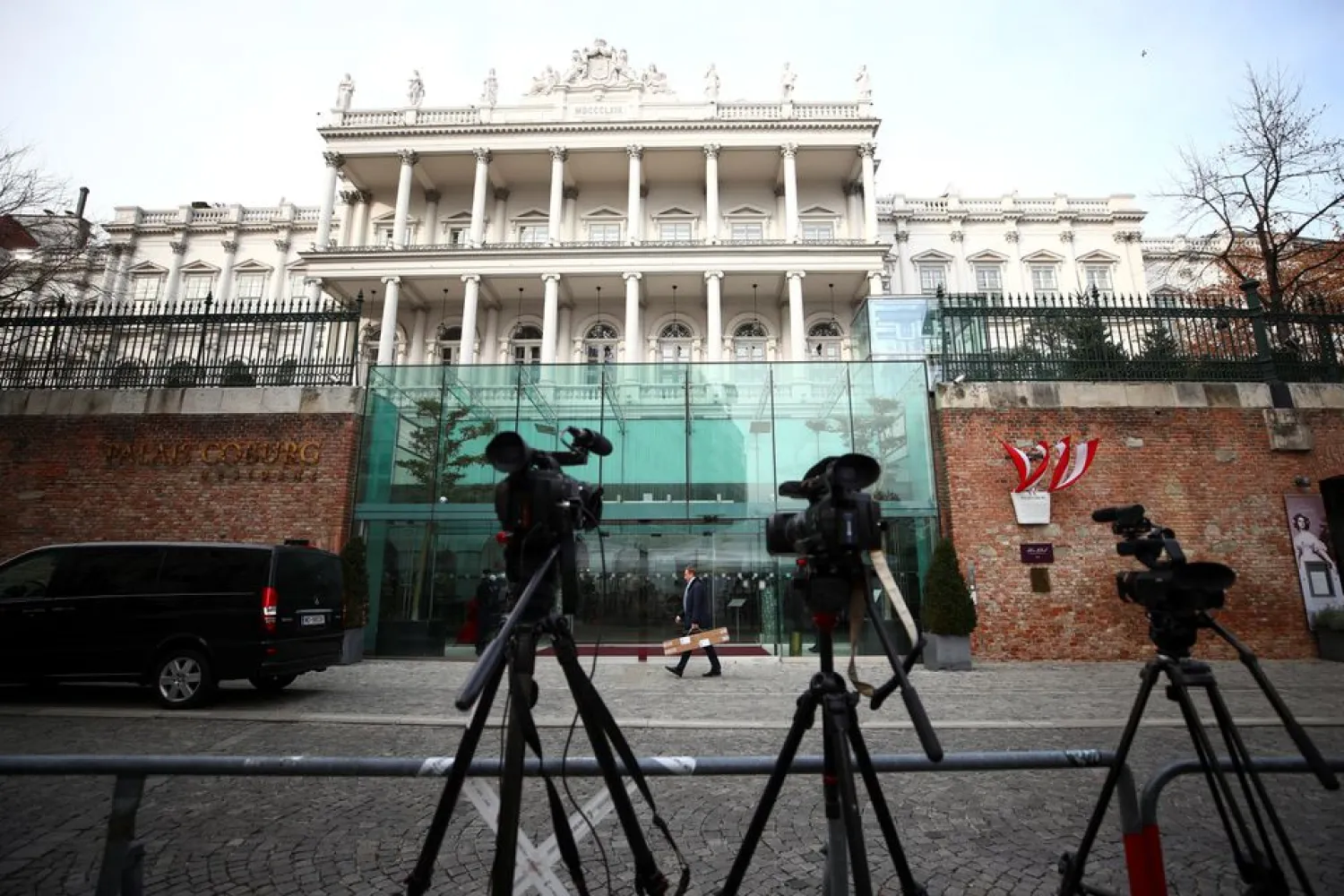
Cameras stand outside Palais Coburg, the site of a meeting of the Joint Comprehensive Plan of Action (JCPOA), in Vienna, Austria, November 29, 2021. (Reuters)
TT

Iran Nuclear Deal Talks Resume, Chair Feels 'Positive'

Cameras stand outside Palais Coburg, the site of a meeting of the Joint Comprehensive Plan of Action (JCPOA), in Vienna, Austria, November 29, 2021. (Reuters)

Negotiators in Vienna resumed talks Monday over reviving Iran’s 2015 nuclear deal with world powers, with the United States taking part at arms length as in previous rounds since the Trump administration pulled out of the accord three years ago.

Hopes of quick progress were muted after a hard-line new government in Tehran led to a more than five-month hiatus in negotiations. But the European Union official chairing the talks sounded an upbeat note after the first meeting concluded.

“I feel positive that we can be doing important things for the next weeks,” EU diplomat Enrique Mora told reporters.

All participants had shown a willingness to listen to the positions and “sensibilities” of the new Iranian delegation, Mora said. At the same time, Tehran's team made clear it wanted to engage in “serious work” to bring the accord back to life, he said.

The remaining signatories to the nuclear deal formally known as the Joint Comprehensive Plan of Action — Iran, Russia, China, France, Germany and Britain — convened at the Palais Coburg, a luxury hotel where the agreement was signed six years ago.

A US delegation headed by the Biden administration's special envoy for Iran, Robert Malley, was staying at a nearby hotel where it was being briefed on the talks by diplomats from the other countries.

President Joe Biden has signaled he wants to rejoin the talks. The last round, aimed at bringing Iran back into compliance with the agreement and paving the way for the US to rejoin, was held in June.

“There is a sense of urgency in putting an end to the suffering of the Iranian people,” said Mora, referring to the crippling sanctions the US re-imposed on Iran when it quit the accord.

“And there is a sense of urgency in putting the Iranian nuclear program under the transparent monitoring of the international community,” he said.

“What has been the norm over the first six rounds will be again the practice in this seventh round,” Mora added. “Nothing new on working methods.”

The United States left the deal under then-President Donald Trump’s “maximum pressure” campaign against Tehran in 2018.

The nuclear deal saw Iran limit its enrichment of uranium in exchange for the lifting of economic sanctions. Since the deal's collapse, Iran now enriches small amounts of uranium up to 60% purity — a short step from weapons-grade levels of 90%. Iran also spins advanced centrifuges barred by the accord and its uranium stockpile now far exceeds the accord’s limits.

Iran maintains its atomic program is peaceful. However, US intelligence agencies and international inspectors say Iran had an organized nuclear weapons program up until 2003. Nonproliferation experts fear the brinkmanship could push Tehran toward even more extreme measures to try to force the West to lift sanctions.

Making matters more difficult, United Nations nuclear inspectors remain unable to fully monitor Iran's program after Tehran limited their access. A trip to Iran last week by the head of the International Atomic Energy Agency, Rafael Grossi, failed to make any progress on that issue.

Russia’s top representative, Mikhail Ulyanov, said he held “useful” informal consultations with officials from Iran and China on Sunday. That meeting, he said, was aimed at “better understanding ... the updated negotiating position of Tehran.“ He tweeted a picture of a meeting Monday he described as a preparatory session with members before Iran joined the discussions.

A delegation appointed by new Iranian President Ebrahim Raisi is joining the negotiations for the first time. Iran has made maximalist demands, including calls for the US to unfreeze $10 billion in assets as an initial goodwill gesture, a tough line that might be an opening gambit.

Ali Bagheri, an Iranian nuclear negotiator, told Iranian state television late Sunday Tehran “has entered the talks with serious willpower and strong preparation.” However, he cautioned that “we cannot anticipate a timeframe on the length of these talks now.”

Iranian Foreign Ministry spokesman Saeed Khatibzadeh, meanwhile, suggested Monday that the US could “receive a ticket for returning to the room” of the nuclear talks if it agrees to “the real lifting of sanctions.” He also criticized a recent opinion piece written by the foreign ministers of Britain and Israel that pledged to “work night and day to prevent the Iranian regime from ever becoming a nuclear power.”

Israeli Prime Minister Naftali Bennett, in a video address delivered to nations negotiating in Vienna, warned that he saw Iran trying to “end sanctions in exchange for almost nothing.”

“Iran deserves no rewards, no bargain deals and no sanctions relief in return for their brutality," Bennett said in the video that he later posted to Twitter. "I call upon our allies around the world: Do not give in to Iran’s nuclear blackmail.”

British Foreign Secretary Liz Truss called the meeting “the last opportunity for the Iranians to come to the table" after a meeting with Israeli Foreign Minister Yair Lapid.

“We want those talks to work,” Truss said. “But if they don’t work, all options are on the table.”

In an interview with NPR broadcast Friday, US negotiator Malley said signs from Iran “are not particularly encouraging.”

Russia’s Ulyanov said there’s pressure to get the process moving after “a very protracted pause.”

“The talks can’t last forever,” he tweeted on Sunday. “There is the obvious need to speed up the process.”

Mora, the EU official, said participants in Monday's meeting had agreed on a plan of work for the coming days. Diplomats planned to discuss the issue of sanctions on Tuesday, followed by a meeting on Iran's nuclear commitments Wednesday.



US Judge Blocks Deportation of Columbia University Palestinian Activist

Mohsen Mahdawi at a press conference in Vermont last year - Photo by Alex Driehaus/AP
TT

US Judge Blocks Deportation of Columbia University Palestinian Activist

Mohsen Mahdawi at a press conference in Vermont last year - Photo by Alex Driehaus/AP

A US immigration judge has blocked the deportation of a Palestinian graduate student who helped organize protests at Columbia University against Israel's war in Gaza, according to US media reports.

Mohsen Mahdawi was arrested by immigration agents last year as he was attending an interview to become a US citizen.

Mahdawi had been involved in a wave of demonstrations that gripped several major US university campuses since Israel began a massive military campaign in the Gaza Strip.

A Palestinian born in the occupied West Bank, Mahdawi has been a legal US permanent resident since 2015 and graduated from the prestigious New York university in May. He has been free from federal custody since April.

In an order made public on Tuesday, Judge Nina Froes said that President Donald Trump's administration did not provide sufficient evidence that Mahdawi could be legally removed from the United States, multiple media outlets reported.

Froes reportedly questioned the authenticity of a copy of a document purportedly signed by Secretary of State Marco Rubio that said Mahdawi's activism "could undermine the Middle East peace process by reinforcing antisemitic sentiment," according to the New York Times.

Rubio has argued that federal law grants him the authority to summarily revoke visas and deport migrants who pose threats to US foreign policy.

The Trump administration can still appeal the decision, which marked a setback in the Republican president's efforts to crack down on pro-Palestinian campus activists.

The administration has also attempted to deport Mahmoud Khalil, another student activist who co-founded a Palestinian student group at Columbia, alongside Mahdawi.

"I am grateful to the court for honoring the rule of law and holding the line against the government's attempts to trample on due process," Mahdawi said in a statement released by his attorneys and published Tuesday by several media outlets.

"This decision is an important step towards upholding what fear tried to destroy: the right to speak for peace and justice."


Fire Breaks out Near Iran's Capital Tehran, State Media Says

Smoke rises from a fire caused by an explosion in Tehran (File photo - Reuters)
TT

Fire Breaks out Near Iran's Capital Tehran, State Media Says

Smoke rises from a fire caused by an explosion in Tehran (File photo - Reuters)

A fire broke out in Iran's Parand near the capital city Tehran, state media reported on Wednesday, publishing videos of smoke rising over the area which is close to several military and strategic sites in the country's Tehran province, Reuters reported.

"The black smoke seen near the city of Parand is the result of a fire in the reeds around the Parand river bank... fire fighters are on site and the fire extinguishing operation is underway", state media cited the Parand fire department as saying.


Pakistan PM Sharif to Seek Clarity on Troops for Gaza in US Visit

US President Donald Trump looks at Pakistan's Prime Minister Shehbaz Sharif speaking following the official signing of the first phase of the Gaza ceasefire agreement between Israel and Hamas, during a world leaders' summit on ending the Gaza war, in Sharm El-Sheikh, Egypt, October 13, 2025. REUTERS/Evelyn Hockstein/File Photo
TT

Pakistan PM Sharif to Seek Clarity on Troops for Gaza in US Visit

US President Donald Trump looks at Pakistan's Prime Minister Shehbaz Sharif speaking following the official signing of the first phase of the Gaza ceasefire agreement between Israel and Hamas, during a world leaders' summit on ending the Gaza war, in Sharm El-Sheikh, Egypt, October 13, 2025. REUTERS/Evelyn Hockstein/File Photo

Before Pakistan commits to sending troops to Gaza as part of the International Stabilization Force it wants assurances from the United States that it will be a peacekeeping mission rather than tasked with disarming Hamas, three sources told Reuters.

Pakistan's Prime Minister Shehbaz Sharif is set to attend the first formal meeting of President Donald Trump's Board of Peace in Washington on Thursday, alongside delegations from at least 20 countries.

Trump, who will chair the meeting, is expected to announce a multi-billion dollar reconstruction plan for Gaza and detail plans for a UN-authorized stabilization force for the Palestinian enclave.

Three government sources said during the Washington visit Sharif wanted to better understand the goal of the ISF, what authority they were operating under and what the chain of command was before making a decision on deploying troops.

"We are ready to send troops. Let me make it clear that our troops could only be part of a peace mission in Gaza," said one of the sources, a close aide of Sharif.

"We will not be part of any other role, such as disarming Hamas. It is out of the question," he said.

Analysts say Pakistan would be an asset to the multinational force, with its experienced military that has gone to war with arch-rival India and tackled insurgencies.

"We can send initially a couple of thousand troops anytime, but we need to know what role they are going to play," the source added.

Two of the sources said it was likely Sharif, who has met Trump earlier this year in Davos and late last year at the White House, would either have an audience with him on the sidelines of the meeting or the following day at the White House.

Initially designed to cement Gaza's ceasefire, Trump sees the Board of Peace, launched in late January, taking a wider role in resolving global conflicts. Some countries have reacted cautiously, fearing it could become a rival to the United Nations.

While Pakistan has supported the establishment of the board, it has voiced concerns against the mission to demilitarize Gaza's militant group Hamas.