


Barbados Says Goodbye to Queen, Transforms Into Republic

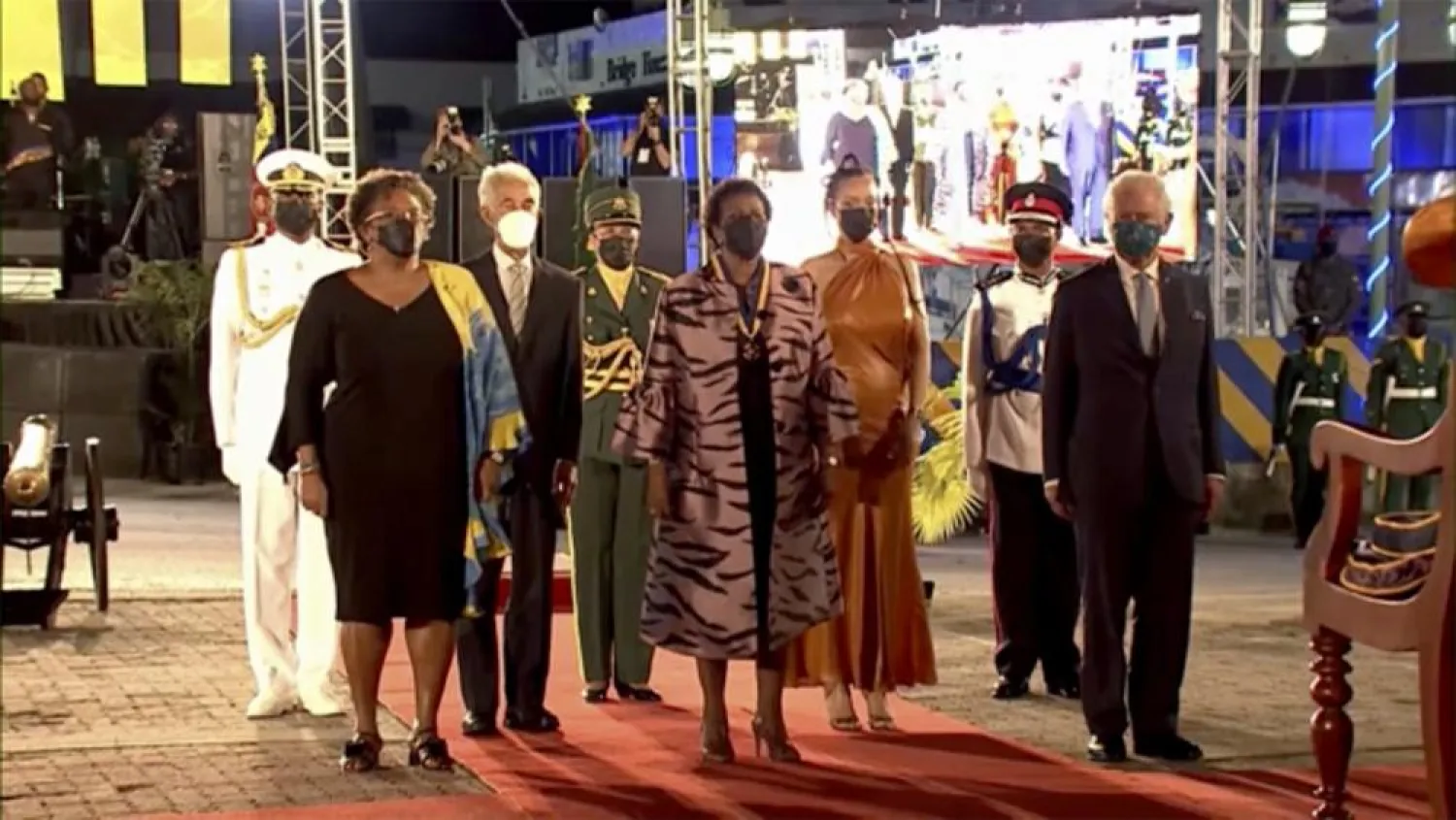
In this image made from video provided by Prime Minister's office, Barbados' Prime Minister Mia Mottley, left, former cricketer Garfield Sobers, center left, President Sandra Mason, center, singer Rihanna Fenty, center right, and Prince Charles, right, attend the presidential inauguration ceremony in Bridgetown, Barbados on Tuesday Nov. 30, 2021. (Prime Minister's Office via AP)
TT

Barbados Says Goodbye to Queen, Transforms Into Republic

In this image made from video provided by Prime Minister's office, Barbados' Prime Minister Mia Mottley, left, former cricketer Garfield Sobers, center left, President Sandra Mason, center, singer Rihanna Fenty, center right, and Prince Charles, right, attend the presidential inauguration ceremony in Bridgetown, Barbados on Tuesday Nov. 30, 2021. (Prime Minister's Office via AP)

Barbados stopped pledging allegiance to Queen Elizabeth II on Tuesday as it shed another vestige of its colonial past and became a republic for the first time in history.

Several leaders and dignitaries, including Prince Charles, attended the ceremony that began late Monday in a popular square where the statue of a well-known British lord was removed last year amid a worldwide push to erase symbols of oppression, The Associated Press said.

Fireworks peppered the sky at midnight as Barbados officially became a republic, with screens set up across the island so people could watch the event that featured an orchestra with more than 100 steel pan players and numerous artists. It was also broadcast online, prompting a flurry of excited messages from Bajans living in the US, Canada and beyond.

“Happy Independence Day and freedom to all,” wrote one viewer.

The drive to become a republic began more than two decades ago and culminated with the island’s Parliament electing its first ever president last month in a two-thirds majority vote. Barbados Governor General Sandra Mason was scheduled to be sworn in before dawn on Tuesday as the island marked its 55th independence from Britain.

Mason, 72, is an attorney and judge who also has served as ambassador to Venezuela, Colombia, Chile and Brazil. She will help Prime Minister Mia Mottley lead the wealthy Caribbean island of more than 300,000 people that is dependent on tourism, manufacturing and finance.

Barbados did not need permission from the UK to become a republic, although the island will remain a member of the Commonwealth Realm. It’s an event that the Caribbean has not experienced since the 1970s, when Guyana, Dominica and Trinidad and Tobago became republics.

Barbados became independent from the United Kingdom in November 1966, more than three centuries after English settlers arrived and turned the island into a wealthy sugar colony based on the work of hundreds of thousands of African slaves.

In recent decades, the island has begun distancing itself from its colonial past. In 2005, Barbados dropped the London-based Privy Council and chose the Trinidad-based Caribbean Court of Justice as its final court of appeal. Then in 2008, it proposed a referendum on the issue of becoming a republic, but it was pushed back indefinitely.

Last year, Barbados announced plans to stop being a constitutional monarchy and removed a statue of British Vice-Admiral Horatio Nelson from National Heroes Square, the location of the event to celebrate becoming a republic.

Barbados’ flag, coat of arms and national anthem will remain the same, but certain references will change, according to Suleiman Bulbulia, a columnist for the Barbados Today newspaper. He wrote that the terms “royal” and “crown” will no longer be used, so the Royal Barbados Police Force will become the Barbados Police Service and “crown lands” will become “state lands.”

“It is the beginning of a new era,” he wrote. “Any Barbadian can aspire now to be our Head of State.”



Trump Says Iran Wants Deal, US ‘Armada’ Larger Than in Venezuela Raid

US President Donald Trump signs executive orders in the Oval Office at the White House, Washington, DC, USA, 30 January 2026. (EPA)
TT

Trump Says Iran Wants Deal, US ‘Armada’ Larger Than in Venezuela Raid

US President Donald Trump signs executive orders in the Oval Office at the White House, Washington, DC, USA, 30 January 2026. (EPA)

President Donald Trump said Thursday he believed Tehran wanted to make a deal to avoid military action, adding that the US "armada" near Iran was bigger than the one he dispatched to topple Venezuela's leader.

"We have a large armada, flotilla, call it whatever you want, heading toward Iran right now, even larger than what we had in Venezuela," the Republican president told reporters in the Oval Office.

"Hopefully we'll make a deal. If we do make a deal, that's good. If we don't make a deal, we'll see what happens."

Asked if he had given Iran a deadline to make a deal on its nuclear program, ballistic missiles and other issues, Trump said "yeah I have" but added that "only they know for sure" what it was.

Trump, however, cited what he said was Iran's decision to halt executions of protesters -- after a crackdown in which rights groups say more than 6,000 people were killed -- as evidence to show Tehran was ready to comply.

"I can say this, they do want to make a deal," Trump said.

Trump declined to say whether, if Iran did not reach a deal, he planned a repeat of the dramatic operation in Venezuela in which US forces captured president Nicolas Maduro.

"I don't want to talk about anything having to do with what I'm doing militarily," he said.


‘He Probably Would’ve Survived’: Iran Targeting Hospitals in Crackdown

A bus burned during protests on a street in Tehran, Iran, January 16, 2026. Majid Asgaripour/WANA (West Asia News Agency) via Reuters
TT

‘He Probably Would’ve Survived’: Iran Targeting Hospitals in Crackdown

A bus burned during protests on a street in Tehran, Iran, January 16, 2026. Majid Asgaripour/WANA (West Asia News Agency) via Reuters

Hospitals are no longer places of safety as Iran's crackdown on anti-government protests impacts all aspects of life, rights groups say, with authorities arresting wounded protesters and even the medics who treat them.

Activists accuse security forces of killing thousands of people and wounding more by directly firing on protests, often with birdshot that can leave metal pellets lodged in the body until hygienically extracted by a professional.

But rights groups say authorities have raided hospitals searching for people with wounds that suggest they were involved in protests. At least five doctors have meanwhile been arrested for treating them, according to the World Health Organization.

Amnesty International said security forces had "arrested protesters receiving treatment in hospitals", adding it had received information that medical staff in central Isfahan province had been ordered to notify authorities about patients with injuries from gunshots and shotgun pellets.

The New York-based Center for Human Rights in Iran (CHRI) said it "has documented cases in which security forces raided hospitals to identify and arrest protesters injured during demonstrations".

In apparent response to the charges, Iran's health ministry this week urged those injured in the protests to go to hospital.

"Our advice to the public is that if they suffer any kind of injury, they should not try to treat it at home, and they should not worry about going to medical centers," the health ministry said, in a statement carried by state television.

- 'Raiding medical facilities' -

Sajad Rahimi, 36, from Iran's Gulf island of Qeshm, was badly wounded after security forces shot at him when he joined a protest in the southern province of Fars at the peak of the movement on January 9, according to Norway-based NGO Iran Human Rights.

But fearing he could be shot dead by security forces in a "coup de grace", he asked friends not to take him directly to hospital, said IHR, which has investigated this and several other cases and spoke to the man's brother.

Eventually, the family transferred him to hospital, but he died as a result of a deep wound caused by live ammunition and severe bleeding.

"The doctor said that if he had arrived at the hospital just ten minutes earlier, he would probably have survived," his brother told IHR.

The group said it had reports of "security forces raiding certain medical facilities and informal shelters for the wounded in order to arrest medical staff and volunteer first responders".

The Hengaw rights group, also based in Norway, highlighted the case of Dr Ali Reza Golchni, a physician from the city of Qazvin, northwest of Tehran, who it said had been arrested "for providing medical care to injured protesters".

- 'Grave violations' -

World Health Organization director general Tedros Adhanom Ghebreyesus said he was "deeply concerned by multiple reports of health personnel and medical facilities in Iran being impacted by the recent insecurity, and prevented from delivering their essential services to people requiring care".

He said there were reports of "at least five doctors detained, while treating injured patients".

The World Medical Association (WMA) said it had received reports that security forces arrested injured protesters in both the Isfahan and the southwestern province of Chaharmahal-and-Bakhtiari.

"Hospital staff have also been instructed to report patients suffering gunfire injuries to security authorities, with non-compliance exposing them to prosecution and other reprisals," it said, citing information received by the WMA.

Hengaw also cited the case of Taher Malekshahi, a 12-year-old Kurdish-Iranian boy from Qorveh in western Iran who was severely injured after being shot in the face and eyes with pellet ammunition.

It said he lost one eye and suffered serious damage to the other, publishing a picture of his face with the boy's entire forehead pock-marked with pellet wounds.

It said while he was currently receiving intensive medical treatment in Tehran, "authorities have pressured his family to falsely claim he was wounded by 'terrorists' in exchange for state recognition as a war-disabled victim."


Guterres Warns of UN’s ‘Imminent Financial Collapse’

 United Nations Secretary-General Antonio Guterres speaks during a press conference outlining his priorities for 2026 at UN headquarters in New York City, US, January 29, 2026. (Reuters)
United Nations Secretary-General Antonio Guterres speaks during a press conference outlining his priorities for 2026 at UN headquarters in New York City, US, January 29, 2026. (Reuters)
TT

Guterres Warns of UN’s ‘Imminent Financial Collapse’

 United Nations Secretary-General Antonio Guterres speaks during a press conference outlining his priorities for 2026 at UN headquarters in New York City, US, January 29, 2026. (Reuters)
United Nations Secretary-General Antonio Guterres speaks during a press conference outlining his priorities for 2026 at UN headquarters in New York City, US, January 29, 2026. (Reuters)

The UN chief has told member states that the organization is at risk of "imminent financial collapse", citing unpaid fees and a budget rule that forces the global body to return unspent money, a letter seen by Reuters on Friday showed.

UN Secretary-General Antonio Guterres has repeatedly spoken about the organization's worsening liquidity crisis, but this is his starkest warning yet, and it comes as its main contributor the United States is retreating from multilateralism on numerous fronts.

"The crisis is deepening, threatening program delivery and risking financial collapse. ‌And the situation ‌will deteriorate further in the near future," Guterres wrote ‌in ⁠a letter ‌to ambassadors dated January 28.

The US has slashed voluntary funding to UN agencies and refused to make mandatory payments to its regular and peacekeeping budgets. US President Donald Trump has described the UN as having "great potential" but said it is not fulfilling that, and he has launched a Board of Peace which some fear could undermine the older international body.

Founded in 1945, the UN has 193 member states and works to maintain ⁠international peace and security, promote human rights, foster social and economic development, and coordinate humanitarian aid.

In his letter, Guterres ‌said "decisions not to honor assessed contributions that finance a ‍significant share of the approved regular ‍budget have now been formally announced."

He did not say which state or ‍states he was referring to, and a UN spokesperson was not immediately available for comment.

'KAFKAESQUE CYCLE'

Under UN rules, contributions depend on the size of the economy of each member state. The US accounts for 22% of the core budget followed by China with 20%.

But by the end of 2025 there was a record $1.57 billion in outstanding dues, Guterres said, without naming them.

“Either all Member States honor their ⁠obligations to pay in full and on time – or Member States must fundamentally overhaul our financial rules to prevent an imminent financial collapse," he said.

Guterres launched a reform task force last year, known as UN80, which seeks to cut costs and improve efficiency. To that end, states agreed to cut the 2026 budget by around 7% to $3.45 billion.

Still, Guterres warned in the letter that the organization could run out of cash by July.

One of the problems is a rule now seen as antiquated whereby the global body has to credit back hundreds of millions of dollars in unspent dues to states each year.

"In other words, we are trapped in a Kafkaesque cycle expected ‌to give back cash that does not exist," said Guterres, referring to author Franz Kafka who wrote about oppressive bureaucratic processes.