

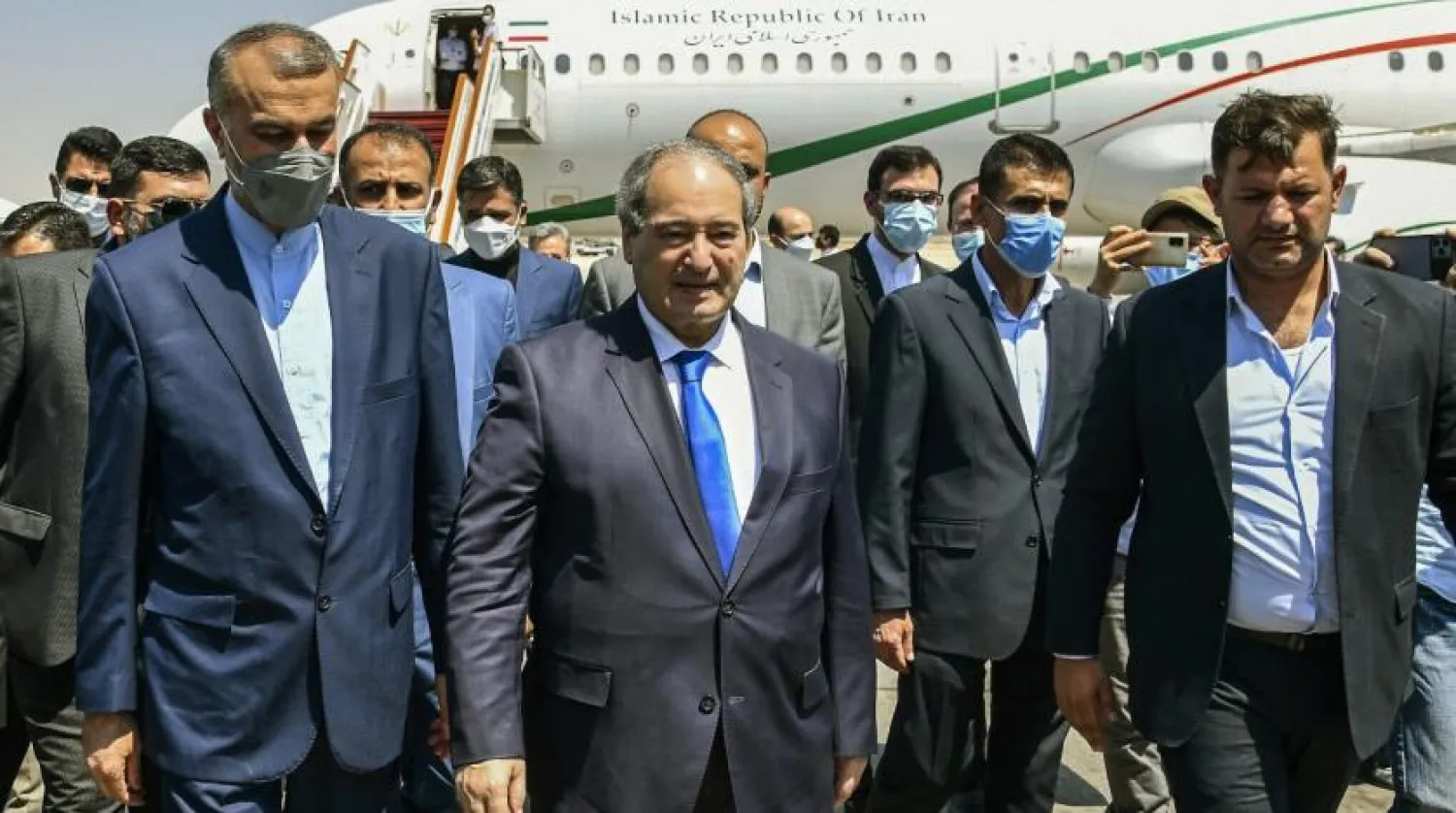

Syrian Foreign Minister Visits Tehran

Syria's Foreign Minister Faisal al-Mekdad, with Iran's Foreign Minister Hossein Amir-Abdollahian. (SANA)
TT

Syrian Foreign Minister Visits Tehran

Syria's Foreign Minister Faisal al-Mekdad, with Iran's Foreign Minister Hossein Amir-Abdollahian. (SANA)

Syria's Foreign Minister Faisal al-Mekdad arrived in Tehran on Sunday for a two-day visit at the invitation of his Iranian counterpart Hossein Amir-Abdollahian.

The visit aims to boost strategic relations between the two countries, according to Syria's al-Watan newspaper.

Deputy Foreign Minister Bashar al-Jaafari is accompanying Mekdad, who is heading an official delegation, on the trip.

The visit comes days after Damascus received an Iranian economic delegation headed by the Iranian Minister of Industry, Mine, and Trade Reza Fatemi Amin.

The delegation met several senior officials in Damascus at the opening of the exhibition of Iranian products and services in the capital.

They also launched the Syrian-Iranian Investment Forum last week, in conjunction with the announcement of a joint bank to facilitate trade and financial exchange between the two countries.

The Syrian-Iranian economic and diplomatic activity witnessed a remarkable increase, with the gradual return of Arab economic-diplomatic relations, especially from the United Arab Emirates.

Last week, Damascus hosted its first Arab economic conference since the outbreak of the Syrian conflict in 2011.

Iran's state-owned IRNA reported that the UAE's National Security Adviser, Tahnoun bin Zayed Al Nahyan, will visit Iran Monday at the invitation of the Secretary of the Supreme National Security Council Ali Shamkhani to discuss expanding bilateral ties.



Flooding in Southern China Has Killed 39 People

In this photo released by Xinhua News Agency, rescuers evacuate stranded residents in the aftermath of tropical storm Maysak in Qinzhou City, south China's Guangxi Zhuang Autonomous Region Tuesday, July 7, 2026. (Zhang Ailin/Xinhua via AP)
TT

Flooding in Southern China Has Killed 39 People

In this photo released by Xinhua News Agency, rescuers evacuate stranded residents in the aftermath of tropical storm Maysak in Qinzhou City, south China's Guangxi Zhuang Autonomous Region Tuesday, July 7, 2026. (Zhang Ailin/Xinhua via AP)

Authorities in southern China said Thursday that 39 people have died in flooding from Tropical Storm Maysak, as Taiwan and China's east coast braced for another major storm expected to make landfall in the coming days.

Most of the deaths were related to the breach of a dam in an area east of the city of Nanning, which claimed 26 lives, said Ding Wei, the city's vice mayor, at a news briefing. Nine people remained missing in the broader Guangxi region.

Maysak brought record rainfall to Guangxi starting Saturday, breaching reservoirs and stranding people for days in homes and other buildings. The previously announced death toll was six people.

Typhoon Bavi is forecast to pass just north of Taiwan, bringing heavy rain to the island of 23 million people, and make landfall in Zhejiang or Fujian province on Saturday.

Heavy rain battered southern Guangxi for days, with cumulative rainfall of 10 to 40 centimeters (4 to 16 inches) in some areas and more than 90 centimeters (35 inches) in hard-hit areas, the national meteorological center said.

The reservoir breaches sent torrents of water into towns and cities, The Associated Press reported.

Drones and some 5,700 boats have been used in a massive relief and rescue operation to reach people trapped by the waters, with rescuers battling stiff currents and debris to try to reach people. About 130,000 people have been evacuated.

Ding said the floodwaters are receding but more rain is expected in some areas in the next two days. Crews have been deployed to clear mud and debris and disinfect several towns in hard-hit Hengzhou city, which is east of Nanning and under its jurisdiction.

Road repairs are ongoing and electricity has been restored to more than 60,000 homes, Ding said.


US, Iran Trade New Strikes in Fight Over Hormuz Strait

Smoke rises from explosions at an unknown location, following what US Central Command (CENTCOM) said were strikes on Iranian military targets, in this screen grab from a video released on July 8, 2026. (US Central Command/Handout via Reuters)
TT

US, Iran Trade New Strikes in Fight Over Hormuz Strait

Smoke rises from explosions at an unknown location, following what US Central Command (CENTCOM) said were strikes on Iranian military targets, in this screen grab from a video released on July 8, 2026. (US Central Command/Handout via Reuters)

The United States and Iran traded strikes on Thursday for the second day running as Washington and Tehran battled over the strategic Strait of Hormuz.

The vital oil shipping corridor is a flashpoint in the Middle East war, with Tehran insisting on control of the strait despite it being open to free passage before the US-Israeli attacks in February.

After the foes traded attacks on Wednesday, US President Donald Trump said the ceasefire with Iran was "over", but left the door open to more talks and added any strikes would end quickly.

US forces said the latest attacks against Iran were aimed at "their ability to threaten the freedom of navigation in the Strait of Hormuz", citing recent strikes against commercial ships in the waterway.

The US Central Command said they had struck approximately 90 military targets, including missile and drone storage as well as military logistics sites along Iran's coastline.

Iran's reprisals came quickly, with the Revolutionary Guards (IRGC) saying they had struck "key infrastructure and facilities" at US bases in the region.

American strikes hit a railway bridge in Iran's northeast, according to several official media, and the official IRNA news agency reported strikes on a military base in coastal Bushehr, which hosts the nation's only civilian nuclear power plant.

Earlier, warplanes were heard over Iran's Kish Island and explosions rocked the port cities of Bandar Abbas, Konarak and Chabahar, part of which lost electricity, IRNA reported.

"This is in retribution for yesterday's bombing of ships by Iran," Trump said in a post on Truth Social on Wednesday. "If it happens again, it will get much worse!"

Late on Wednesday while speaking to reporters aboard Air Force One, Trump said the Iranian side had "called a little while ago," and that they wanted "to make a deal so badly".

Trump did not provide further details of the call -- including who was on the line -- but went on to cast doubt over the value of any deal, calling the Iranians "sort of crazy".

- Control over the strait -

Iran's chief negotiator said Thursday that the Strait of Hormuz would be opened only under "Iranian arrangements".

"The United States still has not learned that bullying and breaking its promises no longer come without consequences," Mohammad Bagher Ghalibaf said on X. "Let me be clear: If you strike, you will be struck."

Since US-Israeli strikes triggered war in February, Tehran has insisted on controlling the strait, saying it will charge fees for passage and threatening to hit vessels that deviate from its authorized route.

Its military struck at least three ships in recent days, prompting extensive US strikes against Iranian targets on Tuesday.

The latest strikes come just ahead of the Thursday burial of Ali Khamenei, Iran's former supreme leader, who was killed at the outbreak of the war on February 28.

UN chief Antonio Guterres called meanwhile "on all parties to exercise maximum restraint" -- as did Pakistan, a key mediator in the US-Iran talks.

Iran said Foreign Minister Abbas Araghchi and Qatar's prime minister had spoken over the phone on Wednesday and "underscored the importance of using diplomatic means to resolve regional issues".

Both the United States and Iran said they had hit dozens of targets in the initial wave of attacks, which Iranian state television said had killed eight Iranian military personnel.

CENTCOM said its forces struck more than 80 targets on Tuesday, while the Guards said they hit dozens of US military facilities in Kuwait and Bahrain.

The latest attacks by Iran did not result in any American casualties or cause major damage to facilities, a US military official said on Wednesday.

Washington wants free passage for ships while Iran is insisting on fees and has refused to allow vessels to pass through Omani waters.

All three vessels recently struck were sailing close to Oman, which had proposed a temporary transit corridor hugging its coastline.

Maritime traffic had tentatively resumed after Washington and Tehran signed the deal to end hostilities last month.

But almost 6,000 seafarers remain stranded in the area, International Maritime Organization chief Arsenio Dominguez said Wednesday.


Trump Says the US Will Give License to Ukraine to Produce Patriot Defense Systems

US President Donald Trump meets with Ukraine's President Volodymyr Zelenskyy on the sidelines of the NATO summit in Ankara, Türkiye, Wednesday, July 8, 2026. (AP)
TT

Trump Says the US Will Give License to Ukraine to Produce Patriot Defense Systems

US President Donald Trump meets with Ukraine's President Volodymyr Zelenskyy on the sidelines of the NATO summit in Ankara, Türkiye, Wednesday, July 8, 2026. (AP)

President Donald Trump said Wednesday that the US will give a license to Ukraine to manufacture Patriot air defense systems to help counter Russian missile attacks, a huge coup for Ukraine which has badly needed the technology for the war now in its fifth year.

“We’ll give them the right to make Patriots. We’ll show them how to do it,” Trump said as he met with Ukrainian President Volodymyr Zelenskyy at a NATO summit in Türkiye. “I think they can produce them pretty quickly.”

Patriots are expensive, in high demand and take a long time to produce. Zelenskyy has for years been asking for more of them, and more recently for a license so that Ukraine can manufacture its own.

The tone of Trump's meeting with the Ukrainian leader was a break from earlier encounters which ended in acrimony, and Trump praised Zelenskyy's willingness to reach a deal on ending the fighting in Ukraine.

He said the Ukrainian president has “done an amazing job” and “been very effective” in the war.

“We’ve actually developed a good relationship. It’s hard to believe,” Trump said, adding he believed a deal on ending the war was on the horizon and that the US would “work on some kind of security package” to provide to Ukraine.

Trump takes aim at NATO partners

Trump wasn't as friendly with some of his NATO partners, saying he was unhappy with the alliance for pushing back against his efforts to take control of Greenland and for not supporting his war in Iran.

NATO's European members plus Canada have scrambled to meet the increased defense spending targets Trump has demanded, as the US draws down the number of troops it has in Europe and insists the continent take more responsibility for its own security.

But Trump reopened old wounds as he arrived at the meeting of 32 NATO leaders by insisting again that the United States should control Greenland, a semiautonomous Danish territory. He blasted some European countries for refusing to participate in the Iran campaign, singling out Spain as “a terrible partner in NATO” and renewing his threats to cut off trade.

Ahead of the summit, Trump said Greenland “is very important” for the US but not for Denmark, declaring, “We need it for protection of the world, not just the United States.”

But Denmark's Prime Minister Mette Frederiksen said her country is “ready to defend every inch of NATO including our own territory” in the event of an attack, and would rely on NATO allies to honor their commitment to defend each other.

Trump’s criticisms have in the past drawn European countries closer together as they confront wars in Ukraine and Iran, a ballooning trade deficit with China, and threats from Russia.

The president's renewed interest in Greenland could put at risk the entire future of NATO, which was founded in 1949 to counter the threat to European security posed by the Soviet Union during the Cold War.

NATO Secretary-General Mark Rutte sought to tamp down the president's ire by giving him credit for recent increases in defense spending from NATO allies.

“Grab the win. It’s there,” Rutte told Trump on Wednesday.

NATO chief backs latest US strikes on Iran

Ahead of the summit, Rutte praised Trump for the series of US strikes on Iran overnight, after Tehran struck three merchant ships in the Strait of Hormuz.

“I think what you did last night was absolutely necessary,” Rutte said to Trump. “It was a very strong response, and I’m with you on this.”

The US strikes, as well as the revoking of a license allowing Iran to sell its oil on global markets, underscored the fragility of an interim deal to end months of fighting.

Trump said of the interim agreement with Iran: “For me, I think it’s over” — but added he will allow talks to continue.

“It’s just a waste of time dealing with them,” he said.

NATO leaders sought to show Trump they were boosting defense

Rutte has dedicated a huge amount of energy to keeping Trump's support for NATO and to holding the summit together.

The NATO chief pointed to countries including Estonia, Latvia, Poland and Denmark that are investing more in defense, but noted the Trump administration expects “the Europeans and Canadians will equalize their spending with the United States.”

Last month Rutte went to Washington to hail the “Trump Trillion” — the $1.2 trillion that European allies and Canada have added to defense spending since Trump came to power in 2017.

As leaders converged on Ankara, Rutte hosted a “big reveal” event to showcase the many deals planned for the increased spending — much of it to be spent on US companies, creating thousands of jobs for Americans.

At last year's summit, the allies agreed to invest 5% of their gross domestic product on defense — 3.5% on their defense budgets and 1.5% on infrastructure so troops and equipment can move faster in times of conflict.

Yet figures released by NATO on Tuesday showed that Slovenia, Belgium, Spain and the Czech Republic have struggled to meet the alliance’s old spending target of 2% of GDP.

The Trump administration wants to see a leaner “NATO 3.0,” with Europe taking responsibility for its own security, including Ukraine, with conventional weapons while America would continue to provide its nuclear umbrella.

The Pentagon has launched a six-month review of US military presence in Europe, leaving allies to seek clarity on just how deeply Trump intends to cut US force numbers.

Zelenskyy pushes for NATO entry

Zelenskyy made a fresh appeal Tuesday for Ukraine to be allowed to join the alliance, saying Ukrainian armed forces are highly experienced and would only boost NATO’s defense capabilities.

He's highlighted Ukraine’s adaptability and its ability to strike deep inside Russia. He said Ukraine’s armed forces are “eliminating” on average 30,000 Russian troops every month.

In a declaration following Wednesday's summit, NATO leaders pledged to provide Ukraine with $80 billion to help meet its defense needs this year and next, noting “the long-term threat Russia poses to Euro-Atlantic security.”

Concern has been mounting among some countries with borders near Russia that Moscow might be preparing a hybrid attack — a combination of conventional warfare with tactics like cyberattacks — on the continent as President Vladimir Putin struggles to secure victory in Ukraine.