


US Seizes Iranian Arms Destined for Yemen’s Houthis

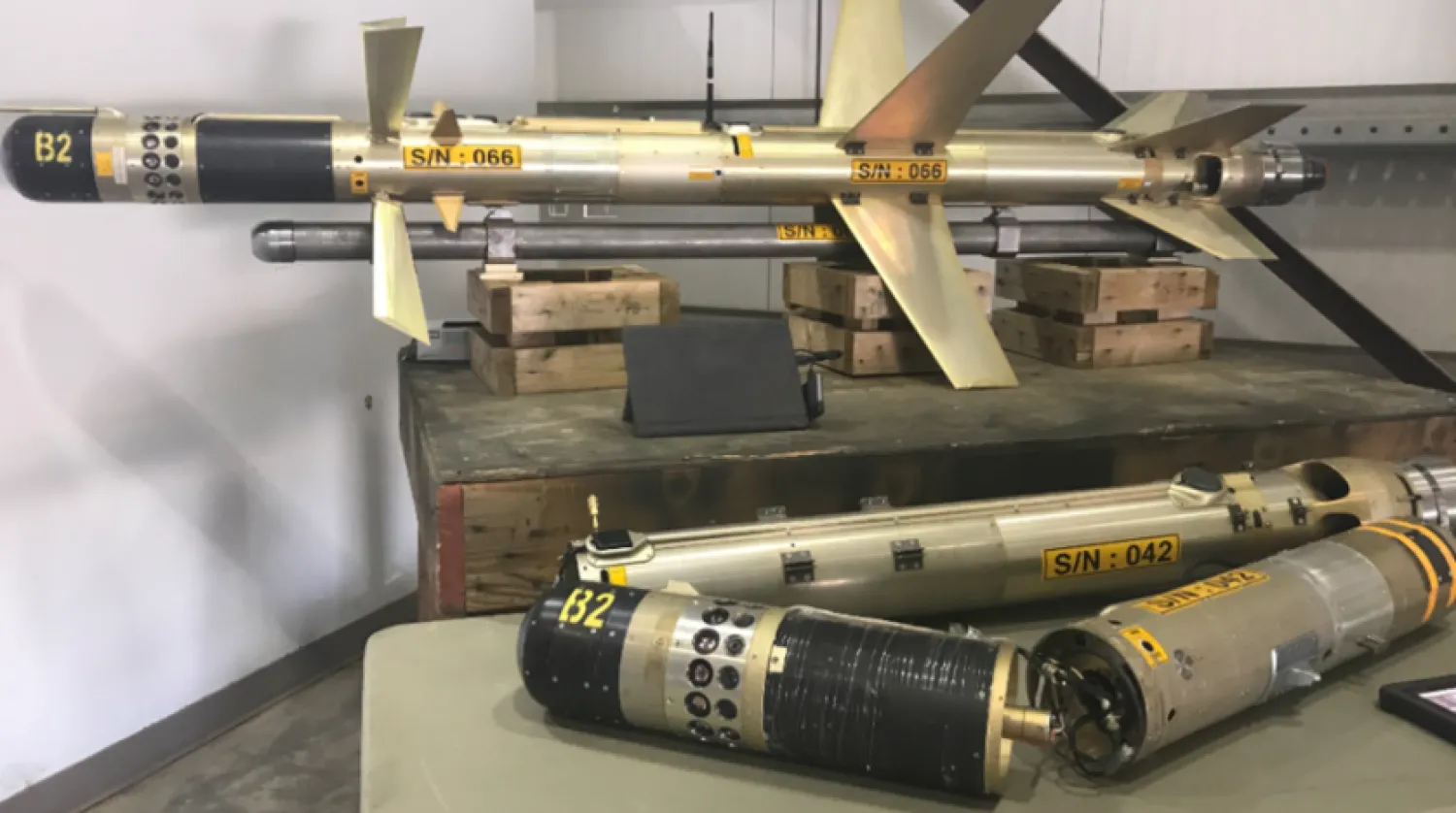
Iran’s Revolutionary Guard Corps (IRGC) orchestrated the arms shipments, which were destined for the Houthis. Photo courtesy of the US Justice Department
TT

US Seizes Iranian Arms Destined for Yemen’s Houthis

Iran’s Revolutionary Guard Corps (IRGC) orchestrated the arms shipments, which were destined for the Houthis. Photo courtesy of the US Justice Department

The US Justice Department announced on Tuesday that it has seized two large caches of Iranian arms, including 171 surface-to-air missiles and eight anti-tank missiles, destined for Yemen’s Houthi militias.

“The US Navy seized the weapons from two vessels in the Arabian Sea while conducting routine maritime security operations,” said the Justice Department.

Iran’s Revolutionary Guard Corps (IRGC) orchestrated the arms shipments, which were destined for the Houthis, it said.

“The US government similarly seized the Iranian petroleum products from four foreign-flagged tankers in or around the Arabian Sea while en route to Venezuela. These actions represent the government’s largest-ever forfeitures of fuel and weapons shipments from Iran,” it added.

The US in the two cases struck a "resounding blow” to the Iranian government and to the criminal networks supporting the IRGC, said Assistant Attorney General Matthew G. Olsen of the Justice Department’s National Security Division.

“The Department of Justice will continue to use all available tools to combat the threats posed by terrorist organizations and all those who seek to harm the United States and its allies.”

“These two cases demonstrate that not only can we disrupt the Islamic Revolutionary Guard Corps’ ability to finance its operations through petroleum sales, but we can also thwart its ability to use the proceeds of such sales to arm its terrorist proxies and export terrorism abroad,” said US Attorney Matthew M. Graves for the District of Columbia. “Given our expertise and special statutory authority, the US Attorney’s Office for the District of Columbia is uniquely positioned to support its law enforcement partners in such terrorism cases. We are deeply committed to this mission.”

“The combined efforts of the FBI and our partners to seize missiles and over a million barrels of petroleum demonstrate our commitment to defend against foreign terrorist organizations and enforce US sanctions,” said Assistant Director Alan E. Kohler Jr. of the FBI’s Counterintelligence Division. “The Government of Iran’s sponsorship of terrorism has left innocent victims in its wake and its attempts to support regimes dangerous to the United States and our allies will be met with the full force of the law. The FBI has a continued resolve to hold the Government of Iran accountable for its illegal actions, and we urge anyone with information about violations of sanctions on Iran to contact the FBI.”

US Navy Central Command (NAVCENT) seized the weapons from two flagless vessels in the Arabian Sea on Nov. 25, 2019, and Feb. 9, 2020, respectively. The weapons included 171 guided anti-tank missiles, eight surface-to-air missiles, land attack cruise missile components, anti-ship cruise missile components, thermal weapons optics and other components for missiles and unmanned aerial vehicles.

On Aug. 20, 2020, the Justice Department filed a complaint seeking to forfeit the seized weapons in US District Court for the District of Columbia. The complaint alleged that the arms shipments were part of an IRGC trafficking network designed to distribute illicit weapons to the Houthis in Yemen. The court granted the government’s motion for default judgment and entered a final order of forfeiture on Nov. 15. In its opinion, the court found that the government had adequately alleged that the weapons belonged to the IRGC and that the IRGC constitutes an entity engaged in planning or perpetrating a federal crime of terrorism against the US.



Türkiye Says Greece-Chevron Activity off Crete Unlawful 

A Chevron gas station sign is pictured at one of their retain gas stations in Cardiff, California October 9, 2013. REUTERS/Mike Blake/File Photo
TT

Türkiye Says Greece-Chevron Activity off Crete Unlawful 

A Chevron gas station sign is pictured at one of their retain gas stations in Cardiff, California October 9, 2013. REUTERS/Mike Blake/File Photo

Türkiye said on Thursday it opposed Greece's "unilateral activities" in energy fields south of Crete with a consortium led by US major Chevron as a violation of international law and good neighbourly relations.

Athens responded that its policies abide international law.

The Chevron-led consortium signed exclusive lease agreements on Monday to look for natural gas off southern Greece, expanding US presence in the eastern Mediterranean.

"We oppose this unlawful activity, which is being attempted in violation of the 2019 Memorandum of Understanding on Maritime Jurisdiction between Libya and our country," the Turkish Defense Ministry said at a press briefing.

It said the activity, while not directly impacting Türkiye's continental shelf, also violated Libya's maritime jurisdiction that was declared to the United Nations in May last year.

"We continue to provide the necessary support to the Libyan authorities to take action against these unilateral and unlawful activities by Greece," the ministry said.

A 2019 agreement signed by Türkiye and Libya set out maritime boundaries in the Mediterranean Sea. It was rejected by Greece as it ignored the presence of the Greek island of Crete between the coasts of Türkiye and Libya. The Chevron deal doubles the amount of Greek maritime acreage available for exploration and is the second in months involving a US energy major, as the European Union seeks to phase out supplies from Russia and the US seeks to replace them.

Asked about the Turkish objections later on Thursday, Greek government spokesman Pavlos Marinakis told a press briefing that Athens followed an "active policy" and "exercises its rights in accordance with international law and respects international law steadfastly - and I think no one questions that, period."

There was no immediate comment from Chevron.

Neighbors and NATO members Türkiye and Greece have been at odds over a range of issues for decades, primarily maritime boundaries and rights in the Aegean, an area widely believed to hold energy resources and with key implications for airspace and military activity.

A 2023 declaration on friendly relations prompted a thaw between the sides and leaders have voiced a desire to address remaining issues.


Andrew Mountbatten-Windsor Arrested on Suspicion of Misconduct in Public Office

FILE - Britain’s Andrew Mountbatten-Windsor, formerly known as Prince Andrew, looks round as he leaves after attending the Easter Matins Service at St. George's Chapel, Windsor Castle, England, April 20, 2025. (AP Photo/Kirsty Wigglesworth, File)
TT

Andrew Mountbatten-Windsor Arrested on Suspicion of Misconduct in Public Office

FILE - Britain’s Andrew Mountbatten-Windsor, formerly known as Prince Andrew, looks round as he leaves after attending the Easter Matins Service at St. George's Chapel, Windsor Castle, England, April 20, 2025. (AP Photo/Kirsty Wigglesworth, File)

UK police arrested Andrew Mountbatten-Windsor on Thursday on suspicion of misconduct in public office.

The Thames Valley Police, an agency that covers areas west of London, including Mountbatten-Windsor’s former home, said it was “assessing” reports that the former Prince Andrew sent trade reports to convicted sex offender Jeffrey Epstein in 2010. The assessment followed the release of millions of pages of documents connected to a US investigation of Epstein.

The police force did not name Mountbatten-Windsor, as is normal under UK law. But when asked if he had been arrested, the force pointed to a statement saying that they had arrested a man in his 60s. Mountbatten-Windsor is 66.

“Following a thorough assessment, we have now opened an investigation into this allegation of misconduct in public office,’’ the statement said. “It is important that we protect the integrity and objectivity of our investigation as we work with our partners to investigate this alleged offence."

“We understand the significant public interest in this case, and we will provide updates at the appropriate time,” the statement added.

Pictures circulated online appearing to show unmarked police cars at Wood Farm on the Sandringham Estate in Norfolk, with plainclothes officers appearing to gather outside the home of Mountbatten-Windsor.


Georgia Arrests Two Foreigners Trying to Purchase Uranium

FILE PHOTO: A block with the symbol, atomic number and mass number of Uranium (U) element, in this illustration taken January 21, 2026. REUTERS/Dado Ruvic/Illustration/File Photo
TT

Georgia Arrests Two Foreigners Trying to Purchase Uranium

FILE PHOTO: A block with the symbol, atomic number and mass number of Uranium (U) element, in this illustration taken January 21, 2026. REUTERS/Dado Ruvic/Illustration/File Photo

Georgia has ‌detained two people who attempted to purchase $3 million worth of uranium and a cache of a radioactive isotope found in nuclear weapons testing programs, the national security service said on Thursday.

Two foreign nationals from unspecified countries were arrested in the city of Kutaisi, the State Security Service said in a statement.

"They were planning to ‌illegally purchase ‌nuclear material uranium and radioactive ‌substance ⁠Cesium 137 for $3 ⁠million and illegally transport it to the territory of another country," Reuters quoted it as saying.

It said other foreigners had been arriving in Georgia in recent weeks with the aim of purchasing and transporting the nuclear and ⁠radioactive materials, without elaborating further.

The ‌statement did ‌not specify the quantity of materials the individuals were ‌attempting to procure. There were ‌no details on the substances' origin or potential destination.

Cesium 137 is a radioactive isotope present primarily in the aftermath of nuclear weapons testing ‌and nuclear power plant accidents such as the Chernobyl disaster in ⁠then-Soviet ⁠Ukraine in 1986.

The security of nuclear materials was one of the biggest concerns after the 1991 fall of the Soviet Union, of which Georgia was part. There have been several serious incidents involving the illicit trade in nuclear materials in Georgia over recent decades.

Most recently, three Chinese citizens were arrested in the capital Tbilisi for attempting to purchase two kilograms of "nuclear material" uranium.