

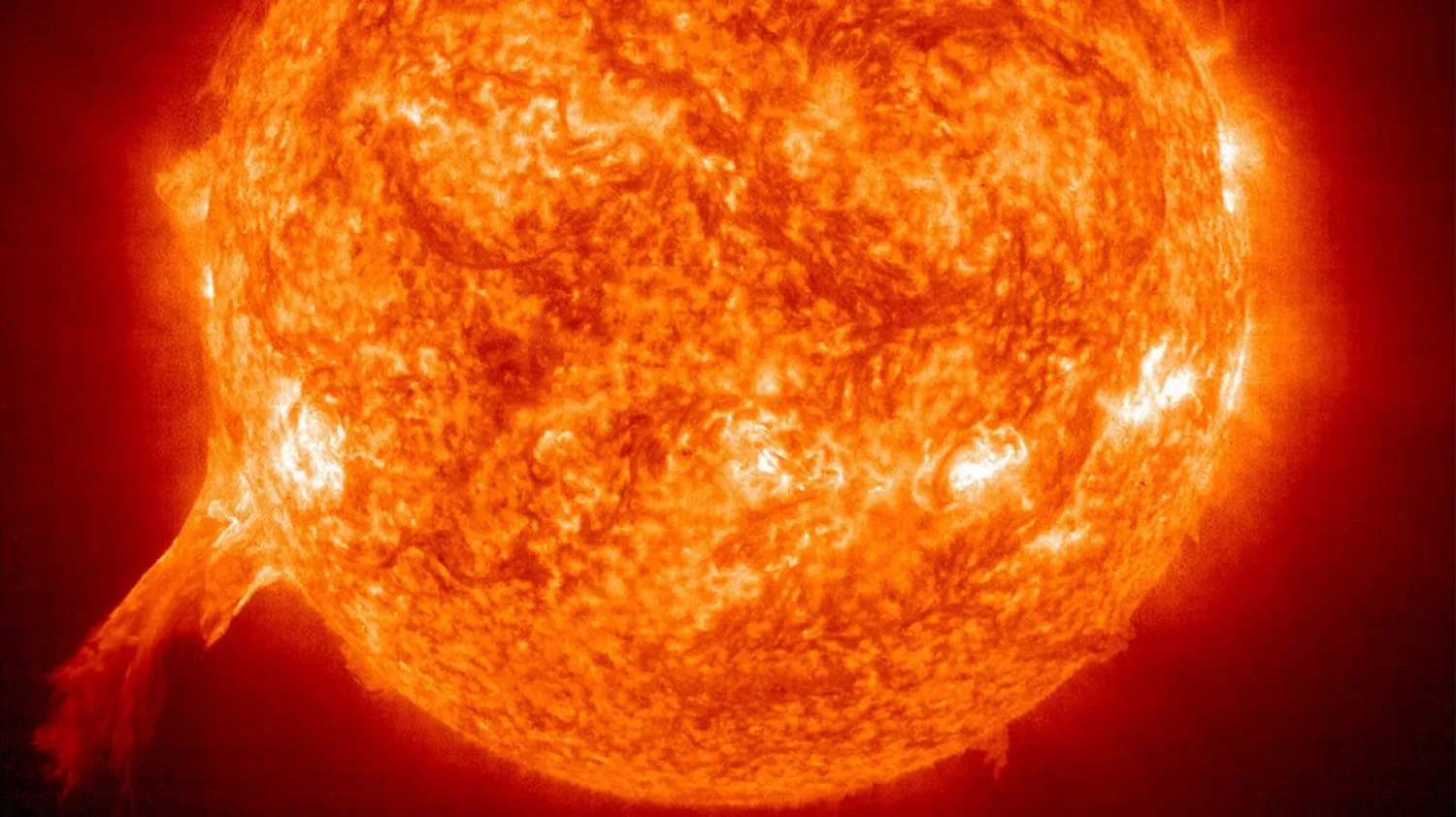

NASA Craft ‘Touches’ the Sun for First Time, Dives Into Atmosphere

A massive solar eruption, more than 30 times the length of Earth's diameter, blasted away from the Sun on July 1, 2002, and a satellite captured graphic images of the event. (Reuters)
TT

NASA Craft ‘Touches’ the Sun for First Time, Dives Into Atmosphere

A massive solar eruption, more than 30 times the length of Earth's diameter, blasted away from the Sun on July 1, 2002, and a satellite captured graphic images of the event. (Reuters)

A NASA spacecraft has officially “touched” the sun, plunging through the unexplored solar atmosphere known as the corona.

Scientists announced the news Tuesday during a meeting of the American Geophysical Union.

The Parker Solar Probe actually flew through the corona in April during the spacecraft’s eighth close approach to the sun. Scientists said it took a few months to get the data back and then several more months to confirm.

"Fascinatingly exciting,” said project scientist Nour Raouafi of Johns Hopkins University.

Launched in 2018, Parker was 8 million miles (13 million kilometers) from the center of the sun when it first crossed the jagged, uneven boundary between the solar atmosphere and outgoing solar wind. The spacecraft dipped in and out of the corona at least three times, each a smooth transition, according to scientists, Reuters reported.

“The first and most dramatic time we were below for about five hours ... Now you might think five hours, that doesn't sound big," the University of Michigan's Justin Kasper told reporters. But he noted that Parker was moving so fast it covered a vast distance during that time, tearing along at more than 62 miles (100 kilometers) per second.

The corona appeared dustier than expected, according to Raouafi. Future coronal excursions will help scientist better understand the origin of the solar wind, he said, and how it is heated and accelerated out into space. Because the sun lacks a solid surface, the corona is where the action is; exploring this magnetically intense region up close can help scientists better understand solar outbursts that can interfere with life here on Earth.

Preliminary data suggest Parker also dipped into the corona during its ninth close approach in August, but scientists said more analyses are needed. It made its 10th close approach last month.

Parker will keep drawing ever closer to the sun and diving deeper into the corona until its grand finale orbit in 2025.

The latest findings were also published by the American Physical Society.


El Nino May Return in 2026 and Make Planet Even Hotter

FILE -  Villagers fetch water from a makeshift borehole in Mudzi, Zimbabwe, Tuesday, July 2, 2024. (AP Photo/Aaron Ufumeli, File)
FILE - Villagers fetch water from a makeshift borehole in Mudzi, Zimbabwe, Tuesday, July 2, 2024. (AP Photo/Aaron Ufumeli, File)
TT

El Nino May Return in 2026 and Make Planet Even Hotter

FILE -  Villagers fetch water from a makeshift borehole in Mudzi, Zimbabwe, Tuesday, July 2, 2024. (AP Photo/Aaron Ufumeli, File)
FILE - Villagers fetch water from a makeshift borehole in Mudzi, Zimbabwe, Tuesday, July 2, 2024. (AP Photo/Aaron Ufumeli, File)

The warming El Nino weather phenomenon could form later this year, potentially pushing global temperatures to record heights.

There is a 50- to 60-percent chance of El Nino developing during the July-September period and beyond, according to the US National Oceanic and Atmospheric Administration (NOAA).

The World Meteorological Organization will issue an update on El Nino on Tuesday.

Here's what you need to know about El Nino and its cooler sister, La Nina:

- Why the name? –

El Nino and its cooler sister La Nina are two phases of a natural climate pattern across the tropical Pacific known as the El Nino-Southern Oscillation (ENSO).

Peruvian and Ecuadoran fishermen coined the term El Nino ("the boy" or "the Christ Child") in the 19th century for the arrival of an unusually warm ocean current off the coast that reduced their catch just before Christmas.

Scientists chose the name La Nina as the opposite of El Nino. Between the two events, there is a "neutral" phase.

- El Nino -

El Nino can weaken consistent trade winds that blow east to west across the tropical Pacific, influencing weather by affecting the movement of warm water across this vast ocean.

This weakening warms the usually cooler central and eastern sides of the ocean, altering rainfall over the equatorial Pacific and wind patterns around the world.

The extra heat at the surface of the Pacific releases energy into the atmosphere that can temporarily drive up global temperatures, which is why El Nino years are often among the warmest on record.

"All else being equal, a typical El Nino event tends to cause a temporary increase in the global mean temperature on the order of 0.1C-0.2C," Nat Johnson, an NOAA meteorologist, told AFP.

El Nino occurs every two to seven years.

It typically results in drier conditions across southeast Asia, Australia, southern Africa, and northern Brazil, and wetter conditions in the Horn of Africa, the southern United States, Peru and Ecuador.

- Another record? -

The last El Nino occurred in 2023-2024, contributing to making 2023 the second highest year on record and 2024 the all-time high.

Carlo Buontempo, director of the European Union's Copernicus Climate Change Service, told AFP in January that 2026 could be "another record-breaking year" if El Nino appears this year.

However, El Nino's impact would be higher in 2027 than in 2026 if it develops in the second half of this year, said Tido Semmler, a climate scientist at Ireland's National Meteorological Service.

"It takes time for the global atmosphere to react to the El Nino," he said.

"Having said this, there is a risk of 2026 being the warmest year on record even without El Nino, due to the global warming trend," Semmler told AFP.

"2027 would face an increased risk of getting a record warm year if El Nino developed in the second half of 2026," he added.

- La Nina -

The latest La Nina episode was relatively weak and short lived, starting in December 2024 and due to enter a neutral phase during the Februady-April period.

La Nina cools the eastern Pacific Ocean for a period of about one to three years, generating the opposite effects to El Nino on global weather.

It leads to wetter conditions in parts of Australia, southeast Asia, India, southeast Africa and northern Brazil, while causing drier conditions in parts of South America.

La Nina did not stop 2025 from being the third hottest on record.

- New calculation –

The NOAA adopted in February a new way of determining El Nino and El Nino events.

The old Oceanic Nino Index (ONI) compared the three-month average sea surface temperature one region of the Pacific with a 30-year average in the same area.

But as the oceans have been warming rapidly, that old 30-year average can be out of date.

The new method, the Relative Oceanic Nino Index (RONI), compares how warm or cool the east-central Pacific is compared to the rest of the tropics.

The NOAA said RONI is a "clearer, more reliable way" to track El Nino and La Nina in real time.


More Than 10.7 Million Worshippers Visit Prophet’s Mosque in First 10 Days of Ramadan

More than 10.7 million worshippers visit Prophet’s mosque in first 10 days of Ramadan. (SPA)
TT

More Than 10.7 Million Worshippers Visit Prophet’s Mosque in First 10 Days of Ramadan

More than 10.7 million worshippers visit Prophet’s mosque in first 10 days of Ramadan. (SPA)

The General Authority for the Care of the Affairs of the Grand Mosque and the Prophet’s Mosque announced that 10,789,467 worshippers visited the Prophet’s Mosque during the first 10 days of Ramadan 1447 AH, performing the five daily prayers and Taraweeh amid a comprehensive and well-coordinated service system.

According to the authority, 317,025 worshippers prayed in the Rawdah Sharifah during the same period, while 784,379 visitors conveyed their greetings to Prophet Muhammad (peace be upon him) and his two companions.

The authority emphasized that these figures reflect the effectiveness of an integrated operational plan designed to manage crowds, streamline worship procedures, and ensure the highest standards of safety and comfort for visitors throughout the holy month of Ramadan.


Wadi Al-Aqiq in Madinah Blends Spiritual, Natural Appeal

Wadi Al-Aqiq was famed for the quality and sweetness of its water (SPA)
TT

Wadi Al-Aqiq in Madinah Blends Spiritual, Natural Appeal

Wadi Al-Aqiq was famed for the quality and sweetness of its water (SPA)

Wadi Al-Aqiq in Saudi Arabia's Madinah region stands out as one of the area’s most significant geographical and tourist landmarks, known for its striking terrain and the sweetness of its water.

The valley draws much of its fame from its association with the Prophet Muhammad, peace be upon him, and is known as the “Blessed Valley,” based on his saying: "Tonight there came to me a visitor from Allah, saying: 'Pray in this blessed valley.'"

Although several valleys across the Arabian Peninsula share the same name, Wadi Al-Aqiq remains the most renowned.

According to a report by the Saudi Press Agency (SPA), the valley was famed for the purity of its water, to such an extent that some Umayyad caliphs transported it to Damascus.

At the time, it was likened to the “Ghouta of Damascus” for its dense trees and lush greenery. Several of the Prophet’s companions settled along its banks, including Abu Hurairah and Saied bin Al-Aas.

They died there and were later carried to Madinah. Among the successors, Urwa bin Al-Zubayr and Sukaynah bint Al-Hussein had palaces in the valley, some of which remain standing today.

Wadi Al-Aqiq is now undergoing rehabilitation and development overseen by Al Madinah Region Development Authorityand related bodies.

The project stretches nearly 15 kilometers, from the Miqat Dhi Al-Hulayfah, south of Madinah, to Al-Jurf, in the north, aiming to balance urban growth with natural resources.

Works span key sites along the valley, including Qasr Urwa, the Al-Salam Road intersection, the Islamic University Square and the agricultural areas of Al-Jurf.

The projects are part of broader efforts to improve Madinah’s urban landscape and introduce environmentally friendly developments that enhance the city’s visual appeal.

The Wadi Al-Aqiq walkway has emerged as a leading destination for walking and recreation in Madinah, thanks to its distinctive natural setting.

Extending about 1,500 meters, it overlooks the “Blessed Valley,” mentioned in the Prophet’s traditions, giving it spiritual and historical weight that attracts visitors interested in religious and nature tourism.

Designed to blend with its surroundings, the walkway features prepared paths, seating areas overlooking the valley and shade trees lining the route. A modern lighting system enhances safety and highlights the site’s beauty at night.
