Japanese Space Tourists Return to Earth after 12 Days on ISS

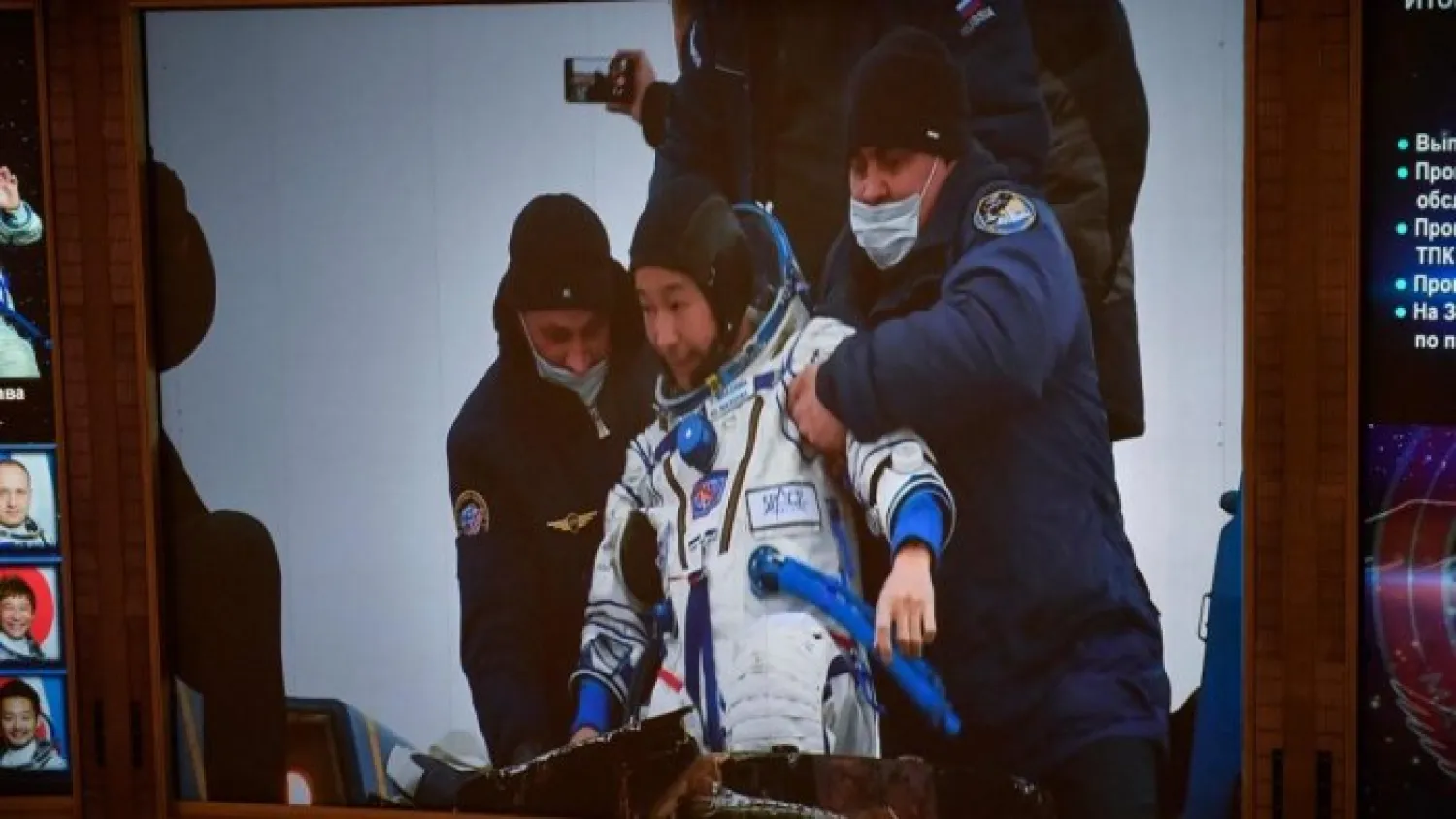
A screen shows Japanese billionaire Yusaku Maezawa shortly after the landing of the Soyuz MS-20 capsule. Credit: AFP Photo
TT

Japanese Space Tourists Return to Earth after 12 Days on ISS

A screen shows Japanese billionaire Yusaku Maezawa shortly after the landing of the Soyuz MS-20 capsule. Credit: AFP Photo

A Japanese billionaire returned to Earth Monday, after 12 days spent on the International Space Station where he made videos about performing mundane tasks in space including brushing teeth and going to the bathroom.

Online fashion tycoon Yusaku Maezawa and his assistant Yozo Hirano parachuted onto Kazakhstan's steppe at around the expected landing time of 0313 GMT Monday, along with Russian cosmonaut Alexander Misurkin.

Footage from the landing site, around 150 kilometers (90 miles) southeast of the central Kazakhstan town of Zhezkazgan, showed the trio smiling after being helped out of the Soyuz descent module and into evacuation vehicles in freezing, foggy conditions, AFP reported.

"The crew is feeling good," a commentator on NASA TV said, translating comments from Russian mission control.

Russia's defense ministry had said on Sunday that Maezawa and Hirano were set to be surprised by recovery crews with a traditional Japanese noodle dish.

Their journey marked Russia's return to space tourism after a decade-long pause that saw the rise of competition from the United States.

The trio spent 12 days on the orbiting laboratory where the Japanese tourists documented their daily life aboard the ISS for Maezawa's popular YouTube channel.

Addressing his one million followers on YouTube, the 46-year-old billionaire explained how to brush teeth and go to the bathroom in space.

In one of the videos, he explained in detail the business of relieving oneself on the ISS.

"Peeing is very easy," he said as he demonstrated a handheld funnel astronauts use to suck their urine away.

In other videos, he showed his followers how to properly drink tea and sleep in zero gravity.

When the three space travelers arrived on the ISS on December 8, they joined a seven-team crew who were engaged in space biology and physics research.

Maezawa plans to take eight people with him on a 2023 mission around the moon, operated by Elon Musk's SpaceX.

He and his assistant are the first private Japanese citizens to visit space since journalist Toyohiro Akiyama travelled to the Mir station in 1990.

- Turning point -
Their return from space caps a banner year that many have seen as a turning point for private space travel.

Billionaires Musk, Jeff Bezos and Richard Branson all made breakthrough commercial tourism flights this year, bursting into a market Russia is keen to defend.

Russia has a history of sending self-funded tourists to space.

In partnership with US-based company Space Adventures, Russian space agency Roscosmos has previously taken seven tourists to the ISS since 2001 -- one of them twice.

The last was Canada's Cirque du Soleil co-founder Guy Laliberte in 2009, who was dubbed the first clown in space.

In October, Russia launched its first untrained cosmonauts into space since Laliberte's trip, delivering a Russian actress and a director to the ISS, where they filmed scenes for the first movie in orbit.

Moscow had stopped sending tourists to space after NASA retired its Space Shuttle in 2011, which left Russia with a monopoly on supplying the ISS.

NASA bought up all Soyuz launch seats for a reported $90 million (80 million euros) per spot -- effectively ending tourist flights.

That changed last year when a SpaceX spacecraft successfully delivered its first astronauts to the ISS.

NASA began purchasing flights from SpaceX, stripping Russia of its monopoly and costing its cash-strapped space agency millions of dollars in revenue.

While the cost of tickets to space for tourists has not been disclosed, Space Adventures has indicated they are in the range of $50-60 million.

Roscosmos plans to continue growing its space tourism business, already commissioning two Soyuz rockets for such trips.


Missing Teen Found Alive After 6 Days in Australian Woodlands

In this image made from video and provided by the Victoria State Police 17-year-old William, center right, is embraced by his mother Elizabeth, only first names were provided by police, while in a helicopter in Cowwarr, Australia, Thursday, Nov. 12, 2026, after William spent six days lost in eastern Australian woodlands. (Victoria Police via AP)
TT

Missing Teen Found Alive After 6 Days in Australian Woodlands

In this image made from video and provided by the Victoria State Police 17-year-old William, center right, is embraced by his mother Elizabeth, only first names were provided by police, while in a helicopter in Cowwarr, Australia, Thursday, Nov. 12, 2026, after William spent six days lost in eastern Australian woodlands. (Victoria Police via AP)

A 17-year-old boy with autism was found alive Thursday after six days lost in eastern Australian woodlands.

The boy, whom police identified only as William, had begun camping with a teenage friend when he disappeared last Friday near Walhalla, a former gold-mining town 185 kilometers (115 miles) east of Melbourne, police said.

A police helicopter crew found him surrounded by wilderness lying asleep on a flat rock beside a creek, and he was later reunited with his mother. William was in good spirits and mostly in good health, the police statement said.

Video shot from the rescue helicopter showed he was shirtless and sunburned. He was wearing shorts and boots and was using towels as blankets.

“I’m just over the moon that he’s alive,” his mother, Elizabeth, told reporters.

The AP has decided not to provide her family name to avoid identifying her son.

“And he’s never leaving the house again. He’s grounded for life. He’s not going anywhere ever again,” she joked.

William was later taken to a hospital for his health to be monitored, police said.

William's family have said he has Level 2 autism. That requires “substantial support,” according to the Australian advocacy group Autism360.

Such a person may have marked deficits in verbal and non-verbal social communication and rely heavily on routines and predictable activities.

Disruption can cause significant distress.

The Southern Hemisphere spring weather had been mild for the past week in the alpine region where William was lost and there had been little rain.

Elizabeth had dropped off her son and his friend last Friday for a weekend of camping. William walked a short distance from the campsite to the drop-off location to collect more camping equipment but never returned to his friend, police said.

After becoming lost, William trekked for days up and down “some very steep terrain,” Acting Police Inspector Jason Benbow said.

He spent the last two days where he was found at the creek, trapped by the steepness of his surrounds 2 kilometers (1.2 miles) from his camp site, Benbow said.

“He woke up to the sound of the helicopter, gave them a thumbs up and they winched him to safety,” Benbow told reporters.

The extensive police search for him involved more than 100 emergency services personnel and volunteers.


Europe’s Hera Spacecraft Begins Close Inspections of an Asteroid Rammed by NASA in a 2022 Test

This undated image provided by the European Space Agency on Nov. 5, 2026 and taken by the Hera spacecraft, shows asteroid Didymos. (European Space Agency via AP)
TT

Europe’s Hera Spacecraft Begins Close Inspections of an Asteroid Rammed by NASA in a 2022 Test

This undated image provided by the European Space Agency on Nov. 5, 2026 and taken by the Hera spacecraft, shows asteroid Didymos. (European Space Agency via AP)

A European spacecraft has begun close inspections of an asteroid rammed by NASA four years ago in a planetary defense test.

The European Space Agency announced Wednesday that the Hera spacecraft is now studying Didymos and its moonlet Dimorphos from just 15 miles to 18 miles (25 kilometers to 30 kilometers) away, The AP news reported.

NASA’s Dart spacecraft deliberately slammed into little Dimorphos in 2022 to see whether such a defensive move might help save Earth from a killer space rock one day.

The impact shortened the moonlet’s orbit around Didymos. More importantly, it nudged the moonlet into a slightly different path around the sun.

Next month, the small car-sized Hera, launched in 2024, will venture even closer — just 12 miles (20 kilometers) away.

ESA officials consider this a “crash site investigation” worthy of its finest robotic detective. Hera is carrying 25 science instruments as well as a pair of shoebox-sized Cubesats to survey Dimorphos even more closely and attempt to land on it.

The Dart spacecraft — short for Double Asteroid Redirection Test — sent rubble and even boulders flying off Dimorphos, providing an extra kick to the impact’s momentum. The debris trail extended thousands of miles (more than 10,000 kilometers) into space for months.

Some of that debris could still be in the vicinity, according to scientists.

Dimorphos is an estimated 500 feet (151 meters) in diameter. Didymos is roughly 2,560 feet (780 meters) in diameter.


Euclid Mission Data Release Spans More than 900 Million Galaxies

Looking across vast distances means peering into the past because of the time needed for light from distant objects to reach us (Reuters)
TT

Euclid Mission Data Release Spans More than 900 Million Galaxies

Looking across vast distances means peering into the past because of the time needed for light from distant objects to reach us (Reuters)

The European Space Agency has released its first big collection of data from the orbiting Euclid telescope's mission to map the universe's large-scale structure, including observations of more than 900 million galaxies, as scientists investigate the puzzling cosmic components dark matter and dark energy.

The data unveiled on Thursday covered a survey of the sky equal to about 9,500 times the size of the moon as viewed from Earth. The mission's goal is to complete the largest-ever three-dimensional atlas of the cosmos, spanning more than a third of the sky, in 2031.

Thursday's release encompassed around 13 months of Euclid observations, totaling an enormous 1.7 petabytes — 1.7 million gigabytes — of data, Reuters reported.

"It marks a major milestone for ESA's Euclid mission and for everyone involved," said astrophysicist Valeria Pettorino, ESA's Euclid project scientist.

Euclid, launched from Florida in 2023, is gathering data on how the universe has expanded and how its structure has formed over time while amassing information about the nature of dark energy and dark matter and the role of gravity on large scales.

"Euclid will not just take images of galaxies in the sky, in two dimensions, but will also measure their distance, the third dimension. This will tell us where galaxies are in space and time, across 10 billion years, and in all directions beyond our galactic plane," Pettorino said.

"Galaxies cluster along filaments, surrounded by empty space, and form a network that we call the cosmic web. Euclid will reconstruct the cosmic web and how it has grown over time. This is important because the exact configuration of the cosmic web, how many clusters or voids are there, how fast it changed, depend on the properties of dark energy and dark matter," Pettorino said.

The universe's contents include ordinary matter as well as dark matter and dark energy.

Ordinary matter — stars, planets, gas, dust and all the familiar stuff on Earth — represents about 5% of the contents. Dark matter, known from the gravitational effects it exerts on galactic scales, is invisible material that may make up about 27% of the cosmos. Dark energy, thought to be responsible for the accelerated expansion of the universe, may account for 68%.

Dark matter and dark energy do not emit or absorb light and cannot be directly observed.

Previous Euclid data releases covered only a few days of observations. The newly released dataset includes more than a year of data and still spans only 14% of the total sky area Euclid is due to survey in visible and near-infrared light over six years. This data release will be completed next year with the first results on dark energy and dark matter.

GRAVITATIONAL LENSING

Light traveling toward Earth from faraway galaxies can be bent and distorted by normal matter and dark matter in the foreground, an effect called gravitational lensing. Thus, the nearer galaxy's gravity warps the light coming from the one behind.

Gravitational lensing is one of the tools being used to study dark matter's distribution. The new Euclid data includes about 15,000 strong gravitational lens candidates, exceeding the total number discovered in the previous half century.

"Gravitational lenses are nature's own weighing scales," said Natalie Lines, a doctoral student in astrophysics at the University of Portsmouth in England and a member of the Euclid Consortium of scientists.

"How strongly the light is bent tells us how much matter a galaxy contains, including invisible components like dark matter. With thousands of lenses, we can study how dark matter is spread through galaxies and understand how galaxies form and evolve over cosmic time," Lines said.

Lines noted the sharpness of the Euclid images over a huge area of the cosmos.

"Telescopes on Earth can cover large areas of the night sky, but their view is blurred by the atmosphere. The Hubble and James Webb space telescopes take beautifully sharp images, but only of tiny patches of sky. Euclid does both at once, and that is crucial for finding things that are small and rare, like strong gravitational lenses," Lines said.

Looking across vast distances means peering into the past because of the time needed for light from distant objects to reach us. The most distant objects Euclid has viewed are quasars, the brilliant cores of galaxies powered by supermassive black holes. The telescope has pinpointed 60 million of them.

"Euclid has found some dating back to when the universe was just 5% of its current age, so their light set off around 13 billion years ago," Lines said.