‘Serious’ Talk between Biden and Putin Sets Stage for Diplomacy

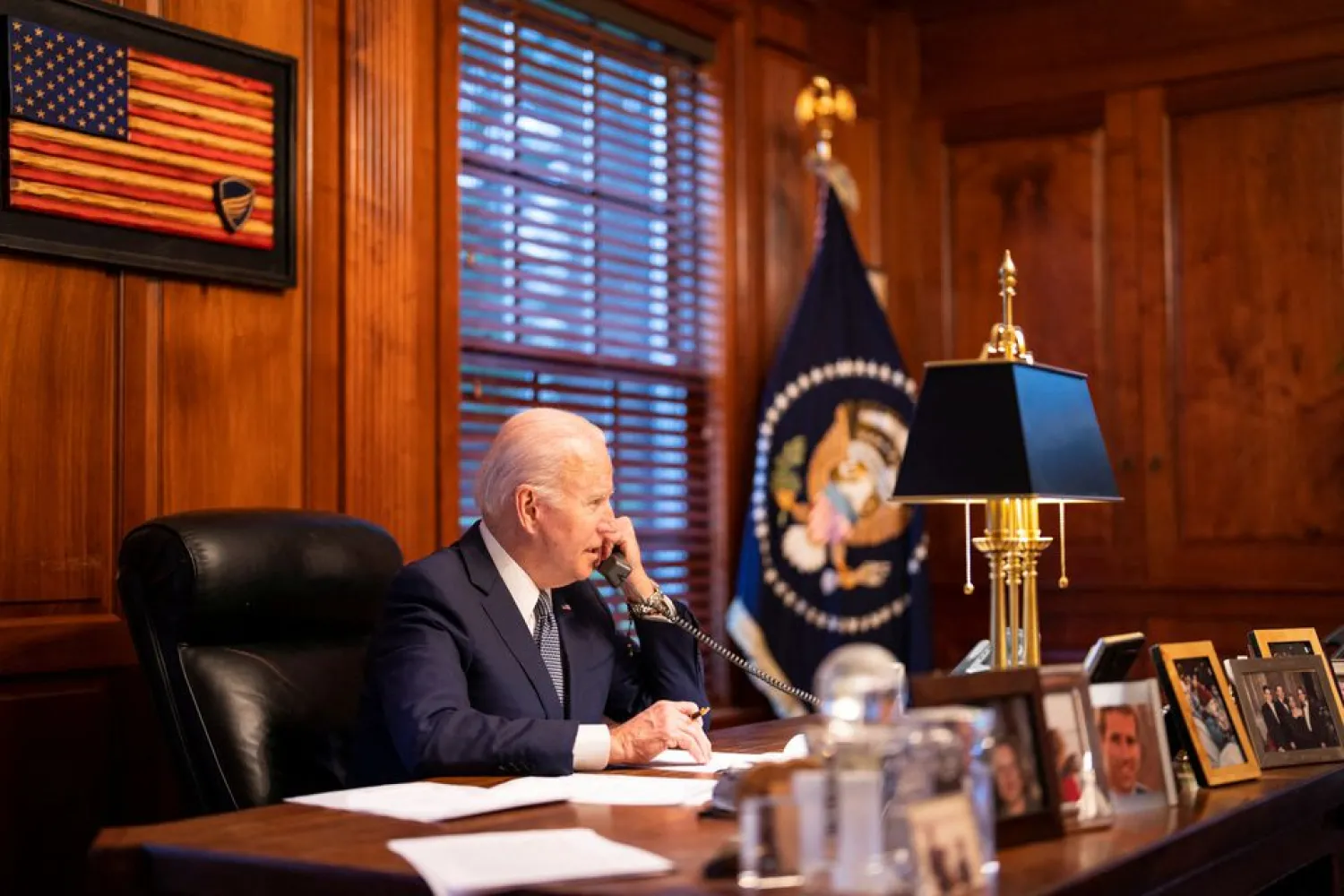
US President Joe Biden speaks with Russia's President Vladimir Putin from his home in Wilmington, Delaware, US December 30, 2021. (Reuters)
TT

‘Serious’ Talk between Biden and Putin Sets Stage for Diplomacy

US President Joe Biden speaks with Russia's President Vladimir Putin from his home in Wilmington, Delaware, US December 30, 2021. (Reuters)

US President Joe Biden and Russian President Vladimir Putin on Thursday exchanged warnings over Ukraine but conveyed some optimism that diplomatic talks in January could ease spiraling tensions.

In a 50-minute call, their second conversation this month, Biden said he needed to see Russia decrease its military build-up near Ukraine, while Putin said sanctions threatened by Washington and allies could lead to a rupture in ties. The call was requested by Putin.

"President Biden reiterated that substantive progress in these dialogues can occur only in an environment of de-escalation rather than escalation," said White House press secretary Jen Psaki.

Kremlin aide Yuri Ushakov said the call created a "good backdrop" for future talks.

The leaders' exchange set the stage for lower-level engagement between the countries, including a Jan. 9-10 US-Russia security meeting, followed by a Russia-NATO session on Jan. 12, and a broader conference including Moscow, Washington and other European countries slated for Jan. 13.

Despite the talk of diplomacy, the tone of the call was described by officials on both sides as "serious." And neither country detailed significant progress towards a resolution or the outlines of any deal.

In Kyiv, leaders worry about the 60,000 to 90,000 Russian troops that have gathered to its north, east and south. The North Atlantic Treaty Organization security alliance has been making its own preparations from the west.

Washington has not been convinced by a report over the weekend that Russia would be pulling back about 10,000 troops, with officials saying they've seen little evidence of a drawdown. The United States deployed its JSTARS military plane in Ukrainian airspace for the first time earlier this week, though different types of surveillance aircraft are common in the region.

For his part, Biden reiterated his threat of unprecedented sanctions if Russia chose to invade Ukraine.

"Biden laid out two paths," including diplomacy and deterrence, including "serious costs and consequences," said a senior administration official.

"Both leaders acknowledged that there were likely to be areas where we could make the meaningful progress as well as areas where agreements may be impossible, and that the upcoming talks would determine more precisely the contours of each of those categories."

Aides have said the possibilities include measures that would effectively disconnect Russia from the global financial system, while further arming NATO.

Ushakov said Putin "immediately responded" that any sanctions now or later "could lead to a complete breakdown in ties between our countries." He added: "Our president also mentioned that it would be a mistake that our descendants would see as a huge error."

Moscow's troop deployments over the past two months alarmed the West, following its seizure of Ukraine's Crimea peninsula in 2014 and its backing of separatists fighting in eastern Ukraine.

Russia denies planning to attack Ukraine and says it has the right to move its troops on its own soil as it likes.

Moscow, worried by what it says is the West's re-arming of Ukraine, has said it wants legally-binding guarantees the 30-member NATO alliance will not expand further eastwards, and that certain offensive weapons will not be deployed to Ukraine or other neighboring countries.

The Kremlin said Biden appeared to agree with Putin's contention that Moscow needed some security guarantees from the West and also that he said the United States did not intend to deploy offensive weapons in Ukraine.

A White House spokesperson did not immediately respond to a request for comment on the Kremlin's characterization of Biden's remarks.

Putin has compared the current tensions to the Cold War-era Cuban Missile Crisis in 1962. Washington regards many of his demands, including restrictions on NATO expansion, as non-starters.


Pakistan Army Chief and Iran FM Discuss Regional Peace, Security

Vessels at the Strait of Hormuz, as seen from Musandam, Oman, November 17, 2026. (Reuters)
TT

Pakistan Army Chief and Iran FM Discuss Regional Peace, Security

Vessels at the Strait of Hormuz, as seen from Musandam, Oman, November 17, 2026. (Reuters)

Asim Munir, the powerful army chief of mediating country Pakistan, met with Iranian foreign minister Abbas Araghchi, the Pakistani military said Tuesday, during continued efforts to end the war between the United States and Iran.

Pakistan brokered a June accord that led to a brief halt in fighting between the United States and Iran and set a roadmap for further agreement on reopening the crucial Strait of Hormuz waterway and for negotiations on Tehran's nuclear program.

But the truce collapsed with Washington and Tehran accusing each other of violating the agreement and prompting months of shuttle diplomacy to resuscitate the ceasefire, led principally by mediators Qatar and Pakistan.

During the meeting on Monday, "matters of mutual interest, regional security dynamics and evolving geopolitical developments were discussed," the Pakistani military's media wing said in a statement.

Munir "underscored the importance of sustained engagement, mutual trust and close coordination between the two brotherly countries for promoting regional peace and stability", it added.

Araghchi arrived in Pakistan late on Sunday for a meeting of the Economic Cooperation Organization, a group of nations from Central and South Asia and the Middle East.

Pakistani Foreign Minister Ishaq Dar said on Monday he had held "very candid, very frank" discussions with Araghchi, during the conference confirming that Iran had put forward a two-day proposal to reopen the Strait of Hormuz as part of efforts to end the war with the United States.

He said Washington had not yet responded.

The United States and Israel launched the war on February 28, killing members of Iran's leadership and demanding it cease any nuclear-related activities.

The war plunged the Middle East into violence, with Tehran's retaliatory strikes targeting Gulf countries and sending global energy prices skyrocketing.

Tehran has insisted that Washington meet conditions including the release of frozen assets abroad, sanctions relief and an end to the US naval blockade of Iranian ports in exchange for reopening the Strait of Hormuz.


US Probes Why a Router Installation Sparked Mass Flight Grounding

A person takes a photo of a screen displaying information of delayed and cancelled flights at Hartsfield-Jackson Atlanta International Airport in Atlanta, Georgia, US, November 13, 2026. (Reuters)
TT

US Probes Why a Router Installation Sparked Mass Flight Grounding

A person takes a photo of a screen displaying information of delayed and cancelled flights at Hartsfield-Jackson Atlanta International Airport in Atlanta, Georgia, US, November 13, 2026. (Reuters)

US Transportation Secretary Sean Duffy said on Monday it remains unclear why a router installed by L3Harris Technologies in a remote Arkansas facility triggered a nearly five-hour nationwide aviation ground stop on Friday.

Shares of L3Harris, the contractor for the Federal Aviation Administration, closed down 3.7% after the government blamed the mass flight shutdown on its router installation. Airlines canceled more than 18,000 flights as a result.

Shares of Hewlett Packard Enterprise, which owns Juniper Networks, the maker of the routers that L3Harris installed, dropped 4.5% on Monday.

L3Harris has said it is ‌cooperating with ‌the official investigation into what went wrong.

Duffy, speaking on CNBC, said the ‌installation ⁠at an FAA radio ⁠communications site in El Dorado, Arkansas, led to an overload of a key government communications system at a rate of 1,000 connection attempts every four to five seconds.

That destabilized aircraft communications and radar feeds, affecting 17 of 22 FAA en route air traffic control centers that were using old routers and prompting the ground stop, Duffy said. He added that he has urged Congress to fund the construction of a new telecom network that is not owned by L3Harris.

Duffy is set to brief US senators ⁠on the investigation on Tuesday.

The FAA had said on Sunday that the ‌initial investigation suggested the data overload could have happened in ‌two locations: the El Dorado site and a radar site in Amarillo, Texas. Duffy said L3Harris had replaced ‌the router in Amarillo three weeks earlier.

Duffy said testing of the two routers was taking ‌place at an L3Harris lab in Florida overseen by the FAA. He invited the FBI to attend the investigation to make sure the review is being done correctly.

The FAA said that after the data "inconsistencies" occurred, L3Harris ultimately blocked those two locations, stabilizing the network. The broadcasting function was also disabled on all the new routers as ‌well as 60 other routers in the system as a precaution, it added.

L3Harris had been installing Juniper Networks routers to replace Cisco routers, produced ⁠in 2001, which ⁠were supposed to have been replaced in 2006, the FAA said.

"Based on what we know and have been told by others, our equipment was working as configured," HPE said on Monday. "The FAA is assessing the configuration and performance of all infrastructure involved to determine the cause."

Duffy has asked for billions of dollars from Congress to build a new fiber network operated by AT&T, Verizon and Lumen to replace the old L3Harris-owned copper network.

"I have the architecture ready. These companies are ready to deploy tomorrow. All I need is the money to tell them to start," he said on NBC on Sunday. "I want to get away from L3Harris and get to a new one. But they own the network. So I can’t cancel the network that they own and I operate on."

The FAA said the Arkansas router replacement was part of the $1 billion a year it spends to maintain and sustain the existing 1980s telecom network, but not part of its broader modernization effort.


Dispute Over PKK Disarmament Hinders Türkiye’s Peace Process

The PKK says it has withdrawn all its fighters from Türkiye and areas near its borders, accusing Ankara of failing to implement the peace process. (AP)
TT

Dispute Over PKK Disarmament Hinders Türkiye’s Peace Process

The PKK says it has withdrawn all its fighters from Türkiye and areas near its borders, accusing Ankara of failing to implement the peace process. (AP)

Disagreements over the disarmament of the Kurdistan Workers’ Party (PKK) have become the biggest obstacle to Türkiye’s peace initiative, which Ankara calls the “Terror-Free Türkiye” process.

Statements by Turkish officials indicate that disarmament remains underway under the supervision of relevant state institutions.

President Recep Tayyip Erdogan said last week that “the government’s priority was to ensure the PKK completed its dissolution, surrendered all its weapons and had both steps conclusively verified by the relevant authorities.”

He added that state institutions were clearing the group’s hideouts according to a predetermined plan and that the process would continue as scheduled.

Türkiye’s National Security Council must formally confirm the completion of disarmament before implementation can begin of the Law on Strengthening National Solidarity and Social Cohesion, the peace process’s framework legislation, approved by parliament on August 10.

The 12-article law provides for the conditional return and reintegration of PKK members, excluding the group’s leadership.

The PKK, meanwhile, insists it has fulfilled all its commitments, withdrawing its fighters and evacuating hideouts near the Turkish border, leaving no threat to Türkiye’s security.

It accused Ankara of failing to improve the detention conditions of imprisoned PKK leader Abdullah Ocalan, introduce the necessary legal measures or facilitate the return and reintegration of its members.

In a statement published by Turkish media Monday, the group’s leadership, which has operated under the name “Movement Leadership” since the PKK announced its dissolution on May 12, 2025, following Ocalan’s appeal, expressed frustration with Ankara’s response.

The statement said PKK fighters had withdrawn completely from Türkiye and areas near its borders, while more than 10 caves and hideouts in northern Iraq previously used as combat positions had been evacuated over the past two months.

“We no longer have any forces near the border or at any military positions where the Turkish army is stationed,” it said.

The group also claimed that its “sleeper cells” in major Turkish cities had relocated to what it calls the “Media Defense Areas” in northern Iraq, and that positions near the Turkish border had been abandoned.

It recalled that its unilateral ceasefire, announced on March 1, 2025, followed Ocalan’s February 27 “Call for Peace and a Democratic Society,” which urged the PKK to dissolve, lay down its arms and pursue democratic political activity within a legal framework.

The PKK criticized the Turkish government for failing to take concrete steps to accelerate the peace process.

It called for changes to Ocalan’s detention conditions to allow him to exercise a leadership role in managing the initiative, alongside legislation and regulations facilitating the return of PKK members to Türkiye.

“The government’s failure to take concrete steps in response to the measures taken by the PKK has raised public doubts,” the statement said.

It argued that Ankara had made no progress toward democratization even on matters requiring no new legislation, fueling debate over whether the process had stalled or been frozen.

“Our commitment to a democratic political solution is firm and unwavering. We are seriously pursuing peace and building a democratic society, and the steps we have taken are the best evidence of that,” it stated.

Erdogan, meanwhile, reiterated last week that the “Terror-Free Türkiye” initiative would proceed as planned and that no one should doubt its continuation.

Despite reports that the PKK has evacuated more than 10 caves near the Turkish border, Ankara reportedly considers the clearance of major weapons depots in the Gara and Hakurk regions of northern Iraq essential to completing disarmament.

Turkish authorities are also placing greater emphasis on the surrender of PKK members stationed in those areas.

According to press reports, a final assessment confirming the completion of disarmament cannot be issued until those facilities have been cleared.