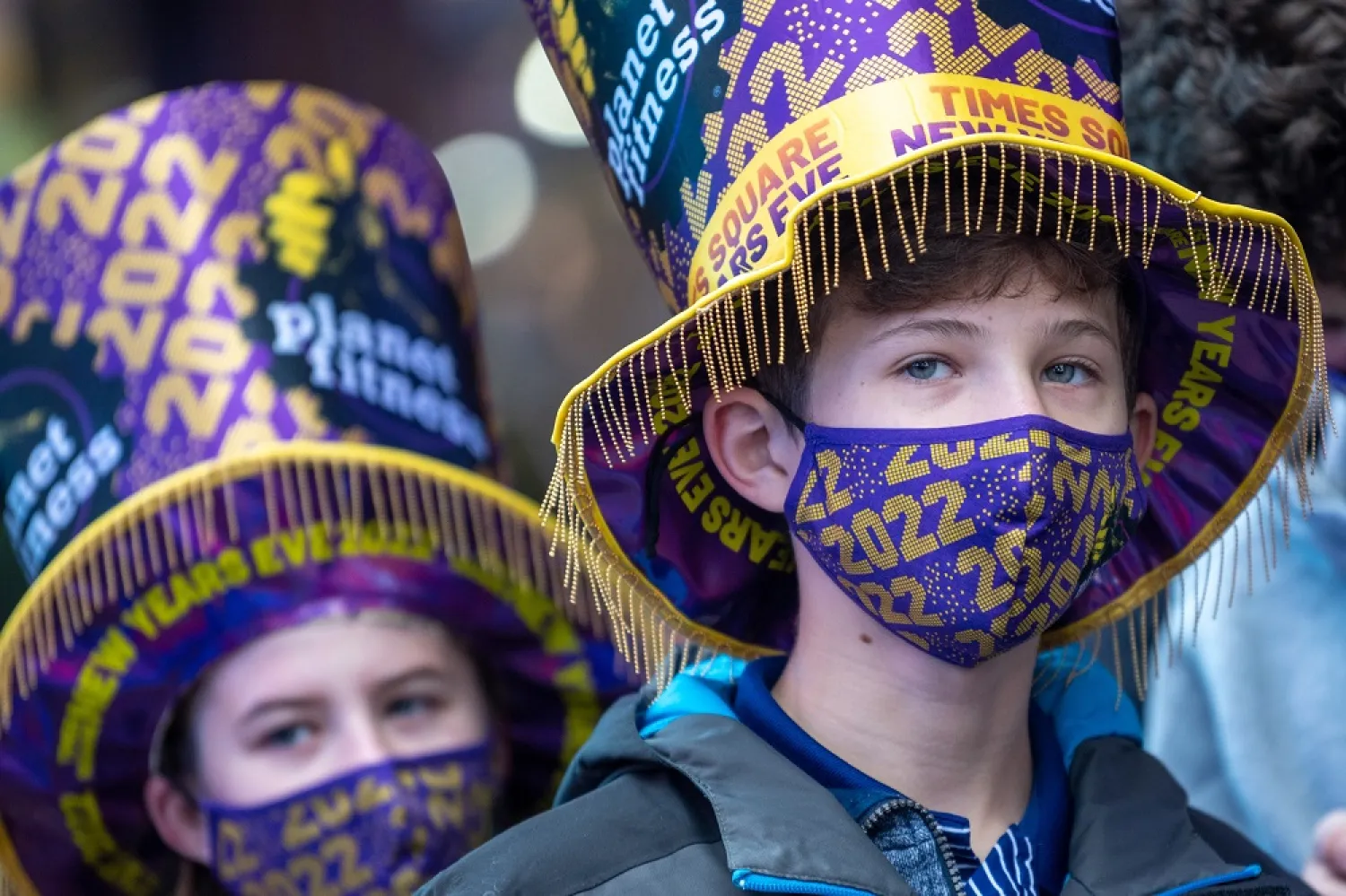
New Year’s Eve Muted by Omicron; Many Hoping for Better 2022

People wearing 2022 hats and masks gather before confetti is released from the Hard Rock Cafe marquee during a "confetti test" ahead of New Year’s Eve in Times Square on December 29, 2021 in New York City. Getty Images)
TT

New Year’s Eve Muted by Omicron; Many Hoping for Better 2022

People wearing 2022 hats and masks gather before confetti is released from the Hard Rock Cafe marquee during a "confetti test" ahead of New Year’s Eve in Times Square on December 29, 2021 in New York City. Getty Images)

Good riddance to 2021. Let 2022 bring fresh hope.

That was a common sentiment as people around the world began welcoming in the new year.

In many places, New Year's Eve celebrations were muted or canceled for the second straight year due to a surge of coronavirus infections, this time driven by the highly contagious omicron variant.

Even before omicron hit, many people were happy to say goodbye to a second grinding year of the pandemic.

But so far, at least, the omicron surge hasn't resulted in the same levels of hospitalizations and deaths as previous outbreaks — especially among vaccinated people — offering a glimmer of hope for 2022.

New Zealand was one of the first places to celebrate the new year with a low-key lights display projected onto Auckland landmarks, including the Sky Tower and Harbor Bridge. That replaced the traditional fireworks show. While there hasn't yet been any community spread of omicron in New Zealand, authorities still wanted to discourage crowds gathering.

In Japan, writer Naoki Matsuzawa said he would spend the next few days cooking and delivering food to the elderly because some stores would be closed. He said vaccinations had made people less anxious about the pandemic, despite the new variant.

“A numbness has set in, and we are no longer overly afraid," said Matsuzawa, who lives in Yokohama, southwest of Tokyo. "Some of us are starting to take for granted that it won’t happen to me.”

Like many other people, Matsuzawa hopes that life will improve in 2022.

“I hope the restrictions can disappear,” he said.

Across Japan, many people planned to take new year trips to spend time with their families. On New Year's Eve, people thronged temples and shrines, most of them wearing masks.

Some appeared to be shrugging off virus fears, however, by dining and drinking raucously in downtown Tokyo and flocking to shops, celebrating not only the holidays but a sense of exhilaration over being freed from recent virus restrictions.

Because of where the international date line sits, countries in Asia and the Pacific region are among the first to usher in each new year.

Australia was planning to go ahead with its celebrations despite an explosion in virus cases. The centerpiece of festivities is the renowned fireworks display from the Sydney Harbor Bridge and Sydney Opera House.

Hours before the celebrations were due to begin, Australian health authorities reported a record 32,000 new virus cases, many of them in Sydney. Because of the surge, authorities were expecting far smaller crowds than in pre-pandemic years, when as many as 1 million revelers would crowd inner Sydney.

In South Korea's capital, Seoul, the annual New Year’s Eve bell-ringing ceremony was canceled for the second straight year due to a surge in cases.

Officials said a pre-recorded video of this year’s bell-ringing ceremony would instead be broadcast online and on television. The ceremony had previously drawn tens of thousands of people. Last year's cancellation was the first since the ceremony began in 1953.

South Korean authorities also planned to close many beaches and other tourist attractions along the east coast, which usually swarm with people hoping to catch the year's first sunrise. On Friday, South Korea said it will extend tough distancing rules for another two weeks.

In India, millions of people were planning to ring in the new year from their homes, with nighttime curfews and other restrictions taking the fizz out of celebrations in large cities including New Delhi and Mumbai.

Authorities have imposed restrictions to keep revelers away from restaurants, hotels, beaches and bars amid a surge in cases fueled by omicron.

But some places, including Goa, a tourist paradise, and Hyderabad, an information technology hub, have been spared from night curfews thanks to smaller numbers of infections, although other restrictions still apply.

Many Indonesians were also forgoing their usual festivities for a quieter evening at home, after the government banned many New Year's Eve celebrations. In Jakarta, fireworks displays, parades and other large gatherings were prohibited, while restaurants and malls were allowed to remain open but with curfews imposed.

Vietnam also canceled fireworks shows and celebrations. In Hanoi, authorities closed off central streets, while in Ho Chi Minh City, audiences were banned from watching live countdown performances, which instead were to be shown on social media.

In Hong Kong, about 3,000 people planned to attend a New Year’s Eve concert featuring local celebrities including boy band Mirror. The concert will be the first big New Year’s Eve event held since 2018, after events were canceled in 2019 due to political strife and last year because of the pandemic.

In mainland China, the Shanghai government canceled events including an annual light show along the Huangpu River in the city center that usually draws hundreds of thousands of spectators.

There were no plans for public festivities in Beijing, where popular temples have been closed or had limited access since mid-December. The government has called on people to avoid leaving the Chinese capital if possible and requires tests for travelers arriving from areas where there are infections.

Popular temples in the eastern Chinese cities of Nanjing, Hangzhou and other major cities canceled traditional New Year’s Eve “lucky bell-ringing” ceremonies and asked the public to stay away.

But in Thailand, authorities were allowing New Year’s Eve parties and fireworks displays to continue, albeit with strict safety measures. They were hoping to slow the spread of the omicron variant while also softening the blow to the country’s battered tourism sector. New Year’s Eve prayers, which are usually held in Buddhist temples around Thailand, will be held online instead.

In the Philippines, a powerful typhoon two weeks ago wiped out basic necessities for tens of thousands of people ahead of New Year’s Eve. More than 400 were killed by Typhoon Rai and at least 82 remain missing. Half a million homes were damaged or destroyed.

Leahmer Singson, a 17-year-old mother, lost her home to a fire last month, and then the typhoon blew away her temporary wooden shack in Cebu city. She will welcome the new year with her husband, who works in a glass and aluminum factory, and her 1-year-old baby in a ramshackle tent in a coastal clearing where hundreds of other families erected small tents from debris, rice sacks and tarpaulins to shield themselves from the rain and sun.

Asked what she wants for the new year, Singson had a simple wish: “I hope we won’t get sick.”


Pakistan Army Chief and Iran FM Discuss Regional Peace, Security

Vessels at the Strait of Hormuz, as seen from Musandam, Oman, November 17, 2026. (Reuters)
TT

Pakistan Army Chief and Iran FM Discuss Regional Peace, Security

Vessels at the Strait of Hormuz, as seen from Musandam, Oman, November 17, 2026. (Reuters)

Asim Munir, the powerful army chief of mediating country Pakistan, met with Iranian foreign minister Abbas Araghchi, the Pakistani military said Tuesday, during continued efforts to end the war between the United States and Iran.

Pakistan brokered a June accord that led to a brief halt in fighting between the United States and Iran and set a roadmap for further agreement on reopening the crucial Strait of Hormuz waterway and for negotiations on Tehran's nuclear program.

But the truce collapsed with Washington and Tehran accusing each other of violating the agreement and prompting months of shuttle diplomacy to resuscitate the ceasefire, led principally by mediators Qatar and Pakistan.

During the meeting on Monday, "matters of mutual interest, regional security dynamics and evolving geopolitical developments were discussed," the Pakistani military's media wing said in a statement.

Munir "underscored the importance of sustained engagement, mutual trust and close coordination between the two brotherly countries for promoting regional peace and stability", it added.

Araghchi arrived in Pakistan late on Sunday for a meeting of the Economic Cooperation Organization, a group of nations from Central and South Asia and the Middle East.

Pakistani Foreign Minister Ishaq Dar said on Monday he had held "very candid, very frank" discussions with Araghchi, during the conference confirming that Iran had put forward a two-day proposal to reopen the Strait of Hormuz as part of efforts to end the war with the United States.

He said Washington had not yet responded.

The United States and Israel launched the war on February 28, killing members of Iran's leadership and demanding it cease any nuclear-related activities.

The war plunged the Middle East into violence, with Tehran's retaliatory strikes targeting Gulf countries and sending global energy prices skyrocketing.

Tehran has insisted that Washington meet conditions including the release of frozen assets abroad, sanctions relief and an end to the US naval blockade of Iranian ports in exchange for reopening the Strait of Hormuz.


US Probes Why a Router Installation Sparked Mass Flight Grounding

A person takes a photo of a screen displaying information of delayed and cancelled flights at Hartsfield-Jackson Atlanta International Airport in Atlanta, Georgia, US, November 13, 2026. (Reuters)
TT

US Probes Why a Router Installation Sparked Mass Flight Grounding

A person takes a photo of a screen displaying information of delayed and cancelled flights at Hartsfield-Jackson Atlanta International Airport in Atlanta, Georgia, US, November 13, 2026. (Reuters)

US Transportation Secretary Sean Duffy said on Monday it remains unclear why a router installed by L3Harris Technologies in a remote Arkansas facility triggered a nearly five-hour nationwide aviation ground stop on Friday.

Shares of L3Harris, the contractor for the Federal Aviation Administration, closed down 3.7% after the government blamed the mass flight shutdown on its router installation. Airlines canceled more than 18,000 flights as a result.

Shares of Hewlett Packard Enterprise, which owns Juniper Networks, the maker of the routers that L3Harris installed, dropped 4.5% on Monday.

L3Harris has said it is ‌cooperating with ‌the official investigation into what went wrong.

Duffy, speaking on CNBC, said the ‌installation ⁠at an FAA radio ⁠communications site in El Dorado, Arkansas, led to an overload of a key government communications system at a rate of 1,000 connection attempts every four to five seconds.

That destabilized aircraft communications and radar feeds, affecting 17 of 22 FAA en route air traffic control centers that were using old routers and prompting the ground stop, Duffy said. He added that he has urged Congress to fund the construction of a new telecom network that is not owned by L3Harris.

Duffy is set to brief US senators ⁠on the investigation on Tuesday.

The FAA had said on Sunday that the ‌initial investigation suggested the data overload could have happened in ‌two locations: the El Dorado site and a radar site in Amarillo, Texas. Duffy said L3Harris had replaced ‌the router in Amarillo three weeks earlier.

Duffy said testing of the two routers was taking ‌place at an L3Harris lab in Florida overseen by the FAA. He invited the FBI to attend the investigation to make sure the review is being done correctly.

The FAA said that after the data "inconsistencies" occurred, L3Harris ultimately blocked those two locations, stabilizing the network. The broadcasting function was also disabled on all the new routers as ‌well as 60 other routers in the system as a precaution, it added.

L3Harris had been installing Juniper Networks routers to replace Cisco routers, produced ⁠in 2001, which ⁠were supposed to have been replaced in 2006, the FAA said.

"Based on what we know and have been told by others, our equipment was working as configured," HPE said on Monday. "The FAA is assessing the configuration and performance of all infrastructure involved to determine the cause."

Duffy has asked for billions of dollars from Congress to build a new fiber network operated by AT&T, Verizon and Lumen to replace the old L3Harris-owned copper network.

"I have the architecture ready. These companies are ready to deploy tomorrow. All I need is the money to tell them to start," he said on NBC on Sunday. "I want to get away from L3Harris and get to a new one. But they own the network. So I can’t cancel the network that they own and I operate on."

The FAA said the Arkansas router replacement was part of the $1 billion a year it spends to maintain and sustain the existing 1980s telecom network, but not part of its broader modernization effort.


Dispute Over PKK Disarmament Hinders Türkiye’s Peace Process

The PKK says it has withdrawn all its fighters from Türkiye and areas near its borders, accusing Ankara of failing to implement the peace process. (AP)
TT

Dispute Over PKK Disarmament Hinders Türkiye’s Peace Process

The PKK says it has withdrawn all its fighters from Türkiye and areas near its borders, accusing Ankara of failing to implement the peace process. (AP)

Disagreements over the disarmament of the Kurdistan Workers’ Party (PKK) have become the biggest obstacle to Türkiye’s peace initiative, which Ankara calls the “Terror-Free Türkiye” process.

Statements by Turkish officials indicate that disarmament remains underway under the supervision of relevant state institutions.

President Recep Tayyip Erdogan said last week that “the government’s priority was to ensure the PKK completed its dissolution, surrendered all its weapons and had both steps conclusively verified by the relevant authorities.”

He added that state institutions were clearing the group’s hideouts according to a predetermined plan and that the process would continue as scheduled.

Türkiye’s National Security Council must formally confirm the completion of disarmament before implementation can begin of the Law on Strengthening National Solidarity and Social Cohesion, the peace process’s framework legislation, approved by parliament on August 10.

The 12-article law provides for the conditional return and reintegration of PKK members, excluding the group’s leadership.

The PKK, meanwhile, insists it has fulfilled all its commitments, withdrawing its fighters and evacuating hideouts near the Turkish border, leaving no threat to Türkiye’s security.

It accused Ankara of failing to improve the detention conditions of imprisoned PKK leader Abdullah Ocalan, introduce the necessary legal measures or facilitate the return and reintegration of its members.

In a statement published by Turkish media Monday, the group’s leadership, which has operated under the name “Movement Leadership” since the PKK announced its dissolution on May 12, 2025, following Ocalan’s appeal, expressed frustration with Ankara’s response.

The statement said PKK fighters had withdrawn completely from Türkiye and areas near its borders, while more than 10 caves and hideouts in northern Iraq previously used as combat positions had been evacuated over the past two months.

“We no longer have any forces near the border or at any military positions where the Turkish army is stationed,” it said.

The group also claimed that its “sleeper cells” in major Turkish cities had relocated to what it calls the “Media Defense Areas” in northern Iraq, and that positions near the Turkish border had been abandoned.

It recalled that its unilateral ceasefire, announced on March 1, 2025, followed Ocalan’s February 27 “Call for Peace and a Democratic Society,” which urged the PKK to dissolve, lay down its arms and pursue democratic political activity within a legal framework.

The PKK criticized the Turkish government for failing to take concrete steps to accelerate the peace process.

It called for changes to Ocalan’s detention conditions to allow him to exercise a leadership role in managing the initiative, alongside legislation and regulations facilitating the return of PKK members to Türkiye.

“The government’s failure to take concrete steps in response to the measures taken by the PKK has raised public doubts,” the statement said.

It argued that Ankara had made no progress toward democratization even on matters requiring no new legislation, fueling debate over whether the process had stalled or been frozen.

“Our commitment to a democratic political solution is firm and unwavering. We are seriously pursuing peace and building a democratic society, and the steps we have taken are the best evidence of that,” it stated.

Erdogan, meanwhile, reiterated last week that the “Terror-Free Türkiye” initiative would proceed as planned and that no one should doubt its continuation.

Despite reports that the PKK has evacuated more than 10 caves near the Turkish border, Ankara reportedly considers the clearance of major weapons depots in the Gara and Hakurk regions of northern Iraq essential to completing disarmament.

Turkish authorities are also placing greater emphasis on the surrender of PKK members stationed in those areas.

According to press reports, a final assessment confirming the completion of disarmament cannot be issued until those facilities have been cleared.