Ex-Afghan President Says Decision to Flee Kabul Made in 'Minutes'

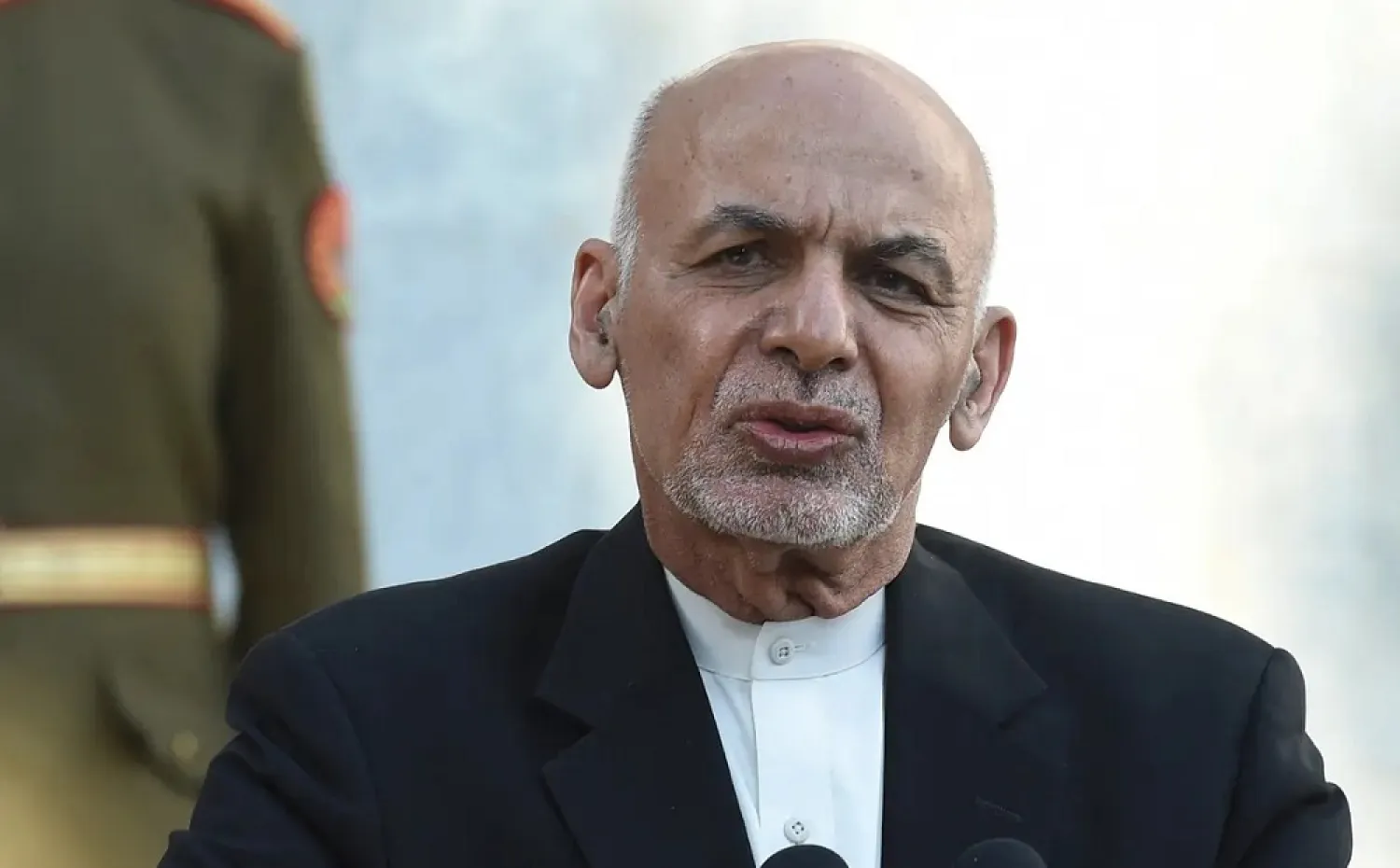
Afghan President Ashraf Ghani speaks during a joint press conference with Pakistan's Prime Minister Imran Khan (not pictured) at the Presidential Palace in Kabul on November 19, 2020. (AFP)
TT

Ex-Afghan President Says Decision to Flee Kabul Made in 'Minutes'

Afghan President Ashraf Ghani speaks during a joint press conference with Pakistan's Prime Minister Imran Khan (not pictured) at the Presidential Palace in Kabul on November 19, 2020. (AFP)

Former Afghan president Ashraf Ghani on Thursday described fleeing the Taliban's victory march on Kabul, saying the decision had been taken in "minutes" and that he did not know he was leaving the country until he was taking off.

Ghani told BBC's Radio 4 "Today" program that on the morning of August 15, 2021, the day the extremists took control of the capital and his own government fell apart, he had "no inkling" that it would be his last day in Afghanistan.

But by that afternoon security at the presidential palace had "collapsed," he said.

"If I take a stand they will all be killed, and they were not capable of defending me," Ghani said in the interview, conducted by former UK chief of defense staff, General Nick Carter.

His national security adviser, Hamdullah Mohib, was "literally terrified," Ghani said. "He did not give me more than two minutes."

He said his instructions had originally been to fly by helicopter to southeastern Khost city.

But Khost had fallen in the Taliban's lightning offensive which saw provincial capitals topple around the country in the days ahead of the withdrawal of international forces, set for the end of August.

The eastern city of Jalalabad, on the border with Pakistan, had also fallen, he said.

"I did not know where we will go," Ghani said.

"Only when we took off did it become clear that we were leaving."

Ghani has been in the United Arab Emirates ever since.

He has been highly criticized in Afghanistan for leaving, with Afghans now trapped under the Taliban's harsh rule accusing him of abandoning them -- and of taking millions of dollars in cash, a claim he "categorically" denied again on Thursday.

The former World Bank official has released several previous statements on his departure, admitting that he owed the Afghan people an explanation. Thursday was his first interview.

He said again that his first concern had been to prevent brutal street fighting in the capital, already packed with tens of thousands of refugees fleeing violence elsewhere in the country.

And he said his decision to leave was "the hardest thing".

"I had to sacrifice myself in order to save Kabul and to expose the situation for what it is: a violent coup, not a political agreement."

But even if he'd stayed, he said, he could not have changed the outcome, which has seen the Taliban establish their new regime as the country faces one of the worst humanitarian crises in history.

"Unfortunately I was painted in total black," he said. "It became an American issue. Not an Afghan issue."

"My life work has been destroyed, my values have been trampled on and I've been made a scapegoat," he said.

Afghans had "rightly" blamed him, he said. "I completely understand that anger, because I share that anger."


Millions Join Spain Housing Strike, Scores Arrested in Clashes

A worker sweeps broken glass behind the shattered entrance door of an Apple store in Plaza de Catalunya in Barcelona, northeastern Spain, 12 November 2026. EPA/QUIQUE GARCIA
TT

Millions Join Spain Housing Strike, Scores Arrested in Clashes

A worker sweeps broken glass behind the shattered entrance door of an Apple store in Plaza de Catalunya in Barcelona, northeastern Spain, 12 November 2026. EPA/QUIQUE GARCIA

More than 3 million Spaniards took to the streets on Wednesday as part of a mostly peaceful general strike protesting against a growing housing crisis, unions said, though 115 people were arrested, mainly during evening clashes in Barcelona and Madrid.

Workers endured stormy weather to set up picket lines, with large marches in Madrid, Barcelona and other cities across Spain less than three weeks before a snap general election.

In the evening, clashes between police and some protesters erupted in Barcelona. Furniture was set alight in the street after the main march ended, Reuters video showed.

Tensions also rose in Madrid, when riot police used foam bullets, tear gas and pepper spray to disperse protesters around the central Plaza de España, a Reuters witness said.

Police forces reported at least 115 arrests nationwide from incidents linked to the general strike, including blockades of offices and industrial estates.

Sumar, the Socialist government's junior coalition partner, called on Thursday for Interior Minister Fernando Grande-Marlaska to resign over what it described as an "excessive and ‌disproportionate" response by police.

Amnesty ‌International said it had documented excessive use of police force including blows with batons on peaceful protesters and ‌indiscriminate use ⁠of pepper ⁠spray on crowds.

Grande-Marlaska on Thursday ordered investigations into the incidents, the Interior Ministry said.

It was the first general strike since workers downed tools in 2012 against austerity measures during the euro zone debt crisis. The Tenants Union said more than 3 million people, including unionized workers as well as students, pensioners, tenants, the self-employed and jobless, took part in demonstrations to protest against rising rents and evictions.

A strike by Spanish women in 2018 drew 5 million people, according to unions.

Prime Minister Pedro Sanchez hopes to harness voter resentment over housing in the November 29 election to shift the attention away from a deadly migration rush into Ceuta and a train crash last month. His government has defended its handling of the disasters but so far, his Socialist Party still trails in opinion polls.

Unions described the strike as a success even though participation ⁠was uneven across Spain, with the strongest support in coastal regions where housing pressures have been particularly acute.

SHOPS SHUTTERED

On ‌Madrid's Gran Via, one of the capital's main shopping streets, protesters cheered as stores including Primark, H&M and ‌Pull&Bear brought down their shutters amid a heavy riot police presence.

"We're going to close the Mango store," the protesters chanted as they jangled sets of house keys above ‌their heads.

Spain has a deficit of about 750,000 homes, which is set to grow to more than a million by 2028, according to the ‌central bank.

With fewer people able to afford a home, renting has increased sharply, putting pressure on that market. The average rental price of €1,176 ($1,315) is equivalent to about 98.7% of a young person's average monthly salary in Spain, according to the Youth Council of Spain.

"I’m 36 years old and I still can’t move out on my own," said Madrid resident Jesus Gonzalez, who works in a hospital IT department and supports the strike. "Rents just keep going up, house prices just keep going up, and it’s simply impossible."

TURNOUT STRONGEST AT PORTS, ‌AUTO PLANTS

Angela de Miguel, vice president of Spain's main business lobby CEOE, said the strike was counterproductive because small businesses were also affected by the housing crisis, since shortages of homes made recruitment more challenging.

Speaking on ⁠state broadcaster TVE, she said the ⁠solution was to build more homes and to lower taxes on construction and the home-buying process.

Two heavy storms, dubbed Charles and Bruna, threatened plans for massive protest marches in the afternoon, with unions suspending demonstrations in the southern port city of Cadiz and other cities in the south.

According to UGT and CCOO, participation in the strike reached 90% at ports and in the automotive sector, with "total stoppages" reported at factories including Volkswagen's in Navarre and SEAT's in Barcelona.

LESS IMPACT DUE TO REMOTE WORKING

Barcelona's metro said no trains would run outside peak commuting hours, while Madrid's metro said peak-hour usage was down 42% compared with the same period last week.

However, with more people able to work remotely and the increasing weight of services in Spain’s economy, the impact of the strike is likely to be less pronounced than in previous years, according to Miguel Cardoso, chief economist at BBVA Research. He estimated that the strike could shave 0.1% to 0.2% off Spain’s annual gross domestic product.

Spain's fast-growing hospitality and finance industries are less unionized than the public and industrial sectors.

Unions said they would file a criminal complaint against what they described as a “disproportionate” response during a police operation involving tear gas and batons that injured 20 protesters. The Interior Ministry did not immediately respond to a request for comment.

The strike follows weeks of demonstrations provoked by the eviction and subsequent death of an 87-year-old woman in Madrid.

Those protests, along with parliament's rejection last month of government decrees aimed at curbing evictions and limiting rent pressures, prompted Sanchez to call the snap election.


Iran's Guards Say 'Accident' Left Two Tankers on Fire in Hormuz

FILE PHOTO: A drone view shows vessels near the Strait of Hormuz, as seen from Musandam, Oman, August 28, 2026. REUTERS/Stringer/File Photo
TT

Iran's Guards Say 'Accident' Left Two Tankers on Fire in Hormuz

FILE PHOTO: A drone view shows vessels near the Strait of Hormuz, as seen from Musandam, Oman, August 28, 2026. REUTERS/Stringer/File Photo

Iran's Revolutionary Guards said Thursday that two tankers carrying over four million barrels of oil had caught fire after an "accident" on an unauthorized route in the Strait of Hormuz.

Since the outbreak of the Middle East war in late February, Tehran has heavily restricted traffic through the strategic shipping channel, insisting vessels use routes it has approved.

The United States has in response imposed a naval blockade on Iranian ports and helped tankers travel the strait, which normally carries about one-fifth of global oil, reported AFP.

"Last night, two tankers -- acting in violation of regulations and despite repeated warnings from the Revolutionary Guards Navy regarding the unauthorized and dangerous nature of the southern maritime route -- were involved in an accident while traversing this prohibited path in the strait," the Guards said in a statement.

They did not specify the nature of the "accident" but said it left the two tankers immobilized after they were hit with a "violent explosion".

"These two supertankers were carrying a combined total of over four million barrels of oil, which are now ablaze -- a consequence of the blind trust placed in the aggressive American military," the statement said.

Iranian forces have made multiple announcements in recent weeks of ships catching fire attempting to use routes that Tehran considers off-limits.

Tehran has often said they struck mines, but the US military recently claimed all mines had been cleared from the strait.


10 Police, 18 Militants Killed in Pakistan's Northwest

A wounded policeman receives treatment at a hospital in Kohat in northwestern Pakistan on November 11, 2026 following an attack on a police convoy. Basit SHAH / AFP
TT

10 Police, 18 Militants Killed in Pakistan's Northwest

A wounded policeman receives treatment at a hospital in Kohat in northwestern Pakistan on November 11, 2026 following an attack on a police convoy. Basit SHAH / AFP

Gunmen attacked police during an operation against illegal gold mining in northwestern Pakistan on Wednesday, killing 10 officers, while 18 militants died in the ensuing fighting, an official police statement said.

A statement by provincial police in Pakistan's Khyber Pakhtunkhwa said officers were returning from a mine in the Gumbat area of Kohat district when militants opened fire on them.

In addition to the 10 police and 18 militant deaths, 12 police personnel were wounded, the statement said.

In the aftermath of the clashes, the Pakistani Taliban, the Tehreek-e-Taliban Pakistan (TTP), claimed responsibility for a series of attacks across the country, including one on a police convoy in the Gumbat area.

Earlier, a senior administrative official in Kohat told AFP that militants set two police vehicles on fire during the assault, while two other police vehicles and one private vehicle were missing.

Another senior administrative official in the Orakzai area of Kohat said that 10 militants belonging to the TTP were killed during a separate operation in the district.

A large quantity of weapons was also recovered from the militants, the official added.

Security forces are battling an intensifying militancy in the border province they say emanates from Afghanistan, an accusation its Taliban government denies.

A spokesman for a local emergency service earlier on Wednesday said there had been a "firing incident involving police personnel" in Kohat district, adding that rescue workers were treating a dozen wounded officers.

- 'Open war' -

Relations between Pakistan and Afghanistan have been fraught since the Taliban authorities took power in 2021, and worsened after deadly border clashes in October last year that led to near-total closure of the border.

Clashes subsided after mediation, but the conflict intensified again in February, with Pakistan declaring "an open war" on its neighbor.

In a statement, Pakistan's President Asif Ali Zardari condemned the attack, expressed his sorrow over the deaths of the police and said "national determination to completely eradicate terrorism from the country is unwavering".

Pakistan's foreign minister Ishaq Dar said he was "deeply grieved by the loss of precious lives in a cowardly terrorist attack on our police personnel in Kohat".

Islamabad accuses Kabul of allowing militants responsible for deadly attacks on Pakistani territory to operate from its soil. Afghanistan's Taliban authorities have denied the allegations.

Hundreds of civilians have been killed in fighting between the two countries since October last year, according to figures from the United Nations' mission in Afghanistan.

Earlier this month, militants in Khyber Pakhtunkhwa killed two police officers assigned to protect a polio vaccination team travelling near the Afghan border.

The province was placed under emergency rule last month in a move authorities said came in reaction to the failure by the provincial government to act against militancy.

The imposition of emergency measures sidelined the last remaining bastion of power for jailed former prime minister Imran Khan's Pakistan Tehreek-e-Insaf (PTI) party.

The special constitutional measures also set off a province-wide crackdown on Khan's supporters, with hundreds of detentions.