Two TV Journalists Freed in Sudan after Mass Street Protests

Sudanese demonstrators in the streets of the capital Khartoum in protest at the army's October 25 coup. (AFP)
TT

Two TV Journalists Freed in Sudan after Mass Street Protests

Sudanese demonstrators in the streets of the capital Khartoum in protest at the army's October 25 coup. (AFP)

Sudanese security forces have released two journalists from Saudi Arabia's Asharq television channel, a day after detaining them as deadly violence flared during renewed protests against the military government, the station said Friday.

During Thursday's protests in and near Khartoum, "five uniformed security officers" held journalists Maha al-Talb and Sally Othman and their teams in their office for several hours, the channel said.

Sudan has been gripped by turmoil since military leader General Abdel Fattah al-Burhan launched a coup on October 25 and detained Prime Minister Abdalla Hamdok.

Hamdok was reinstated on November 21, but mass protests have continued as demonstrators distrust Burhan's promises of seeking to guide the country toward full democracy.

Protesters charge that the deal simply aims to give the cloak of legitimacy to the generals, whom they accuse of trying to continue the regime built by former president Omar al-Bashir, who was toppled in 2019 following mass protests.

In the worst street clashes since Hamdok's return, five demonstrators were killed and dozens wounded by bullets on Thursday, said the independent Doctors' Committee, which is part of the pro-democracy movement.

Authorities also cut phone lines and the internet and cracked down on media, also including the satellite channel Al-Arabiya.

Othman was interrupted by security forces in the middle of a live broadcast and can be heard saying in a clip shared widely on social networks: "I will not be able to continue, the authorities are now forbidding me to continue with you".

Sudanese police blamed the incident on "reprehensible individual actions" which would be investigated.

The Doctors' Committee charged that "crimes against humanity" were committed in Omdurman, twin city of the capital Khartoum, on Thursday.

It said five demonstrators were killed by bullets to the head or chest, and that ambulances were blocked and at least one seriously injured person was forcibly removed from an ambulance by the security forces.

A police spokesman said four people died in Thursday's unrest and 297 people were injured, "including 49 police officers".

He also said "three police vans were set on fire" and accused protest "leaders clearly hostile to the security forces" of having sought to "turn a peaceful march into violence and confrontations with the security forces".

Street clashes since the October coup have claimed 53 lives and left hundreds wounded, and supporters of civilian rule in Sudan have continued to call for protests.


States Backing UN Peacekeepers in Lebanon Voice 'Deep Alarm' at Hostilities

Members of the UNIFIL peacekeeping force enter a bus at the site of an Israeli strike at the northern entrance of the southern city of Sidon, on November 7, 2024, amid the ongoing war between Israel and Hezbollah.  (Photo by Mahmoud ZAYAT / AFP)
Members of the UNIFIL peacekeeping force enter a bus at the site of an Israeli strike at the northern entrance of the southern city of Sidon, on November 7, 2024, amid the ongoing war between Israel and Hezbollah. (Photo by Mahmoud ZAYAT / AFP)
TT

States Backing UN Peacekeepers in Lebanon Voice 'Deep Alarm' at Hostilities

Members of the UNIFIL peacekeeping force enter a bus at the site of an Israeli strike at the northern entrance of the southern city of Sidon, on November 7, 2024, amid the ongoing war between Israel and Hezbollah.  (Photo by Mahmoud ZAYAT / AFP)
Members of the UNIFIL peacekeeping force enter a bus at the site of an Israeli strike at the northern entrance of the southern city of Sidon, on November 7, 2024, amid the ongoing war between Israel and Hezbollah. (Photo by Mahmoud ZAYAT / AFP)

Around 30 countries, including those with United Nations peacekeepers in Lebanon, voiced concern Wednesday over renewed fighting after Israel launched strikes in retaliation for attacks by Hezbollah.

"We troop contributing countries to the UN peacekeeping force in Lebanon, joined by several other member states, express our deep alarm at the escalation of hostilities in Lebanon," Jerome Bonnafont, the French ambassador to the United Nations, told reporters in New York, Reuters reported.

"Faced with war, Lebanon must be supported. Its sovereignty and territorial integrity must be preserved. We express our full solidarity with Lebanon and the Lebanese people," he added in the joint statement.

Bonnafont said the countries he represented, including France, Britain, Germany, India and Korea, "condemn in the strongest terms" Hezbollah's attacks.

He spoke as the Security Council was to meet at the UN headquarters to discuss the uptick in fighting in Lebanon, which has left 570 people dead, according to the country's health ministry.

Israel's UN envoy Danny Danon said Wednesday that Israeli forces will continue to operate in Lebanon "as long (as) there will be a threat against us."

"Israel does not want to be operating, but Israel will not accept rockets fired at our people, and we will do whatever is necessary to stop them," Danon told reporters.


Shrapnel from Bombing Kills Woman in Iraq

Members of Kataeb Hezbollah attend the funeral in Baghdad of comrades killed in a strike on the Syrian border (file photo – Reuters)
TT

Shrapnel from Bombing Kills Woman in Iraq

Members of Kataeb Hezbollah attend the funeral in Baghdad of comrades killed in a strike on the Syrian border (file photo – Reuters)

Shrapnel killed a woman following a strike on an arms depot belonging to an Iran-backed armed group in Iraq, health and security officials told AFP.

A security source said "a bombing targeted an arms depot at a military base", which mainly hosts the powerful Asaib Ahl al-Haq group, near the town of Al-Suwaira, southeast of Baghdad.

He added that "a woman was martyred when shrapnel from a rocket fell near her after the strike" in the town in Wasit province.

A local health official confirmed her death and said another person was seriously wounded.

The military base belongs to the Hashed al-Shaabi, or the Popular Mobilization Forces, a former paramilitary coalition now integrated into Iraq's regular army.

It also encompasses brigades from Iran-backed groups, including the US-blacklisted Asaib Ahl al-Haq.

Since the start of the Middle East war, bases belonging to the Hashed al-Shaabi have been hit several times by strikes blamed on the US and Israel.

At least 20 fighters have been killed so far, according to an AFP tally based on figures from the armed groups.


Israeli Settler Violence Rises in West Bank Under Iran War Curbs

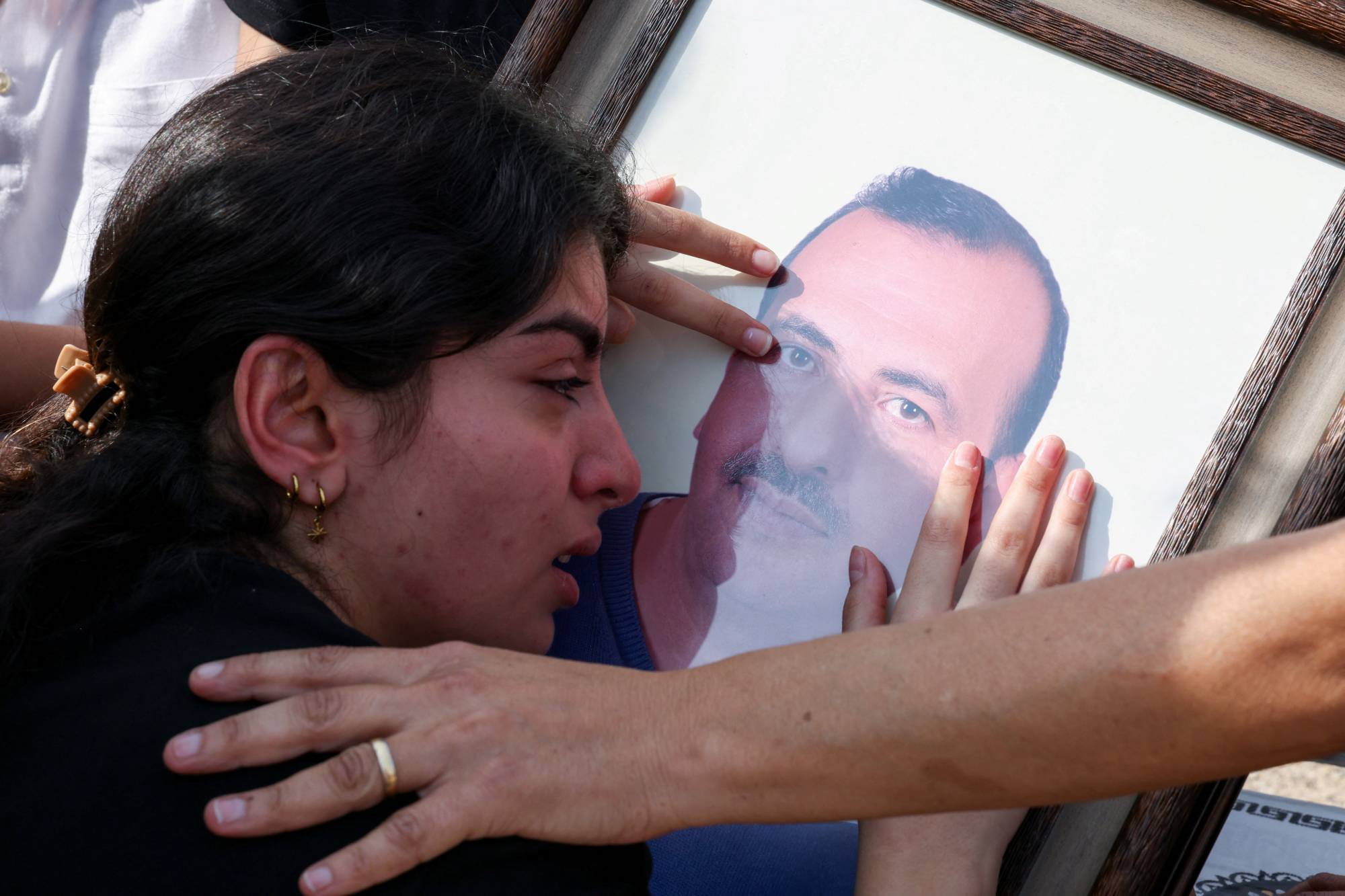
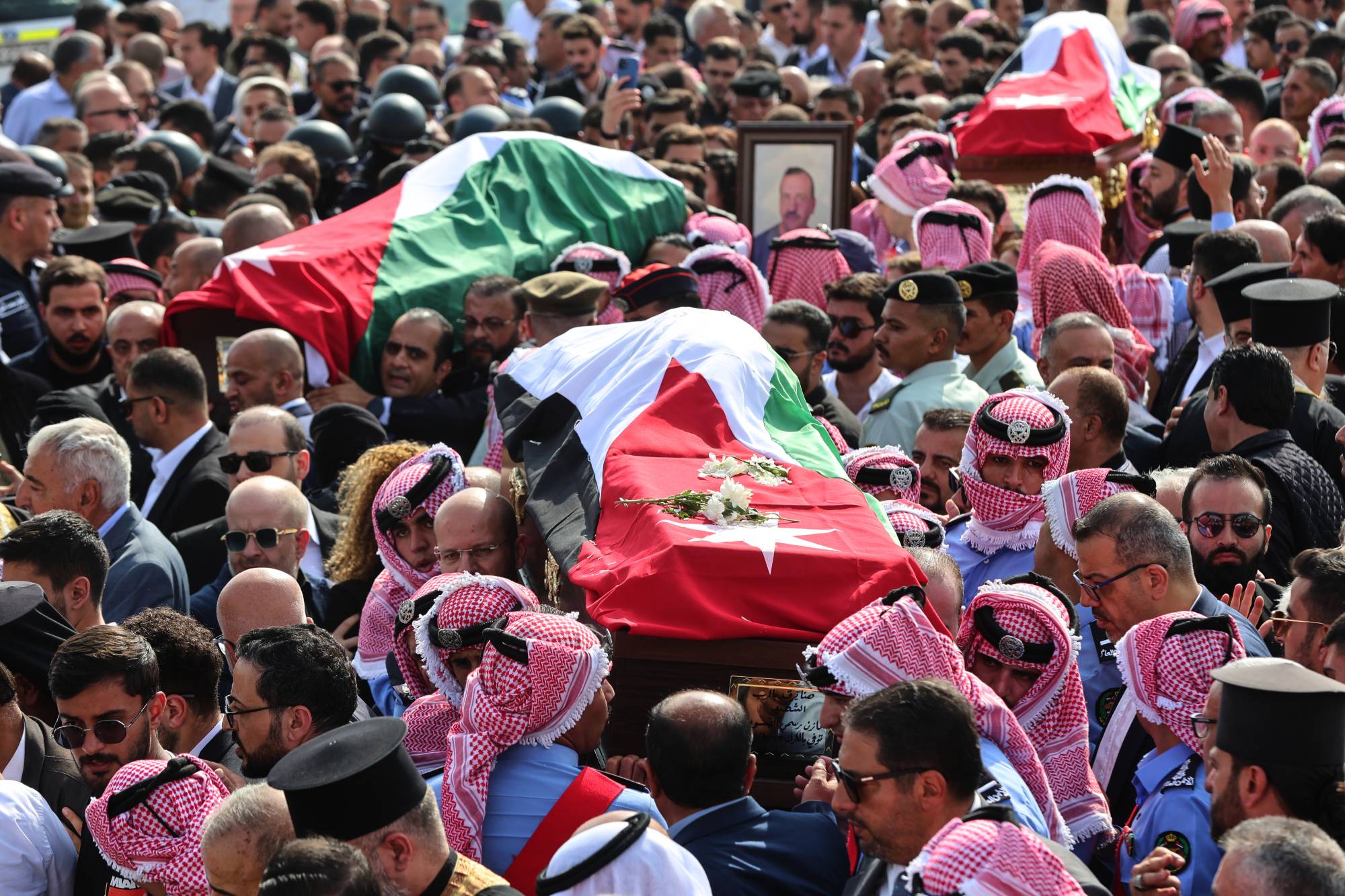
Mourners carry the bodies of three Palestinians killed in a reported attack by Israeli settlers in the town of Abu Falah, northeast of Ramallah in the occupied West Bank, during the funeral on March 8, 2026. (Photo by Zain JAAFAR / AFP)
TT

Israeli Settler Violence Rises in West Bank Under Iran War Curbs

Mourners carry the bodies of three Palestinians killed in a reported attack by Israeli settlers in the town of Abu Falah, northeast of Ramallah in the occupied West Bank, during the funeral on March 8, 2026. (Photo by Zain JAAFAR / AFP)

Israeli settlers in the occupied West Bank are taking advantage of curbs on movement imposed during the war on Iran to attack Palestinians, with military roadblocks preventing ambulances reaching victims quickly, rights groups and medics say.

Settlers have killed at least five Palestinians in the West Bank since the United States and Israel began airstrikes against Iran on February 28, according to the Palestinian health ministry. A sixth man died after inhaling teargas fired during an attack, according to Israeli rights group B'Tselem.

Israel's military blocked many West Bank roads with iron gates and mounds of earth on the first day of the war, and has largely shut crossings with Israel.

The Israeli military says the curbs are preemptive measures while it is carrying out airstrikes on Iran and against Lebanese group Hezbollah, which has fired missiles at Israel in solidarity with Tehran.

Palestinians in remote West Bank villages say the roadblocks have left them increasingly exposed to settler violence.

The Israeli military has also continued to carry out the raids it frequently conducts in Palestinian cities and towns during peacetime to arrest Palestinians, often without charge, they say.

A spokesperson for the Yesha Council, which represents Jewish settlements, did not immediately respond to a Reuters request for comment on the attacks.

Malak ⁠Beirat's husband, Thaer, ⁠was one of two Palestinians who residents and the Palestinian health ministry say were shot dead by settlers before dawn on Sunday in Abu Falah, north of the city of Ramallah.

"Thaer loved life. I never expected he would die," said Beirat, fighting back tears as she sat with her two children.

Witnesses told Reuters that when over 100 settlers gathered on the outskirts of Abu Falah, a local WhatsApp group rallied men to protect the small village. The initial confrontation involved stone throwing, but armed settlers arrived later and began shooting, they said.

Beirat's husband was shot dead while trying to protect a house from attack, a man who helped defend the village said.

Blood could still be seen on Monday in olive groves at the scene of the attack, where villagers have erected ⁠two Palestinian flags at the spots where the two men were killed - one for each victim.

A third Palestinian died after the attack. B'Tselem said his death was probably caused by the effect of teargas fired by Israeli troops deployed to the village during the attack.

The Israeli military says an investigation has been launched into the incident and that it condemns "violence of any kind".

Medics say the new roadblocks have led to delays in reaching injured Palestinians.

"There are obstacles - and even attacks by settlers and the military on the (medical) crews," said Ahmed Jibril, spokesman for the Palestinian Red Crescent ambulance service.

There have been over 109 reports of settler violence against Palestinians in the West Bank since the start of the war with Iran including shootings, physical assaults, property damage, and threats, said Israeli monitoring group Yesh Din.

All the reported killings of Palestinians by settlers this year were in the last week, B'Tselem said.

Settlers shot dead Amir Muhammad Shanaran in a village near the city of Hebron on Saturday, and brothers Muhammad and Fahim ‘Azem were shot dead in Qaryut southeast of the city of Nablus last Monday, the Palestinian health ministry said.

"Taking advantage of the war, armed settler ⁠militias, often operating with support from the ⁠army, continue to attack and harass Palestinian communities across the West Bank in an effort to force them out," B'Tselem said.

In three of the settler shootings, the settlers were wearing Israeli army uniform, Yesh Din said. The Israeli military did not immediately respond to a request for comment.

Palestinians accuse the military of protecting settlers rather than villagers. Israel's military denies this.

Israeli indictments of settler violence are rare. At the end of 2025, Yesh Din said that of the hundreds of cases of settler violence it had documented since the Hamas-led attacks on Israel in October 2023 that led to the Gaza war, only 2% resulted in indictments.

The United Nations says nearly 700 Palestinians were displaced by settler violence from the start of 2025 through early February 2026.

Israel's government has expanded settlements in a construction push that Finance Minister Bezalel Smotrich says is aimed at burying the idea of a Palestinian state.

Right-wing Israeli minister Yossi Dagan announced on Wednesday the establishment of a new settlement in a strategic position in the mountain overlooking Nablus, one of 22 new settlements announced by the Israeli government last May.

Palestinians have long sought an independent state in the West Bank, Gaza and East Jerusalem, territories Israel captured and occupied in the 1967 Middle East war.

Over 700,000 settlers live in East Jerusalem and the West Bank among more than 3 million Palestinians, according to a European Union report in 2024.
Most of the world considers Israel's settlement activity in the West Bank illegal under international law relating to military occupations. Israel disputes this view.