


Sudan: The Aftermath of Hamdok's Resignation

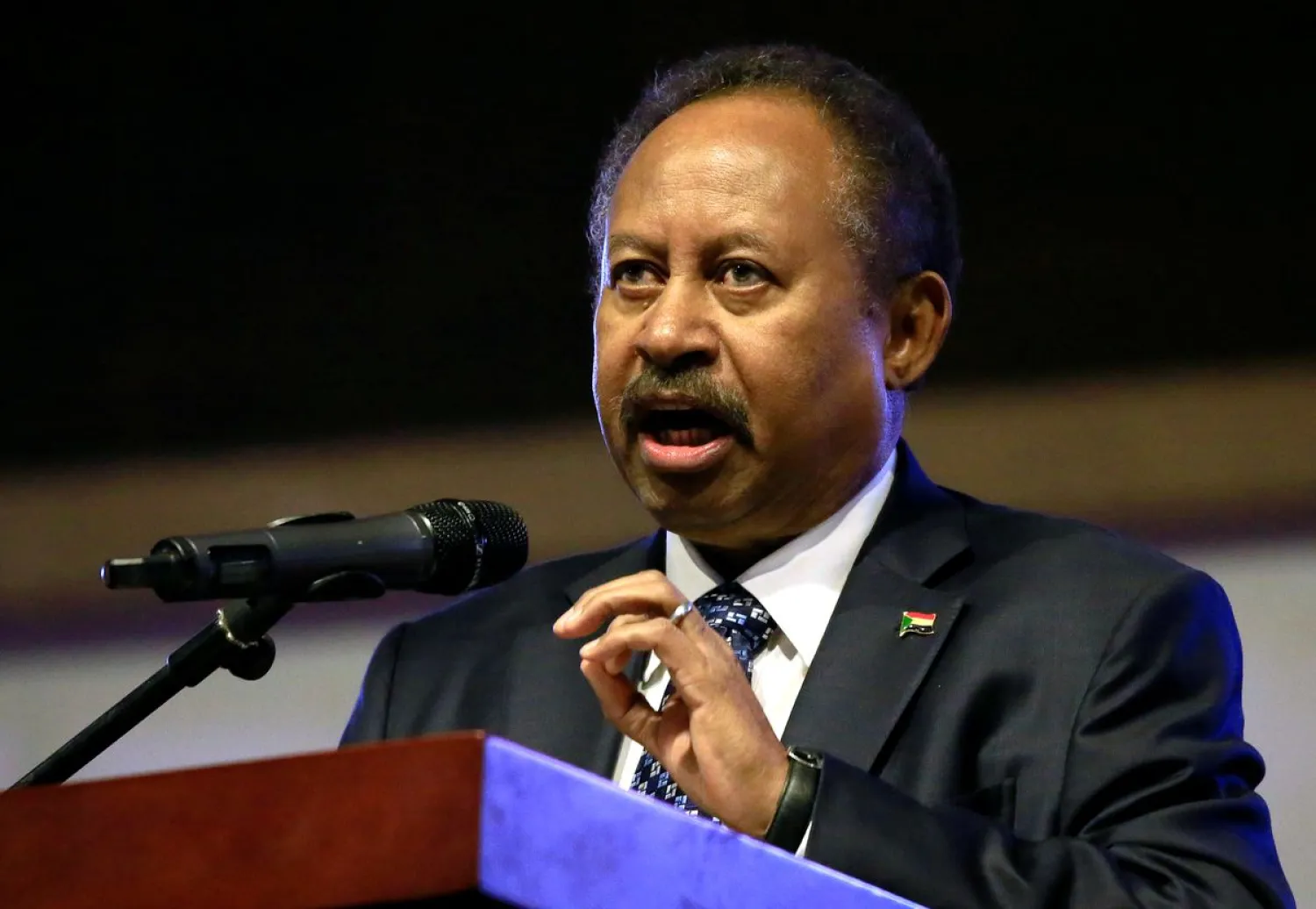
Prime Minister Abdalla Hamdok addresses people at the Friendship Hall in Khartoum, Sudan December 25, 2019. Picture taken December 25, 2019. (Reuters)
TT

Sudan: The Aftermath of Hamdok's Resignation

Prime Minister Abdalla Hamdok addresses people at the Friendship Hall in Khartoum, Sudan December 25, 2019. Picture taken December 25, 2019. (Reuters)

Prime Minister Abdalla Hamdok threw the Sudanese political scene into disarray by announcing his resignation and therefore compounding the crisis and division in the country.

It appears as though the hopes that were pinned on Hamdok to help Sudan out of its plight and lead it towards becoming a stable, modern and prosperous state have all but evaporated.

In his resignation speech, Hamdok said his first and second governments had faced fateful challenges and massive difficulties. The end result was more division between the military and civilian partners that reflected on the government and society and hampered the state on various levels.

Hamdok had warned that the division had reached society and its various segments. Hate speech, accusations of treason and failure to recognize the other had started to emerge in the country, while dialogue appeared impossible between the parties. This all rendered the transition process fragile and fraught with hurdles and challenges.

Hamdok's resignation was largely expected among political and popular circles. Speculation over his resignation had occupied the country for about two weeks.

His eventual stepping down has exposed new flaws and left the country vulnerable and fearful of slipping into chaos and beyond.

Since last Sunday, the political scene was grappling with major questions over the fate of the country in wake of the vacuum left by Hamdok's resignation. Who will succeed him? Constitutionally, who has the right to appoint a new prime minister, knowing that work on the new constitutional document had come to a halt since the military coup on October 25. Does the current sovereign council, which was appointed by army commander, Abdul Fattah al-Burhan, have the authority to name a new premier? Or will an agreement be reached in coming days over another side that can?

It appears as though the leaders of the army are aware of what will happen. Burhan had underscored during a meeting with senior military leaders on Monday the need to form an independent caretaker government comprised of experts within weeks. The ministers would be tasked with specified duties that are agreed on by all Sudanese. Reports have said that a small committee would be formed in order to meet with civilian figures to agree on a new prime minister.

The question here is how will the civilian component react to the measures the army is determined to carry out? Will it approve of them or will the crisis escalate again?

Deputy Chairperson of National Ummah Party (NUP) Dr. Ibrahim Al-Amin said the measures announced by the army on October 25 - that effectively eliminated their civilian partner, dissolved the government, and removed articles from the constitutional document that governed the transitional period - were viewed by the civilian component as a total coup.

Any decisions taken after this are therefore considered unconstitutional. This includes the appointment of a prime minister, he added.

"At the moment, no party enjoys the constitutional right to name a new prime minister. The country is now ruled by a small group of people and they are managing affairs as they like," he remarked.

Burhan has two choices, said Al-Amin. He can continue with his coup and appoint a new prime minister. In this case, he will be confronted with more rejection, division, popular anger, violence and blood, and perhaps even the collapse of the state contract.

His other option is reconsidering his coup, announcing courageous decisions and ending the current collapse, added Al-Amin.

Meanwhile, the media has leaked the names of potential prime minister candidates, including former finance minister in Hamdok's first government, Ibrahim al-Badawi, who confirmed that he has been contacted, but demanded that national consensus, including the approval of the youth revolution bloc, be reached before he takes on the job.

Other candidates include Sudan's former ambassador to Washington, Noureddine Sati, who told Asharq Al-Awsat that he learned through social media that he was being considered for the post.

He stressed that he would refuse the candidacy, saying that all civilian forces of the revolution should be the ones to hold consultations to name a prime minister, who will play a pivotal role in ending the current crisis.

He added: "This is an opportunity for the revolutionary forces to prove their ability to overcome their differences and agree on a roadmap and a joint program over what remains of the transitional period."

Furthermore, he stressed that the sovereign council was not qualified to name Hamdok's successor.

"The sovereign council is tasked with approving the prime minister, who is chosen by the civilian component," he explained.

Hamdok's departure from the political scene "has complicated the situation and led to constitutional vacuum and caused an imbalance between the civilian and military components," Sati remarked.

He warned that Sudan was facing the worst case scenario because no political solution is in sight.

"The situation will only become right when the constitutional authority is reinstated, the constitutional document clause on naming a prime minister from the civilian component is implemented and a civilian government with executive powers is formed to lead the country to safety," he continued.

He urged the need to listen to the demands of the youth as they are the real force of change and they will form the future.

Journalist and political analyst Al-Gamil Al-Fadil shared a different view. He believes that Hamdok's exit from the political scene will have great benefits and create positive momentum that would revive the revolutionary movement.

He said that during the recent period, the military component had used Hamdok to avoid implementing the goals of the revolution.

"The mask now has fallen," he stated.

He explained that it was in the interest of the generals and the old political camp to have Hamdok around.

The old political camp had sought to reproduce past political practices that were adopted in the first democratic phase in the 1960s, the second in the 1980s and third in 2019.

"Hamdok was like an alien body that was planted in the political scene. His fabric is not aligned with the spirit of the constitution," said Al-Fadil.

"Revolution is an act of rebellion and rejection. It is an expression of change and attempt to reap several gains and hang on to them. His departure from the scene is therefore a rare opportunity for the revolutionary forces to retake the spotlight," he stressed.



Israeli Military Says Detained Suspected ISIS Militant in Syria

FILE PHOTO: Israeli military vehicles manoeuvre along the Israel-Lebanon border, as seen from northern Israel, November 24, 2025. REUTERS/Shir Torem/File Photo
TT

Israeli Military Says Detained Suspected ISIS Militant in Syria

FILE PHOTO: Israeli military vehicles manoeuvre along the Israel-Lebanon border, as seen from northern Israel, November 24, 2025. REUTERS/Shir Torem/File Photo

The Israeli military said on Saturday its forces had arrested a suspected ISIS militant in Syria earlier this week and taken him back to Israel.

In a statement, the military said that on Wednesday "soldiers completed an operation in the area of Rafid in southern Syria to apprehend a suspected terrorist affiliated with ISIS.”

"The suspect was transferred for further processing in Israeli territory," the statement said.


Report: Colombian Mercenaries in Sudan ‘Recruited by UK-registered Firms’

(COMBO) This combination of satellite images released by Planet Labs PBC on December 19, 2025, shows from top left to bottom right:- the graves near the United Nations Children's Fund (UNICEF) headquarters in El-Fasher, taken on the following dates: on October 8, 2025, on October 27, 2025, on January 15, 2025, and on December 14, 2025. (Photo by Handout / Planet Labs / AFP)
TT

Report: Colombian Mercenaries in Sudan ‘Recruited by UK-registered Firms’

(COMBO) This combination of satellite images released by Planet Labs PBC on December 19, 2025, shows from top left to bottom right:- the graves near the United Nations Children's Fund (UNICEF) headquarters in El-Fasher, taken on the following dates: on October 8, 2025, on October 27, 2025, on January 15, 2025, and on December 14, 2025. (Photo by Handout / Planet Labs / AFP)

An exclusive investigation by UK’s The Guardian has found companies hiring hundreds of Colombian fighters for Sudan’s Rapid Support Forces.

A one-bedroom flat off north London’s Creighton Road in Tottenham is, according to UK government records, tied to a transnational network of companies involved in the mass recruitment of mercenaries to fight in Sudan alongside the RSF, said the report.

Colombian mercenaries were directly involved in the RSF’s seizure of the southwestern Sudanese city of El Fasher in late October, which prompted a killing frenzy that analysts say has cost at least 60,000 lives.

“The flat in Tottenham is registered to a company called Zeuz Global, set up by two individuals named and sanctioned last week by the US treasury for hiring Colombian mercenaries to fight for the RSF,” said The Guardian.

“Both figures – Colombian nationals in their 50s – are described in documents at Companies House, the government register of firms operating in the UK, as living in Britain,” it said.

“The day after the US treasury announced sanctions on those behind the Colombian mercenary operation –December 9 – Zeuz Global abruptly moved its operation to the very heart of London. On 10 December the firm shared “new address details” Its new postcode matches One Aldwych, a five-star hotel in Covent Garden,” the report added.

Yet the first line of Zeuz Global’s new address is, confusingly, “4dd Aldwych,” which corresponds to the Waldorf Hilton hotel 100 meters away, according to The Guardian.

Both hotels said they had no link to Zeuz Global and had no idea why the firm had used their postcodes.

“It is of major concern that the key individuals the US government claims are directing this mercenary supply have been able to set up a UK company operating from a flat in north London, and even to claim that they’re resident in the UK,” said Mike Lewis, a researcher and former member of the UN panel of experts on Sudan.

When Companies House was asked if it had any knowledge of what Zeuz Global actually did, or is doing, it did not respond. The government agency would also not confirm whether the sanctioned individuals were, in fact, resident in the UK.

Contacting Zeuz proved fruitless; its website, set up in May, was labelled as “under construction” with no contact details provided.


Egyptian President Urges UN Security Council Reforms for Africa's Larger Role

In this photo, provided by Egypt's presidency media office, Egyptian President Abdel-Fattah el-Sisi, front right, greets Russian Foreign Minister Sergei Lavrov, left, before their meeting at the Presidential Palace in Cairo, Egypt, Saturday, Dec. 20, 2025. (Egyptian Presidency Media Office via AP)
TT

Egyptian President Urges UN Security Council Reforms for Africa's Larger Role

In this photo, provided by Egypt's presidency media office, Egyptian President Abdel-Fattah el-Sisi, front right, greets Russian Foreign Minister Sergei Lavrov, left, before their meeting at the Presidential Palace in Cairo, Egypt, Saturday, Dec. 20, 2025. (Egyptian Presidency Media Office via AP)

Egypt’s President Abdel-Fattah el-Sisi on Saturday reiterated calls for structural changes in the UN Security Council to grant Africa a larger role in shaping global decisions.

El-Sisi made the plea for a “more pluralistic” world order at a conference of the Russia-Africa partnership held in Cairo, which was attended by Russian Foreign Minister Sergei Lavrov and ministers from more than 50 African countries along with representatives from several African and regional organizations.

“The voice of Africa should be present and influential in making global decisions given the continent’s human, economic, political and demographic weight,” el-Sisi said in a statement read out by his foreign minister at the plenary session of the conference.

According to The Associated Press, he added that international financial institutions need to undergo similar reforms to ensure Africa an equitable representation.

Since 2005, the African Union has been demanding that Africa be granted two permanent seats with veto powers in the Security Council, arguing that such reforms would contribute to achieving peace and stability on the continent, which has been struggling with wars for decades.

The Security Council, which is charged with maintaining international peace and security, has not changed from its 1945 configuration: 10 non-permanent members from all regions of the world elected for two-year terms without veto power, and five countries that were dominant powers at the end of World War II are permanent members with veto power: The United States, Russia, China, Britain and France.

In his statement, el-Sisi said that the Russia-Africa ministerial conference will develop a plan to consolidate the partnership ahead of next year’s summit of heads of state.

“We remain a reliable partner for African states in strengthening their national sovereignty, both politically and in matters of security, as well as in other dimensions,” Lavrov said at the plenary session. “We’re committed to further unlocking the existing enormous potential of our practical cooperation.”