Iran, US Lock Horns over Sanctions Relief, Nuclear Curbs in Vienna Talks

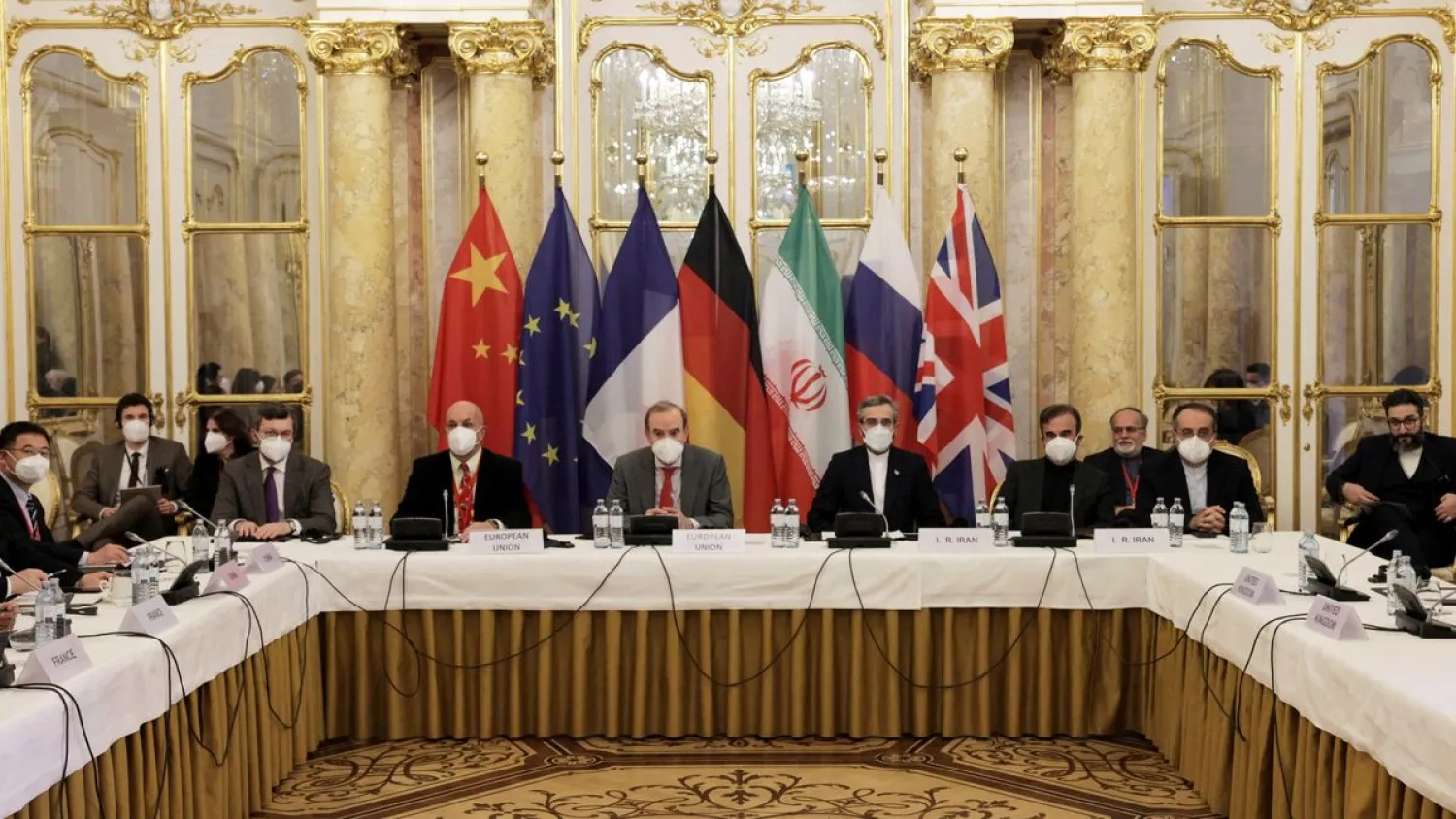
Deputy Secretary General of the European External Action Service (EEAS) Enrique Mora and Iran's chief nuclear negotiator Ali Bagheri Kani and delegations wait for the start of a meeting of the JCPOA Joint Commission in Vienna, Austria December 17, 2021. EU Delegation in Vienna/EEAS/Handout via Reuters
TT

Iran, US Lock Horns over Sanctions Relief, Nuclear Curbs in Vienna Talks

Deputy Secretary General of the European External Action Service (EEAS) Enrique Mora and Iran's chief nuclear negotiator Ali Bagheri Kani and delegations wait for the start of a meeting of the JCPOA Joint Commission in Vienna, Austria December 17, 2021. EU Delegation in Vienna/EEAS/Handout via Reuters

Iran and the United States are displaying little flexibility on core issues in indirect nuclear talks, raising questions about whether a compromise can be found soon to renew a 2015 deal that could dispel fears of a wider Middle East war, diplomats say.

After eight rounds of talks, the thorniest points remain the speed and scope of lifting sanctions on Tehran -- including Iran's demand for a US guarantee of no further punitive steps -- and how and when to restore curbs on Iran's atomic work.

The nuclear deal limited Iran´'s uranium enrichment activity to make it harder for it to develop nuclear arms -- an ambition Tehran denies -- in return for lifting international sanctions.

But former US President Donald Trump ditched the pact in 2018, saying it did not do enough to curb Iran's nuclear activities, ballistic missile program and regional influence, and reimposed sanctions that badly damaged Iran's economy.

After waiting for a year, Iran responded to Trump's pressure by gradually breaching the accord, including rebuilding stockpiles of enriched uranium, refining it to higher fissile purity and installing advanced centrifuges to speed up output.

Following months of stop-start talks that began after Joe Biden replaced Trump in the White House, Western officials now say time is running out to resurrect the pact. But Iranian officials deny they are under time pressure, arguing the economy can survive thanks to oil sales to China.

'We need guarantees'

A former Iranian official said Iran's rulers "are certain that their uncompromising, maximalist approach will give results."

France said on Tuesday that despite some progress at the end of December, Iran and world powers were still far away from reviving the deal.

The US State Department said on Jan. 4 the issues "at the heart of the negotiations" were sanctions relief and the nuclear steps that Iran would take to return the accord.

Iran insists on immediate removal of all Trump-era sanctions in a verifiable process. Washington has said it would remove curbs inconsistent with the 2015 pact if Iran resumed compliance with the deal, implying it would leave in place others such as those imposed under terrorism or human rights measures.

"Americans should give assurances that no new sanctions under any label would be imposed on Iran in future. We need guarantees that America will not abandon the deal again," said a senior Iranian official.

Iran's Nournews, a media outlet affiliated to the Supreme National Security Council, reported on Wednesday that Iran's key conditions at the talks "are assurances and verifications."

US officials were not immediately available to comment on the question of guarantees. However, US officials have said Biden cannot promise the US government will not renege on the agreement because the nuclear deal is a non-binding political understanding, not a legally-binding treaty.

Asked to comment on that US constitutional reality, an Iranian official said: "It's their internal problem."

On the issue of obtaining verification that sanctions have been removed -- at which point Iran would have to revive curbs on its nuclear program -- the senior Iranian official said Iran and Washington differed over the timetable.

"Iran needs a couple of weeks to verify sanctions removal (before it reverses its nuclear steps). But the other party says a few days would be enough to load oil on a ship, export it and transfer its money through banking system," the official said.

Threats

Shadowing the background of the talks have been threats by Israel, widely believed to have the Middle East's only nuclear weaponry but which sees Iran as a existential threat, to attack Iranian nuclear installations if it deems diplomacy ultimately futile in containing Tehran's atomic abilities and potential.

Iran says it would hit back hard if it were attacked.

A Western diplomat said "early-February is a realistic end-date for Vienna talks" as the longer Iran remains outside the deal, the more nuclear expertise it will gain, shortening the time it might need to race to build a bomb if it chose to.

"Still we are not sure whether Iran really wants a deal," said another Western diplomat.

Iran has ruled out adhering to any "artificial" deadline.

"Several times, they asked Iran to slow down its nuclear work during the talks, and even Americans conveyed messages about an interim deal through other parties," said a second Iranian official, close to Iran's negotiating team.

"It was rejected by Iran."

Asked for comment, a State Department spokesperson who declined to be identified told Reuters: "Of course we - and the whole international community - want Iran to slow down their nuclear program and have communicated that very clearly."

"Beyond that, we don't negotiate the details in public, but these reports are far off."

Other points of contention include Iran's advanced nuclear centrifuges -- machines that purify uranium for use as fuel in atomic power plants or, if purified to a high level, weapons.

"Discussions continue on Iran's demand to store and seal its advanced centrifuges ... They wanted those centrifuges to be dismantled and shipped abroad," the first official said.

Asked to comment on this question, a Western diplomat said: "We are looking for ways to overcome our differences with Iran about verification process.


France Braces for Fresh Public Sector Strike Over Pay

Minor clashes break out between protesters and riot police at the end of a march in Paris on Saturday, Nov. 14, 2026, as demonstrators called for higher wages, voiced support for the high school protest movement and opposed a proposed security bill that would expand police powers. (AP)
TT

France Braces for Fresh Public Sector Strike Over Pay

Minor clashes break out between protesters and riot police at the end of a march in Paris on Saturday, Nov. 14, 2026, as demonstrators called for higher wages, voiced support for the high school protest movement and opposed a proposed security bill that would expand police powers. (AP)

France braced for fresh protests on Tuesday after unions called a nationwide strike by public sector workers in a bid to secure pay rises, despite government efforts to ease tensions as demonstrations roil the country.

France's 5.8 million public sector employees have been called to mobilize after talks with Prime Minister Sebastien Lecornu on Friday failed to satisfy unions, which had been pushing for across-the-board pay rises since last week's boost to the minimum wage for private-sector workers.

Tuesday marks the third call for a united day of action and strikes in the public sector since September, including one earlier this month that saw hundreds of thousands of workers march and police firing tear gas as clashes broke out in some cities.

More unions joined the call after the meeting organized by Lecornu, which union representatives left saying proposed measures failed to address the urgency of the pay situation.

In Paris, a main rally is scheduled to begin at 2:00 pm (1300 GMT), with dozens of other gatherings planned across the country.

Between 40,000 and 80,000 people are expected to demonstrate in the capital, and between 220,000 and 300,000 nationwide, a police source told AFP.

The European Union's second-largest economy has been rocked by more than a month of high school blockades and cost-of-living protests, with presidential elections looming next year and the far right hoping to seize power.

Youth union organizations and Yellow Vest activists also plan to join the latest demonstrations, which come after weekend protests over grievances ranging from inflation to a proposed police law.

Some of the largely peaceful rallies have seen fringe violence, as well as accusations of police brutality.

Authorities have imposed restrictions on undeclared gatherings near several schools and universities in Paris and temporarily banned the sale of firecrackers, citing concerns about possible violence during protests.

The protests come as France races to adopt a 2027 budget under pressure to reduce its deficit.

Public-sector staff aim to pressure the government to unfreeze the pay scale point used to calculate their basic salary. In its draft budget, the government has ruled out any general pay rise for the fourth consecutive year.

This is unacceptable for the unions, which put the loss of purchasing power for public servants at 16 percent since 2017, leading to increasing numbers of public employees ending up on or close to the minimum wage against a backdrop of inflation.


Tokyo Protests After 2 Suspected Russian Aircraft Violate Airspace in Southwestern Japan

Japan's Defense Minister Shinjiro Koizumi speaks to reporters after attending the ASEAN Defense Ministers' Meeting-Plus (ADMM-Plus) in Cebu, central Philippines, Thursday, Oct. 29, 2026. (AP)
TT

Tokyo Protests After 2 Suspected Russian Aircraft Violate Airspace in Southwestern Japan

Japan's Defense Minister Shinjiro Koizumi speaks to reporters after attending the ASEAN Defense Ministers' Meeting-Plus (ADMM-Plus) in Cebu, central Philippines, Thursday, Oct. 29, 2026. (AP)

Japan said it strongly protested to Moscow on Tuesday after two suspected Russian aircraft entered its airspace off its southwestern coast, the latest incident fueling escalating tensions between the neighbors.

Defense Minister Shinjiro Koizumi told reporters the suspected Russian aircraft early Tuesday violated Japanese airspace for about five minutes near Fukuoka, long enough for the Air Self-Defense Force to scramble fighter jets and send warnings.

Japan's government has lodged "an extremely stern protest" and “strongly” demanded preventive measures be taken, Koizumi said. He did not specify the types of aircraft involved.

“The violation of the Japanese airspace by the Russian aircraft is not only a serious violation of our country's sovereignty, but also a threat to our safety,” Koizumi said. “It is absolutely unacceptable.”

The Russian aircraft flew across the Tsushima Strait, then headed south and flew above the waters between Taiwan and Japan's westernmost island of Yonaguni, Koizumi said.

Separately, South Korea’s military said several Russian military aircraft temporarily entered the country’s air defense identification zone over waters between the Korean Peninsula and Japan on Monday, though they did not violate South Korean airspace.

South Korea’s Joint Chiefs of Staff said the military had detected the aircraft before they entered the zone and scrambled fighter jets. The South’s military did not disclose the number of Russian aircraft it detected or what types of planes they were.

Koizumi did not comment on why the violations took place but said Japan continues to closely monitor Russian military activity “with strong interest."

Japan has raised growing concern over growing joint military activity between Russia and China around the Japanese coasts.

The airspace violation was the latest sign of deteriorating relations between the two countries. Tensions have risen since Russian President Vladimir Putin visited Iturup in August, one of four Russian-controlled islands off Japan’s northern coast that Tokyo also claims.

Tensions escalated in mid-October after the arrest of a Japanese journalist in Russia on suspicion of spying. Despite repeated protests and demands for his immediate release, the journalist, who works for the Hokkaido newspaper, remains in custody.

Earlier this month, Russia placed several subsidiaries of Japan Tobacco Inc. under the temporary management of a Russian company following a presidential order issued by Putin. Japan protested and demanded the measure be withdrawn.

The Soviet Union seized the Kuril Islands from Japan in the final days of World War II. The territorial dispute has prevented the two countries from signing a peace treaty formally ending hostilities.


Iranian Leaders Fret Over Public Mood as Gas Shortages Add to War Ills

People visit a heating equipment store, amid a gas shortage, in Tehran, Iran, November 14, 2026. Majid Asgaripour/WANA (West Asia News Agency) via Reuters
TT

Iranian Leaders Fret Over Public Mood as Gas Shortages Add to War Ills

People visit a heating equipment store, amid a gas shortage, in Tehran, Iran, November 14, 2026. Majid Asgaripour/WANA (West Asia News Agency) via Reuters

Iran shows no sign of making concessions in the war with the US, but its warnings to citizens of gas shortages this winter are the latest sign of its own vulnerabilities in the conflict, with its ports blockaded and infrastructure hammered by US strikes.

The government said last week that, though Iran has had gas shortages before, they would be more severe this winter because of war damage to processing plants and most regions would be affected.

Toiling under the effects of a war that has intensified rampant inflation and destroyed millions of jobs, Iranians face growing hardships that senior figures fear will deepen divisions still raw from the crushing of mass protests last winter.

"The reality is that if our gas gets cut off, we'll have to close down and go home," said Seyyed Ahmad Seyyedi, a street vendor.

"This war must end so that we can return to normal life and all the problems and high prices can come to an ‌end. Continuing life under ‌these conditions is difficult," said Mina Lahrasabi, 65, who works in a rice factory ‌near ⁠Iran's Caspian coast.

A ⁠senior Iranian official and an Iranian security official told Reuters the country's hierarchy was increasingly concerned about the situation, with the internal fuel shortage adding to worries of public unrest.

There have been no notable protests against the ruling system since the war began on February 28 with US and Israeli strikes that killed Supreme Leader Ali Khamenei, but domestic intelligence agencies were on alert, the security official said.

The agencies were closely monitoring for any sign of opposition and believed the US might seek to provoke street demonstrations, the security official added.

The senior official warned that the increasingly difficult living standards faced by the Iranian population were getting harder for people ⁠to withstand, describing it as a fire smoldering beneath ashes.

"This is the most severe ‌siege imposed on us since the revolution," said Iranian analyst Saeed Leylaz.

GROWING SHORTAGES

At ‌a heater company in Tehran, salesman Amin Sha'bani said the prospect of a cold winter was concerning – and that customers were increasingly considering ‌electric products rather than gas, though both were often now too expensive for customers.

"Given what has happened in the past ‌nine months, with power plants attacked, it's perfectly natural to worry that the weather will get colder," he said.

Although Iran is a major gas producer controlling part of the world's biggest gas field, it has sometimes been unable to meet domestic consumption because of outdated equipment, a problem worsened by international sanctions.

Government spokesperson Fatemeh Mohajerani said last week that the gas shortage this winter would likely be 430 million cubic ‌meters, compared to 300 million last year.

Iran's national gas company has blamed the worsening shortage on damage to four processing plants early in the war, which it says it ⁠is trying to fix.

However, ⁠the senior Iranian official told Reuters measures being taken to resolve the problem only amounted to short-term fixes and said there had been numerous meetings to try to manage the looming crisis for the winter.

A second senior Iranian source said Iran was in talks to import gas from Russia.

"This could become a critical issue, but measures have been taken and we will get through it," said Leylaz, the analyst. "In the worst-case scenario, we may have to cut gas supplies to industries for a period, but we have not reached that point yet."

That more sanguine view was held by several Iranians Reuters reached inside the country by messaging app.

Reza, a 45-year-old in Urmia in the northwest of Iran, where the winters can bring heavy snowfall, said there was little concern among people he knew about the potential shortages and that his family had bought three electric heaters in case.

Iran has also suffered periodic power blackouts in recent years.

"The reality is that I don't mean to start crying now over what might happen. We already have enough problems – inflation, high prices and other difficulties to see a potential fuel shortage as relatively minor," said Zahra Hosseini, 44, who works for a food company in Tabriz.