


Review: 'Who We Are' Offers a Searing View of Racism in US

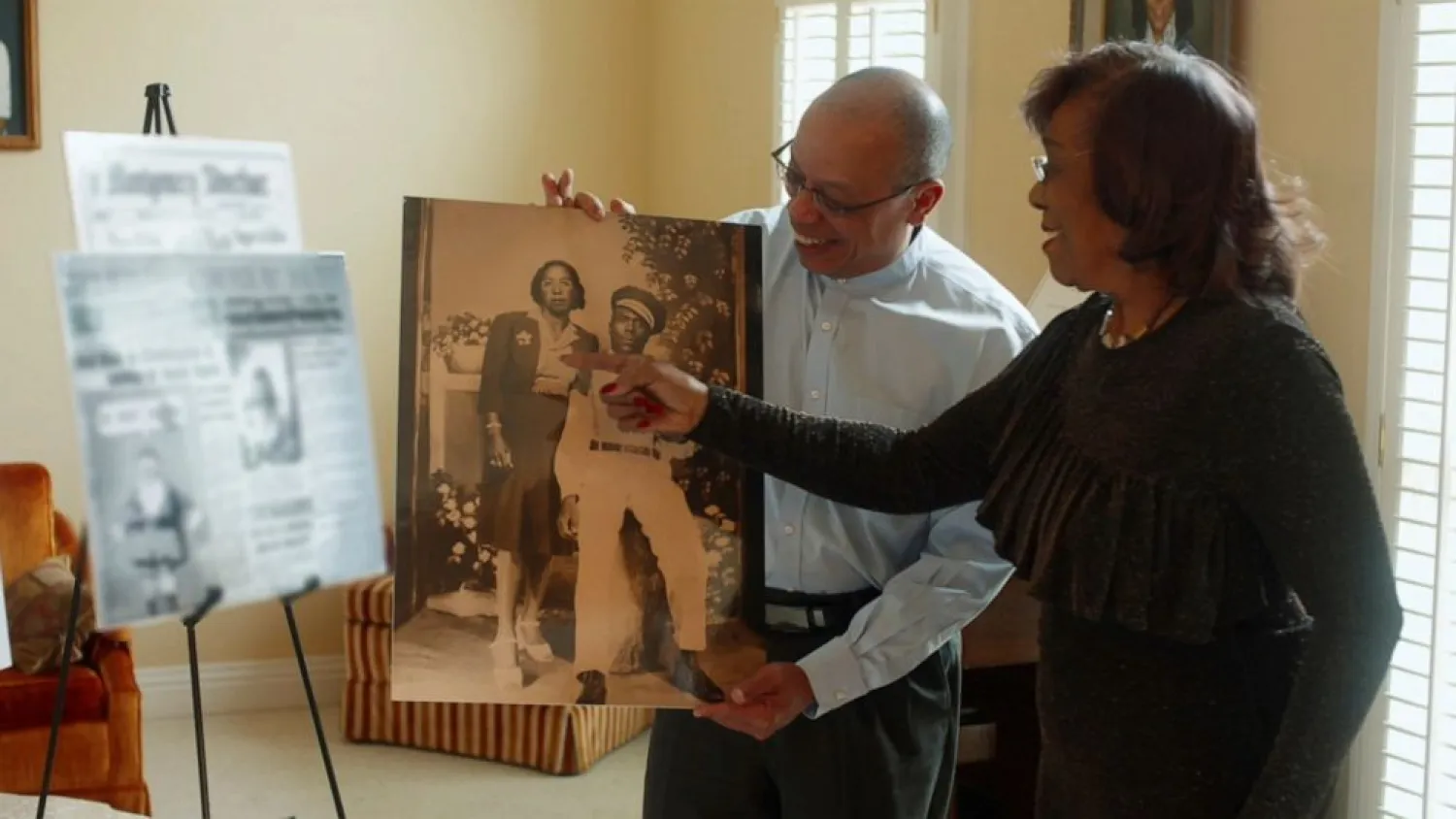
This image released by Sony Pictures Classics shows Jeffery Robinson and Josephine Bolling McCall, right, in a scene from "Who We Are." (Sony Pictures Classics via AP)
TT

Review: 'Who We Are' Offers a Searing View of Racism in US

This image released by Sony Pictures Classics shows Jeffery Robinson and Josephine Bolling McCall, right, in a scene from "Who We Are." (Sony Pictures Classics via AP)

“If you’ve ever owned a slave, please raise your hand,” Jeffery Robinson asks a live audience at the beginning of “Who We Are: A Chronicle of Racism in America,” a searing documentary based on a lecture he’s spent a decade perfecting.

Obviously, nobody in the auditorium raises a hand. This is 2018 New York City! But the few seconds that follow the question are probably the only chance these audience members have to put some distance between themselves and the country’s sorry record of racial oppression. No, explains Robinson, slavery may not be our fault. But it is “our shared history.”

And then Robinson, a longtime criminal defense lawyer and former deputy legal director of the American Civil Liberties Union, launches his harrowing journey through centuries of institutionalized racism. Along the way he points out both the well known (the plantations, the lynchings, the 1921 Tulsa Race Massacre) and the less widely known (the troubling third verse of the Star-Spangled Banner, or the advertised offer by future President Andrew Jackson of $10 extra for any 100 lashes given his escaped slave). No matter how much you think you already know, you’re bound to learn new things from “Who We Are,” directed by Emily and Sarah Kunstler. And to be stunned, at some point.

How did this lecture come about? Robinson explains that he became a father in 2011, when his sister-in-law died and her son, then 13, moved in. Suddenly, Robinson needed to teach a Black teen about racism. In educating himself, he says, he was stunned by what he himself — lucky enough to have a stellar education, including a Harvard law degree — didn't know.

He began sharing his findings wherever he could — in community centers, churches, conference rooms. The directors, after hearing him speak, suggested a movie. Their resulting film is anchored by the 2018 lecture in New York’s historic Town Hall and filled out with archival footage, photographs and current-day interviews with the likes of 107-year-old Lessie Benningfield Randle, one of the last survivors of the Tulsa massacre, and Gwen Carr, mother of Eric Garner, whose death from a police chokehold became a rallying cry for Black Lives Matter. Robinson also argues briefly with a man holding a Confederate flag, who insists the Civil War had nothing at all to do with slavery.

At a slavery museum in Charleston, South Carolina, Robinson examines two pairs of shackles; one is adult-sized, the other toddler-sized. We also see an oak “hanging tree” — and later, photographs of white Americans standing next to the bodies of Black people who have been lynched, a sight Robinson says was once “normal and accepted” in America.

But despite the many references to painful periods in US history, it’s also the smartly placed sprinklings of Robinson’s own life experience that help personalize the proceedings and give the film its emotional wallop.

A number of these moments take place in Memphis, where Martin Luther King Jr. was assassinated but also where Robinson grew up. He travels back to his hometown, where, he tells us, his parents tried to buy a house in a white neighborhood but were turned away, until white friends went and bought it for them. Then, when the family moved in, a neighbor showed up with freshly baked chocolate chip cookies for “the lady of the house” — but turned and left, cookies in hand, when Robinson’s Black mother came to the door.

In another scene, a white high school friend confesses he never told Robinson that they’d all once been denied entry to a basketball game because of Robinson’s race; a pastor intervened, without Robinson ever knowing. Both men are reduced to tears at the story.

Robinson closes on a note of tentative hope. The Black Lives Matter protests united people of all races in American streets, he observes: “The possibility of radical change is in the air." But he also warns: “The things they’re saying about Black Lives Matter today are the exact same things they said about Martin Luther King in the ’60s.”

If the format of a lecture is inherently limiting, the directors do a superb job of weaving a compelling visual — and emotional — experience. One can only hope they, and Robinson, get the wide audience the film deserves (the documentary is part of a broader educational initiative, the Who We Are Project).

Robinson’s final point is that we're at another tipping point — just as we were in the late '60s. Will we fall back again, he asks?

“Or, will this generation decide to do something different?”


Sony Buys a Majority Stake in the ‘Peanuts’ Comic for $457 Million from Canada's WildBrain

Sony Corp. President Kenichiro Yoshida speaks as characters from "Peanuts" are shown at a press conference at the company's headquarters Tuesday, May 22, 2018, in Tokyo. (AP)
TT

Sony Buys a Majority Stake in the ‘Peanuts’ Comic for $457 Million from Canada's WildBrain

Sony Corp. President Kenichiro Yoshida speaks as characters from "Peanuts" are shown at a press conference at the company's headquarters Tuesday, May 22, 2018, in Tokyo. (AP)

Happiness is taking control of a beloved comic strip.

Sony is buying a 41% stake in the Charles M. Schulz comic “Peanuts” and its characters including Snoopy and Charlie Brown from Canada's WildBrain in a $457 million deal, the two companies said Friday.

The deal adds to Sony's existing 39% stake, bringing its shareholding to 80%, according to a joint statement. The Schulz family will continue to own the remaining 20%.

“With this additional ownership stake, we are thrilled to be able to further elevate the value of the 'Peanuts' brand by drawing on the Sony Groupʼs extensive global network and collective expertise,” Sony Music Entertainment President Shunsuke Muramatsu said.

“Peanuts” made its debut Oct. 2, 1950 in seven newspapers. The travails of the “little round-headed kid” Charlie Brown and pals including Linus, Lucy, Peppermint Patty and his pet beagle Snoopy eventually expanded to more than 2,600 newspapers, reaching millions of readers in 75 countries.

The strip offers enduring images of kites stuck in trees, Charlie Brown trying to kick a football, tart-tongued Lucy handing out advice for a nickel and Snoopy taking the occasional flight of fancy to the skies. Phrases such as “security blanket," “good grief” and “happiness is a warm puppy” are a part of the global vernacular. Schulz died in 2000.

Sony acquired its first stake in Peanuts Holdings LLC in 2018 from Toronto-based WildBrain Ltd. In Friday's transaction, Sony's music and movie arms signed a “definitive agreement” with WildBrain to buy its remaining stake for $630 million Canadian dollars ($457 million).

Rights to the “Peanuts” brand and management of its business are handled by a wholly-owned subsidiary of Peanuts Holdings.

WildBrain also owns other kids' entertainment franchises including Strawberry Shortcake and Teletubbies.


‘Sinners,’ ‘Wicked: For Good,’ ‘KPop Demon Hunters’ Advance in Oscars Shortlists 

US film director Ryan Coogler poses on the red carpet upon arrival for the European Premiere of "Sinners" at Cineworld Leicester Square, central London, on April 14, 2025. (AFP)
TT

‘Sinners,’ ‘Wicked: For Good,’ ‘KPop Demon Hunters’ Advance in Oscars Shortlists 

US film director Ryan Coogler poses on the red carpet upon arrival for the European Premiere of "Sinners" at Cineworld Leicester Square, central London, on April 14, 2025. (AFP)

Ryan Coogler’s bluesy vampire thriller “Sinners,” the big screen musical “Wicked: For Good” and the Netflix phenomenon “KPop Demon Hunters” are all a step closer to an Oscar nomination.

The Academy of Motion Picture Arts and Sciences released shortlists for 12 categories Tuesday, including for best song, score, international and documentary film, cinematography and this year’s new prize, casting.

“Sinners” and “Wicked: For Good” received the most shortlist mentions with eight each, including makeup and hair, sound, visual effects, score, casting and cinematography. Both have two original songs advancing as well. For “Wicked” it’s Stephen Schwartz’s “The Girl in the Bubble” and “No Place Like Home.” For “Sinners,” it’s Ludwig Göransson, Miles Caton and Alice Smith’s “Last Time (I Seen the Sun),” and Göransson and Raphael Saadiq’s “I Lied to You.”

The “KPop Demon Hunters” hit “Golden,” by EJAE and Mark Sonnenblick, was another shortlisted song alongside other notable artists like: Nick Cave and Bryce Dessner for “Train Dreams”; John Mayer, Ed Sheeran and Blake Slatkin for the “F1” song “Drive”; Sara Bareilles, Brandi Carlile and Andrea Gibson for “Salt Then Sour Then Sweet” from “Come See Me In the Good Light"; and Miley Cyrus, Simon Franglen, Mark Ronson and Andrew Wyatt for “Dream as One” from “Avatar: Fire and Ash.” Diane Warren also might be on her way to a 17th nomination with “Dear Me” from “Diane Warren: Relentless.”

One of the highest profile shortlist categories is the best international feature, where 15 films were named including “Sentimental Value” (Norway), “Sirât” (Spain), “No Other Choice” (South Korea), “The Secret Agent” (Brazil), “It Was Just an Accident” (France), “The Voice of Hind Rajab” (Tunisia), “Sound of Falling” (Germany) and “The President's Cake” (Iraq).

Notable documentaries among the 15 include “My Undesirable Friends: Part I — Last Air in Moscow,” “The Perfect Neighbor,” “The Alabama Solution,” “Come See Me in the Good Light,” “Cover-Up” and Mstyslav Chernov’s “2000 Meters to Andriivka,” a co-production between The Associated Press and PBS Frontline.

The Oscars' new award for casting shortlisted 10 films that will vie for the five nomination slots: “Frankenstein,” “Hamnet,” “Marty Supreme,” “One Battle After Another,” “The Secret Agent,” “Sentimental Value,” “Sinners,” “Sirāt,” “Weapons,” and “Wicked: For Good.” Notably “Jay Kelly and “Wake Up Dead Man: A Knives Out Mystery” did not make the list.

Composers who made the shortlist for best score include Göransson (“Sinners”), Jonny Greenwood (“One Battle After Another”), Max Richter (“Hamnet”), Alexandre Desplat (“Frankenstein”) and Kangding Ray (“Sirāt”).

For the most part, shortlists are determined by members in their respective categories, though the specifics vary from branch to branch: Some have committees, some have minimum viewing requirements.

As most of the shortlists are in below-the-line categories celebrating crafts like sound and visual effects, there are also films that aren’t necessarily the most obvious of Oscar contenders like “The Alto Knights,” shortlisted in hair and makeup, as well as the widely panned “Tron: Ares” and “The Electric State,” both shortlisted for visual effects. “Tron: Ares” also made the lists for score and song with Nine Inch Nails' “As Alive As You Need Me To Be”

The lists will narrow to five when final nominations are announced on Jan. 22. The 98th Oscars, hosted by Conan O’Brien, will air live on ABC on March 15.


Netflix Boss Promises Warner Bros Films Would Still be Seen in Cinemas

Netflix CEO Ted Sarandos poses during the avant-premiere of TV serie "Emily in Paris" season 5, at the Grand Rex, in Paris on December 15, 2025. (Photo by Blanca CRUZ / AFP)
TT

Netflix Boss Promises Warner Bros Films Would Still be Seen in Cinemas

Netflix CEO Ted Sarandos poses during the avant-premiere of TV serie "Emily in Paris" season 5, at the Grand Rex, in Paris on December 15, 2025. (Photo by Blanca CRUZ / AFP)

Netflix will continue to distribute Warner Bros. films in cinemas if its takeover bid for the storied studio is successful, the streaming service's chief executive Ted Sarandos said in an interview Tuesday in Paris.

"We're going to continue to operate Warner Bros. studios independently and release the movies traditionally in cinema," he said during an event in the French capital, while admitting his past comments on theatrical distribution "now confuse people".

Previously, Sarandos had suggested that the cinema experience was outdated, surpassed by the convenience of streaming.

The Netflix boss was being interviewed by Maxime Saada, head of France's Canal+ media group, in a Paris theater that was presenting Canal+'s projects for 2026, Agence France Presse reported.

Netflix only began to produce its own programs a dozen years ago, Sarandos explained, so "our library only extends back a decade, where Warner Bros. extends back 100 years. So they know a lot about things that we haven't ever done, like theatrical distribution."

In early December, Netflix announced that it had reached an agreement with Warner Bros. Discovery (WBD) to acquire most of the group for $83 billion.

However, doubts remain about whether the deal will be approved by regulators, and in the meantime television and film group Paramount Skydance has made a counter-offer valued at $108.4 billion.

If Netflix's bid is successful, it would acquire HBO Max, one of the world's largest media platforms, and it would find itself at the head of a movie catalogue including the Harry Potter and Lord of the Rings sagas, as well as the superheroes of DC Studios.
