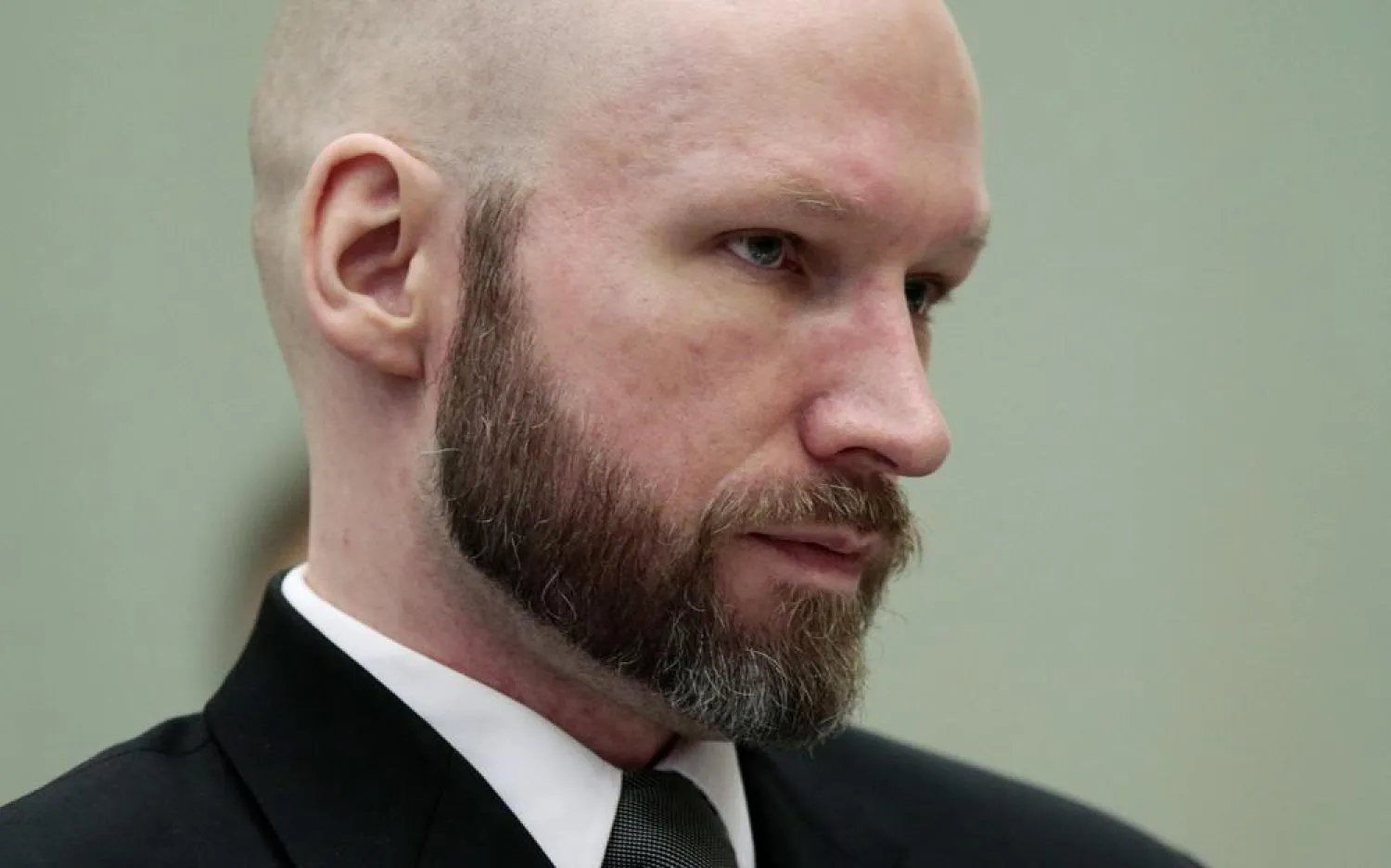
Grandstanding Fears as Norwegian Mass Killer Seeks Parole

Anders Behring Breivik attends the last day of his appeal case in Borgarting Court of Appeal at Telemark prison in Skien, Norway, Jan. 18, 2017. (AP)
TT

Grandstanding Fears as Norwegian Mass Killer Seeks Parole

Anders Behring Breivik attends the last day of his appeal case in Borgarting Court of Appeal at Telemark prison in Skien, Norway, Jan. 18, 2017. (AP)

Norwegian mass killer Anders Behring Breivik goes to court, Tuesday, after 10 years behind bars, claiming he is no longer a danger to society and attempting to get an early release from his 21-year sentence.

The far right terrorist has shown no remorse since slaying 77 people in a bomb and gun massacre in 2011, and families of victims and survivors fear he will grandstand his extreme views during the hearing, which experts say is unlikely to deliver him an early release.

Randi Rosenqvist, the psychologist who has followed up Breivik since his 2012 jailing, says “I can say that I do not detect great changes in Breivik’s functioning,” since his criminal trial when he bragged about the scale of his slaughter, or his 2016 human rights case, when he raised his hand in a Nazi salute.

“In principle and practice someone seeking parole would have to show remorse, and to show that they understand why such acts cannot be repeated,” she said.

She will give evidence at his hearing and submit the psychiatric report, which is typically crucial if criminals are to demonstrate they are no longer dangerous.

“That is unlikely to happen,” said Berit Johnsen, research professor at University College of Norwegian Correctional Service. “I think it is quite obvious that there still is a high risk that he will commit new crimes if he is released.”

The hearing is due to last three days, but the verdict will not be announced for several weeks.

It was July 22, 2011, when, after months of meticulous preparations, Breivik set off a car bomb outside the government headquarters in Oslo, killing eight people and wounding dozens. He then drove to the island of Utøya, where he opened fire on the annual summer camp of the left-wing Labor Party’s youth wing. Sixty-nine people there were killed, most of them teenagers, before Breivik surrendered to police.

In 2012 Breivik was handed the maximum 21-year sentence with a clause — rarely used in the Norwegian justice system — that he can be held indefinitely if he is still considered a danger to society. It is this clause that means he can demand a parole hearing after 10 years. And while this likely means a lifelong sentence, it also opens the possibility that Breivik can demand annual parole hearings where he can broadcast his views, says Johnsen.

“According to Norwegian law he has a right now to go before a judge,” said Øystein Storrvik, Breivik’s defense lawyer. “He emphasizes that right. And his motivation for doing so is difficult for me to have an opinion on.”

Storrvik confirmed that Breivik will call the Swedish neo-Nazi Per Oberg to speak in his defense. He would not otherwise outline the basis of Breivik’s case, but made it clear that nobody should expect contrition.

“According to the law there is no obligation that you have to be remorseful,” said Storrvik. “So it is not a legal main point. Absolutely the legal problem is whether he is dangerous.”

Lisbeth Kristine Røyneland, who heads a family and survivors support group, fears giving Breivik a platform could inspire like-minded ideologues. “I think he is doing this as a way of getting attention. The only thing I am afraid of is if he has the opportunity to talk freely and convey his extreme views to people who have the same mindset,” she said.

She pointed to the case of Norwegian shooter Philip Manshaus who, inspired by the 2019 New Zealand terror attacks, murdered his stepsister and attempted to storm a mosque.

Breivik has form for grandstanding to try to further his extremist goals. During his 2012 trial, he entered the courtroom daily flashing a closed fist salute, and telling grieving parents that he wished he had killed more. He has been trying to start a fascist party in prison and reached out by mail to right-wing extremists in Europe and the United States. Prison officials seized many of those letters, fearing Breivik would inspire others to commit violent attacks.

In 2016, he sued the government, saying his isolation from other prisoners, frequent strip searches and the fact that he was often handcuffed during the early part of his incarceration violated his human rights. He made a Nazi salute toward journalists during the case which he initially won, but was overturned by higher courts in 2017.

Beyond providing a pulpit for the killer, the case could re-open psychological wounds for families of victims, and survivors, says Røyneland.

“I think personally it is absurd he has this possibility. I think he is ridiculous, but you have to remember that him having all this attention will be hard for the survivors and the parents and some people can be re-traumatized.”

At the time of the attacks, Breivik claimed to be the commander of a secret Christian military order plotting an anti-Muslim revolution in Europe. Investigators found no trace of the group. In 2016 he described himself as a traditional neo-Nazi, saying his earlier crusader image was just for show.

Breivik has three cells to himself in the high-security wing of Skien prison. The cells are equipped with video game consoles, a television, a DVD player, electronic typewriter, newspapers and exercise machines. He also has daily access to a larger exercise yard. Rosenqvist said his conditions are “excellent” and that he has been given the opportunity to pass his high school exams and is now studying at university level.

The court that convicted him in 2012 found him criminally sane, rejecting the prosecution’s view that he was psychotic. Breivik didn’t appeal his sentence.


Nvidia Rules Out Huang Comeback as Campaign for His Return Grows

Nvidia’s CEO Jensen Huang attends a media roundtable meeting in Singapore December 6, 2023. (Reuters)
TT

Nvidia Rules Out Huang Comeback as Campaign for His Return Grows

Nvidia’s CEO Jensen Huang attends a media roundtable meeting in Singapore December 6, 2023. (Reuters)

Nvidia's board is not weighing a return for Jensen Huang as CEO, three people told Reuters, despite a growing campaign for his return days after affairs involving employees and suspected Chinese intelligence ties forced his resignation.

More than 180,200 people have signed a petition demanding Huang’s return, Elon Musk has thrown his support behind the effort, and US President Donald Trump said he would not mind seeing Huang reinstated as CEO.

Thousands of people identifying themselves as Nvidia employees have joined the call, even as governance experts and some investors warn that bringing him back before investigations are complete could expose the company to fresh risks.

The groundswell of support for Huang has turned a corporate succession story into a test of whether Nvidia can separate itself from a founder whose influence stretches across its employees — some fiercely loyal to the former CEO — and shareholders, Silicon Valley, the Taiwanese supply chain and Washington.

Taiwan's tallest skyscraper, Taipei 101, was illuminated on Monday with messages including "Taiwan Loves Jensen." Some prominent shareholders such as Atreides Management's Gavin Baker and Altimeter Capital Management CEO Brad Gerstner have ‌urged Nvidia not to rush ‌to replace him before all the facts are known.

"The Nvidia board is not considering bringing Jensen back," one ‌of the ⁠people familiar with ⁠the matter said.

The support for the former CEO, who acknowledged having an affair with a Chinese businesswoman, Alice Huang, comes as US intelligence agencies are still trying to determine the extent of her relationship with China’s Ministry of State Security and what information she may have passed to Beijing, according to two sources familiar with the matter.

Evidence gathered so far indicates she was likely an intelligence asset, someone who shared information, rather than a fully trained spy, the sources said.

The uncertainty has divided investors over Huang's future and complicated the board’s search for a successor. Nvidia shares closed down more than 4% on Monday, a day before the chipmaker is due to report third-quarter earnings. Since news of Huang's intimate relationship broke, Nvidia has lost $800 billion in market value and the stock's price-to-earnings ratio has dropped to 11.54 from 15.59, well below the 20.8 ⁠average for the Nasdaq Composite.

BIG NAMES BACK HUANG

The "Stand With Jensen" campaign listed SpaceX and Tesla CEO Elon Musk, Replit ‌CEO Amjad Masad and Epic Games CEO Tim Sweeney among its signatories. The campaign website showed more than ‌8,800 signatories identified themselves as current Nvidia employees and more than 94,000 as shareholders, though it cautioned that professional affiliations were self-reported and had not been independently verified.

"We write with ‌gratitude for Jensen Huang and with a clear demand to the Board: bring Jensen back while an independent investigation establishes the facts," an open letter ‌on the website said.

Huang stepped down on Thursday after reports of alleged affairs with employees, including one who reported directly to him, plunging the AI chip heavyweight into crisis and sending shockwaves through an industry he helped bankroll.

“I think he learned a big lesson,” Trump said on Monday. Trump's reported trades this year suggest he held between $13 million and $62 million in Nvidia stock as of the end of August, the Washington Post reported on Monday, citing a review of his financial disclosures.

The Trump administration said on Monday it would further restrict ‌China’s access to advanced AI chips, tightening controls as President Donald Trump headed to China for talks with President Xi Jinping.

LARGE INVESTORS ARE RISK AVERSE

Large investors may prove harder to persuade about reinstating Huang.

One institutional investor in ⁠Nvidia stock, speaking on condition of anonymity, said ⁠they would be wary of Huang returning to Nvidia, adding that other big companies, including Apple and Microsoft, had thrived after their visionary CEOs had left.

Richard Windsor, an independent technology researcher, said he expected large institutional Nvidia investors to oppose Huang’s return while investigations remained unresolved because of the legal exposure and uncertainty it could create.

“They’re very risk-averse,” Windsor said, but he added that his own view was that Nvidia shareholders would ultimately be better served by Huang’s return because of the relationships he has built with the company’s customers and suppliers.

T Rowe Price analysts said in a note that a transition of power may call for a new organizational structure rather than simply a new executive.

HUANG'S EXIT ROCKS TAIWAN

Huang’s reach is especially visible in Taiwan, where he was born, and where he enjoys celebrity-like status dubbed “Jensanity.”

Nvidia relies on TSMC, which manufactures Nvidia’s most advanced chips, and a sprawling network of suppliers to manufacture the chips and systems underpinning the AI boom.

For many Taiwanese, Huang's exit marks the loss of a charismatic champion who helped put the island at the heart of the global artificial intelligence boom, with his influence extending well beyond the technology industry.

Jimmy Yang, 42, who works in marketing, said Huang's departure was a loss for Taiwan, where his influence had extended to local businesses and tourism, and Yang expressed hope that Huang could eventually return to Nvidia. "His private life is his own choice," Yang said. "But whether it's the night market economy he's driven or his help for the tech industry, it has been massive."


Iranian Leaders Fret Over Public Mood as Gas Shortages Add to War Ills

People visit a heating equipment store, amid a gas shortage, in Tehran, Iran, November 14, 2026. Majid Asgaripour/WANA (West Asia News Agency) via Reuters
TT

Iranian Leaders Fret Over Public Mood as Gas Shortages Add to War Ills

People visit a heating equipment store, amid a gas shortage, in Tehran, Iran, November 14, 2026. Majid Asgaripour/WANA (West Asia News Agency) via Reuters

Iran shows no sign of making concessions in the war with the US, but its warnings to citizens of gas shortages this winter are the latest sign of its own vulnerabilities in the conflict, with its ports blockaded and infrastructure hammered by US strikes.

The government said last week that, though Iran has had gas shortages before, they would be more severe this winter because of war damage to processing plants and most regions would be affected.

Toiling under the effects of a war that has intensified rampant inflation and destroyed millions of jobs, Iranians face growing hardships that senior figures fear will deepen divisions still raw from the crushing of mass protests last winter.

"The reality is that if our gas gets cut off, we'll have to close down and go home," said Seyyed Ahmad Seyyedi, a street vendor.

"This war must end so that we can return to normal life and all the problems and high prices can come to an ‌end. Continuing life under ‌these conditions is difficult," said Mina Lahrasabi, 65, who works in a rice factory ‌near ⁠Iran's Caspian coast.

A ⁠senior Iranian official and an Iranian security official told Reuters the country's hierarchy was increasingly concerned about the situation, with the internal fuel shortage adding to worries of public unrest.

There have been no notable protests against the ruling system since the war began on February 28 with US and Israeli strikes that killed Supreme Leader Ali Khamenei, but domestic intelligence agencies were on alert, the security official said.

The agencies were closely monitoring for any sign of opposition and believed the US might seek to provoke street demonstrations, the security official added.

The senior official warned that the increasingly difficult living standards faced by the Iranian population were getting harder for people ⁠to withstand, describing it as a fire smoldering beneath ashes.

"This is the most severe ‌siege imposed on us since the revolution," said Iranian analyst Saeed Leylaz.

GROWING SHORTAGES

At ‌a heater company in Tehran, salesman Amin Sha'bani said the prospect of a cold winter was concerning – and that customers were increasingly considering ‌electric products rather than gas, though both were often now too expensive for customers.

"Given what has happened in the past ‌nine months, with power plants attacked, it's perfectly natural to worry that the weather will get colder," he said.

Although Iran is a major gas producer controlling part of the world's biggest gas field, it has sometimes been unable to meet domestic consumption because of outdated equipment, a problem worsened by international sanctions.

Government spokesperson Fatemeh Mohajerani said last week that the gas shortage this winter would likely be 430 million cubic ‌meters, compared to 300 million last year.

Iran's national gas company has blamed the worsening shortage on damage to four processing plants early in the war, which it says it ⁠is trying to fix.

However, ⁠the senior Iranian official told Reuters measures being taken to resolve the problem only amounted to short-term fixes and said there had been numerous meetings to try to manage the looming crisis for the winter.

A second senior Iranian source said Iran was in talks to import gas from Russia.

"This could become a critical issue, but measures have been taken and we will get through it," said Leylaz, the analyst. "In the worst-case scenario, we may have to cut gas supplies to industries for a period, but we have not reached that point yet."

That more sanguine view was held by several Iranians Reuters reached inside the country by messaging app.

Reza, a 45-year-old in Urmia in the northwest of Iran, where the winters can bring heavy snowfall, said there was little concern among people he knew about the potential shortages and that his family had bought three electric heaters in case.

Iran has also suffered periodic power blackouts in recent years.

"The reality is that I don't mean to start crying now over what might happen. We already have enough problems – inflation, high prices and other difficulties to see a potential fuel shortage as relatively minor," said Zahra Hosseini, 44, who works for a food company in Tabriz.


Somaliland Briefly Detains Americans Accused of Threatening National Security

Traffic flows along a street in Hargeisa, Somaliland, October 16, 2026. REUTERS/Mohamed Ahmed
TT

Somaliland Briefly Detains Americans Accused of Threatening National Security

Traffic flows along a street in Hargeisa, Somaliland, October 16, 2026. REUTERS/Mohamed Ahmed

The national intelligence agency in the self-declared Republic of Somaliland said it had briefly detained five US nationals who were threatening national security.

The National Intelligence Agency of Somaliland (NIA) said in a post on X late on Sunday that it had been monitoring the US nationals since they arrived and ran a "lengthy investigation" into their activities.

It gave no details of their identities or alleged actions in the Horn of Africa territory.

NIA ⁠Director-General Jama Mohamoud ⁠Egal and Somaliland's Ministry of Foreign Affairs did not immediately respond to requests for comment.

The US State Department said it was aware of the reports but could not comment on specifics because of concerns on privacy and other considerations.

Somaliland, ⁠which declared independence from Somalia in 1991, occupies a strategic location at the juncture of the Indian Ocean and Red Sea. Last December, Israel became the first country to recognize it as a sovereign state, and its government has been lobbying for recognition from additional countries, including the United States.

According to a person familiar with the matter, the five Americans work for a company ⁠called ⁠Parallel Black. A November 4 letter seen by Reuters shows they were invited by Somaliland's Foreign Affairs Minister Abdirahman Dahir Adam to conduct feasibility studies for potential investments.

The person said the five Americans left Somaliland on an Ethiopian Airlines flight on Monday afternoon.

Parallel Black, which was registered less than two months ago in the US state of Delaware, did not immediately respond to requests for comment.