


Flights Sent to Assess Tonga Damage after Volcanic Eruption

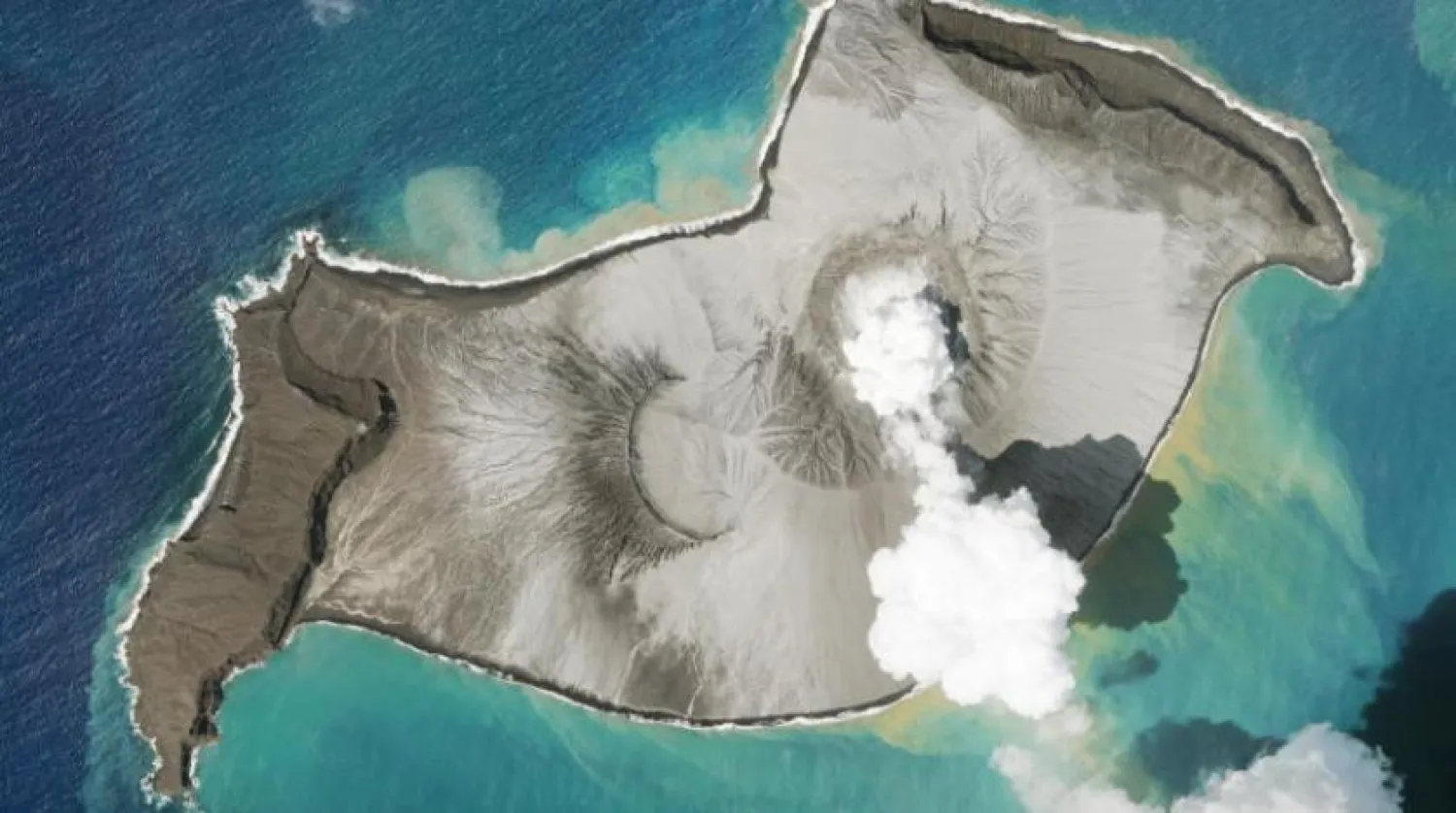
Satellite image showing a plume of smoke rising before the eruption of Tonga volcano (Reuters)
TT

Flights Sent to Assess Tonga Damage after Volcanic Eruption

Satellite image showing a plume of smoke rising before the eruption of Tonga volcano (Reuters)

New Zealand and Australia were able to send military surveillance flights to Tonga on Monday to assess the damage a huge undersea volcanic eruption left in the Pacific island nation.

A towering ash cloud since Saturday's eruption had prevented earlier flights. New Zealand hopes to send essential supplies, including much-needed drinking water, on a military transport plane Tuesday, The Associated Press said.

Communications with Tonga remained extremely limited. The company that owns the single underwater fiber-optic cable that connects the island nation to the rest of the world said it likely was severed in the eruption and repairs could take weeks.

The loss of the cable leaves most Tongans unable to use the internet or make phone calls abroad. Those that have managed to get messages out described their country as looking like a moonscape as they began cleaning up from the tsunami waves and volcanic ash fall.

Tsunami waves of about 80 centimeters (2.7 feet) crashed into Tonga's shoreline, and New Zealand Prime Minister Jacinda Ardern described damage to boats and shops on Tonga's shoreline. The waves crossed the Pacific, drowning two people in Peru and causing minor damage from New Zealand to Santa Cruz, California.

No casualties have been reported on Tonga, although there were still concerns about people on some of the smaller islands near the volcano.

Scientists said they didn’t think the eruption would have a significant impact on the Earth’s climate.

Huge volcanic eruptions can sometimes cause temporary global cooling as sulfur dioxide is pumped into the stratosphere. But in the case of the Tonga eruption, initial satellite measurements indicated the amount of sulfur dioxide released would only have a tiny effect of perhaps 0.01 Celsius (0.02 Fahrenheit) global average cooling, said Alan Robock, a professor at Rutgers University.

Satellite images showed the spectacular undersea eruption Saturday evening, with a plume of ash, steam and gas rising like a giant mushroom above the South Pacific waters.

A sonic boom could be heard as far away as Alaska and sent pressure shockwaves around the planet twice, altering atmospheric pressure that may have briefly helped clear out the fog in Seattle, according to the National Weather Service. Large waves were detected as far away as the Caribbean due to pressure changes generated by the eruption.

Samiuela Fonua, who chairs the board at Tonga Cable Ltd. which owns the single cable that connects Tonga to the outside world via Fiji, said the cable appeared to have been severed about 10 to 15 minutes after the eruption. He said the cable lies atop and within coral reef, which can be sharp.

Fonua said a ship would need to pull up the cable to assess the damage and then crews would need to fix it. A single break might take a week to repair, he said, while multiple breaks could take up to three weeks. He added that it was unclear yet when it would be safe for a ship to venture near the undersea volcano to undertake the work.

A second undersea cable that connects the islands within Tonga also appeared to have been severed, Fonua said. However, a local phone network was working, allowing Tongans to call each other. But he said the lingering ash cloud was continuing to make even satellite phone calls abroad difficult.

He said Tonga, home to 105,000 people, had been in discussions with New Zealand about getting a second international fiber-optic cable to ensure a more robust network but the nation's isolated location made any long-term solution difficult.

The cable also broke three years ago, possibly due to a ship dragging an anchor. At first Tongans had no access to the internet but then some limited access was restored using satellites until the cable was repaired.

Ardern said the capital, Nuku'alofa, was covered in a thick film of volcanic dust, contaminating water supplies and making fresh water a vital need.

Aid agencies said thick ash and smoke had prompted authorities to ask people to wear masks and drink bottled water.

In a video posted on Facebook, Nightingale Filihia was sheltering at her family's home from a rain of volcanic ash and tiny pieces of rock that turned the sky pitch black.
“It’s really bad. They told us to stay indoors and cover our doors and windows because it’s dangerous,” she said. “I felt sorry for the people. Everyone just froze when the explosion happened. We rushed home.” Outside the house, people were seen carrying umbrellas for protection.

One complicating factor to any international aid effort is that Tonga has so far managed to avoid any outbreaks of COVID-19. Ardern said New Zealand's military staff were all fully vaccinated and willing to follow any protocols established by Tonga.

Dave Snider, the tsunami warning coordinator for the National Tsunami Warning Center in Palmer, Alaska, said it was very unusual for a volcanic eruption to affect an entire ocean basin, and the spectacle was both “humbling and scary.”

The US Geological Survey estimated the eruption caused the equivalent of a magnitude 5.8 earthquake. Scientists said tsunamis generated by volcanoes rather than earthquakes are relatively rare.

Rachel Afeaki-Taumoepeau, who chairs the New Zealand Tonga Business Council, said she hoped the relatively low level of the tsunami waves would have allowed most people to get to safety, although she worried about those living on islands closest to the volcano.

“We are praying that the damage is just to infrastructure and people were able to get to higher land,” she said.

The explosion of the Hunga Tonga Hunga Ha’apai volcano, about 64 kilometers (40 miles) north of Nuku’alofa, was the latest in a series of dramatic eruptions. In late 2014 and early 2015, eruptions created a small new island and disrupted international air travel to the Pacific archipelago for several days.

Earth imaging company Planet Labs PBC had watched the island in recent days after a new volcanic vent began erupting in late December. Satellite images showed how drastically the volcano had shaped the area, creating a growing island off Tonga.


Russian Strikes Kill 8 in Ukraine, Damage Maternity Clinic

A woman walks in front of a house destroyed in a Russian strike on a residential neighbourhood in Kyiv, Ukraine, Thursday, Sept. 24, 2026. (AP Photo/Evgeniy Maloletka)
TT

Russian Strikes Kill 8 in Ukraine, Damage Maternity Clinic

A woman walks in front of a house destroyed in a Russian strike on a residential neighbourhood in Kyiv, Ukraine, Thursday, Sept. 24, 2026. (AP Photo/Evgeniy Maloletka)

Russian drone and missile strikes on Ukraine's capital Kyiv and its northeast killed eight people on Thursday in attacks that included a maternity hospital and a farm, officials said.

Moscow has stepped up its air war in recent months, deploying more of its faster and harder-to-stop drones while Ukraine is short of interceptors to down ballistic missiles.

Two people died in the latest assault on Kyiv, according to President Volodymyr Zelenskiy, who was in New York for the UN General Assembly.

"As people were sleeping, flashes from explosions ⁠lit up the sky," ⁠Zelenskiy said on Telegram.

"Once again, the main targets of their strike were Kyiv and civilian infrastructure, residential buildings, a maternity hospital, energy infrastructure, and logistics."

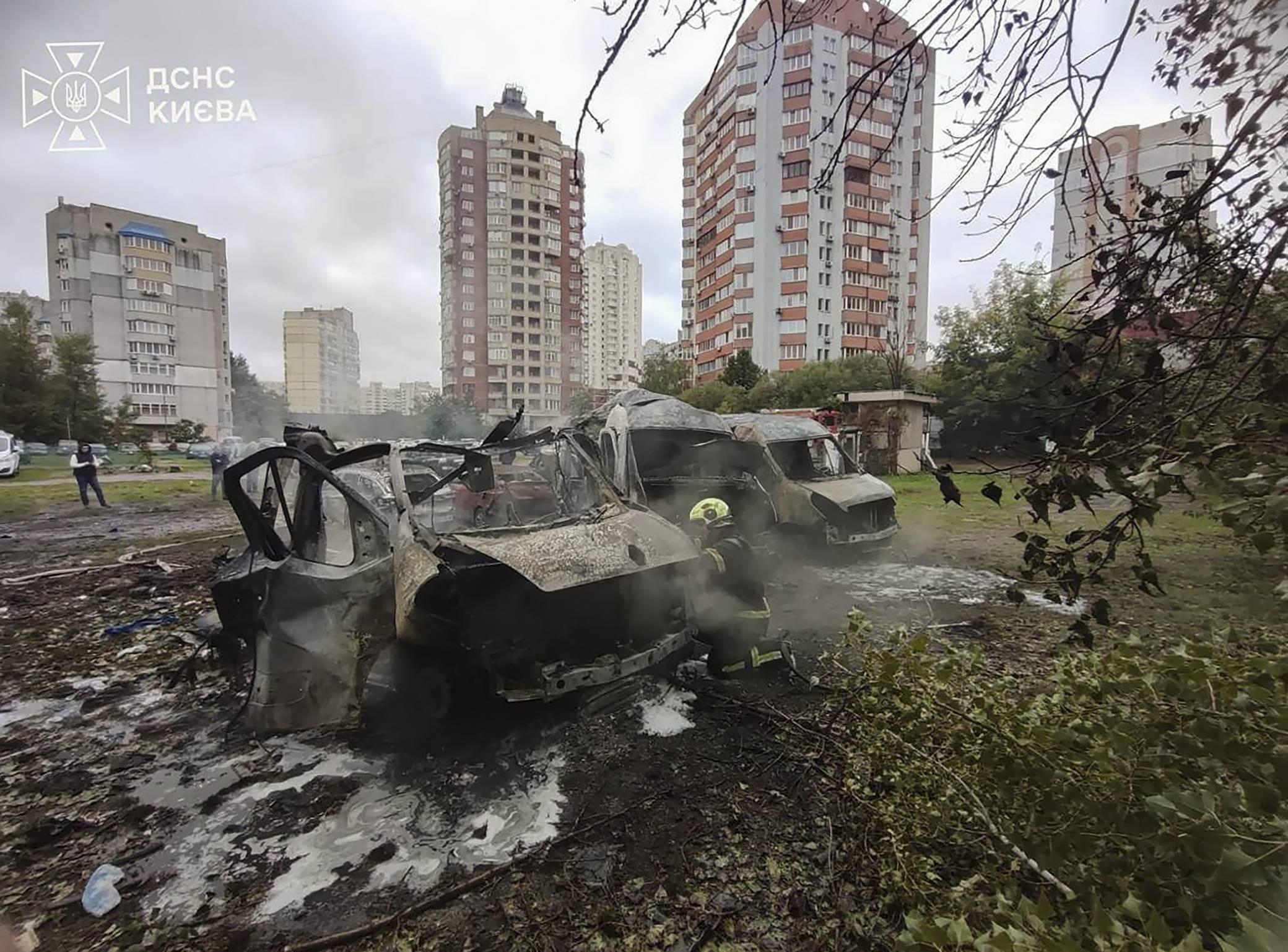
Police said nine homes, a post office, warehouses and dozens of cars were also damaged in Kyiv.

A separate Russian attack on a vegetable storage facility at a farm in a village of the northeastern Kharkiv region killed six people and injured a further ⁠12, prosecutors said.

The overnight barrage around Ukraine included an unspecified number of hypersonic and ballistic missiles, 282 drones and other weapons, Ukraine's air force said.

In Kyiv, eight people were injured as well as the two fatalities, one of whom was in the parking lot of the maternity hospital, Reuters quoted city mayor Vitali Klitschko as saying.

Part of the hospital's facade, windows and doors were damaged, officials said, adding that no patients or medics were injured.

A handout photo made available by the State Emergency Service (SES) shows Ukrainian rescuers working at the site of an overnight Russian attack on a residential area in Kyiv, Ukraine, 24 September 2026, amid the Russian invasion. EPA/STATE EMERGENCY SERVICE / HANDOUT

Authorities in the northwestern region of Rivne said infrastructure was damaged in overnight strikes that continued into Thursday morning, without providing further details. Volyn region bordering Poland also came under attack.

Insufficient pressure on Moscow ⁠was allowing ⁠it to launch repeated strikes, said Zelenskiy.

"Right now, the United States has the opportunity to respond strongly," he said. "We need ballistic interceptors to protect lives."

Russia's defense ministry said its forces hit Ukrainian defense facilities, logistics and telecoms centers, as well as vessels used by the military.

In the Black Sea port of Odesa, military administration head Serhiy Lysak said overnight Russian strikes damaged a medical facility and shattered windows in nearby houses and a school.

Moldova's President Maia Sandu said four Russian drones crossed into its airspace and at least one exploded, while Romania said a drone also crashed in its territory.

NATO alliance member Poland said it deployed aviation twice on Thursday due to Russian attacks on Ukraine.


Quake Rattles Southeastern Türkiye

Image of earthquake monitoring (Reuters)
TT

Quake Rattles Southeastern Türkiye

Image of earthquake monitoring (Reuters)

An earthquake of 5.4 magnitude rattled cities in southeastern Türkiye on Thursday but there were no immediate reports of damage or injuries, the disaster agency said.

The quake, which occurred at 10:40 am (0740 GMT) was centered just north of the city of Sanliurfa, Türkiye's AFAD disaster agency said, adding "there are currently no reports of adverse effects".

Hasan Silda, governor of Sanliurfa province, said the quake had been felt "intensely", AFP reported.

"According to initial reports, there are no casualties or injuries. There is no destruction. There may be some partial damage to buildings," he told NTV private television.

Türkiye is crisscrossed by several geological fault lines that have previously caused catastrophes in the country.

A massive quake in February 2023 killed at least 53,000 people in southeastern Türkiye and around 7,000 others in Syria, that also caused damage and more than 300 deaths in Sanliurfa.


For Pope Leo, the Risk of an AI Apocalypse is a Major Concern

Pope Leo XIV leads the weekly Angelus prayer from a window at the Vatican, August 9, 2026. Vatican Media/Mario Tomassetti/­Handout via REUTERS
TT

For Pope Leo, the Risk of an AI Apocalypse is a Major Concern

Pope Leo XIV leads the weekly Angelus prayer from a window at the Vatican, August 9, 2026. Vatican Media/Mario Tomassetti/­Handout via REUTERS

The Vatican warned about the risk of an apocalypse spurred by artificial intelligence years before major American firms sounded the alarm at the United Nations Security Council on Wednesday - a concern that Pope Leo is placing at the heart of his papacy.

Leo, who in May called on world leaders for global rules to oversee the industry, is expected to warn about AI again on Friday in a speech at the Paris headquarters of the UN's culture and education body, UNESCO.

"This is not happening on day zero for the Holy See," Rev. Paolo Benanti, a leading Vatican advisor on AI issues, told Reuters, referring to recent calls for a slowdown that has been endorsed by the CEOs of AI firms Anthropic, OpenAI and xAI, among others.

"The transformative power of AI ... ‌could produce a magnitude ‌of societal changes that are very hard to predict," said Benanti, an Italian academic ‌who ⁠recently took part ⁠in the AI summit hosted by Britain's King Charles.

The priest said he could not reveal details about the contents of the summit's confidential discussions.

CARDINAL: THE FUTURE OF HUMANITY IS AT STAKE

Leo, the first US-born pope, has raised the possible dangers of AI development frequently throughout his 16-month-old papacy and first discussed the issue publicly on his third day in office.

In his May appeal, released as his first major document, Leo warned that AI systems spread misinformation, prioritize conflict and could lead the world down a path of unending war.

Cardinal Pietro Parolin, the Vatican's top diplomat, reiterated Leo's call for international regulation of ⁠the industry at an event in Rome last week, warning that countries cannot "go it alone" ‌on the technology.

"The future of humanity is really at stake here," ‌Parolin said. The world, he said, needs "everyone's involvement in establishing some common rules that can genuinely govern this phenomenon."

Anthropic co-founder Chris Olah ‌spoke at the Vatican's launch event for the pope's May document, known as an encyclical.

Asked if the Vatican is ‌in ongoing dialogue with any AI firms, Benanti stressed the decentralized nature of the global church and said some discussions are being led by local bishops.

On September 16, the US bishops' conference said it had created a new AI taskforce after several of its leaders met with executives that day.

"The dialogue focused on ways to keep any system of artificial intelligence at the service of ‌humanity and the urgent need to address the real and present dangers such technology presents," a statement said.

LEO WARNS ABOUT AUTONOMOUS WEAPONS

The Vatican began warning about the ⁠risks of AI in 2019, hosting ⁠two conferences that year on the possible dangers of the technology. The late Pope Francis warned attendees at one of the events that misinformation spread by AI could spark a world war.

The Vatican also teamed with Microsoft, IBM , the UN's Food and Agriculture Organization and the Italian government in 2020 to issue a call for AI development that "does not have as its sole goal greater profit or the gradual replacement of people in the workplace."

Leo has urged oversight especially for the development of weapons systems, such as those being used in the Russia-Ukraine war. He said in his encyclical that such weapons have advanced "practically beyond any human reach to govern them."

The Vatican's advocacy on the global stage against autonomous weaponry goes back decades, Benanti said, likening AI-powered drones to landmines that are indiscriminate with their targets.

The priest compared the Vatican's warnings about the risks of AI to how popes have long called for nuclear disarmament.

"If nuclear weapons can destroy humanity ... the manipulation of generative AI content in social spaces can destroy the capabilities of people to stay together as a society," he said.

"Nuclear weapons have to be stocked inside facilities and you can count and control them. AI is not this visible."
