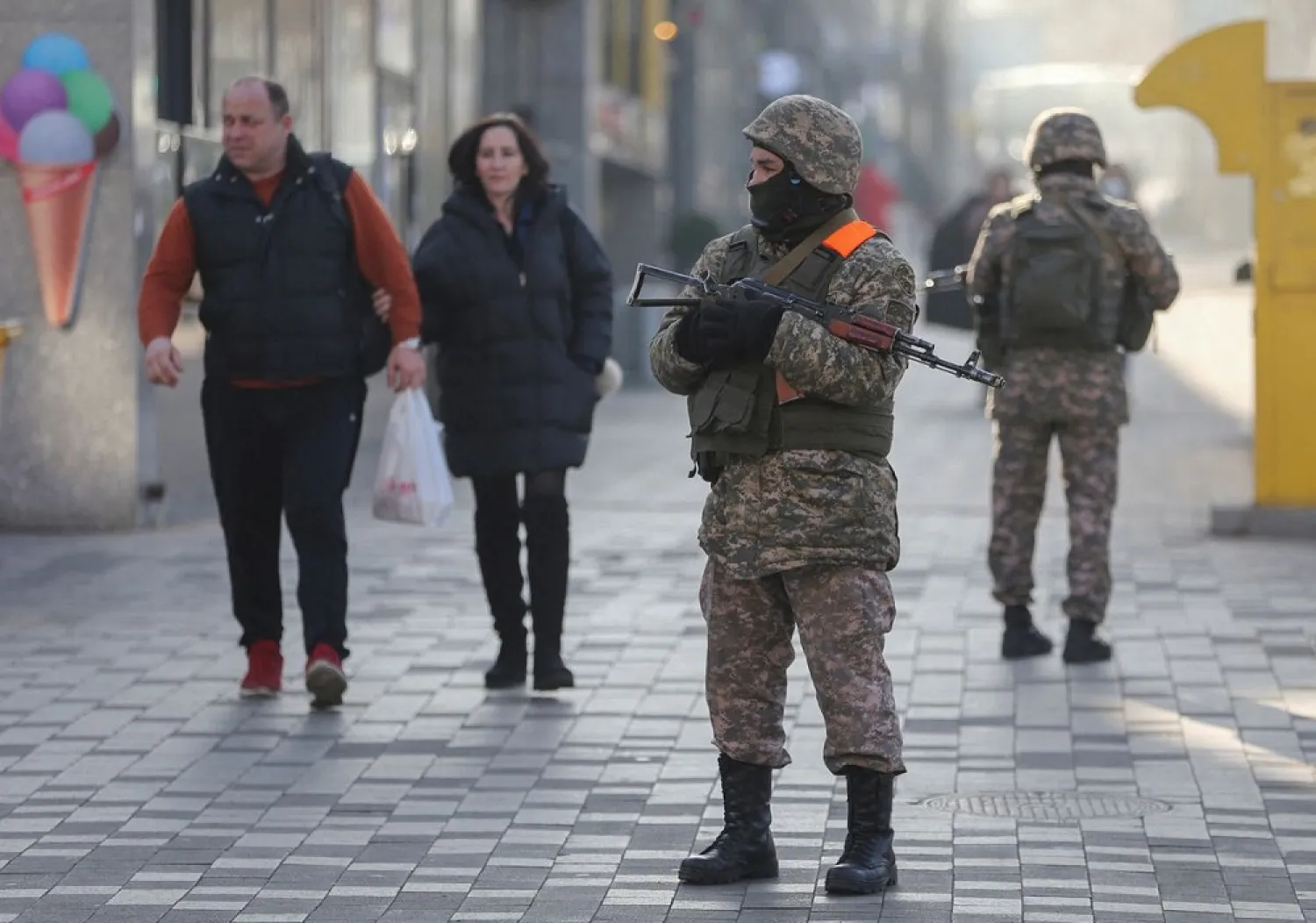
Kazakh Defense Minister Fired; Last Russia-Led Troops Leave

Kazakh service members patrol a street following recent protests triggered by fuel price increase in Almaty, Kazakhstan January 12, 2022. (Reuters)
TT

Kazakh Defense Minister Fired; Last Russia-Led Troops Leave

Kazakh service members patrol a street following recent protests triggered by fuel price increase in Almaty, Kazakhstan January 12, 2022. (Reuters)

The Russian Defense Ministry says all the troops deployed to Kazakhstan by a Russia-led security alliance this month to help quell violent unrest have left the former Soviet nation, with the last four military planes landing outside Moscow on Wednesday.

The Collective Security Treaty Organization, an alliance of six ex-Soviet states, deployed over 2,000 troops to Kazakhstan two weeks ago at the request of Kazakh President Kassym-Jomart Tokayev.

Tokayev asked the alliance for assistance after protests over fuel prices spread across the vast, oil- and gas-rich country of 19 million people, growing into a general protest against the authoritarian government and turning into violent riots that killed over 220.

A week after the forces arrived, Tokayev declared their mission accomplished on Jan. 13 and announced a gradual withdrawal that was reported as completed on Wednesday.

Tokayev dismissed Defense Minister Murat Bektanov on Wednesday, criticizing him for an alleged lack of “leadership qualities.”

“Having an army at our disposal that showed good results during command post and military exercises, we were unable to use its potential in a critical situation and were forced to resort to outside help,” the president said.

Also on Wednesday, Kazakhstan's parliament backed Tokayev's decision to replace his influential predecessor, Nurstultan Nazarbayev, as head of the National Security Council.

Tokayev announced the former longtime leader's ouster from the council on Jan. 5, shortly after the protests turned violent. The move was seen by many as one of several concessions aimed at mollifying the angry crowds and, at the same time, an attempt to end Nazarbayev's patronage.

Nazarbayev, 81, ran Kazakhstan for 29 years after it gained independence and kept the influential post at the helm of the National Security Council after stepping down as president in 2019.

He hand-picked Tokayev as his successor, and some observers speculated that a rift between the two could have played a role in exacerbating this month's unrest.

After keeping mum for over two weeks, Nazarbayev released a video address on Tuesday in which he denied tensions among Kazakhastan's ruling elites and backed Tokayev's decision to replace him as leader of the National Security Council.
He called himself “a retiree, currently enjoying retirement in the capital of Kazakhstan.”


Nvidia Rules Out Huang Comeback as Campaign for His Return Grows

Nvidia’s CEO Jensen Huang attends a media roundtable meeting in Singapore December 6, 2023. (Reuters)
TT

Nvidia Rules Out Huang Comeback as Campaign for His Return Grows

Nvidia’s CEO Jensen Huang attends a media roundtable meeting in Singapore December 6, 2023. (Reuters)

Nvidia's board is not weighing a return for Jensen Huang as CEO, three people told Reuters, despite a growing campaign for his return days after affairs involving employees and suspected Chinese intelligence ties forced his resignation.

More than 180,200 people have signed a petition demanding Huang’s return, Elon Musk has thrown his support behind the effort, and US President Donald Trump said he would not mind seeing Huang reinstated as CEO.

Thousands of people identifying themselves as Nvidia employees have joined the call, even as governance experts and some investors warn that bringing him back before investigations are complete could expose the company to fresh risks.

The groundswell of support for Huang has turned a corporate succession story into a test of whether Nvidia can separate itself from a founder whose influence stretches across its employees — some fiercely loyal to the former CEO — and shareholders, Silicon Valley, the Taiwanese supply chain and Washington.

Taiwan's tallest skyscraper, Taipei 101, was illuminated on Monday with messages including "Taiwan Loves Jensen." Some prominent shareholders such as Atreides Management's Gavin Baker and Altimeter Capital Management CEO Brad Gerstner have ‌urged Nvidia not to rush ‌to replace him before all the facts are known.

"The Nvidia board is not considering bringing Jensen back," one ‌of the ⁠people familiar with ⁠the matter said.

The support for the former CEO, who acknowledged having an affair with a Chinese businesswoman, Alice Huang, comes as US intelligence agencies are still trying to determine the extent of her relationship with China’s Ministry of State Security and what information she may have passed to Beijing, according to two sources familiar with the matter.

Evidence gathered so far indicates she was likely an intelligence asset, someone who shared information, rather than a fully trained spy, the sources said.

The uncertainty has divided investors over Huang's future and complicated the board’s search for a successor. Nvidia shares closed down more than 4% on Monday, a day before the chipmaker is due to report third-quarter earnings. Since news of Huang's intimate relationship broke, Nvidia has lost $800 billion in market value and the stock's price-to-earnings ratio has dropped to 11.54 from 15.59, well below the 20.8 ⁠average for the Nasdaq Composite.

BIG NAMES BACK HUANG

The "Stand With Jensen" campaign listed SpaceX and Tesla CEO Elon Musk, Replit ‌CEO Amjad Masad and Epic Games CEO Tim Sweeney among its signatories. The campaign website showed more than ‌8,800 signatories identified themselves as current Nvidia employees and more than 94,000 as shareholders, though it cautioned that professional affiliations were self-reported and had not been independently verified.

"We write with ‌gratitude for Jensen Huang and with a clear demand to the Board: bring Jensen back while an independent investigation establishes the facts," an open letter ‌on the website said.

Huang stepped down on Thursday after reports of alleged affairs with employees, including one who reported directly to him, plunging the AI chip heavyweight into crisis and sending shockwaves through an industry he helped bankroll.

“I think he learned a big lesson,” Trump said on Monday. Trump's reported trades this year suggest he held between $13 million and $62 million in Nvidia stock as of the end of August, the Washington Post reported on Monday, citing a review of his financial disclosures.

The Trump administration said on Monday it would further restrict ‌China’s access to advanced AI chips, tightening controls as President Donald Trump headed to China for talks with President Xi Jinping.

LARGE INVESTORS ARE RISK AVERSE

Large investors may prove harder to persuade about reinstating Huang.

One institutional investor in ⁠Nvidia stock, speaking on condition of anonymity, said ⁠they would be wary of Huang returning to Nvidia, adding that other big companies, including Apple and Microsoft, had thrived after their visionary CEOs had left.

Richard Windsor, an independent technology researcher, said he expected large institutional Nvidia investors to oppose Huang’s return while investigations remained unresolved because of the legal exposure and uncertainty it could create.

“They’re very risk-averse,” Windsor said, but he added that his own view was that Nvidia shareholders would ultimately be better served by Huang’s return because of the relationships he has built with the company’s customers and suppliers.

T Rowe Price analysts said in a note that a transition of power may call for a new organizational structure rather than simply a new executive.

HUANG'S EXIT ROCKS TAIWAN

Huang’s reach is especially visible in Taiwan, where he was born, and where he enjoys celebrity-like status dubbed “Jensanity.”

Nvidia relies on TSMC, which manufactures Nvidia’s most advanced chips, and a sprawling network of suppliers to manufacture the chips and systems underpinning the AI boom.

For many Taiwanese, Huang's exit marks the loss of a charismatic champion who helped put the island at the heart of the global artificial intelligence boom, with his influence extending well beyond the technology industry.

Jimmy Yang, 42, who works in marketing, said Huang's departure was a loss for Taiwan, where his influence had extended to local businesses and tourism, and Yang expressed hope that Huang could eventually return to Nvidia. "His private life is his own choice," Yang said. "But whether it's the night market economy he's driven or his help for the tech industry, it has been massive."



Iranian Leaders Fret Over Public Mood as Gas Shortages Add to War Ills

People visit a heating equipment store, amid a gas shortage, in Tehran, Iran, November 14, 2026. Majid Asgaripour/WANA (West Asia News Agency) via Reuters
TT

Iranian Leaders Fret Over Public Mood as Gas Shortages Add to War Ills

People visit a heating equipment store, amid a gas shortage, in Tehran, Iran, November 14, 2026. Majid Asgaripour/WANA (West Asia News Agency) via Reuters

Iran shows no sign of making concessions in the war with the US, but its warnings to citizens of gas shortages this winter are the latest sign of its own vulnerabilities in the conflict, with its ports blockaded and infrastructure hammered by US strikes.

The government said last week that, though Iran has had gas shortages before, they would be more severe this winter because of war damage to processing plants and most regions would be affected.

Toiling under the effects of a war that has intensified rampant inflation and destroyed millions of jobs, Iranians face growing hardships that senior figures fear will deepen divisions still raw from the crushing of mass protests last winter.

"The reality is that if our gas gets cut off, we'll have to close down and go home," said Seyyed Ahmad Seyyedi, a street vendor.

"This war must end so that we can return to normal life and all the problems and high prices can come to an ‌end. Continuing life under ‌these conditions is difficult," said Mina Lahrasabi, 65, who works in a rice factory ‌near ⁠Iran's Caspian coast.

A ⁠senior Iranian official and an Iranian security official told Reuters the country's hierarchy was increasingly concerned about the situation, with the internal fuel shortage adding to worries of public unrest.

There have been no notable protests against the ruling system since the war began on February 28 with US and Israeli strikes that killed Supreme Leader Ali Khamenei, but domestic intelligence agencies were on alert, the security official said.

The agencies were closely monitoring for any sign of opposition and believed the US might seek to provoke street demonstrations, the security official added.

The senior official warned that the increasingly difficult living standards faced by the Iranian population were getting harder for people ⁠to withstand, describing it as a fire smoldering beneath ashes.

"This is the most severe ‌siege imposed on us since the revolution," said Iranian analyst Saeed Leylaz.

GROWING SHORTAGES

At ‌a heater company in Tehran, salesman Amin Sha'bani said the prospect of a cold winter was concerning – and that customers were increasingly considering ‌electric products rather than gas, though both were often now too expensive for customers.

"Given what has happened in the past ‌nine months, with power plants attacked, it's perfectly natural to worry that the weather will get colder," he said.

Although Iran is a major gas producer controlling part of the world's biggest gas field, it has sometimes been unable to meet domestic consumption because of outdated equipment, a problem worsened by international sanctions.

Government spokesperson Fatemeh Mohajerani said last week that the gas shortage this winter would likely be 430 million cubic ‌meters, compared to 300 million last year.

Iran's national gas company has blamed the worsening shortage on damage to four processing plants early in the war, which it says it ⁠is trying to fix.

However, ⁠the senior Iranian official told Reuters measures being taken to resolve the problem only amounted to short-term fixes and said there had been numerous meetings to try to manage the looming crisis for the winter.

A second senior Iranian source said Iran was in talks to import gas from Russia.

"This could become a critical issue, but measures have been taken and we will get through it," said Leylaz, the analyst. "In the worst-case scenario, we may have to cut gas supplies to industries for a period, but we have not reached that point yet."

That more sanguine view was held by several Iranians Reuters reached inside the country by messaging app.

Reza, a 45-year-old in Urmia in the northwest of Iran, where the winters can bring heavy snowfall, said there was little concern among people he knew about the potential shortages and that his family had bought three electric heaters in case.

Iran has also suffered periodic power blackouts in recent years.

"The reality is that I don't mean to start crying now over what might happen. We already have enough problems – inflation, high prices and other difficulties to see a potential fuel shortage as relatively minor," said Zahra Hosseini, 44, who works for a food company in Tabriz.


Somaliland Briefly Detains Americans Accused of Threatening National Security

Traffic flows along a street in Hargeisa, Somaliland, October 16, 2026. REUTERS/Mohamed Ahmed
TT

Somaliland Briefly Detains Americans Accused of Threatening National Security

Traffic flows along a street in Hargeisa, Somaliland, October 16, 2026. REUTERS/Mohamed Ahmed

The national intelligence agency in the self-declared Republic of Somaliland said it had briefly detained five US nationals who were threatening national security.

The National Intelligence Agency of Somaliland (NIA) said in a post on X late on Sunday that it had been monitoring the US nationals since they arrived and ran a "lengthy investigation" into their activities.

It gave no details of their identities or alleged actions in the Horn of Africa territory.

NIA ⁠Director-General Jama Mohamoud ⁠Egal and Somaliland's Ministry of Foreign Affairs did not immediately respond to requests for comment.

The US State Department said it was aware of the reports but could not comment on specifics because of concerns on privacy and other considerations.

Somaliland, ⁠which declared independence from Somalia in 1991, occupies a strategic location at the juncture of the Indian Ocean and Red Sea. Last December, Israel became the first country to recognize it as a sovereign state, and its government has been lobbying for recognition from additional countries, including the United States.

According to a person familiar with the matter, the five Americans work for a company ⁠called ⁠Parallel Black. A November 4 letter seen by Reuters shows they were invited by Somaliland's Foreign Affairs Minister Abdirahman Dahir Adam to conduct feasibility studies for potential investments.

The person said the five Americans left Somaliland on an Ethiopian Airlines flight on Monday afternoon.

Parallel Black, which was registered less than two months ago in the US state of Delaware, did not immediately respond to requests for comment.