US, Russia Dig in Heels over Ukraine as Tensions Mount

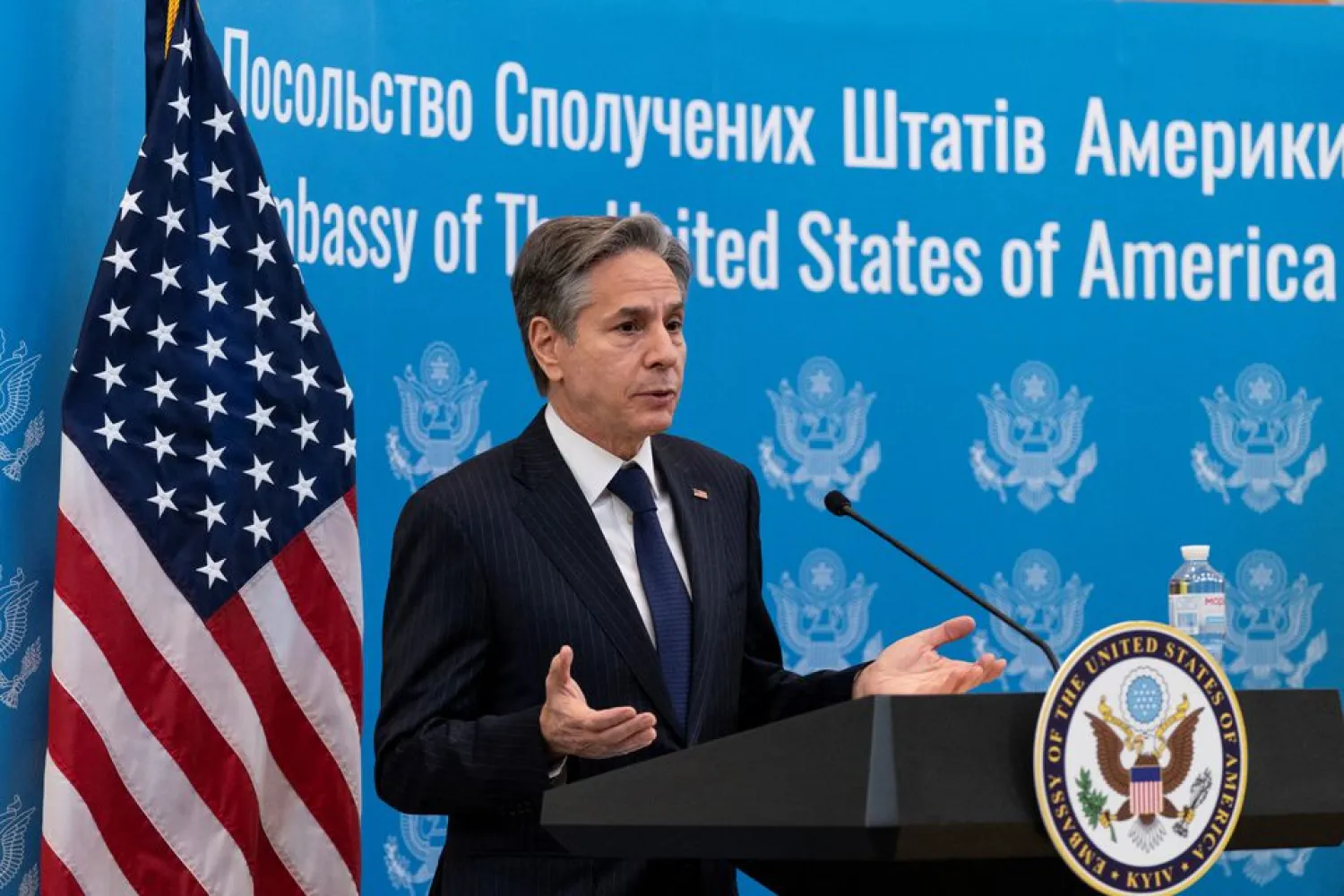
Secretary of State of US Antony Blinken speaks as he greets embassy staff at the U.S. embassy, in Kyiv, Ukraine, January 19, 2022. (Reuters)
TT

US, Russia Dig in Heels over Ukraine as Tensions Mount

Secretary of State of US Antony Blinken speaks as he greets embassy staff at the U.S. embassy, in Kyiv, Ukraine, January 19, 2022. (Reuters)

The United States and Russia dug in their heels Wednesday over Russia's military buildup on Ukraine's border with no sign either will relent from entrenched positions that have raised fears of a Russian invasion and a new war in Europe.

Ahead of critical talks Friday between US Secretary of State Antony Blinken and Russia's Foreign Minister Sergei Lavrov, the two sides appeared no closer to any compromise that might ease tensions and avert the threat of a Russian invasion. Ukraine, meanwhile, said it was prepared for the worst and would survive whatever difficulties come its way.

On a visit to Ukraine's capital, Kyiv, Blinken accused Russia of planning to reinforce the more than 100,000 troops it has deployed along the Ukrainian border and suggested that number could double “on relatively short order.”

Blinken did not elaborate, but Russia has sent an unspecified number of troops from the country’s far east to its ally Belarus, which also shares a border with Ukraine, for major war games next month.

Blinken also reiterated Washington's demands for Russia to de-escalate the situation by removing its forces from the border area, something that Moscow has flatly refused to do. And, Blinken said he wouldn't give Russia the written response it expects to its demands when he and Lavrov meet in Geneva.

Meanwhile, a top Russian diplomat said Moscow would not back down from its insistence that the US formally ban Ukraine from ever joining NATO and reduce its and the alliance's military presence in Eastern Europe. Deputy Foreign Minister Sergei Ryabkov said Moscow had no intention of invading Ukraine but that its demands for security guarantees were non-negotiable.

The US and its allies have said the Russian demands are non-starters, that Russia knows they are and that Russian President Vladimir Putin is using them in part to create a pretext for invading Ukraine, which has strong ethnic and historical ties to Russia. The former Soviet republic aspires to join the alliance, though has little hope of doing so in the foreseeable future.

The stalemate left little hope that Blinken and Lavrov's meeting, which follows a series of inconclusive talks last week, will ease tensions that have been rising since last year but have soared in the past weeks with increased Russian military activity.

The US has not concluded whether Putin plans to invade or whether the show of force is intended to squeeze the security concessions without an actual conflict.

In Kyiv, Blinken urged Western nations to remain united in the face of Russian aggression. He also reassured Ukraine's leader of NATO support while calling for Ukrainians to stand strong.

Blinken told Ukrainian President Volodymyr Zelenskyy that the US and its allies were steadfast in backing his country and its democratic aspirations against Russian attempts to incite division and discord through “relentless aggression."

“Our strength depends on preserving our unity and that includes unity within Ukraine,” he told Zelenskyy. “I think one of Moscow’s long-standing goals has been to try to sow divisions between and within our countries, and quite simply we cannot and will not let them do that.”

The Biden administration had said earlier it was providing an additional $200 million in defensive military aid to Ukraine. Blinken said more assistance is coming and that it would only increase should Russia invade.

Zelenskyy thanked Blinken for the aid, which was approved in late December but not confirmed until Wednesday.

“This (military) support not only speaks to our strategic plans of Ukraine joining the alliance, but more importantly to the level of our military, our military supplies,” he said, referring to Kyiv’s desire to join NATO.

“Your visit is very important,” Zelenskyy said. "It underlines once again your powerful support of our independence and sovereignty.”

From Kyiv, Blinken plans a short trip to Berlin for talks with German and other European allies on Thursday before meeting with Lavrov.

On Wednesday, French President Emmanuel Macron called on the European Union to draw up a plan to ease tensions with Russia, “We should build it among Europeans, then share it with our allies in the framework of NATO, and then propose it for negotiation to Russia,” he said.

Washington and its allies have kept the door open to possible further talks on arms control and confidence-building measures to reduce the potential for hostilities.

Ryabkov insisted, however, that there can’t be any meaningful talks on those issues if the West doesn’t heed the main Russian requests for the non-expansion of NATO with a formal response. He said the Russian demands are "a package, and we’re not prepared to divide it into different parts, to start processing some of those at the expense of standing idle on others.”

Blinken, though, said no such formal response was coming. “I won’t be presenting a paper at that time to Foreign Minister Lavrov,” he said. "We need to see where we are and see if there remain opportunities to pursue the diplomacy and pursue the dialogue.”

The Biden administration and its allies have accused Putin of creating the crisis and say it is up to him and the Russians to decide whether to invade and suffer severe economic consequences.

Russia has brushed off calls to withdraw its troops by saying it has a right to deploy its forces wherever it likes on its own territory. It also has rejected US allegations that it’s preparing a “false flag operation" to use as a pretext for intervention. Russia has angrily denied the charge.

Before Blinken's visit to Kyiv, a delegation of US senators traveled to Ukraine to emphasize congressional support for the country.

Russia in 2014 seized the Crimean Peninsula after the ouster of Ukraine’s Moscow-friendly leader and also threw its weight behind a separatist insurgency in eastern Ukraine. More than 14,000 people have been killed in nearly eight years of fighting between the Russia-backed rebels and Ukrainian forces in the country’s industrial heartland, called Donbas.


Iranian Leaders Fret Over Public Mood as Gas Shortages Add to War Ills

People visit a heating equipment store, amid a gas shortage, in Tehran, Iran, November 14, 2026. Majid Asgaripour/WANA (West Asia News Agency) via Reuters
TT

Iranian Leaders Fret Over Public Mood as Gas Shortages Add to War Ills

People visit a heating equipment store, amid a gas shortage, in Tehran, Iran, November 14, 2026. Majid Asgaripour/WANA (West Asia News Agency) via Reuters

Iran shows no sign of making concessions in the war with the US, but its warnings to citizens of gas shortages this winter are the latest sign of its own vulnerabilities in the conflict, with its ports blockaded and infrastructure hammered by US strikes.

The government said last week that, though Iran has had gas shortages before, they would be more severe this winter because of war damage to processing plants and most regions would be affected.

Toiling under the effects of a war that has intensified rampant inflation and destroyed millions of jobs, Iranians face growing hardships that senior figures fear will deepen divisions still raw from the crushing of mass protests last winter.

"The reality is that if our gas gets cut off, we'll have to close down and go home," said Seyyed Ahmad Seyyedi, a street vendor.

"This war must end so that we can return to normal life and all the problems and high prices can come to an ‌end. Continuing life under ‌these conditions is difficult," said Mina Lahrasabi, 65, who works in a rice factory ‌near ⁠Iran's Caspian coast.

A ⁠senior Iranian official and an Iranian security official told Reuters the country's hierarchy was increasingly concerned about the situation, with the internal fuel shortage adding to worries of public unrest.

There have been no notable protests against the ruling system since the war began on February 28 with US and Israeli strikes that killed Supreme Leader Ali Khamenei, but domestic intelligence agencies were on alert, the security official said.

The agencies were closely monitoring for any sign of opposition and believed the US might seek to provoke street demonstrations, the security official added.

The senior official warned that the increasingly difficult living standards faced by the Iranian population were getting harder for people ⁠to withstand, describing it as a fire smoldering beneath ashes.

"This is the most severe ‌siege imposed on us since the revolution," said Iranian analyst Saeed Leylaz.

GROWING SHORTAGES

At ‌a heater company in Tehran, salesman Amin Sha'bani said the prospect of a cold winter was concerning – and that customers were increasingly considering ‌electric products rather than gas, though both were often now too expensive for customers.

"Given what has happened in the past ‌nine months, with power plants attacked, it's perfectly natural to worry that the weather will get colder," he said.

Although Iran is a major gas producer controlling part of the world's biggest gas field, it has sometimes been unable to meet domestic consumption because of outdated equipment, a problem worsened by international sanctions.

Government spokesperson Fatemeh Mohajerani said last week that the gas shortage this winter would likely be 430 million cubic ‌meters, compared to 300 million last year.

Iran's national gas company has blamed the worsening shortage on damage to four processing plants early in the war, which it says it ⁠is trying to fix.

However, ⁠the senior Iranian official told Reuters measures being taken to resolve the problem only amounted to short-term fixes and said there had been numerous meetings to try to manage the looming crisis for the winter.

A second senior Iranian source said Iran was in talks to import gas from Russia.

"This could become a critical issue, but measures have been taken and we will get through it," said Leylaz, the analyst. "In the worst-case scenario, we may have to cut gas supplies to industries for a period, but we have not reached that point yet."

That more sanguine view was held by several Iranians Reuters reached inside the country by messaging app.

Reza, a 45-year-old in Urmia in the northwest of Iran, where the winters can bring heavy snowfall, said there was little concern among people he knew about the potential shortages and that his family had bought three electric heaters in case.

Iran has also suffered periodic power blackouts in recent years.

"The reality is that I don't mean to start crying now over what might happen. We already have enough problems – inflation, high prices and other difficulties to see a potential fuel shortage as relatively minor," said Zahra Hosseini, 44, who works for a food company in Tabriz.


Somaliland Briefly Detains Americans Accused of Threatening National Security

Traffic flows along a street in Hargeisa, Somaliland, October 16, 2026. REUTERS/Mohamed Ahmed
TT

Somaliland Briefly Detains Americans Accused of Threatening National Security

Traffic flows along a street in Hargeisa, Somaliland, October 16, 2026. REUTERS/Mohamed Ahmed

The national intelligence agency in the self-declared Republic of Somaliland said it had briefly detained five US nationals who were threatening national security.

The National Intelligence Agency of Somaliland (NIA) said in a post on X late on Sunday that it had been monitoring the US nationals since they arrived and ran a "lengthy investigation" into their activities.

It gave no details of their identities or alleged actions in the Horn of Africa territory.

NIA ⁠Director-General Jama Mohamoud ⁠Egal and Somaliland's Ministry of Foreign Affairs did not immediately respond to requests for comment.

The US State Department said it was aware of the reports but could not comment on specifics because of concerns on privacy and other considerations.

Somaliland, ⁠which declared independence from Somalia in 1991, occupies a strategic location at the juncture of the Indian Ocean and Red Sea. Last December, Israel became the first country to recognize it as a sovereign state, and its government has been lobbying for recognition from additional countries, including the United States.

According to a person familiar with the matter, the five Americans work for a company ⁠called ⁠Parallel Black. A November 4 letter seen by Reuters shows they were invited by Somaliland's Foreign Affairs Minister Abdirahman Dahir Adam to conduct feasibility studies for potential investments.

The person said the five Americans left Somaliland on an Ethiopian Airlines flight on Monday afternoon.

Parallel Black, which was registered less than two months ago in the US state of Delaware, did not immediately respond to requests for comment.


Le Pen Says France Will No Longer Aid Ukraine ‘Financially’ if Elected

Marine Le Pen (C), the far-right National Rally (RN) party's candidate for the 2027 French presidential election, visits the "Made in France" fair at the Porte de Versailles exhibition center in Paris, France, 13 November 2026. (EPA)
TT

Le Pen Says France Will No Longer Aid Ukraine ‘Financially’ if Elected

Marine Le Pen (C), the far-right National Rally (RN) party's candidate for the 2027 French presidential election, visits the "Made in France" fair at the Porte de Versailles exhibition center in Paris, France, 13 November 2026. (EPA)

Marine Le Pen on Monday said that France would provide no further financial aid to Ukraine if she is elected president next year, after a meeting with Kyiv's ambassador in Paris.

"The state of France's public finances would no longer allow the country to provide financial assistance to Ukraine in the coming months," Le Pen said in a statement, while insisting France would honor existing commitments, including toward a 90-billion-euro ($100-billion) European Union loan.

Le Pen is currently ahead in polls in the race to succeed President Emmanuel Macron next year, as the war sparked by Russia's 2022 full-scale invasion of Ukraine grinds towards its fifth anniversary.

She has faced criticism over past links to Russia, which included a 2017 meeting in the Kremlin with President Vladimir Putin and her party taking a loan from a Russian bank that it paid off in full in 2023.

But she has opposed the invasion and, at her talks in Paris with Ukrainian ambassador Vadym Omelchenko, Le Pen made clear her "unwavering support for Ukraine since the beginning of the conflict".

The statement said the talks -- the first such between Le Pen and the Ukrainian ambassador -- were "cordial".

While financial aid would be cut, Le Pen told the ambassador that "France would continue to support Ukraine through donations of equipment, humanitarian aid and much more active diplomacy".

The statement said there was a "frank discussion" on the future of the conflict, with Le Pen stressing that "the pursuit of peace -- though a difficult goal to achieve -- must remain a priority for all".

She also asked the ambassador to tell President Volodymyr Zelensky she is ready to meet in "either Paris or Brussels". However, there was no mention of the candidate making the journey to Kyiv after Zelensky invited her to visit the Ukrainian capital.

Le Pen's opponents have expressed alarm that by emphasizing the importance of ending the war swiftly, she could force Ukraine to capitulate on unfavorable terms.

"If Russia imposes its will on a European nation through brutality, all of Europe is weakened," Macron wrote on Facebook at the weekend.

Taking aim at Le Pen, he said: "Let us be clear: those who seek to limit the resources available to Ukraine are, in effect, pushing for an unjust peace -- one that would leave Ukraine permanently vulnerable, and, by extension, leave Europe vulnerable as well."