


ISIS Jailbreak, Attacks in Syria, Iraq Raise Alarm; Scores Die

People prepare to tow away a car damaged by a suicide car bomb explosion in the town of Taji, about 12 miles (20 kilometers) north of Baghdad, Iraq, Monday, Nov. 28, 2011. (AP)
TT

ISIS Jailbreak, Attacks in Syria, Iraq Raise Alarm; Scores Die

People prepare to tow away a car damaged by a suicide car bomb explosion in the town of Taji, about 12 miles (20 kilometers) north of Baghdad, Iraq, Monday, Nov. 28, 2011. (AP)

The ISIS group unleashed its biggest attack in Syria since the fall of its “caliphate” three years ago. More than 100 militants assaulted the main prison holding suspected extremists, sparking a battle with US-backed Kurdish fighters that continued 24 hours later and left dozens dead on Friday.

Across the border in Iraq, gunmen stormed an army barracks north of Baghdad before dawn Friday while soldiers inside slept, killing 11 before escaping — the deadliest attack in months on Iraq’s military, The Associated Press reported.

The bold assaults suggest militants have been revitalized after maintaining a low- level insurgency in Iraq and Syria over the past few years. The group’s territorial control in Iraq and Syria was crushed by a years-long US-backed campaign, but its fighters continued with sleeper cells that have increasingly killed scores of Iraqis and Syrians in past months.

The attack in Syria targeted Gweiran Prison in the northeastern city of Hassakeh, the largest of around a dozen facilities run by US-backed Syrian Kurdish forces holding suspected ISIS fighters. Gweiran holds some 5,000, including ISIS commanders and figures considered among the most dangerous, according to Farhad Shami, a spokesman for the Kurdish-led Syrian Democratic Forces, or SDF.

The forces' commander, Mazloum Abadi, said ISIS mobilized “most of its sleeper cells” to organize the jailbreak.

The militants, armed with heavy machine guns and vehicles rigged with explosives, attacked Thursday evening, aiming to free their comrades, Shami said.

The fighting started with a large explosion around 7 p.m., followed by two more blasts later, said one resident whose home overlooks the area. The assault was complex. Prisoners inside the facility rioted and tried to break out simultaneously as a car bomb went off outside and gunmen clashed with security forces, Shami said. A car bomb hit a nearby petroleum depot, sparking a fire that still burned Friday.

On Friday, Kurdish forces were trying to retake the northern part of the prison, where inmates remained in control and attempted a second escape.

The SDF was also attacking in the nearby Zuhour neighborhood, where ISIS militants were holed up. Fighting there was intense and movement slow because the militants have boobytrapped houses with explosives and were using civilians as human shields, Shami said. Coalition helicopters and other aircraft carried out strikes during the battle, including in Zuhour and on the prison, he said.

“Since yesterday, helicopters are always in the sky,” said the resident, who spoke on condition of anonymity out of fear for his safety. Civilians were fleeing Zuhour, and shops were closed across Hassakeh as security forces fanned out, he said.

Pentagon press secretary John Kirby said Friday the US used airstrikes to support the SDF in the prison break attack.
“We have provided some airstrikes to support them as they deal with this particular prison break,” Kirby said, adding that the US recognizes that the ISIS threat is not gone, and “we remain focused on that.”

Shami said that the SDF had cordoned off the area and so far recaptured 104 militants who escaped from the prison. But he said the total number who had broken out was not determined.

He said seven Kurdish fighters and at least 28 ISIS attackers were killed in the battle.

A Syrian opposition war monitor reported a higher death toll, 67. The Britain-based Syrian Observatory for Human Rights said at least 23 Kurdish security forces and prison guards were killed, along with 39 militants and five civilians.

Shami said the attack was ISIS’s biggest since it lost its last shred of territory in Syria in 2019. The fighters were led by foreign militants, not Syrians, many of whom spoke in Iraqi dialect. “This is not a local operation,” he said.

On Friday evening, Abadi, the SDF commander, said his forces managed to repel the attack, with the help from the US-led coalition. He tweeted that all fugitives were arrested. Shami, the spokesman, said a standoff was still underway in Zuhour.

The ISIS group claimed responsibility for the attack on its Aamaq news service Friday, saying it aimed to free prisoners and describing it as ongoing. Attempted prison breaks have been a main tactic of the group.

During their 2014 surge in which they overwhelmed territory in Iraq and Syria, they carried out multiple prison breaks.

Friday’s attack in Iraq was a brazen strike on a barracks in the mountainous al-Azim district outside the town of Baqouba.
Two security officials told The Associated Press that ISIS militants broke into the barracks at 3 a.m. after killing a guard, shot dead the soldiers and successfully fled. The officials spoke on condition of anonymity as they weren’t authorized to issue official statements.

The Iraqi military said in a statement that a lieutenant and 10 soldiers were killed. The officials said reinforcements and security forces deployed in the area.

Iraqi Prime Minister Mustafa al-Kadhimi vowed the attack on the barracks “will not go without decisive punishment,” saying the Iraqi military had to duty “to prevent the repeat of these violations and to hunt down the terrorists.”

ISIS was largely defeated in Iraq in 2017, but its militants have continued to wage attacks, frequently hitting security forces and military with roadside bombs and firing on military convoys or checkpoints.

They have at times also attacked civilians. In October, ISIS militants armed with machine guns raided a predominantly Shiite village in Iraq’s Diyala province, killing 11 civilians and wounding several others. Officials at the time said the attack occurred after the militants had kidnapped villagers and their demands for ransom were not met.

The ISIS group’s self-styled caliphate at its height covered a third of both of Iraq and Syria. The ensuing war against them lasted several years, killed thousands, and left large parts of the two neighboring countries in ruins. It also left US-allied Kurdish authorities in control of eastern and northeastern Syria, with a small presence of several hundred American forces still deployed there.



US Slaps Sanctions on Sudan’s RSF Commanders over El-Fasher Killings

FILE - A Sudanese child, who fled el-Fasher city with family after Sudan's RSF attacked the western Darfur region, receives treatment at a camp in Tawila, Sudan, Nov. 2, 2025. (AP Photo/Mohammed Abaker, File)
TT

US Slaps Sanctions on Sudan’s RSF Commanders over El-Fasher Killings

FILE - A Sudanese child, who fled el-Fasher city with family after Sudan's RSF attacked the western Darfur region, receives treatment at a camp in Tawila, Sudan, Nov. 2, 2025. (AP Photo/Mohammed Abaker, File)

The United States announced sanctions on Thursday on three Sudanese Rapid Support Forces (RSF) commanders over their roles in the "horrific campaign" of the siege and capture of El-Fasher.

The US Treasury said the RSF carried out "ethnic killings, torture, starvation, and sexual violence" in the operation.

Earlier Thursday, the UN's independent fact-finding mission on Sudan said the siege and seizure of the city in Darfur bore "the hallmarks of genocide."

Its investigation concluded that the seizure last October had inflicted "three days of absolute horror," and called for those responsible to be brought to justice.

"The United States calls on the Rapid Support Forces to commit to a humanitarian ceasefire immediately," US Treasury Secretary Scott Bessent said in a statement.

"We will not tolerate this ongoing campaign of terror and senseless killing in Sudan."

The Treasury noted that the three sanctioned individuals were part of the RSF's 18-month siege of and eventual capture of El-Fasher.

They are RSF Brigadier General Elfateh Abdullah Idris Adam, Major General Gedo Hamdan Ahmed Mohamed and field commander Tijani Ibrahim Moussa Mohamed.

Bessent warned that Sudan's civil war risks further destabilizing the region, "creating conditions for terrorist groups to grow and threaten the safety and interests of the United States."

The UN probe into the takeover of El-Fasher -- after the 18-month siege -- concluded that thousands of people, particularly from the Zaghawa ethnic group, "were killed, raped or disappeared."


Israel's Netanyahu Says No Reconstruction of Gaza before Demilitarization

Israel’s Prime Minister Benjamin Netanyahu - File Photo/AFP
TT

Israel's Netanyahu Says No Reconstruction of Gaza before Demilitarization

Israel’s Prime Minister Benjamin Netanyahu - File Photo/AFP

Israeli Prime Minister Benjamin Netanyahu said on Thursday there would be no reconstruction of war-shattered Gaza before the disarmament of Hamas, as the "Board of Peace" convened for its inaugural meeting in Washington.

Around two dozen world leaders and senior officials met for the first meeting of the board, which was set up after the United States, Qatar and Egypt negotiated a ceasefire in October to halt two years of war in the Gaza Strip.

"We agreed with our ally the US there will be no reconstruction of Gaza before the demilitarization of Gaza," Netanyahu said during a televised speech at a military ceremony on Thursday, AFP reported.

The meeting in Washington will also look at how to launch the International Stabilization Force (ISF) that will ensure security in Gaza.

One of the most sensitive issues before the board is the future of the Islamist movement Hamas, which fought the war with Israel and still exerts influence in the territory.

Disarmament of the group is a central Israeli demand and a key point in negotiations over the ceasefire's next stage.

US officials including Steve Witkoff, Trump's friend and roving negotiator, have insisted that solid progress is being made and that Hamas is feeling pressure to give up weapons.

Israel has suggested sweeping restrictions including seizing small personal rifles from Hamas.

It remains unclear whether, or how, the Palestinian technocratic committee formed to handle day-to-day governance of Gaza will address the issue of demilitarization.

The 15-member National Committee for the Administration of Gaza (NCAG) will operate under the supervision of the "Board of Peace", and its head, Ali Shaath, is attending the meeting in Washington on Thursday.


Trump Tells First Meeting of Board of Peace that $7 billion Raised for Gaza

US President Donald Trump speaking in Washington - AFP
TT

Trump Tells First Meeting of Board of Peace that $7 billion Raised for Gaza

US President Donald Trump speaking in Washington - AFP

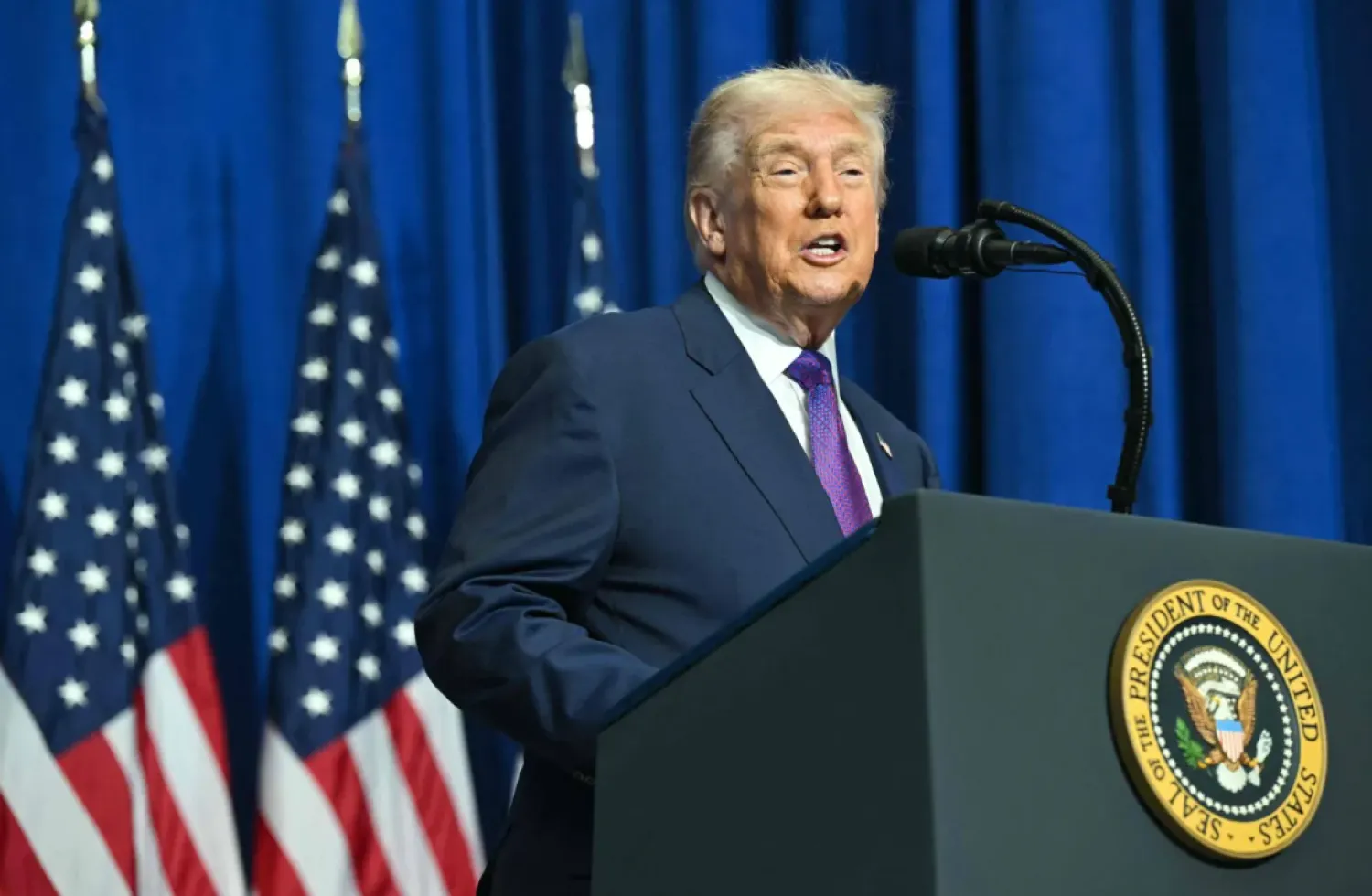
US President Donald Trump told the first meeting of his Board of Peace on Thursday that $7 billion has been contributed to a Gaza reconstruction fund that aims to rebuild the enclave once Hamas disarms, an objective that is far from becoming a reality.

The disarmament of Hamas militants and accompanying withdrawal of Israeli troops, the size of the reconstruction fund and the flow of humanitarian aid to the war-battered populace of Gaza are among the major questions likely to test the effectiveness of the board in the weeks and months ahead.

In a flurry of announcements at the end of a long, winding speech, Trump said the United States will make a contribution of $10 billion to the Board of Peace. He said contributing nations had raised $7 billion as an initial down payment for Gaza reconstruction.

Trump first proposed the board last September when he announced his plan to end Israel's war in Gaza. He later made clear the board's remit would be expanded beyond Gaza to tackle other conflicts worldwide.

Trump also said FIFA will raise $75 million for soccer-related projects in Gaza and that the United Nations will chip in $2 billion for humanitarian assistance.

TRUMP SAYS ANY IRAN DEAL MUST BE MEANINGFUL, PROSPECTS SHOULD BE CLEAR IN 10 DAYS

The Board of Peace includes Israel but not Palestinian representatives and Trump's suggestion that the Board could eventually address challenges beyond Gaza has stirred anxiety that it could undermine the UN's role as the main platform for global diplomacy and conflict resolution.

"We're going to strengthen the United Nations," Trump said, trying to assuage his critics. "It's really very important."

The meeting came as Trump threatens war against Iran and has embarked on a massive military buildup in the region in case Tehran refuses to give up its nuclear program.

Trump said he should know in 10 days whether a deal is possible. "We have to have a meaningful deal," he said.

The event had the feel of a Trump campaign rally, with music blaring from his eclectic playlist from Elvis Presley to the Beach Boys. Red Trump hats were given to participants.

Senior US officials said Trump will also announce that several nations are planning to send thousands of troops to participate in an International Stabilization Force that will help keep the peace in Gaza when it eventually deploys.

Hamas, fearful of Israeli reprisals, has been reluctant to hand over weaponry as part of Trump's 20-point Gaza plan that brought about a fragile ceasefire last October in the two-year Gaza war.

Trump said he hoped use of force to disarm Hamas would not be necessary. He said Hamas had promised to disarm and it "looks like they're going to be doing that, but we'll have to find out."