


How Vaccine Misinformation Left Children Vulnerable to Omicron

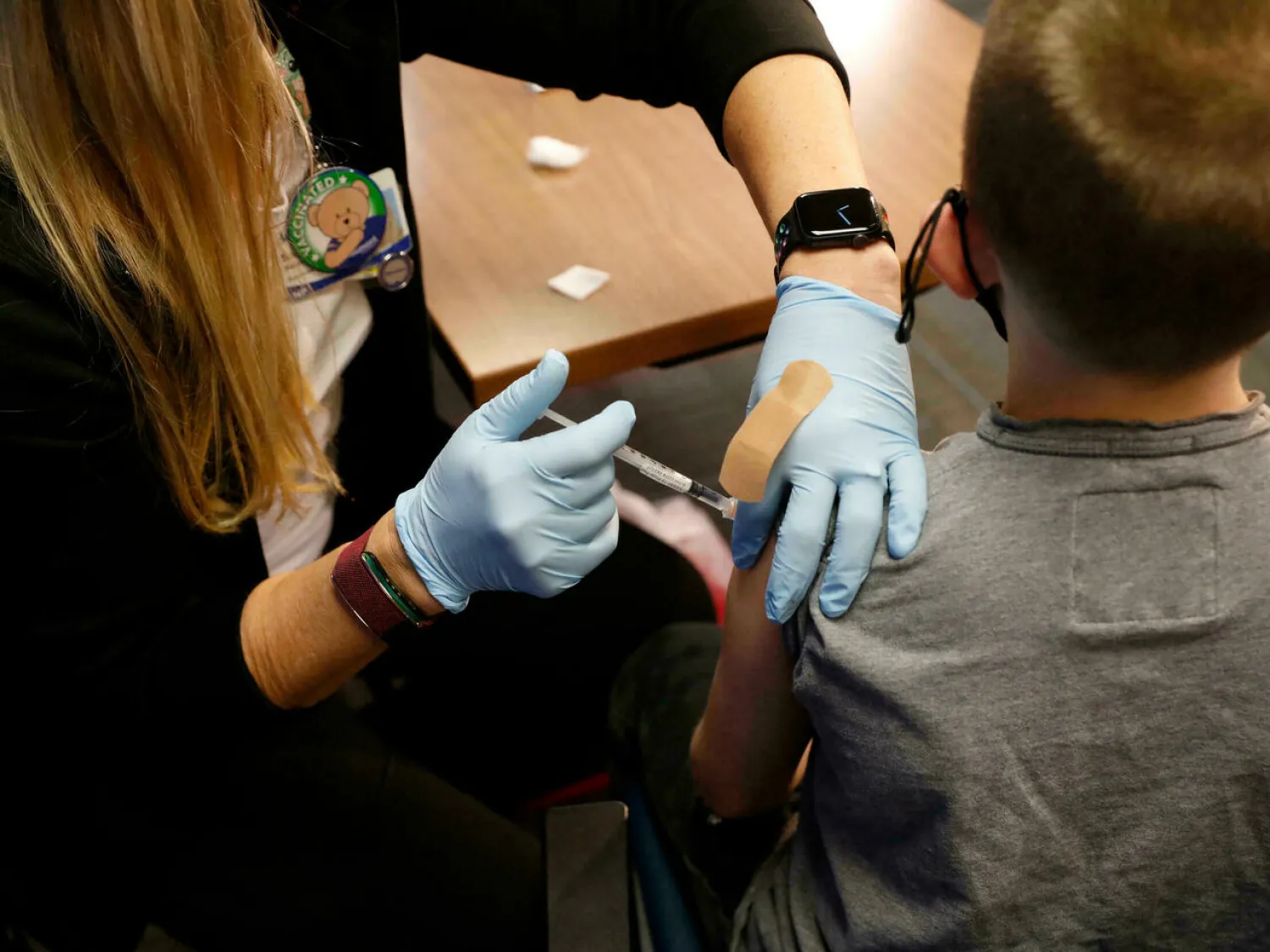
An eight-year-old child receives the Pfizer-BioNTech Covid-19 vaccine at the Beaumont Health offices in Southfield, Michigan on November 5, 2021. JEFF KOWALSKY AFP/File
TT

How Vaccine Misinformation Left Children Vulnerable to Omicron

An eight-year-old child receives the Pfizer-BioNTech Covid-19 vaccine at the Beaumont Health offices in Southfield, Michigan on November 5, 2021. JEFF KOWALSKY AFP/File

The Covid-19 pandemic took a deadly toll on adults in the United States for two years while largely sparing children from adding to the dire statistics.

But the rapid spread of the Omicron variant led to record pediatric infections and hospitalizations in the country, and anti-vaccination misinformation that tells parents the shots are dangerous is adding to the risk, AFP said.

The chances of young people dying from Covid-19 remain low. The shots greatly reduce the odds of severe illness, and vaccinated mothers may pass protection to their babies, but vaccine hesitancy pushed online leaves both parents and children vulnerable.

From worries that the shots were developed too quickly, to false claims that the jabs can impact future fertility, physician Wassim Ballan of Phoenix Children's Hospital said combating misinformation has become part of his job.

"Unfortunately, a lot of times when we're having this time with a family to discuss these things is when the child is already in hospital," he said of the problem.

Parents need to understand that the vaccines are "the most important tool for protection," especially to avoid multisystem inflammatory syndrome in children, a rare and dangerous complication that can follow a mild Covid-19 infection.

Only 27 percent of children aged five to 11 have received a first dose of the vaccine in the United States. Hospitalizations reached a pandemic high of 914 children per day this month, up dramatically from the previous peak of 342 in September 2021.

- Protection from the womb -
The first week of January 2022 saw Texas Children's Hospital in Houston report 12 babies in intensive care with Covid-19.

Babies are too young for the Covid-19 shot, but Kathryn Gray, attending physician of maternal-fetal medicine at Brigham and Women's Hospital, said research increasingly shows that vaccination during pregnancy leads to antibodies safely being transferred to the baby, offering limited protection.

Expectant mothers have also shown hesitancy to get the shot after they were excluded from initial clinical trials.

Gray is among those who are monitoring the situation. "To date there have been no safety signals" in the data, she said, adding that she has "a lot of confidence" in telling patients the shot is safe during pregnancy for mother and baby.

"If they truly want to protect their infants, getting vaccinated is the thing that will protect them the most at this time."

Health agencies across the globe say the same, but the initial lack of data continues to be exploited in vaccine-opposed messaging on social media. Posts on Facebook and Twitter claimed that stillbirths rose following the push to vaccinate pregnant people, even though going unprotected against the disease is the greater risk.

Epidemiologists Carla DeSisto and Sascha Ellington from the US Centers for Disease Control and Prevention said data from 1.2 million US births showed "no evidence the rate of stillbirths is higher overall during the pandemic."

But their research did reveal the risks of contracting the virus while pregnant.

"Compared to pregnant people without Covid-19, pregnant people with Covid-19 are at increased risk of adverse pregnancy outcomes including preterm birth and stillbirth," the researchers said by email.

- 'Unvaccinated milk' -
Breastfeeding has also been the target of misinformation, with posts claiming that babies suffered rashes or even death upon nursing from a vaccinated mother.

The Society for Maternal-Fetal Medicine recommends vaccination for those who are lactating and says there is no reason to stop breastfeeding upon receiving the vaccine.

Misinformation became increasingly common in private Facebook groups where parents connect to share and sell breast milk, group moderators told AFP. In one of the largest such groups, Bethany Bristow said she was concerned by requests for "unvaccinated milk."

The New York mother, along with her fellow moderators, decided to ban such requests, and the rules for her group of more than 10,500 parents now state: "Advertising or requesting vaccine free milk puts you, your children and community at risk."

Studies are finding specific benefits of milk from a vaccinated mother, according to Laura Ward, co-director of the Center for Breastfeeding Medicine at Cincinnati Children's Hospital.

"Antibodies have been detected in the breast milk of vaccinated lactating women. This means that breastfed infants may have some protection against Covid-19 if their mothers receive the vaccine," she said.

Gray agreed. "Breast milk is full of antibodies based on a person's prior exposures both to vaccines and infection. Those things don't pose a risk to infants, they're actually helpful at protecting them," she said.

"Any concerns or unknown pieces about the vaccine are dwarfed by the risk of Covid."


Spain and Portugal Continue to Battle Storm Leonardo as New Storm Approaches

 A mountain landslide blocks railway tracks during heavy rains, as storm Leonardo hits parts of Spain, in Benaojan, Spain, February 6, 2026. (Reuters)
A mountain landslide blocks railway tracks during heavy rains, as storm Leonardo hits parts of Spain, in Benaojan, Spain, February 6, 2026. (Reuters)
TT

Spain and Portugal Continue to Battle Storm Leonardo as New Storm Approaches

 A mountain landslide blocks railway tracks during heavy rains, as storm Leonardo hits parts of Spain, in Benaojan, Spain, February 6, 2026. (Reuters)
A mountain landslide blocks railway tracks during heavy rains, as storm Leonardo hits parts of Spain, in Benaojan, Spain, February 6, 2026. (Reuters)

Storm Leonardo continued to batter the Iberian Peninsula on Friday, bringing floods and putting rivers at risk of bursting their banks while thousands of people were evacuated from their homes in Spain and Portugal.

In southern Spain's Andalusia region, some 7,000 people have had to leave their homes due to successive storms.

Among them were around 1,500 people ordered to evacuate the mountain village of Grazalema, where Andalusia's regional leader Juan Manuel Moreno warned that aquifers were "full to the brim with water,” and at risk of collapsing.

“It's raining on already saturated ground. The land is unable to drain," Moreno said. “We urge extreme caution. This is not over.”

Spanish police said Friday they had found a body located 1,000 meters (about 0.6 miles) away from where a woman had disappeared Wednesday after she fell into a river in Malaga province while trying to rescue her dog. Police said they had not yet identified the body, but believed it belonged to the 45-year-old woman.

Another storm front, Marta, was expected to arrive Saturday, with Spain's weather agency AEMET saying it would bring even more rain and heavy winds, including to areas already drenched by Storm Leonardo.

Marta is expected to affect Portugal, too.

Of particular concern was southern Spain's Guadalquivir River, which flows through Córdoba and Seville and eventually into the Atlantic Ocean, and whose water levels have dramatically risen in recent days.

Additional rain Saturday could leave many more homes at risk in Córdoba, local authorities warned.

In Portugal, parts of Alcacer do Sal were submerged after the Sado River overflowed, forcing residents to leave the city located 90 kilometers (about 56 miles) south of Lisbon.

Alerts were issued also for regions near the Tagus River due to rising water levels.

A separate storm in late January left a trail of destruction in Portugal, killing several people, according to Portuguese authorities.


AROYA Cruises Debuts Arabian Gulf Voyages for 2026

AROYA offers a curated experience featuring culturally inspired entertainment and diverse dining options - SPA
TT

AROYA Cruises Debuts Arabian Gulf Voyages for 2026

AROYA offers a curated experience featuring culturally inspired entertainment and diverse dining options - SPA

AROYA Cruises, a subsidiary of the PIF-owned Cruise Saudi, has officially launched its inaugural season in the Arabian Gulf.

Running from February 21 to May 8, the season marks a milestone in regional tourism by blending authentic Saudi hospitality with international maritime standards, SPA reported.

AROYA offers a curated experience featuring culturally inspired entertainment and diverse dining options.

The season is designed to provide guests with a dynamic way to explore the Gulf, setting a new benchmark for luxury travel that reflects the Kingdom's heritage on a global stage.


Snowstorm Brings Much of Denmark to a Halt

A car drives in heavy snow at Store Heddinge in South Zealand, Denmark, 05 February 2026.  EPA/Mads Claus Rasmussen
A car drives in heavy snow at Store Heddinge in South Zealand, Denmark, 05 February 2026. EPA/Mads Claus Rasmussen
TT

Snowstorm Brings Much of Denmark to a Halt

A car drives in heavy snow at Store Heddinge in South Zealand, Denmark, 05 February 2026.  EPA/Mads Claus Rasmussen
A car drives in heavy snow at Store Heddinge in South Zealand, Denmark, 05 February 2026. EPA/Mads Claus Rasmussen

Denmark authorities halted public transport, closed schools and cancelled flights on Friday as heavy snowfall blanketed much of the country.

The Nordic country's meteorological institute DMI warned that heavy snow would likely continue until Friday evening in the east, where the capital Copenhagen is located.

Police said people should avoid going outdoors unless necessary and stay indoors in the capital and the surrounding region.

Copenhagen's airport cancelled flights to Paris and Berlin and warned of "delay and cancellation risks because of snowy conditions." Many schools were closed.

In the second-largest city of Aarhus, bus services were cancelled.
