


Penny Pinching and Power Cuts; Lebanon’s Middle Class Squeezed by Crisis

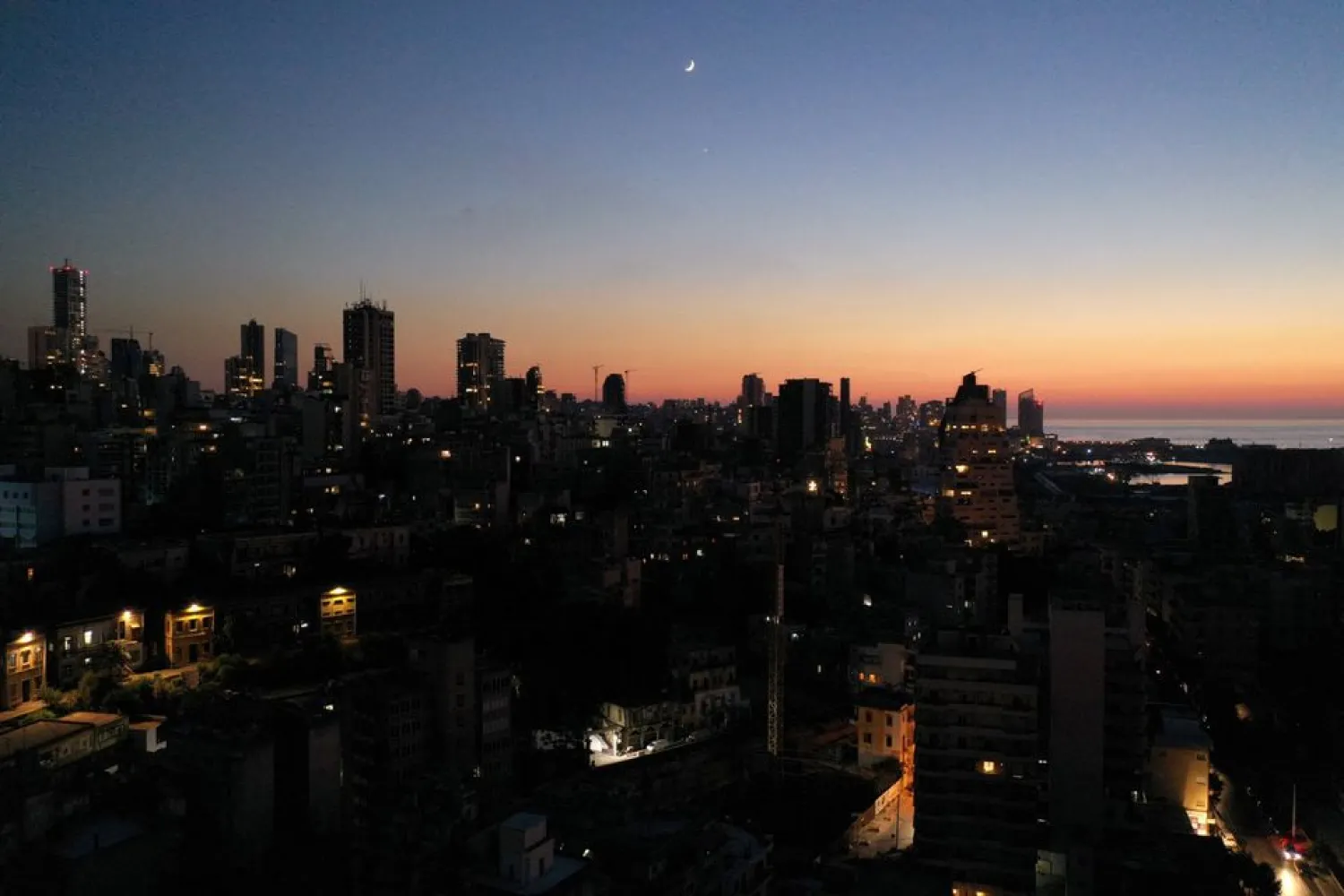
Unlit buildings are seen during a partial blackout in Beirut, Lebanon August 11, 2021. (Reuters)
TT

Penny Pinching and Power Cuts; Lebanon’s Middle Class Squeezed by Crisis

Unlit buildings are seen during a partial blackout in Beirut, Lebanon August 11, 2021. (Reuters)

Lebanese school teacher Sara Wissam and her husband were comfortably off before a run on the local currency decimated the value of their salaries and dragged them towards poverty.

The plight of the Beirut couple is common across Lebanon's middle class, which has been forced to make once unthinkable choices by the worsening economic crisis: cutting back on food, cancelling trips or applying to emigrate for good.

"It used to be that our income lasted a month," the mother of three told Reuters.

"Now it's not enough for one trip to the supermarket to buy essentials," said Wissam, describing how she rarely buys meat, has cut back on cheese and chooses even the smallest treats for her young kids carefully.

Ayman Hadad, a 28-year-old university graduate who found a job in a shop, earns the equivalent of $125 a month and wants to join friends who have emigrated. He has applied to go to Canada. "Enough of Lebanon. We lost hope," he said.

Lebanon's descent into financial ruin began in 2019, the result of a poorly managed spending binge that pushed up debt, political paralysis as rival factions squabbled and foreign lenders' reluctance to bail the country out unless it reformed.

The World Bank ranks the crisis as among the most severe globally since the mid-19th century, devastating a country once seen as a wealthy and liberal outpost in the Middle East before civil war broke out from 1975 to 1990.

About 80% of the population of 6.5 million are considered poor; in September, more than half of families had at least one child who skipped a meal, UNICEF said, compared with just over a third in April.

The currency has lost more than 90% of its value and banks have locked savers out of accounts. By some estimates, state debt reached 495% of gross domestic product in 2021, far above levels that crippled some European states a decade ago.

Adding to people's frustration is the government's failure so far to tackle the problems.

Caretaker administrations have led Lebanon for much of the last three years, and since the cabinet quit after a devastating Beirut port blast in 2020, politicians have been fighting over who should lead an investigation into who was to blame.

Meanwhile people see signs of social and economic collapse. The state telecom firm shut the Internet in parts of Beirut for lack of fuel in recent days and an armed man took hostages at a bank demanding access to his trapped savings.

'Fridge empty'

Lebanon's national power grid was creaking before the crisis, with rolling cuts across the country. Now, a bankrupt government can barely run its power plants and homes often receive only an hour of state electricity a day.

Yola al-Musan, who manages a supermarket in Beirut, uses electricity from a shared neighborhood generator to keep the lights on at home.

When the national grid does fire up, Musan races to switch on the washing machine as only then does she have a strong enough current.

For school teacher Wissam, putting enough food on the table for her family has become tough, even though she and her husband both have steady jobs.

Before the crisis, Wissam and her husband's combined salary was 3 million Lebanese pounds a month, which at the exchange rate at the time of 1,500 to the dollar was around $2,000.

Now their combined earnings are worth the equivalent of $140, even after Wissam's modest wage hike. The currency has plummeted to 25,000 to the dollar, sending the price of imported goods and local products soaring.

"Lebanon's leaders amuse themselves insulting each other and accusing each other of corruption. In fact, they are all corrupt and thieves," she said, echoing widespread public and international criticism of how the crisis has been handled.

Politicians, some former militia leaders and others from families who wielded influence for generations over the nation's Christian and Muslim communities, acknowledge corruption exists but deny they are responsible and say they are doing their best to rescue the economy.

But a lengthy and continuing dispute over who should preside over the port blast inquiry has contributed to delays in talks with the International Monetary Fund, seen as vital to unlocking overseas support led by France.

Gulf donors stepped back years ago, voicing anger at Iran's rising influence in Lebanon through Hezbollah.

Najib Mikati, the billionaire prime minister, has tried to mend Gulf ties. Hezbollah, in turn, stepped up criticism of Gulf states and hosted conferences for domestic opponents of the monarchies.

Meanwhile, the cabinet is expected to hold its first meeting in more than three months on Monday to discuss a draft budget it hopes will ease financial pressures and quell public anger.

"If each one of them donated a small amount of their wealth to the poor, there would be no poor in Lebanon," said Shadi Ali Hamoud, 39, after returning home to his family from work in a restaurant kitchen. "Look at the fridge, it's empty."




Israel Denies Accepting Gaza Health Ministry War Toll

A forensic expert examines one of the bodies of Palestinians returned by Israel the previous day, as part of the Gaza ceasefire deal, in a morgue at al-Shifa hospital in Gaza City on January 30, 2026. (AFP)
TT

Israel Denies Accepting Gaza Health Ministry War Toll

A forensic expert examines one of the bodies of Palestinians returned by Israel the previous day, as part of the Gaza ceasefire deal, in a morgue at al-Shifa hospital in Gaza City on January 30, 2026. (AFP)

Israel's military denied on Friday having accepted the Palestinian health ministry's death toll for the war in Gaza of 71,000 killed since October 2023, as was reported in Israeli media.

"The (Israeli military) clarifies that the details published do not reflect official ... data", military spokesman Lieutenant Colonel Nadav Shoshani posted on social media.

"Any publication or report on this matter will be released through official and orderly channels."

Israel's left-leaning daily Haaretz had reported Thursday that the military "accepted the estimate of the Hamas-run Gaza Health Ministry that approximately 71,000 Palestinians were killed during the Israel-Gaza war," sparked by Hamas' unprecedented attack on Israel on October 7, 2023.

Haaretz added that the military "said it is currently analyzing the data on the dead to see how many of them are combatants and how many are civilians".

Hamas took power in the Gaza Strip in 2007 after winning elections and violently ousting the Palestinian Authority, which had administered the territory since Israel unilaterally withdrew in 2005, after more than 38 years of military occupation.

Its October 7, 2023 attack resulted in the deaths of 1,221 people on the Israeli side, mostly civilians, according to an AFP tally that includes hostages who died or were killed during their captivity in the Gaza Strip.

Since then, at least 71,667 Palestinians have been killed in the small coastal territory by Israel's retaliatory military campaign, according to Gaza's health ministry.

Israeli authorities have repeatedly questioned the credibility of these figures or sought to discredit them by saying one cannot trust an administration under Hamas authority -- a movement Israel, the United States and the European Union designate as a "terrorist organization."

The ministry's figures are nevertheless considered reliable by the United Nations.

While they do not specify the share of armed Palestinian fighters among the dead, the ministry says more than half of those killed are children and women.

Its statistics only record people killed in Israeli bombardments or fighting. They do not take into account deaths whose bodies have not yet been pulled from the rubble of a territory devastated by Israeli strikes, nor indirect deaths caused by the war.

According to the ministry, 492 people have been killed by Israeli fire or bombardments since October 10 and the entry into force of a truce that the two sides accuse each other of violating daily.


Syrian Army Declares ISIS-Linked Camp ‘Closed Security Zone’

Syrian internal security forces stand guard along the fence of Al-Hol camp in the desert region of Syria's Hasakeh province on January 21, 2026. (AFP)
TT

Syrian Army Declares ISIS-Linked Camp ‘Closed Security Zone’

Syrian internal security forces stand guard along the fence of Al-Hol camp in the desert region of Syria's Hasakeh province on January 21, 2026. (AFP)

Syria's army announced Friday that a camp housing suspected relatives of ISIS group fighters was closed to the public, a measure a military source said was meant to bolster security around the facility.

Earlier this month, the army entered the vast Al-Hol camp after the withdrawal of the Kurdish-led Syrian Democratic Forces (SDF).

In a statement Friday, it said the area was a "closed security zone".

Located in a desert region of Hasakeh province, Al-Hol is the largest camp for suspected ISIS relatives and is home to some 24,000 people, mostly women and children, including 6,200 foreigners.

A military source told AFP the army's measure aimed to control security around the camp and maintain order within it.

Some camp residents fled during the "security vacuum" between when the SDF withdrew and the army took control, two former employees of organizations working at the site told AFP last week.

In recent days, new reports emerged of attempts to flee the camp.

In the latest issue of its official al-Naba publication -- translated by the SITE monitoring group -- ISIS called on supporters to free women held captive in Al-Hol.

In 2014, ISIS swept across Syria and Iraq, committing massacres, but backed by a US-led coalition, the Kurdish-led SDF ultimately defeated the extremists in Syria five years later.

The SDF went on to jail thousands of suspected extremists and detain tens of thousands of their relatives in camps.

When the Syrian army took control of the camp, most humanitarian organizations withdrew, and aid has only been trickling in since.

The Save the Children charity warned on Friday that the humanitarian situation in the camp was "rapidly deteriorating as food, water and medicines run dangerously low".

After Syrian government forces advanced against Kurdish forces, Washington said it would transfer 7,000 ISIS suspects, previously held by Syrian Kurdish fighters, to Iraq.

The transfer is still underway.


MSF Says it Will Not Share Staff Details Demanded by Israel to Access Gaza

A pickup truck of the Medecins Sans Frontieres (MSF), stands in front of a market stall for solar energy equipment, in the city of Tine, eastern Chad, November 25, 2025. REUTERS/Amr Abdallah Dalsh
TT

MSF Says it Will Not Share Staff Details Demanded by Israel to Access Gaza

A pickup truck of the Medecins Sans Frontieres (MSF), stands in front of a market stall for solar energy equipment, in the city of Tine, eastern Chad, November 25, 2025. REUTERS/Amr Abdallah Dalsh

Medical charity Medecins Sans Frontieres said on Friday it will not submit lists of staff demanded by Israel to maintain access to Gaza and the West Bank, saying it had not been able to obtain assurances over the safety of its teams.

MSF, which supports and helps staff hospitals in Gaza, is one of 37 international organisations that Israel ordered this month to stop work in the Palestinian territories unless they meet new rules including providing employee details, Reuters reported.

The aid groups say sharing such staff information could pose a safety risk, pointing to the hundreds of aid workers who were killed or injured during the two-year Gaza war.

Israel's diaspora ministry, which manages the registration process, did not immediately respond to a request for comment. Israel has previously said the registrations were meant to prevent diversions of aid by Palestinian armed groups. Aid agencies dispute that substantial aid has been diverted.

MSF had said last week it would be prepared to share a partial list of Palestinian and international staff who had agreed to release that information, provided the list be used only for administrative purposes and not put its team at risk. It also said it wanted to retain control over the management of medical humanitarian supplies.

"However, despite repeated efforts, it became evident in recent days that we were unable to build engagement with Israeli authorities on the concrete assurances required," MSF said in a statement.

It said there could be a devastating impact on humanitarian services if it is banned from operating in Gaza and the West Bank, amid the ongoing humanitarian crisis in Gaza.

The Ministry of Health in Gaza said in a statement on Friday that it rejected sharing data of health staff working with partner health institutions, saying it threatened the personal safety of workers.