
US Tells Diplomats’ Families to Leave Ukraine, Weighs Troop Options

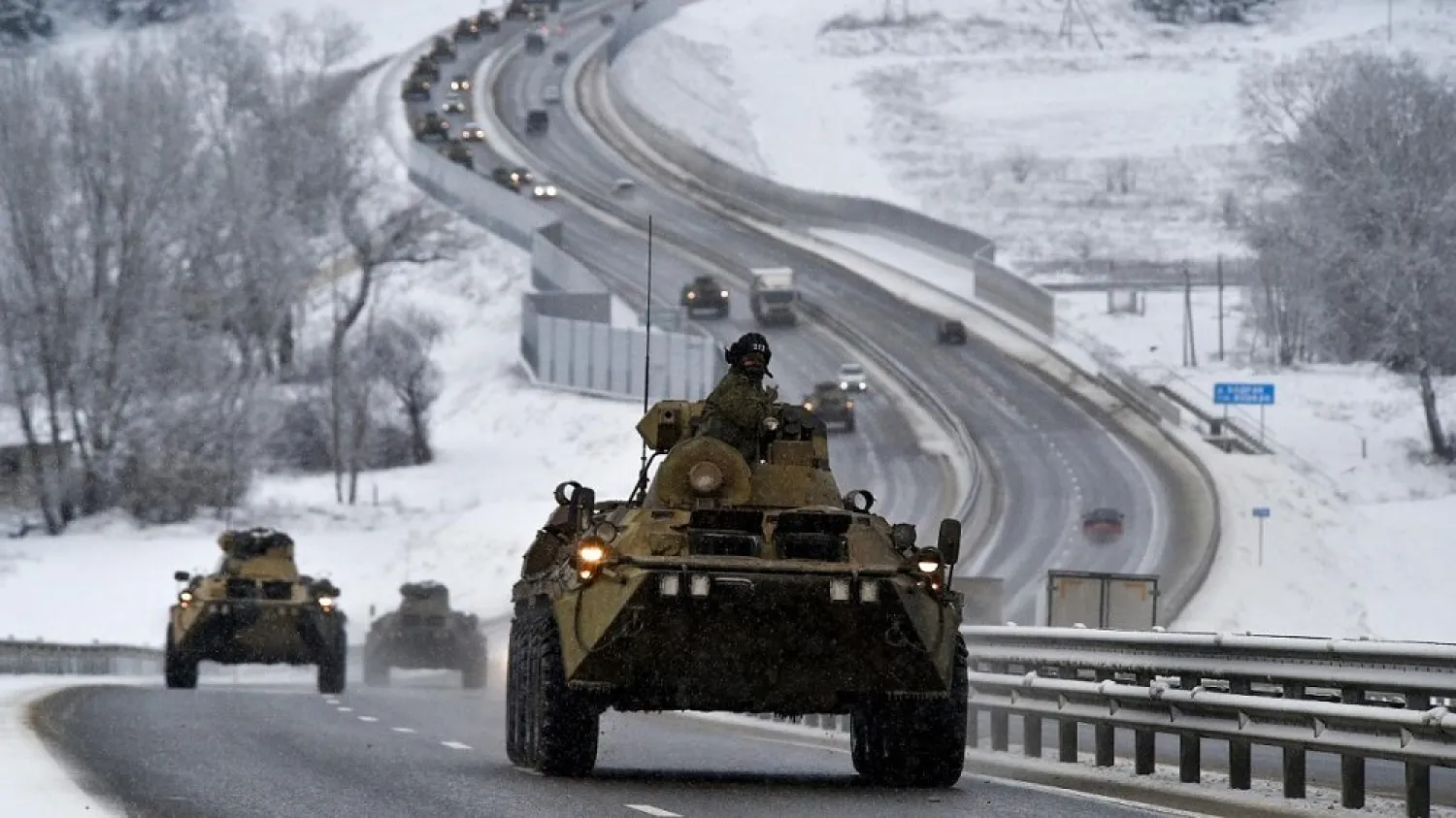
A convoy of Russian armored vehicles moves along a highway in Crimea, Tuesday, Jan. 18, 2022. (AP)
TT

US Tells Diplomats’ Families to Leave Ukraine, Weighs Troop Options

A convoy of Russian armored vehicles moves along a highway in Crimea, Tuesday, Jan. 18, 2022. (AP)

The US State Department announced Sunday it was ordering diplomats' family members to leave Ukraine, as US President Joe Biden weighed options for boosting America's military assets in Eastern Europe to counter a buildup of Russian troops.

The order, which also allowed US diplomats stationed at the embassy in the Ukrainian capital Kyiv to leave voluntarily, was one of the clearest signs yet that American officials are bracing for an aggressive Russian move in the region.

"Military action by Russia could come at any time," the US Embassy said in a statement. Officials "will not be in a position to evacuate American citizens in such a contingency, so US citizens currently present in Ukraine should plan accordingly," it added.

Ukrainian foreign ministry said in a statement that it considered the move as "premature and a manifestation of excessive caution."

"In fact, there have been no cardinal changes in the security situation recently: the threat of new waves of Russian aggression has remained constant since 2014 and the buildup of Russian troops near the state border began in April last year," it said.

Tensions in Ukraine have been increasing for months after the Kremlin massed some 100,000 troops near Ukraine's borders, a dramatic buildup the West says is preparation for a war to prevent Ukraine from ever joining the NATO Western security alliance.

The Kremlin has repeatedly denied planning to invade, but the Russian military already tore off a chunk of Ukrainian territory when it seized Crimea and backed separatist forces who took control of large parts of eastern Ukraine eight years ago.

The State Department's announcement comes a day after British authorities said they had information the Russian government was considering a former Ukrainian lawmaker as a potential candidate to head a pro-Russian leadership in Kyiv.

The Russian Foreign Ministry dismissed the British allegation as "disinformation," accusing NATO of "escalating tensions" over Ukraine.

Troops and sanctions

Biden has begun considering options for boosting America's military assets in the region, senior administration officials said, after meeting with top national security aides at his Camp David retreat on Saturday.

The New York Times said Biden was mulling plans to send 1,000 to 5,000 troops to Eastern European countries, with the possibility of increasing the number should tensions flare further.

A senior administration official declined to confirm the numbers on Sunday but said "we are developing plans and we are consulting with allies to determine options moving forward."

The United States has sent military assistance to Ukraine but has so far held back from sending American personnel.

US Secretary of State Antony Blinken has rebuffed calls to immediately impose economic sanctions on Russia, saying on Sunday that doing so would undercut the West's ability to deter potential Russian aggression against Ukraine.

Blinken was due to meet virtually with members of the European Union's Foreign Affairs Committee on Monday.

As US troop deployments were discussed, a separate senior administration official said US economic penalties on Russia would have far-reaching consequences should it drive any further into Ukraine.

The United States would use the Foreign Direct Product Rule to restrict the export to Russia of products incorporating microelectronics based on US equipment, software or technology.

Britain has also promised stiff sanctions, with British Deputy Prime Minister Dominic Raab telling Sky News there would be "very serious consequences if Russia takes this move to try and invade."

British officials say they have information the Russian government was considering former Ukrainian lawmaker Yevhen Murayev as a potential candidate to head a pro-Russian government in Kyiv.

Murayev poured cold water on the notion.

"This morning I already read in all the news publications this conspiracy theory: absolutely unproven, absolutely unfounded," Murayev told Reuters in a video call, adding he was considering legal action.

He denied having any contact with Russian intelligence officers and dismissed the idea that he could be in league with the Kremlin as "stupid," given he was placed under Russian sanctions in 2018.

Although he says he wants Ukraine to be independent from Russia as well as the West, Murayev, 45, has promoted some views that align with the Kremlin's narratives on Ukraine.

The British foreign ministry declined to provide evidence to back its accusations.

In a message to Reuters, Mykhailo Podolyak, a Ukrainian adviser to the presidential office, said there was doubt among Ukrainians as to whether Murayev was "too ridiculous a figure" to be the Kremlin's pick to lead Ukraine.

But Russia had propped up previously minor figures in leadership positions in annexed Crimea and separatist-held eastern Ukraine, he added.

Therefore "one should take this information as seriously as possible," he said.


UK Foreign Minister to Meet Rubio amid Tensions over Joint Air Base

British Foreign Secretary Yvette Cooper, president of the United Nations Security Council for February speaks during a press conference before the Security Council meeting, at UN headquarters in New York City, US, February 19, 2026. REUTERS/Jeenah Moon
TT

UK Foreign Minister to Meet Rubio amid Tensions over Joint Air Base

British Foreign Secretary Yvette Cooper, president of the United Nations Security Council for February speaks during a press conference before the Security Council meeting, at UN headquarters in New York City, US, February 19, 2026. REUTERS/Jeenah Moon

Britain's foreign minister Yvette Cooper ‌will meet with US Secretary of State Marco Rubio on Friday, after President Donald Trump renewed his criticism of London for ceding sovereignty of ​the Chagos Islands, which is home to a US-UK air base.
Last year, British Prime Minister Keir Starmer agreed a deal to transfer sovereignty of the Indian Ocean islands to Mauritius, while keeping control of one - Diego Garcia - through a 99-year lease that preserved US operations at the base, Reuters said.
Washington last year gave its blessing to the agreement, but Trump has since ‌changed his mind ‌several times. In January, Trump described it ​as ‌an ⁠act ​of "great stupidity", ⁠but earlier this month said he understood the deal was the best Starmer could make, before then renewing his criticism this week.
Cooper is meeting Rubio to discuss defense and security issues in Washington as Trump also toughens his rhetoric on Iran, saying Tehran must make a deal over its nuclear program in the ⁠next 10 to 15 days, or "really bad ‌things" will happen.
The Diego Garcia ‌base has recently been used for ​operations in the Middle East against ‌Yemen's Houthis and in humanitarian aid to Gaza.
Although on Tuesday ‌Rubio's State Department said it backed the Chagos accord, the next day Trump said Britain was making a big mistake.
"DO NOT GIVE AWAY DIEGO GARCIA!" Trump wrote in a post on Truth Social, saying the ‌base could be called upon in any future military operation to "eradicate a potential attack" from ⁠Iran.
Under the ⁠conditions for using the joint base, Britain would need to agree in advance to any operations out of Diego Garcia.
On Thursday, Britain's The Times newspaper reported that Trump's latest criticism of the Chagos deal came because Britain was yet to give permission to use the bases for future strikes against Iran, owing to concerns they may breach international law.
Asked about The Times report, Britain's Ministry of Defence said on Thursday it does not comment on operational matters and that Britain supported ​the ongoing political process between ​the US and Iran.


Turkish Police Detain Deutsche Welle Journalist over Social Media Posts

19 February 2026, Canada: Deutsche Welle (DW) logo is seen displayed on a smartphone screen. Photo: Thomas Fuller/SOPA Images via ZUMA Press Wire/dpa
TT

Turkish Police Detain Deutsche Welle Journalist over Social Media Posts

19 February 2026, Canada: Deutsche Welle (DW) logo is seen displayed on a smartphone screen. Photo: Thomas Fuller/SOPA Images via ZUMA Press Wire/dpa

Turkish police have detained investigative journalist Alican Uludag on suspicion of insulting President Recep Tayyip Erdogan and spreading misinformation, sparking outrage among journalism groups.
Uludag, who works for German broadcaster Deutsche Welle’s Turkish service, was taken from his home in Ankara late Thursday as part of an investigation into social media posts. The Istanbul Chief Prosecutor’s Office said he is suspected of “insulting the president” and “disseminating misleading information.”
The journalist, whose reporting focuses mainly on the judiciary and on corruption cases, was later transferred to Istanbul for questioning.
His detention drew sharp condemnation from press freedom advocates, who described it as an attack on media independence and democratic norms, The Associated Press said.
Deutsche Welle’s director‑general, Barbara Massing, demanded his release, calling the arrest “a deliberate act of intimidation.”
On Friday, journalists gathered outside Istanbul’s Çaglayan Courthouse to protest Uludag’s detention and to call for his immediate release.
The advocacy group, Reporters Without Borders considers Türkiye to be one of the most repressive countries for journalists, nothing that most media organizations are under government control and journalists face frequent legal pressure or intimidation.
At least 14 journalists or media sector workers are currently in prison, according to the Turkish Journalists Syndicate.


South Korea’s Ex-President Yoon Apologizes After Life Sentence Over Martial Law 

South Korean President Yoon Suk Yeol  delivers a speech to declare martial law in Seoul, South Korea, December 3, 2024. (The Presidential Office/Handout via Reuters/File Photo)
South Korean President Yoon Suk Yeol delivers a speech to declare martial law in Seoul, South Korea, December 3, 2024. (The Presidential Office/Handout via Reuters/File Photo)
TT

South Korea’s Ex-President Yoon Apologizes After Life Sentence Over Martial Law 

South Korean President Yoon Suk Yeol  delivers a speech to declare martial law in Seoul, South Korea, December 3, 2024. (The Presidential Office/Handout via Reuters/File Photo)
South Korean President Yoon Suk Yeol delivers a speech to declare martial law in Seoul, South Korea, December 3, 2024. (The Presidential Office/Handout via Reuters/File Photo)

Former ‌South Korean President Yoon Suk Yeol apologized on Friday for his short-lived declaration of martial law in December 2024, a day after a Seoul court sentenced him to life in prison for masterminding an insurrection.

In a statement released by his lawyers, Yoon said that while he was sorry for the "frustration and hardship" brought upon the people by his martial law decree, he stood behind the "sincerity and purpose" behind his actions.

The Seoul Central District Court's decision ‌to hand him ‌a life sentence on Thursday was "predetermined," he ‌said, ⁠adding that the verdict ⁠against him was political retaliation.

"Forces that seek to smear a decision made to save the nation as an 'insurrection' and to use it beyond political attacks as an opportunity to purge and eliminate their opponents will only grow more rampant going forward," he said.

Yoon also questioned ⁠whether an appeal would have meaning ‌in what he described as an ‌environment where judicial independence could not be guaranteed, while telling ‌supporters to "unite and rise."

His lawyers separately said the statement ‌did not amount to an intention to forgo an appeal.

Yoon's martial law declaration lasted around six hours before being voted down by parliament, but it sent shockwaves through the country and ‌sparked street protests.

The court found Yoon guilty of subverting constitutional order by deploying troops ⁠to storm ⁠parliament and move to detain opponents, capping a dramatic fall that saw him stripped of office and end up behind bars.

Yoon, a former career prosecutor, denied the charges, arguing he had presidential authority to declare martial law and his action was aimed at sounding the alarm over opposition parties' obstruction of government.

A special prosecutor had sought the death penalty for Yoon, though South Korea has not carried out an execution since 1997.

A prosecutor said on Thursday the team had some "regret" over the sentencing, but declined to say whether they planned to appeal.