


US Combat Jet Crashes in South China Sea Exercise, 7 Hurt

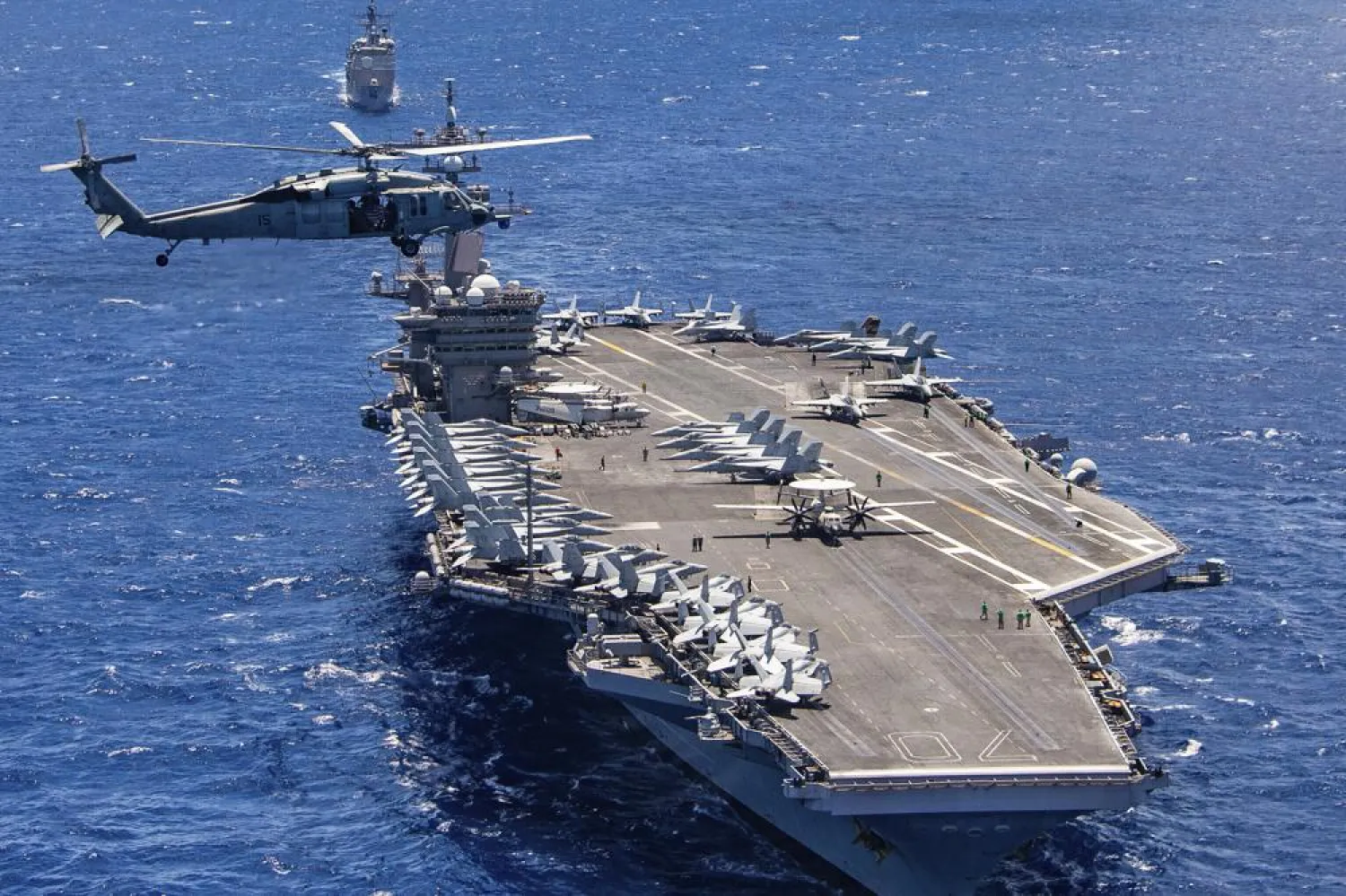
FILE -- In this photo provided by the US. Navy, the aircraft carrier USS Carl Vinson participates in a group sail during the Rim of the Pacific exercise off the coast of Hawaii, July 26, 2018. (Petty Officer 1st Class Arthurgwain L. Marquez/US Navy via AP, File)
TT

US Combat Jet Crashes in South China Sea Exercise, 7 Hurt

FILE -- In this photo provided by the US. Navy, the aircraft carrier USS Carl Vinson participates in a group sail during the Rim of the Pacific exercise off the coast of Hawaii, July 26, 2018. (Petty Officer 1st Class Arthurgwain L. Marquez/US Navy via AP, File)

A US Navy F35C Lightning II combat jet conducting exercises in the South China Sea crashed while trying to land on the deck of an American aircraft carrier, injuring seven sailors, the military said Tuesday.

The pilot was able to eject before the aircraft hit the deck of the USS Carl Vinson on Monday and was safely recovered by a helicopter, said Lt. Mark Langford, a spokesman for the US 7th Fleet.

Seven sailors, including the pilot, were injured and three were evacuated for medical treatment in Manila, Philippines, while four who were treated on board the ship. The three sent to Manila were reported in stable condition on Tuesday morning, the Navy said.

Details on the crash of the multimillion-dollar aircraft were still being verified, Langford said.

“The status and recovery of the aircraft is currently under investigation,” he told The Associated Press.

Two American carrier strike groups with more than 14,000 sailors and marines are conducting exercises in the South China Sea, which the military says is to demonstrate the “US Indo-Pacific Command Joint Force's ability to deliver a powerful maritime force.”

Impact to the deck of the USS Carl Vinson was “superficial,” Langford said, and both carriers have resumed routine flight operations.

As China has pressed territorial claims in the South China Sea and increased pressure on Taiwan, the US and its allies have stepped up exercises in the region, in what they call freedom of navigation operations in line with international law.

As the Carl Vinson and Abraham Lincoln strike groups began their dual carrier operations on Sunday, China flew 39 warplanes toward Taiwan in its largest such sortie of the new year, according to Taiwan's defense ministry.

The formation of 24 Chinese J-16 and 10 J-10 fighter jets stayed out of Taiwanese air space, but the maneuver prompted Taiwan to scramble its own aircraft in response.
Chinese pilots have been flying toward Taiwan on a near-daily basis, and it was unclear if Sunday's flights were a response to the American exercises. China's Ministry of Foreign Affairs refused to comment.

Taiwan and China split during a civil war in 1949, but China claims the island as its own territory. Beijing has used diplomatic and military means to isolate and intimidate the self-ruled island, but the US has continued to support Taiwan by selling it advanced weapons and fighter planes.



US Military Says It Destroyed 2 Small Iranian Boats Trying to Steal a Drone

A US Navy sailor walks across the flight deck of the USS George Washington in the Arabian Sea, September 11, 2026. (Reuters)
TT

US Military Says It Destroyed 2 Small Iranian Boats Trying to Steal a Drone

A US Navy sailor walks across the flight deck of the USS George Washington in the Arabian Sea, September 11, 2026. (Reuters)

The US military said Tuesday that it opened fire and destroyed two small Iranian boats this week trying to steal a drone ship in the waters off Iran.

Capt. Tim Hawkins, US Central Command spokesman said that “Iranian small boats recently attempted to take possession of a US unmanned surface vessel, but they were unsuccessful after CENTCOM forcefully responded."

Iranian state media reported Monday that a pair of fishing boats came under attack in Hormozgan province on Iran’s southern coast and that several fishermen were reported missing, citing a provincial official.

It is the latest volley of fire in the more than six-month-old war as both sides seek control over the Strait of Hormuz, where the US has succeeded in recent weeks in loosening Iran’s grip over the critical energy shipping corridor. But the impact of the unpopular conflict has driven up the cost of oil and gasoline prices, posing political problems for President Donald Trump and his Republican Party.

Hawkins said Tuesday that the drone involved is a “Saildrone” — a small, roughly 25-foot (8-meter) craft — that can operate by itself. US Central Command has been using them in the region for several years to surveil maritime traffic.

Hawkins said all of the command’s surface drones “remain fully accounted for.” The military has long asserted that the technology on the Saildrones is commercially available and not sensitive in nature.

The latest drone incident, which was reported earlier by Axios, comes a week after Iranian state television reported that the country's navy captured one of the US military’s underwater drones at the entrance to the Strait of Hormuz.

Hawkins said then that an Anduril Dive-LD drone had malfunctioned while it was surveying the waters in the region and that the US military no longer had possession of it.

He stressed that the drone was defective and noted that it was also an “older model that neither collected sensitive data no carried any classified sonar or radar equipment.”


UK, US and Netherlands Issue Advisory on Iran-Linked Spyware

Iranians walk past a wall decorated with the image of assassinated Iranian supreme leader Ali Khamenei and the national flag, in central of Tehran on September 14, 2026. (AFP)
TT

UK, US and Netherlands Issue Advisory on Iran-Linked Spyware

Iranians walk past a wall decorated with the image of assassinated Iranian supreme leader Ali Khamenei and the national flag, in central of Tehran on September 14, 2026. (AFP)

Britain, the United States and the Netherlands on Tuesday issued a joint cybersecurity advisory detailing spyware they say is used by Iranian state-linked actors to target dissidents, activists and journalists.

Britain's National Cyber Security Centre said Iranian state-linked cyber actors had used a spyware family known as "CHOSEN ‌BRICK" to steal ‌emails, messages and other ‌sensitive information ⁠through "spear-phishing" campaigns on ⁠messaging platforms including WhatsApp and Telegram.

"The details of this cyber campaign reveal how Iran ruthlessly uses digital surveillance in pursuit of its aim to repress critics of the regime, stealing emails and messages and accessing ⁠devices," Paul Chichester, NCSC Director of Operations, ‌said in ‌a statement.

Iran's embassy in London did not immediately ‌respond to a request for comment.

The malware, ‌according to the advisory, can collect information from contact lists, emails and social media accounts, capture screen content and access a device's microphone. ‌The NCSC said some victims' personal details had later appeared on pro-Iranian ⁠leak ⁠sites.

The NCSC said the attackers often posed as trusted contacts on messaging apps and tailored their approach to individual targets. In some cases, it said, they used fake documents, including fabricated MRI test results, to persuade victims to download the malware.

The NCSC, alongside the FBI and the Netherlands' AIVD intelligence service, said Iran "almost certainly" uses cyber operations to help suppress people it sees as threats.


EU Must Impose ‘Greater Cost’ on Russia to Curb ‘Hybrid Attacks’, Says Kallas

High Representative of the European Union for Foreign Affairs and Security Policy Kaja Kallas speaks during a debate on the "Urgent need for EU support to Ukraine against Russia’s escalation of its war of aggression" at the European Parliament in Strasbourg, France, 15 September 2026. (EPA)
TT

EU Must Impose ‘Greater Cost’ on Russia to Curb ‘Hybrid Attacks’, Says Kallas

High Representative of the European Union for Foreign Affairs and Security Policy Kaja Kallas speaks during a debate on the "Urgent need for EU support to Ukraine against Russia’s escalation of its war of aggression" at the European Parliament in Strasbourg, France, 15 September 2026. (EPA)

The European Union must ramp up measures against the Kremlin, including reviewing the issuance of tourist visas to Russians, to counter Moscow's "hybrid attacks", foreign policy chief Kaja Kallas said Tuesday.

"Despite international efforts to end the war, (Russian President Vladimir) Putin chooses to intensify his war of aggression against Ukraine and hostilities against Europe, and one thing is very clear: Putin will not stop unless he is stopped," Kallas told the European Parliament.

"So, as Russia is willing to take greater risks, Europe must impose a greater cost."

Europe is grappling with what Kallas called a "steady increase in hybrid attacks" by Russia designed to weaken support for Ukraine.

Fears rose over the summer when an explosive-laden drone was discovered at a German airport in an incident Berlin blamed on Moscow.

Beyond ramping up support for Kyiv and sanctioning the Kremlin, Kallas said the EU should look to increase controls on Russians coming into the bloc.

"We can tighten control further over the movement of Russian diplomats within Schengen. We can ban issuing visas for Russian ex-combatants, and we should review the issuance of tourist fissures to Russian citizens," she said.

"We must reduce the pool of people conducting attacks on European soil."

Kallas also urged EU states to better share intelligence and step up the use of artificial intelligence to tackle Russian disinformation.

While the EU eyes more measures, officials admit that the West is struggling to halt actions from Moscow that float in a grey zone beneath open conflict.

"We have all the response options we need when it comes to hybrid. It will not always be visible and public, what we do," NATO chief Mark Rutte said Monday.

"The most important one, of course, is making sure that Ukraine has what it needs to stay in the fight."