Snow Storms, Cold and Fire Threaten Displaced Syrians in Northern Camps

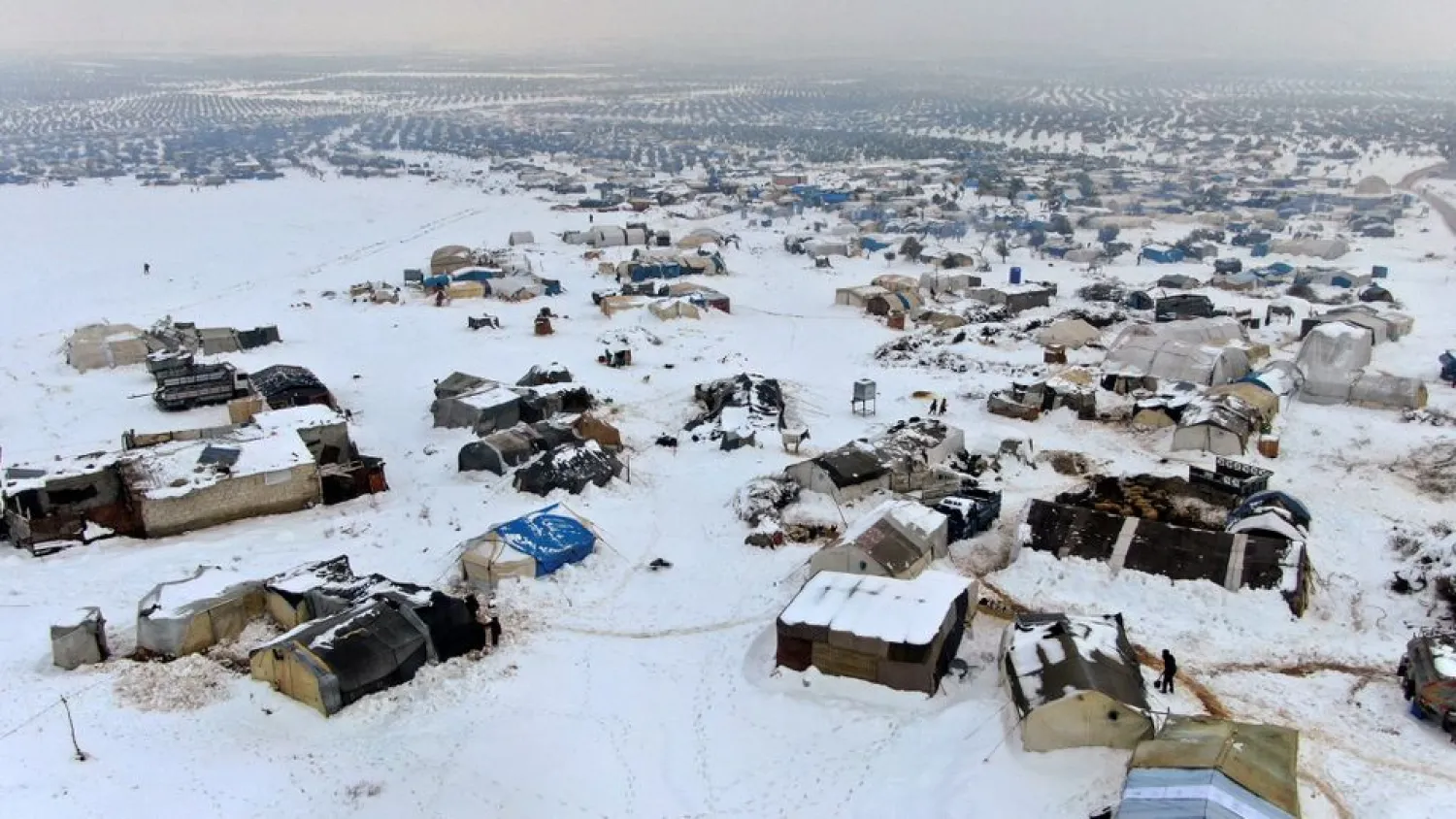
A snow covered camp for internally displaced people is seen in the Aleppo countryside, Syria January 23, 2022. Picture taken January 23, 2022. Picture taken with drone. (Reuters)
TT

Snow Storms, Cold and Fire Threaten Displaced Syrians in Northern Camps

A snow covered camp for internally displaced people is seen in the Aleppo countryside, Syria January 23, 2022. Picture taken January 23, 2022. Picture taken with drone. (Reuters)

Five-year-old Intissar and her younger sister Lin were sheltering from northern Syria's bitter winter cold when fuel from a heater ignited their tent, killing them and seriously injuring their mother.

The young family and other displaced Syrians were living near the Turkish border in a camp of more than 400 tents, which offer little protection from snow storms and plunging temperatures which struck in recent days.

The cold snap has brought chaos to traffic and flights in neighboring countries but its effects are most severe in northwest Syria, where 3 million people have been left homeless in a long-running humanitarian crisis.

Many have been displaced several times by the 11-year war.

"People in the camp are suffering. The tents don't protect from the cold," said Nouredin al-Abdullah, whose cousin Ahmed is the father of the girls who died. "If you think about heating, God forbid, you and your children may go (the same way)".

He said the latest snowfall was the heaviest he had seen. The weight of the snow has collapsed many tents, while water seeped underneath them.

Across the region, food supplies and health services have been disrupted and relief workers are struggling to reach some of the 300 worst affected sites, said Mark Cutts, UN deputy regional humanitarian coordinator for Syria.

"The numbers are just staggering, and it is very difficult to provide people with all the support they need," he said. Desperate to stay warm, people were burning cardboard and plastic bottles, and then inhaling toxic fumes.

"Even more suffering is caused because of the lack of fuel for heating," he told Reuters, adding that at least one child had died from the freezing cold.

"There are more than 1 million people still living in tents or substandard accommodation," Cutts said. "It's becoming increasingly urgent that we get people out of these tents."


Lebanese Forces Boycott Cabinet Meeting Over Hezbollah Explosives Case

Prime Minister Nawaf Salam chairs a cabinet meeting in the absence of Lebanese Forces ministers. (Prime Minister’s Office)
TT

Lebanese Forces Boycott Cabinet Meeting Over Hezbollah Explosives Case

Prime Minister Nawaf Salam chairs a cabinet meeting in the absence of Lebanese Forces ministers. (Prime Minister’s Office)

Ministers from the Lebanese Forces party boycotted a cabinet meeting on Thursday over the government’s failure to refer a case involving Hezbollah explosives seized in Dahr al-Baidar to Lebanon’s Judicial Council.

The boycott marked an escalation in the dispute after the case was left off the agenda of a meeting chaired by Prime Minister Nawaf Salam at the Grand Serail and devoted to waste management.

Lebanese Forces sources told Asharq Al-Awsat that the party could continue boycotting cabinet sessions as long as its demands remained unmet, although it might participate in meetings addressing matters of major strategic importance.

The standoff follows the cabinet’s decision at its previous meeting to postpone a ruling on whether to refer the case to the Judicial Council, pending further progress in the investigation.

Hezbollah has acknowledged responsibility for the explosives shipment, but the Lebanese Forces argue that the seriousness of the case warrants an immediate referral.

Ahead of Thursday’s meeting, Justice Minister Adel Nassar, who is affiliated with the Lebanese Forces, vowed to press the issue.

“I will raise the question of referring the Dahr al-Baidar explosives case to the Judicial Council. There will be no concessions or compromise,” he declared.

Nassar added that he would demand a date for discussing the referral if Salam refused to address it during the session.

Lebanese Forces sources accused the government of repeatedly avoiding a decision on the explosives case.

“The waste management issue is certainly important, but there are more pressing priorities today, foremost among them a case of the magnitude of the Dahr al-Baidar explosives,” they told Asharq Al-Awsat.

They criticized the repeated postponements, arguing that successive Cabinet meetings had failed to produce a decision on referring the case to the Judicial Council.

The party had taken a clear position against attending Cabinet sessions until the matter was resolved, the sources explained.

“A case of this magnitude cannot continue to be handled through repeated delays while meetings are held to discuss other issues, however important they may be,” they added.

The Lebanese Forces stepped up criticism of the judicial investigation, accusing authorities of overlooking public admissions by senior Hezbollah officials while pursuing lower-ranking operatives who lacked the authority to order the explosives shipment.

In a statement, the party’s media office noted that senior Hezbollah officials, including lawmakers and party leaders, had publicly acknowledged that the group was transporting the explosives and that they belonged to it.

The Lebanese Forces described the Dahr al-Baidar case as a matter of national security affecting all Lebanese citizens.

Whatever justification was offered for transporting the explosives, the shipment posed a serious danger even if Hezbollah’s claim that the materials were intended for use against Israel proved true, it added.

The explosives represented a grave threat to residents of South Lebanon in particular and to the Lebanese population as a whole, the statement warned.


Flash Floods Kill Five in Syria

A displaced Syrian girl sweeps rainwater from the floor of her family's tent following a rainstorm at the al-Talae displacement camp in Hasakah, northeastern Syria, on October 29, 2026 [Baderkhan Ahmad/AP Photo]
TT

Flash Floods Kill Five in Syria

A displaced Syrian girl sweeps rainwater from the floor of her family's tent following a rainstorm at the al-Talae displacement camp in Hasakah, northeastern Syria, on October 29, 2026 [Baderkhan Ahmad/AP Photo]

Flash flooding and heavy rains in northern and eastern Syria killed five people, including four children, authorities said Thursday.

Four children died by drowning in the governorates of Raqqa and Deir ez-Zor, the ministry of emergency and disaster management said in a statement.

Another man died in an accident at a bridge in Raqqa.

State news agency SANA said the heavy downpours and subsequent flooding caused a bridge to collapse in Raqqa, closing a road linking the region to neighboring Aleppo.

Five more people are missing in the storms that have been drenching the country since Wednesday, according to the ministry.

Areas across northern and eastern Syria have seen heavy rainfall and strong winds, inundating homes, displacing residents and closing roads, according to local authorities and official media.

Climate change has led to a drop in rainfall in Syria, while remaining downpours are intense, sporadic and less predictable, according to experts.


Syrian Sentenced to 42 Months in US Prison for Pro-Assad Hacking

Reports indicated the images came from hacking attacks targeting social media accounts, as well as cases of online enticement (Reuters).
TT

Syrian Sentenced to 42 Months in US Prison for Pro-Assad Hacking

Reports indicated the images came from hacking attacks targeting social media accounts, as well as cases of online enticement (Reuters).

A Syrian man was sentenced to 42 months in prison on Thursday for his role in computer hacking on behalf of the regime of former Syrian president Bashar al-Assad, the US Justice Department said.

Ahmad Umar Agha, 32, and co-conspirators hacked Western media outlets, businesses, non-governmental organizations and US and allied government entities "to spread the former Syrian government's propaganda," the department said in a statement.

The hacking group known as the Syrian Electronic Army was led by members of Assad's inner circle, it said.

"Agha deployed his hacking skills in the service of Assad's regime to silence reporting on the regime's atrocities, intimidate its opponents, and incite US servicemembers to refuse their orders," Assistant Attorney General John Eisenberg said.

The group's most notorious hack was of a US new agency's Twitter account, resulting in a false 2013 tweet saying then-president Barack Obama had been injured after two blasts at the White House, said AFP.

"Agha's actions caused a flash crash in the US stock market, resulting in a temporary $136 billion loss in the value of stocks making up the Dow Jones Industrial Average," the Justice Department said.

Agha, also known as Th3Pro, was indicted along with an alleged co-conspirator, Firas Dardar, who remains a fugitive.

A third Syrian charged in the case, Peter Romar, was extradited to the United States and pleaded guilty in September 2016 to hacking charges.