

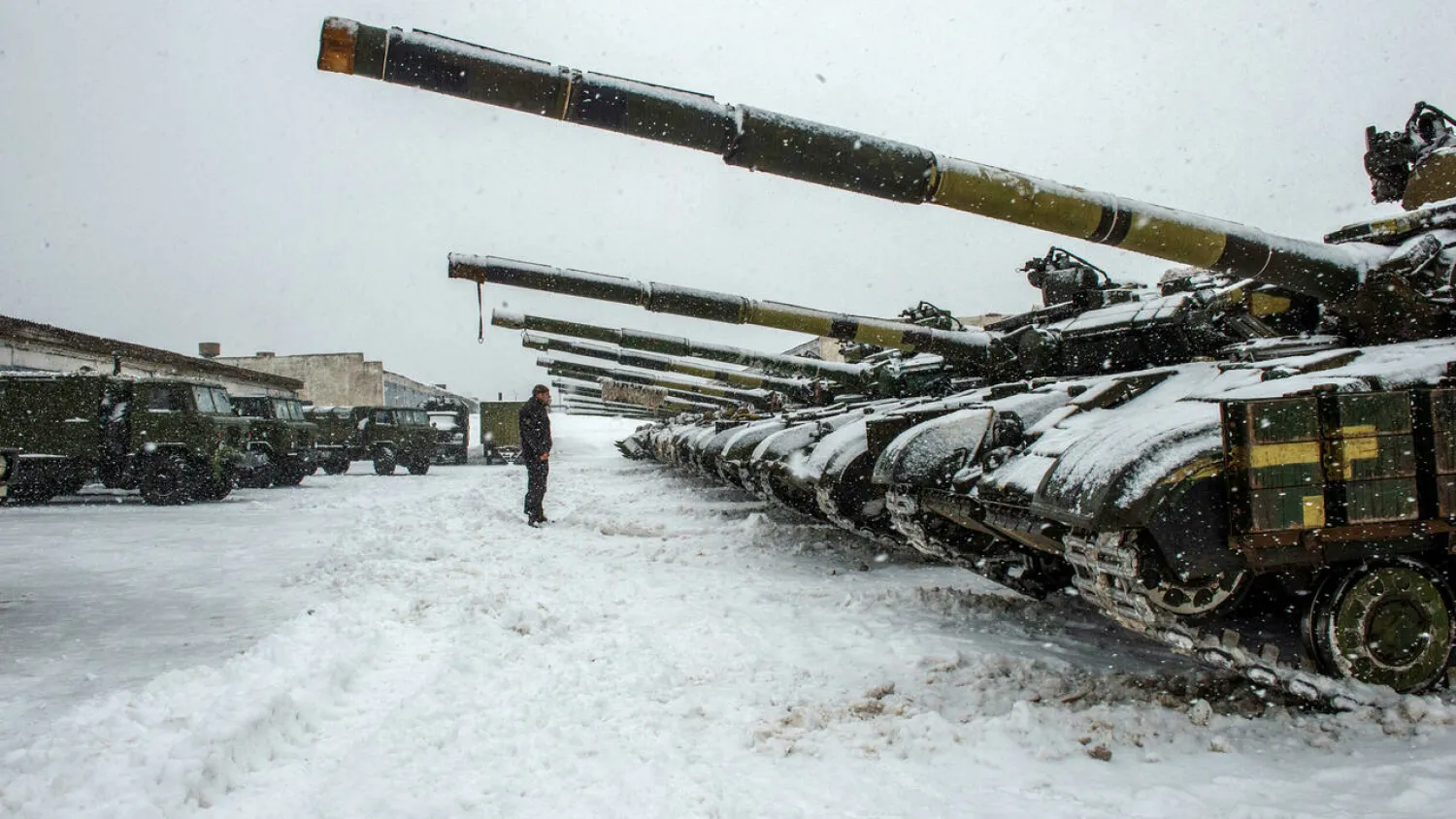

Putin to Host EU Ally Orban amid Ukraine Crisis

The meeting comes with Washington warning Russia against taking military action against Ukraine. Sergey BOBOK AFP
TT

Putin to Host EU Ally Orban amid Ukraine Crisis

The meeting comes with Washington warning Russia against taking military action against Ukraine. Sergey BOBOK AFP

Russian President Vladimir Putin will host talks Tuesday with Hungarian Prime Minister Viktor Orban, who has taken a softer line on the Ukraine crisis than NATO and the EU, with Hungary a member of both.

The Kremlin said the leaders will discuss trade and energy as well as "the current problems of ensuring European security," an allusion to the standoff between Russia and the West over Ukraine, AFP reported.

Orban has said he will seek an agreement to increase Hungary's gas imports from Russia at a time when some in Europe accuse Russia of orchestrating an energy crisis with the aim of putting pressure on European countries.

Hungary's opposition parties released a joint statement at the weekend calling on Orban to cancel his trip, which it said was "contrary to our national interests."

The Hungarian opposition said that, by meeting with Putin, Orban "indirectly encourages the Russian president to further escalate the current tense situation."

US President Joe Biden has accused Russia of plans to invade Ukraine imminently with its troops massed on the border and warned of severe economic sanctions if it does.

The trip is also likely to sit uncomfortably with Hungary's closest European Union allies, most notably Poland.

Warsaw has presented a united front with Budapest against Brussels on issues like the rule of law, but has long resented Orban's ties with Putin.

On the same day of Orban's Moscow visit, his close Polish ally Prime Minister Mateusz Morawiecki will travel to Kyiv to meet with Ukrainian President Volodymyr Zelensky, who is backed by the West.

- 'Peace and de-escalation' -
At a meeting of European conservatives organized by the Spanish far-right in Madrid over the weekend and also attended by Morawiecki, Orban said that Ukraine was a "very important issue" for those in Central Europe.

He stressed he was in favor of "peace and de-escalation," according to his office.

But he did not echo the general EU alarm over Russia's troop buildup on Ukraine's border.

Hungary, which joined NATO in 1999 and the EU in 2004, has taken a softer line on Ukraine, with which it shares a small land border.

Hungarian Foreign Minister Peter Szijjarto has said that Budapest was negotiating a US request for the deployment of NATO troops in Hungary, but called reports that it could be as many as a thousand troops "fake news."

He previously said that Hungary is a loyal NATO member, but that it did not want "a new Cold War."

Biden has announced plans to send US troops to NATO countries in eastern Europe, though not to Ukraine itself, which is not a member of the transatlantic Alliance.

Orban is popular at home despite critics' accusations of rampant corruption and that he is steering Hungary towards authoritarianism.

The Moscow visit comes just two months before the critical election in Hungary, with polls indicating a close race between Orban and a united opposition alliance.

Under Orban, who began his political career in Hungary's anti-Soviet democracy movement, Budapest has been one of Russia's closest EU partners.

In a sign of friendship, Hungary was the first bloc member to approve Moscow's Sputnik V coronavirus vaccine, which has not been green-lighted by the European Medicines Agency (EMA).



China Says It Opposes Outside Interference in Iran’s Internal Affairs

Iranians walk next to a billboard reading "Iran is our Homeland" at Enqelab Square in Tehran, Iran, 13 January 2026. (EPA)
TT

China Says It Opposes Outside Interference in Iran’s Internal Affairs

Iranians walk next to a billboard reading "Iran is our Homeland" at Enqelab Square in Tehran, Iran, 13 January 2026. (EPA)

China opposes any outside interference in Iran's ​internal affairs, the Chinese foreign ministry said on Wednesday, after US President Donald Trump warned that Washington ‌would take "very ‌strong action" ‌against Tehran.

China ⁠does ​not ‌condone the use or the threat of force in international relations, Mao Ning, spokesperson at ⁠the Chinese foreign ministry, said ‌at a ‍regular ‍news conference when ‍asked about China's position following Trump's comments.

Trump told CBS News in ​an interview that the United States would take "very ⁠strong action" if Iran starts hanging protesters.

Trump also urged protesters to keep protesting and said that help was on the way.


South Korea Vows Legal Action Over Drone Incursion into North

A North Korean flag flutters on top of a 160-meter tower in North Korea's propaganda village of Gijungdong in this picture taken from the Dora observatory near the demilitarized zone separating the two Koreas, in Paju, South Korea, April 24, 2018. (Reuters)
TT

South Korea Vows Legal Action Over Drone Incursion into North

A North Korean flag flutters on top of a 160-meter tower in North Korea's propaganda village of Gijungdong in this picture taken from the Dora observatory near the demilitarized zone separating the two Koreas, in Paju, South Korea, April 24, 2018. (Reuters)

The South Korean president's top advisor vowed on Wednesday to punish whoever is found responsible for a recent drone incursion into North Korea, after a furious Pyongyang demanded an apology.

North Korea accused the South over the weekend of sending a drone across their shared border into the city of Kaesong this month, releasing photos of debris from what it said was the downed aircraft.

And on Tuesday the North Korean leader's powerful sister, Kim Yo Jong, demanded an apology over the incident from the "hooligans of the enemy state" responsible.

Seoul has denied any involvement but has left open the possibility that civilians may have flown the drone, a position reiterated by National Security Adviser Wi Sung-lac on Wednesday.

"Our understanding so far is that neither the military nor the government carried out such an operation," Wi told reporters on the sidelines of a summit between the leaders of South Korea and Japan in the Japanese city of Nara.

"That leaves us the task to investigate if someone from the civilian sector may have done it," he said.

"If there is anything that warrants punishment, then there should be punishment."

South and North Korea remain technically at war, as the 1950-53 Korean War ended with an armistice rather than a peace treaty.

Wi noted that despite Pyongyang's criticism and its demand for an apology, the North has also sent its own drones into South Korea.

"There have been incidents in which their drones fell near the Blue House, and others that reached Yongsan," he said, referring to the current and former locations of the presidential offices.

"These, too, are violations of the Armistice Agreement," he said.

South Korean President Lee Jae Myung has ordered a joint military-police probe into the drone case.

Any civilian involvement would be "a serious crime that threatens peace on the Korean peninsula", he warned.


Iran’s Judiciary Signals Fast Trials and Executions for Detained Protesters Despite Trump’s Warning

This video grab taken on January 14, 2026 from UGC images posted on social media on January 13, 2026, shows dozens of bodies lying on the ground at the Tehran Province Forensic Diagnostic and Laboratory Centre in Kahrizak, as grieving relatives search for their loved ones. (UGC / AFP)
TT

Iran’s Judiciary Signals Fast Trials and Executions for Detained Protesters Despite Trump’s Warning

This video grab taken on January 14, 2026 from UGC images posted on social media on January 13, 2026, shows dozens of bodies lying on the ground at the Tehran Province Forensic Diagnostic and Laboratory Centre in Kahrizak, as grieving relatives search for their loved ones. (UGC / AFP)

The head of Iran’s judiciary signaled Wednesday there would be fast trials and executions ahead for those detained in nationwide protests despite a warning from US President Donald Trump.

The comments from Iran’s judiciary chief Gholamhossein Mohseni-Ejei come as activists had warned hangings of those detained could come soon.

Already, a bloody security force crackdown on the demonstrations has killed at least 2,571, the US-based Human Rights Activists News Agency reported. That figure dwarfs the death toll from any other round of protest or unrest in Iran in decades and recalls the chaos surrounding the country’s 1979 revolution.

Trump repeatedly has warned that the United States may take military action over the killing of peaceful protesters, just months after it bombed Iranian nuclear sites during a 12-day war launched by Israel against the Islamic Republic in June.

Mohseni-Ejei made the comment in a video shared by Iranian state television online.

“If we want to do a job, we should do it now. If we want to do something, we have to do it quickly," he said. “If it becomes late, two months, three months later, it doesn’t have the same effect. If we want to do something, we have to do that fast.”

His comments stand as a direct challenge to Trump, who warned Iran about executions an interview with CBS aired Tuesday. “We will take very strong action,” Trump said. “If they do such a thing, we will take very strong action.”

Meanwhile, activists said Wednesday that Starlink was offering free service in Iran. The satellite internet service has been key in getting around an internet shutdown launched by the theocracy on Jan. 8. Iran began allowing people to call out internationally on Tuesday via their mobile phones, but calls from people outside the country into Iran remain blocked.

“We can confirm that the free subscription for Starlink terminals is fully functional,” said Mehdi Yahyanejad, a Los Angeles-based activist who has helped get the units into Iran. “We tested it using a newly activated Starlink terminal inside Iran.”

Starlink itself did not immediately acknowledge the decision.

Security service personnel also apparently were searching for Starlink dishes, as people in northern Tehran reported authorities raiding apartment buildings with satellite dishes. While satellite television dishes are illegal, many in the capital have them in homes, and officials broadly had given up on enforcing the law in recent years.