


Washington Stakes Nuclear Deal on Iran’s ‘Political Decision’

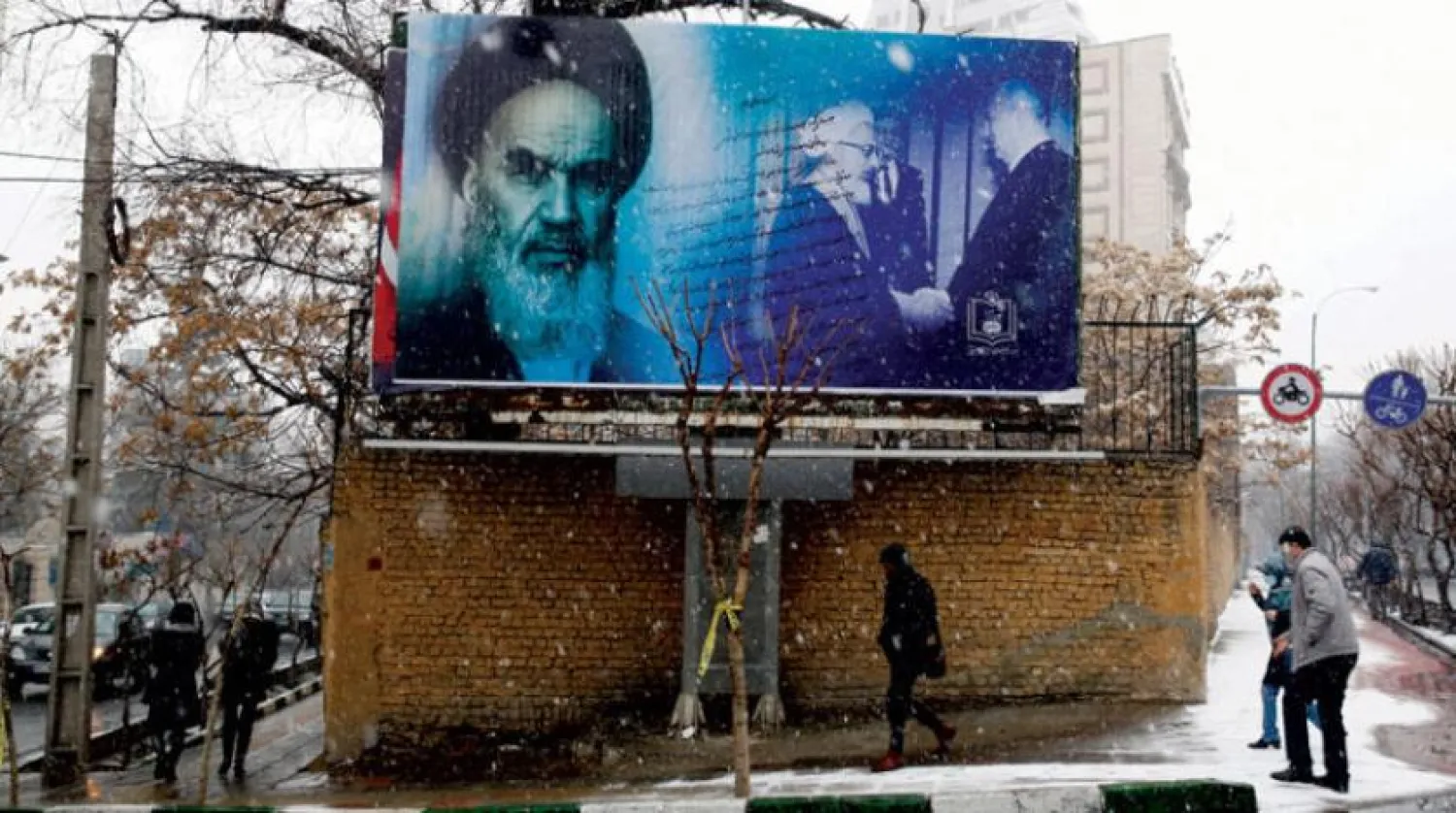
Iranians pass by a poster of Khomeini in Tehran. (EPA)
TT

Washington Stakes Nuclear Deal on Iran’s ‘Political Decision’

Iranians pass by a poster of Khomeini in Tehran. (EPA)

US officials revealed that the Vienna talks aimed at getting Iran and the US to return to mutual compliance with the obligations of the nuclear agreement are nearing completion.

However, they stressed that after many months of negotiations, returning to the deal is now subject to a “political decision” from Tehran, which must retract its violations in exchange for lifting the sanctions imposed on it because of its nuclear program.

Remarks from Biden administration officials point out to the signatories of the 2015 Iran nuclear deal, also known as the Joint Comprehensive Plan of Action (JCPOA), having completed the technical side of steps needed to be taken in Washington and Tehran for their return to full compliance with the agreement.

Four years ago, former US President Donald Trump unilaterally withdrew from the Iran nuclear deal, a move which was followed by several violations from Iran.

The JCPOA was reached between Iran and the P5+1 (the five permanent members of the United Nations Security Council—China, France, Russia, United Kingdom, United States—plus Germany) together with the European Union.

Today’s statements by Biden administration officials confirm that Washington has taken the political decision to return to the deal and is waiting for a similar resolution by Tehran, a matter which largely falls in the hands of Iranian Supreme Leader Ali Khamenei.

In an article published by the New York Times, a senior official said that the new deal would not limit Iran’s missile development and would not halt Tehran’s support for terrorist groups or its proxy forces, which have stirred unrest across the Middle East, as some Democrats and nearly all Republicans have demanded.

Iran continues to back proxies like the Houthis in Yemen, Hezbollah in Lebanon, and Asa’ib Ahl al-Haq in Iraq.

The deal’s restoration would almost certainly become a campaign issue in the midterm elections in Congress this year, the official told the New York Times.

When Trump exited the original agreement in 2018 — which he called “the worst deal ever” — he promised to force Tehran into new negotiations, saying he would get better terms and also halt the country’s support for the Syrian regime, its funding of terrorist groups and its missile tests.

For President Joe Biden, restoring the deal — and with it, limits on Iran’s production capability — would fulfill a major campaign promise and seal a breach Trump created with Britain, France, Germany and the European Union, which participated in the original agreement along with Russia and China. But it also comes with significant political risks.

Despite the risk involved for Democrats, Biden is prepared to return to the 2015 agreement and “to make the political decisions necessary to achieve that goal,” a senior State Department official said in a presser in which Asharq Al-Awsat participated.

The State Department official said that the negotiations to restore the 2015 agreement were “in a final stretch” and that “all sides” needed to commit to returning to full compliance.

“If our goal is to reach an understanding quickly – which is what we need to do – and to avoid misunderstandings and to avoid miscommunication and to make sure that both sides know exactly what they’re getting into, the optimal way to do that in any negotiation is for the parties that have the most at stake to meet directly,” the official told reporters.

“We’re prepared to meet with Iran if they are prepared to meet with us,” they added, noting that it would be very “regrettable” if the two sides didn’t come together for direct talks, especially since there is little time left.

State Department spokesman Ned Price confirmed that “there are only a few weeks left to reach an agreement, and if the talks fail, Washington will increase economic and diplomatic pressure on Tehran.”

He referred to the conditions of American prisoners in Iran, saying that “their release (...) is one of our main priorities in the Vienna talks.”

US officials did not provide any details of the new agreement, but restoring the old agreement would mean that all restrictions imposed on Iran’s production of nuclear materials will end in 2030, which means that Secretary of State Anthony Blinken will not be able to obtain a “longer and stronger” agreement due to Iranian officials’ refusal.

Iranian negotiators sought written guarantees that the US would not abandon the agreement again, but their American counterparts emphasized that Biden could not provide such guarantees.

Although Iran has not accumulated the same amount of enriched uranium it had before the 2015 agreement, it has taken advanced technical steps to raise the level of enrichment to 60 %, which is closer to the 90 % used to produce nuclear weapons.

“A country enriching at 60 percent is a very serious thing,” Rafael Grossi, the director general of the International Atomic Energy Agency, the United Nations body that inspects Iran’s production facilities and verifies compliance with agreements. “Only countries making bombs are reaching this level.”

It is not known whether Tehran will send its 60% enriched fuel to Russia, as it did in the past, or to another country.

Moreover, it is unclear how Israel will respond to any new agreement, given that it has carried out several operations to sabotage Iranian facilities.

The US and Iran also appear to be close to reaching a prisoner swap deal to free four American citizens in exchange for Iranians sentenced for sanctions violations, according to two people familiar with the talks cited by the New York Times.

The senior State Department official said that he could not envision a deal with Iran if Americans were not released, and Iran’s foreign ministry subsequently said it would be open to a prisoner exchange with the US.



Türkiye Says Greece-Chevron Activity off Crete Unlawful 

A Chevron gas station sign is pictured at one of their retain gas stations in Cardiff, California October 9, 2013. REUTERS/Mike Blake/File Photo
TT

Türkiye Says Greece-Chevron Activity off Crete Unlawful 

A Chevron gas station sign is pictured at one of their retain gas stations in Cardiff, California October 9, 2013. REUTERS/Mike Blake/File Photo

Türkiye said on Thursday it opposed Greece's "unilateral activities" in energy fields south of Crete with a consortium led by US major Chevron as a violation of international law and good neighbourly relations.

Athens responded that its policies abide international law.

The Chevron-led consortium signed exclusive lease agreements on Monday to look for natural gas off southern Greece, expanding US presence in the eastern Mediterranean.

"We oppose this unlawful activity, which is being attempted in violation of the 2019 Memorandum of Understanding on Maritime Jurisdiction between Libya and our country," the Turkish Defense Ministry said at a press briefing.

It said the activity, while not directly impacting Türkiye's continental shelf, also violated Libya's maritime jurisdiction that was declared to the United Nations in May last year.

"We continue to provide the necessary support to the Libyan authorities to take action against these unilateral and unlawful activities by Greece," the ministry said.

A 2019 agreement signed by Türkiye and Libya set out maritime boundaries in the Mediterranean Sea. It was rejected by Greece as it ignored the presence of the Greek island of Crete between the coasts of Türkiye and Libya. The Chevron deal doubles the amount of Greek maritime acreage available for exploration and is the second in months involving a US energy major, as the European Union seeks to phase out supplies from Russia and the US seeks to replace them.

Asked about the Turkish objections later on Thursday, Greek government spokesman Pavlos Marinakis told a press briefing that Athens followed an "active policy" and "exercises its rights in accordance with international law and respects international law steadfastly - and I think no one questions that, period."

There was no immediate comment from Chevron.

Neighbors and NATO members Türkiye and Greece have been at odds over a range of issues for decades, primarily maritime boundaries and rights in the Aegean, an area widely believed to hold energy resources and with key implications for airspace and military activity.

A 2023 declaration on friendly relations prompted a thaw between the sides and leaders have voiced a desire to address remaining issues.


Andrew Mountbatten-Windsor Arrested on Suspicion of Misconduct in Public Office

FILE - Britain’s Andrew Mountbatten-Windsor, formerly known as Prince Andrew, looks round as he leaves after attending the Easter Matins Service at St. George's Chapel, Windsor Castle, England, April 20, 2025. (AP Photo/Kirsty Wigglesworth, File)
TT

Andrew Mountbatten-Windsor Arrested on Suspicion of Misconduct in Public Office

FILE - Britain’s Andrew Mountbatten-Windsor, formerly known as Prince Andrew, looks round as he leaves after attending the Easter Matins Service at St. George's Chapel, Windsor Castle, England, April 20, 2025. (AP Photo/Kirsty Wigglesworth, File)

UK police arrested Andrew Mountbatten-Windsor on Thursday on suspicion of misconduct in public office.

The Thames Valley Police, an agency that covers areas west of London, including Mountbatten-Windsor’s former home, said it was “assessing” reports that the former Prince Andrew sent trade reports to convicted sex offender Jeffrey Epstein in 2010. The assessment followed the release of millions of pages of documents connected to a US investigation of Epstein.

The police force did not name Mountbatten-Windsor, as is normal under UK law. But when asked if he had been arrested, the force pointed to a statement saying that they had arrested a man in his 60s. Mountbatten-Windsor is 66.

“Following a thorough assessment, we have now opened an investigation into this allegation of misconduct in public office,’’ the statement said. “It is important that we protect the integrity and objectivity of our investigation as we work with our partners to investigate this alleged offence."

“We understand the significant public interest in this case, and we will provide updates at the appropriate time,” the statement added.

Pictures circulated online appearing to show unmarked police cars at Wood Farm on the Sandringham Estate in Norfolk, with plainclothes officers appearing to gather outside the home of Mountbatten-Windsor.


Georgia Arrests Two Foreigners Trying to Purchase Uranium

FILE PHOTO: A block with the symbol, atomic number and mass number of Uranium (U) element, in this illustration taken January 21, 2026. REUTERS/Dado Ruvic/Illustration/File Photo
TT

Georgia Arrests Two Foreigners Trying to Purchase Uranium

FILE PHOTO: A block with the symbol, atomic number and mass number of Uranium (U) element, in this illustration taken January 21, 2026. REUTERS/Dado Ruvic/Illustration/File Photo

Georgia has ‌detained two people who attempted to purchase $3 million worth of uranium and a cache of a radioactive isotope found in nuclear weapons testing programs, the national security service said on Thursday.

Two foreign nationals from unspecified countries were arrested in the city of Kutaisi, the State Security Service said in a statement.

"They were planning to ‌illegally purchase ‌nuclear material uranium and radioactive ‌substance ⁠Cesium 137 for $3 ⁠million and illegally transport it to the territory of another country," Reuters quoted it as saying.

It said other foreigners had been arriving in Georgia in recent weeks with the aim of purchasing and transporting the nuclear and ⁠radioactive materials, without elaborating further.

The ‌statement did ‌not specify the quantity of materials the individuals were ‌attempting to procure. There were ‌no details on the substances' origin or potential destination.

Cesium 137 is a radioactive isotope present primarily in the aftermath of nuclear weapons testing ‌and nuclear power plant accidents such as the Chernobyl disaster in ⁠then-Soviet ⁠Ukraine in 1986.

The security of nuclear materials was one of the biggest concerns after the 1991 fall of the Soviet Union, of which Georgia was part. There have been several serious incidents involving the illicit trade in nuclear materials in Georgia over recent decades.

Most recently, three Chinese citizens were arrested in the capital Tbilisi for attempting to purchase two kilograms of "nuclear material" uranium.