UK’s Embattled Johnson Seeks Reset with Major Economic Plan

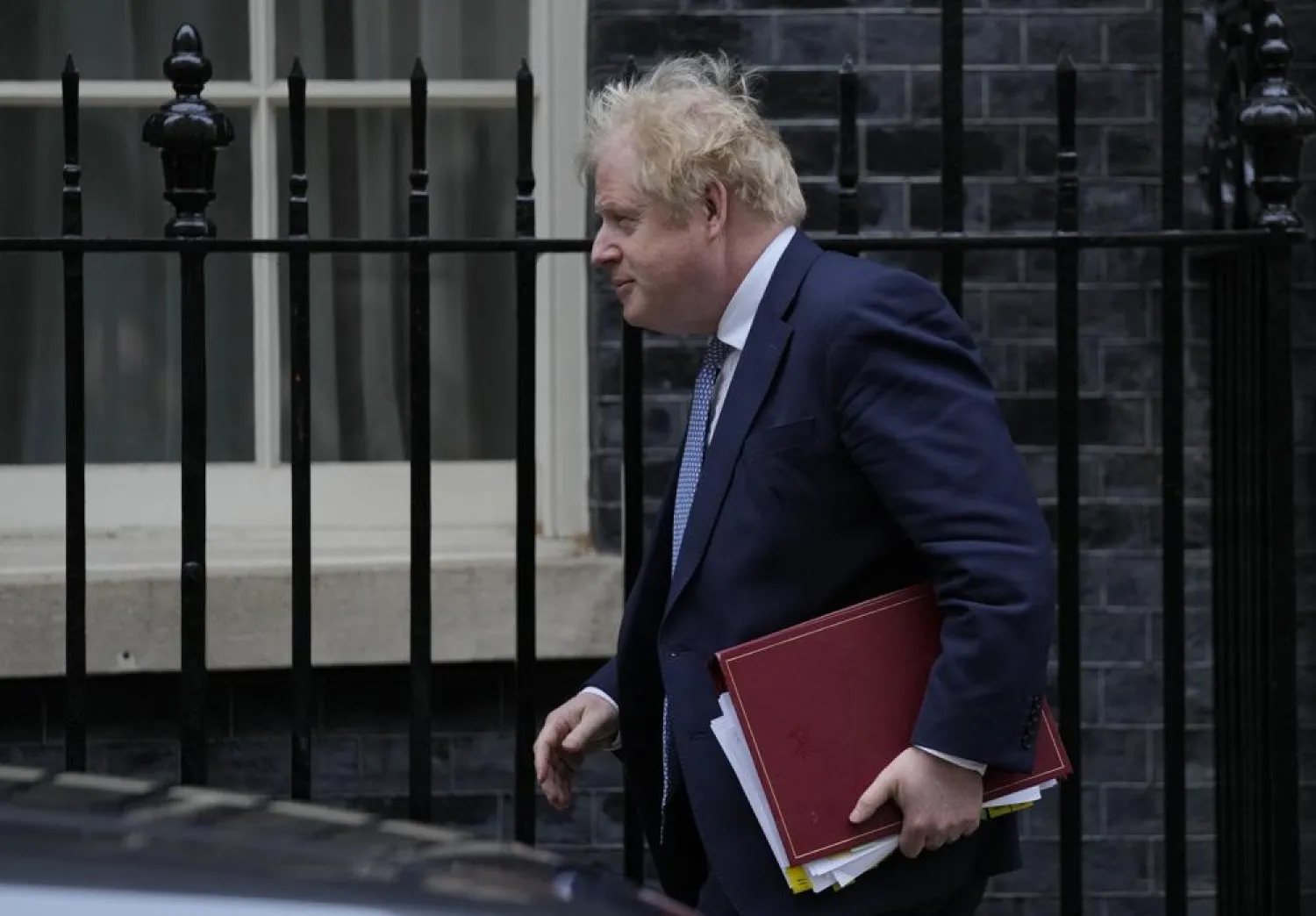
Britain's Prime Minister Boris Johnson leaves 10 Downing Street for the House of Commons for his weekly Prime Minister's Questions in London, Wednesday, Feb. 2, 2022. (AP)
TT

UK’s Embattled Johnson Seeks Reset with Major Economic Plan

Britain's Prime Minister Boris Johnson leaves 10 Downing Street for the House of Commons for his weekly Prime Minister's Questions in London, Wednesday, Feb. 2, 2022. (AP)

The British government set out plans Wednesday for a huge shift in power and wealth to left-behind regions of the country, a long-standing promise to the voters who helped put Prime Minister Boris Johnson in office.

Johnson's Conservative government was elected in 2019 on a pledge to “level up” one of Europe’s most regionally unequal countries by improving transport links, infrastructure and economic opportunities in swaths of the country hit by shuttered industries and public funding cuts.

The government fleshed out that promise Wednesday with details of plans to invest in public transport, education, digital connectivity and R&D in poorer regions, mostly in central and northern England, by 2030. It also said more regions will get elected mayors with substantial powers, and derelict industrial sites will be targeted for major regeneration projects.

As yet, though, there are few details of how the ambitious plans will be funded.

Britain has long had deep regional divides, with money and wealth concentrated in London and the south of England, while heavy industry dominated the north. The closure of mines and factories as the UK moved from industrial powerhouse to service-based economy in recent decades hit those areas hard. The divide grew wider when Conservative-led governments slashed public spending to curb a ballooning deficit after the 2008 global financial crisis. Poorer areas that were most dependent on state funds suffered the biggest hit.

Former industrial cities in England such as Liverpool, Manchester and Leeds, along with Glasgow, Scotland, have done much to reinvent themselves as economic, cultural and creative hotbeds, but smaller towns and cities are still scarred by poverty, poor education and high unemployment.

Michael Gove, the minister in charge of the leveling up plan, said Britain’s 2016 vote to leave the European Union had been “a wake-up call” by voters in neglected areas.

“As well as a clear commandment to leave the European Union it was also a way of saying to people in (Parliament’s postcode) SW1, people like me, ‘look, it’s vital that you change the economic model of this country,’” he said.

Tracy Brabin, mayor of the West Yorkshire region of northern England, welcomed the government’s plans but said “the devil is going to be in the detail.”

“Lots of ambition, lots of hope, but unless you actually have the money and the resources, you are going to be struggling,” she told the BBC.

Johnson hopes announcing the long-awaited plans will provide some respite from scandal over lockdown-breaching parties held in his office during the pandemic. Police are investigating a dozen gatherings that may have breached coronavirus restrictions, and a senior civil servant's report this week slammed “failures of leadership and judgment” in the prime minister’s office.

Johnson has apologized and promised to overhaul his office and regain public trust. But his opponents -- including some in his own Conservative Party -- are calling for him to resign for allowing staff to party while millions endured isolation to help curb the spread of COVID-19.

The party has a history of ousting leaders once they become liabilities, and Johnson could yet face a no-confidence vote from his own side. Under party rules, such a vote is triggered if 15% of party lawmakers — currently 54 people — write letters calling for one.

About a dozen Tory lawmakers have called publicly for Johnson to go, though more have likely submitted letters. Tobias Ellwood, a high-profile Conservative legislator, said Wednesday he would be sending a no-confidence letter to the party committee in charge of leadership challenges.

“This is just horrible for all MPs to continuously have to defend this to the British public,” he told Sky News.

“It’s time to resolve this completely so the party can get back to governing. … I will be submitting my letter today to the 1922 Committee.”


Iranian Leaders Fret Over Public Mood as Gas Shortages Add to War Ills

People visit a heating equipment store, amid a gas shortage, in Tehran, Iran, November 14, 2026. Majid Asgaripour/WANA (West Asia News Agency) via Reuters
TT

Iranian Leaders Fret Over Public Mood as Gas Shortages Add to War Ills

People visit a heating equipment store, amid a gas shortage, in Tehran, Iran, November 14, 2026. Majid Asgaripour/WANA (West Asia News Agency) via Reuters

Iran shows no sign of making concessions in the war with the US, but its warnings to citizens of gas shortages this winter are the latest sign of its own vulnerabilities in the conflict, with its ports blockaded and infrastructure hammered by US strikes.

The government said last week that, though Iran has had gas shortages before, they would be more severe this winter because of war damage to processing plants and most regions would be affected.

Toiling under the effects of a war that has intensified rampant inflation and destroyed millions of jobs, Iranians face growing hardships that senior figures fear will deepen divisions still raw from the crushing of mass protests last winter.

"The reality is that if our gas gets cut off, we'll have to close down and go home," said Seyyed Ahmad Seyyedi, a street vendor.

"This war must end so that we can return to normal life and all the problems and high prices can come to an ‌end. Continuing life under ‌these conditions is difficult," said Mina Lahrasabi, 65, who works in a rice factory ‌near ⁠Iran's Caspian coast.

A ⁠senior Iranian official and an Iranian security official told Reuters the country's hierarchy was increasingly concerned about the situation, with the internal fuel shortage adding to worries of public unrest.

There have been no notable protests against the ruling system since the war began on February 28 with US and Israeli strikes that killed Supreme Leader Ali Khamenei, but domestic intelligence agencies were on alert, the security official said.

The agencies were closely monitoring for any sign of opposition and believed the US might seek to provoke street demonstrations, the security official added.

The senior official warned that the increasingly difficult living standards faced by the Iranian population were getting harder for people ⁠to withstand, describing it as a fire smoldering beneath ashes.

"This is the most severe ‌siege imposed on us since the revolution," said Iranian analyst Saeed Leylaz.

GROWING SHORTAGES

At ‌a heater company in Tehran, salesman Amin Sha'bani said the prospect of a cold winter was concerning – and that customers were increasingly considering ‌electric products rather than gas, though both were often now too expensive for customers.

"Given what has happened in the past ‌nine months, with power plants attacked, it's perfectly natural to worry that the weather will get colder," he said.

Although Iran is a major gas producer controlling part of the world's biggest gas field, it has sometimes been unable to meet domestic consumption because of outdated equipment, a problem worsened by international sanctions.

Government spokesperson Fatemeh Mohajerani said last week that the gas shortage this winter would likely be 430 million cubic ‌meters, compared to 300 million last year.

Iran's national gas company has blamed the worsening shortage on damage to four processing plants early in the war, which it says it ⁠is trying to fix.

However, ⁠the senior Iranian official told Reuters measures being taken to resolve the problem only amounted to short-term fixes and said there had been numerous meetings to try to manage the looming crisis for the winter.

A second senior Iranian source said Iran was in talks to import gas from Russia.

"This could become a critical issue, but measures have been taken and we will get through it," said Leylaz, the analyst. "In the worst-case scenario, we may have to cut gas supplies to industries for a period, but we have not reached that point yet."

That more sanguine view was held by several Iranians Reuters reached inside the country by messaging app.

Reza, a 45-year-old in Urmia in the northwest of Iran, where the winters can bring heavy snowfall, said there was little concern among people he knew about the potential shortages and that his family had bought three electric heaters in case.

Iran has also suffered periodic power blackouts in recent years.

"The reality is that I don't mean to start crying now over what might happen. We already have enough problems – inflation, high prices and other difficulties to see a potential fuel shortage as relatively minor," said Zahra Hosseini, 44, who works for a food company in Tabriz.


Somaliland Briefly Detains Americans Accused of Threatening National Security

Traffic flows along a street in Hargeisa, Somaliland, October 16, 2026. REUTERS/Mohamed Ahmed
TT

Somaliland Briefly Detains Americans Accused of Threatening National Security

Traffic flows along a street in Hargeisa, Somaliland, October 16, 2026. REUTERS/Mohamed Ahmed

The national intelligence agency in the self-declared Republic of Somaliland said it had briefly detained five US nationals who were threatening national security.

The National Intelligence Agency of Somaliland (NIA) said in a post on X late on Sunday that it had been monitoring the US nationals since they arrived and ran a "lengthy investigation" into their activities.

It gave no details of their identities or alleged actions in the Horn of Africa territory.

NIA ⁠Director-General Jama Mohamoud ⁠Egal and Somaliland's Ministry of Foreign Affairs did not immediately respond to requests for comment.

The US State Department said it was aware of the reports but could not comment on specifics because of concerns on privacy and other considerations.

Somaliland, ⁠which declared independence from Somalia in 1991, occupies a strategic location at the juncture of the Indian Ocean and Red Sea. Last December, Israel became the first country to recognize it as a sovereign state, and its government has been lobbying for recognition from additional countries, including the United States.

According to a person familiar with the matter, the five Americans work for a company ⁠called ⁠Parallel Black. A November 4 letter seen by Reuters shows they were invited by Somaliland's Foreign Affairs Minister Abdirahman Dahir Adam to conduct feasibility studies for potential investments.

The person said the five Americans left Somaliland on an Ethiopian Airlines flight on Monday afternoon.

Parallel Black, which was registered less than two months ago in the US state of Delaware, did not immediately respond to requests for comment.


Le Pen Says France Will No Longer Aid Ukraine ‘Financially’ if Elected

Marine Le Pen (C), the far-right National Rally (RN) party's candidate for the 2027 French presidential election, visits the "Made in France" fair at the Porte de Versailles exhibition center in Paris, France, 13 November 2026. (EPA)
TT

Le Pen Says France Will No Longer Aid Ukraine ‘Financially’ if Elected

Marine Le Pen (C), the far-right National Rally (RN) party's candidate for the 2027 French presidential election, visits the "Made in France" fair at the Porte de Versailles exhibition center in Paris, France, 13 November 2026. (EPA)

Marine Le Pen on Monday said that France would provide no further financial aid to Ukraine if she is elected president next year, after a meeting with Kyiv's ambassador in Paris.

"The state of France's public finances would no longer allow the country to provide financial assistance to Ukraine in the coming months," Le Pen said in a statement, while insisting France would honor existing commitments, including toward a 90-billion-euro ($100-billion) European Union loan.

Le Pen is currently ahead in polls in the race to succeed President Emmanuel Macron next year, as the war sparked by Russia's 2022 full-scale invasion of Ukraine grinds towards its fifth anniversary.

She has faced criticism over past links to Russia, which included a 2017 meeting in the Kremlin with President Vladimir Putin and her party taking a loan from a Russian bank that it paid off in full in 2023.

But she has opposed the invasion and, at her talks in Paris with Ukrainian ambassador Vadym Omelchenko, Le Pen made clear her "unwavering support for Ukraine since the beginning of the conflict".

The statement said the talks -- the first such between Le Pen and the Ukrainian ambassador -- were "cordial".

While financial aid would be cut, Le Pen told the ambassador that "France would continue to support Ukraine through donations of equipment, humanitarian aid and much more active diplomacy".

The statement said there was a "frank discussion" on the future of the conflict, with Le Pen stressing that "the pursuit of peace -- though a difficult goal to achieve -- must remain a priority for all".

She also asked the ambassador to tell President Volodymyr Zelensky she is ready to meet in "either Paris or Brussels". However, there was no mention of the candidate making the journey to Kyiv after Zelensky invited her to visit the Ukrainian capital.

Le Pen's opponents have expressed alarm that by emphasizing the importance of ending the war swiftly, she could force Ukraine to capitulate on unfavorable terms.

"If Russia imposes its will on a European nation through brutality, all of Europe is weakened," Macron wrote on Facebook at the weekend.

Taking aim at Le Pen, he said: "Let us be clear: those who seek to limit the resources available to Ukraine are, in effect, pushing for an unjust peace -- one that would leave Ukraine permanently vulnerable, and, by extension, leave Europe vulnerable as well."