


US Warns Chinese Firms against Helping Russia against Potential Ukraine Sanctions

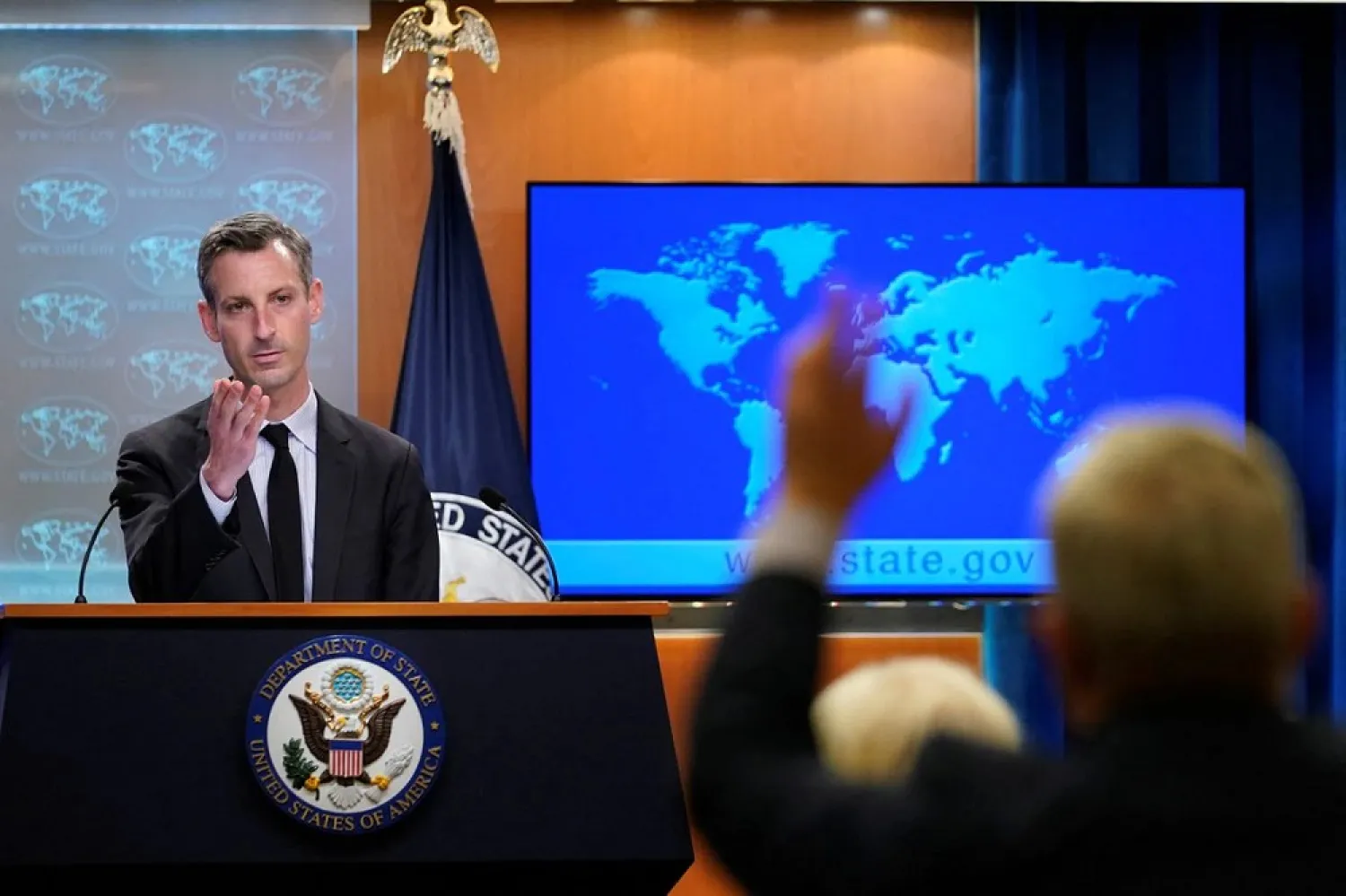
US State Department spokesperson Ned Price gestures during a briefing at the State Department in Washington, DC, US, February 1, 2022. (Reuters)
TT

US Warns Chinese Firms against Helping Russia against Potential Ukraine Sanctions

US State Department spokesperson Ned Price gestures during a briefing at the State Department in Washington, DC, US, February 1, 2022. (Reuters)

The United States warned Chinese firms on Thursday they would face consequences if they sought to evade any export controls imposed on Moscow in the event of Russia invading Ukraine.

US State Department spokesman Ned Price made the remark after China's Foreign Ministry said China and Russia had coordinated their positions on Ukraine during a meeting between their foreign ministers in Beijing on Thursday.

"We have an array of tools that we can deploy if we see foreign companies, including those in China, doing their best to backfill US export control actions, to evade them, to get around them," Price told a regular news briefing.

Western countries say any invasion of Ukraine by Russia would bring sanctions on Moscow and Washington has said it is prepared to impose financial sanctions as well as export-control measures.

White House national security official Peter Harrell said on Wednesday that Washington was working on the export-control measures with allies in Asia, including Japan and South Korea.

Price said Russia should know that a closer relationship with Beijing would not make up for the consequences imposed in response to an invasion.

"If Russia thinks that it will be in a position ... to mitigate some of those consequences, by a closer relationship with (China), that is not the case. It will actually make the Russian economy, in many ways, more brittle," he said.

"If you deny yourself the ability to transact with the West, to import with the West, from Europe, from the United States, you are going to significantly degrade your productive capacity and your innovative potential."

Price said US Secretary of State Antony Blinken and China's Foreign Minister Wang Yi had an extended discussion on potential implications of Russian action against Ukraine in a phone call last week.

Asked to comment on Price's remarks, Liu Pengyu, the spokesman for China's Washington embassy, replied: "We have noted relevant reports. Creating tensions does no good to easing the Ukraine crisis, but only adds more uncertainties to the region and the whole world. China is firmly opposed to this."

China's foreign ministry earlier said Wang met with Russian counterpart Sergei Lavrov and expressed "understanding and support" for Russia's position on security regarding Russia's relationship with the United States and NATO.

It said both sides coordinated their positions on regional issues of common concern, such as Ukraine, Afghanistan and the situation on the Korean Peninsula.

The UN Security Council is due to meet on Friday at the request of the United States and Britain after North Korea's launch of an intermediate-range ballistic missile last weekend.

The United States has been pushing for more international sanctions on North Korea over a recent spate of missile tests, but last month China and Russia delayed a US bid to impose UN sanctions on five North Koreans linked to their country's weapons programs.

Lavrov is in Beijing with President Vladimir Putin, who will meet Chinese President Xi Jinping on Friday before attending the opening ceremony of the Beijing Winter Olympics.



Iran's President Delivers Defiant UN Speech

Iran's President Masoud Pezeshkian speaks during the 81st United Nations General Assembly at the United Nations Headquarters in New York, on September 23, 2026. (Photo by TIMOTHY A. CLARY / AFP)
TT

Iran's President Delivers Defiant UN Speech

Iran's President Masoud Pezeshkian speaks during the 81st United Nations General Assembly at the United Nations Headquarters in New York, on September 23, 2026. (Photo by TIMOTHY A. CLARY / AFP)

Iranian President Masoud Pezeshkian delivered a defiant speech at the United Nations on Wednesday as Tehran downplayed talks with the United States.

He said his country's people had been the “victims of terrorism” by the United States.

Delivering the rare wartime speech at the UN General Assembly, Pezeshkian displayed images of the late Supreme Leader Ali Khamenei and more than 150 schoolchildren killed in the opening days of the conflict.

“We have only defended ourselves. We are not terrorists,” he said. “Our innocent people have been the targets of cowardly attacks and aggressions imposed upon our country.”

Turning to the United States, Pezeshkian added: “Yes, they did hit us, but we did not bend the knee.”

On Wednesday, US Secretary of State Marco Rubio told reporters that President Donald Trump remained open to an agreement “that allows Iran to be what it should be, which is a great and prosperous country.”

Rubio said the prospects for such a deal were hindered by Iran’s nuclear ambitions and “their support of terrorism.” If those policies continued, he said, Trump could exercise “a number of options,” including further military action.

“It must be understood by Mr. Trump and those who seek to bully us that we are ready for dialogue and diplomacy and negotiations without accepting the language of force,” Pezeshkian said in his speech.


WHO: Congo is Running Short of Health Workers as Ebola Remains Out of Control

Ebola response teams organize a public demonstration to raise awareness about the Ebola virus disease in Beni, North Kivu province, eastern Congo, Tuesday, Sept. 22, 2026. (AP Photo/Sebastien Kitsa Musayi)
TT

WHO: Congo is Running Short of Health Workers as Ebola Remains Out of Control

Ebola response teams organize a public demonstration to raise awareness about the Ebola virus disease in Beni, North Kivu province, eastern Congo, Tuesday, Sept. 22, 2026. (AP Photo/Sebastien Kitsa Musayi)

Congo is running short of health workers to staff treatment centers for history's fastest-growing Ebola outbreak, particularly in the eastern province of North Kivu where cases have surged 73% over three weeks, the World Health Organization said Wednesday.

The warning came despite signs of improvement in other provinces, including Ituri, the outbreak’s epicenter. The outbreak has spread to seven provinces, with 7,773 confirmed cases and 3,759 deaths, according to the latest government figures.

Between Aug. 31 and Sept. 20, cases fell 26% in Ituri province and 15% in Haut-Uele, said Marie Roseline Belizaire, the WHO’s regional emergency director for Africa. But transmission patterns vary widely and the outbreak remains uncontrolled, she said.

“While cases and deaths are declining in some provinces, they continue to rise in others,” The Associated Press quoted Belizaire as saying. “The outbreak is still not under control and remains spread across a wide geographic area.”

The outbreak is spreading under extremely difficult conditions, fueled by insecurity, displacement, a health workers’ strike and intense population movements. The World Health Organization has said it is on track to surpass the 2014-2016 West Africa Ebola outbreak, the deadliest on record, which killed more than 11,000 people, primarily in Guinea, Liberia and Sierra Leone.

Catherine Smallwood, the WHO’s Ebola incident manager, said cases and deaths had begun declining in North Kivu after several weeks of increases. But although treatment beds are being added daily, facilities still lack enough staff and partners to operate them.

“The human resources gap is one of the biggest gaps,” Smallwood said.

WHO representative in Congo Anne Ancia said one Ebola treatment center requires about 300 health professionals, including anesthetists, hygienists, nurses and general practitioners.

“We are building Ebola treatment centers but do not always have the human resources needed to operate them,” Ancia said. “Those health workers must be paid.”

Frontline workers in Ituri previously went on strike over unpaid wages, worsening access to care.

Health Minister Roger Kamba said in July that the government was verifying payroll lists after the names of people not involved in the response were added. Frontline workers said officials promised to pay the arrears, but some workers received nothing and others only part of what they were owed.

Another major challenge in the response is the fatality rate among children, according to the WHO. Children under five have the highest case fatality rate, more than 60% compared with approximately 40% among adults, Belizaire said.

WHO Ebola Incident Manager Smallwood said detecting cases among children under five is also very difficult because the children can’t necessarily explain their symptoms, and the presentation of symptoms can be confusing.


Pakistani Officials Say Afghan Taliban Shelled Pakistani Border. Kabul Denies the Attack

Pakistani soldiers near a security fence at the border post in Torkham, Pakistan, in December. Credit Salahuddin/Reuters
TT

Pakistani Officials Say Afghan Taliban Shelled Pakistani Border. Kabul Denies the Attack

Pakistani soldiers near a security fence at the border post in Torkham, Pakistan, in December. Credit Salahuddin/Reuters

Afghanistan's Taliban forces shelled Pakistani border posts overnight after Pakistani troops foiled what they described as a cross-border infiltration attempt by militants, local Pakistani officials said Wednesday.

The spokesman for Afghanistan’s Taliban government, Zabiullah Mujahid, denied any attacks by the Afghan Taliban forces, The Associated Press said.

The conflicting statements came just days after Pakistani fighter jets struck sites in eastern Afghanistan that Islamabad said were militant hideouts, an escalation between Kabul and Islamabad that threatens mediation efforts by regional powers.

Pakistani security forces neutralized two rudimentary drones, which the officials said were launched by the Afghan Taliban, before they could enter the northwestern city of Kohat, the officials said. They said the action underscored Pakistan's round-the-clock vigilance and air-defense systems' readiness to counter emerging aerial threats from Afghanistan.

The airstrikes ended several weeks of relative calm following months of cross-border hostilities. Also, earlier this month, Pakistani security forces killed 15 militants attempting to cross into the country from Afghanistan.

Four local Pakistani officials said Wednesday that militants attempted to infiltrate Pakistan from areas near Afghan border posts in Paktia and Nangarhar provinces, allegedly with support from the Afghan Taliban forces.

The officials referred to the militants as Fitna-ul-Khawarij, a term Islamabad uses for the Pakistani Taliban, a group that is separate but allied with the Afghan Taliban. Pakistan has repeatedly accused Afghanistan’s Taliban government of allowing militants to operate from its territory and carry out attacks across the border, an accusation that Kabul denies.

After Pakistani troops thwarted the infiltration attempt, Afghan Taliban forces allegedly fired mortars and other heavy weapons at Pakistani border posts, the four officials said. Pakistani forces responded with artillery fire, targeting Taliban border posts, mortar sites, and defensive positions.

The officials said Afghan Taliban forces subsequently abandoned several positions and suffered casualties. The four officials spoke on condition of anonymity as they were not authorized to talk to the media about the latest flare-up.

The accounts could not be independently verified. The latest escalations threaten mediation efforts by China, Türkiye, Qatar and Saudi Arabia to broker a lasting peace between Kabul and Islamabad.

In Monday's airstrikes, Pakistan’s Information Ministry said 28 militants were killed, while Afghan authorities said at least three civilians died and four others were wounded. The U.N. mission in Afghanistan confirmed the civilian casualties and Kabul formally protested the attack.

On the sidelines of the UN General Assembly in New York, Pakistani Foreign Minister Ishaq Dar expressed concern about what he said was the presence of more than two dozen anti-Pakistani militant groups in Afghanistan.

Monday’s Pakistani airstrikes followed a shootout with militants in Hangu, a district in northwestern Khyber Pakhtunkhwa province near the Afghan border, that killed six Pakistani security personnel. Days earlier, a suicide bomber struck a mosque inside a police compound in the nearby city of Kohat.

Eight gunmen then stormed the compound, triggering a 20-hour gunbattle that killed at least 21 people, most of them police officers. No group had claimed responsibility for the attacks.

Pakistani authorities blamed the violence on the Pakistani Taliban and allied militant groups. The Pakistani Taliban, formally known as Tehrik-e-Taliban Pakistan, have stepped up their attacks on Pakistani security forces, boosted by the Afghan Taliban's return to power in Afghanistan in 2021.