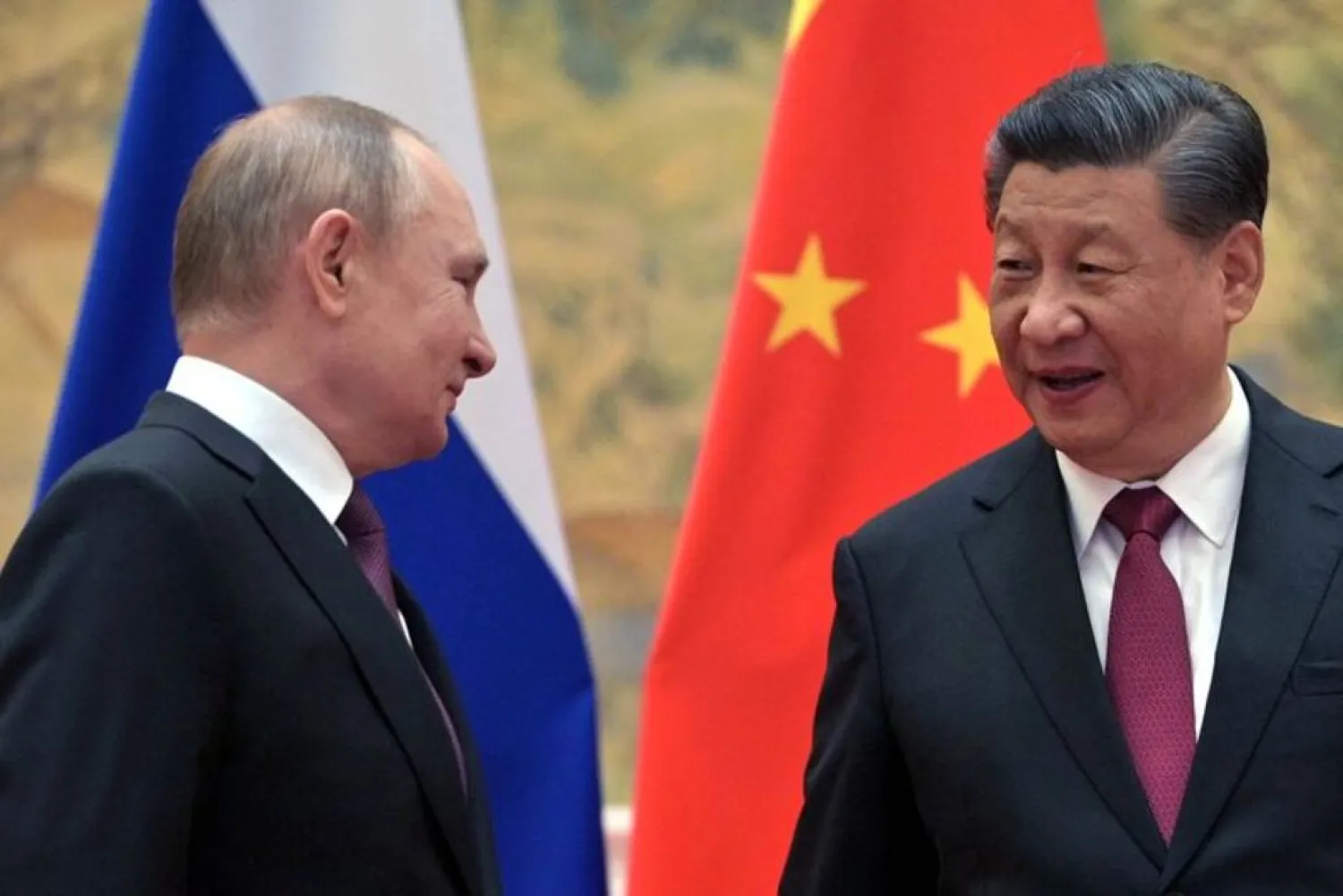
Russia and China Hail ‘No Limits’ Partnership to Stand Up to US

Russian President Vladimir Putin attends a meeting with Chinese President Xi Jinping in Beijing, China February 4, 2022. (Reuters(
TT

Russia and China Hail ‘No Limits’ Partnership to Stand Up to US

Russian President Vladimir Putin attends a meeting with Chinese President Xi Jinping in Beijing, China February 4, 2022. (Reuters(

China and Russia proclaimed a deep strategic partnership on Friday to balance what they portrayed as the malign global influence of the United States as China's President Xi Jinping hosted Russia's Vladimir Putin on the opening day of the Beijing Winter Olympics.

In a joint statement, the two countries affirmed that their new relationship was superior to any political or military alliance of the Cold War era.

"Friendship between the two States has no limits, there are no 'forbidden' areas of cooperation," they declared, announcing plans to collaborate in a host of areas including space, climate change, artificial intelligence and control of the Internet.

The agreement marked the most detailed and assertive statement of Russian and Chinese resolve to work together - and against the United States - to build a new international order based on their own interpretations of human rights and democracy.

Steeped in ideological discourse, it was not clear whether it would immediately translate into an increase in tangible and practical cooperation despite Putin trumpeting a new gas deal with China on Friday, or was intended as more of a statement of general policy intent.

"The two leaders are announcing their determination to stand together and to stand against the US and the West - ready to withstand sanctions and contest American global leadership," said Daniel Russel of the Asia Society think tank, who served as the US State Department's top diplomat for East Asia under the Obama administration.

While not formally allied, the two "are making common cause as a tactical matter to better defend their respective interests and their authoritarian systems from Western pressure", he said.

Jonathan Eyal of the London-based Royal United Services Institute said the declaration marked a "frontal rebuttal" of the US and Western view of the world and a possible building block towards a military alliance.

"It's the most explicit articulation of the 'making the world safe for dictatorship' strategy," he said. "It is a historic point because they both feel cornered and they feel their moment has arrived to state their vision of the world and promote it aggressively."

Mutual support

The two countries have moved closer together as both have come under pressure from the West on a host of issues including their human rights records and Russia's military build-up near Ukraine. The timing of their announcement was highly symbolic, at a China-hosted Olympics that the United States has subjected to a diplomatic boycott.

There was no immediate comment from the White House or State Department.

In the lengthy document - nearly 5,400 words in English translation - each went significantly further than before in backing the other on key flashpoints of tension with the West.

- Russia voiced its support for China's stance that Taiwan is an inalienable part of China, and opposition to any form of independence for the island. Moscow and Beijing also voiced their opposition to the AUKUS alliance between Australia, Britain and the United States, saying it increased the danger of an arms race in the region.

- China joined Russia in calling for an end to NATO enlargement and supported its demand for security guarantees from the West - issues at the heart of Moscow's confrontation with the United States and its allies over Ukraine.

The two countries expressed concern about "the advancement of US plans to develop global missile defense and deploy its elements in various regions of the world, combined with capacity building of high-precision non-nuclear weapons for disarming strikes and other strategic objectives".

Elsewhere, without naming Washington, they criticized attempts by "certain states" to establish global hegemony, fan confrontation and impose their own standards of democracy.

Tech and energy

In the technology arena, Russia and China said they were ready to strengthen cooperation on artificial intelligence and information security.

They said they believed that "any attempts to limit their sovereign right to regulate national segments of the Internet and ensure their security are unacceptable".

Meanwhile Russian state energy giants Gazprom and Rosneft on Friday agreed new gas and oil supply deals with Beijing worth tens of billions of dollars.

The deals capitalize on Putin's drive to diversify Russian energy exports away from the West, which started shortly after he came to power in 1999. Since then Russia has become China's top energy supplier and cut its reliance on the West for revenues.

The Kremlin said the presidents also discussed the need to broaden trade in national currencies because of unpredictability surrounding the use of the dollar.

US President Joe Biden has said Russian companies could be cut off from the ability to trade in dollars as part of sanctions if Russia invades Ukraine.

Moscow denies any such intention, but has used a build-up of more than 100,000 troops near Ukraine's border to grab the attention of the West and press its demands for security guarantees.

The Chinese gas supplies are not directly linked with Russian gas exports to Europe, and more Russian gas for Beijing does not automatically mean less for Europe. However, they serve Putin as an addition revenue cushion amid the rising threat of US and EU sanctions.


Somaliland Briefly Detains Americans Accused of Threatening National Security

Traffic flows along a street in Hargeisa, Somaliland, October 16, 2026. REUTERS/Mohamed Ahmed
TT

Somaliland Briefly Detains Americans Accused of Threatening National Security

Traffic flows along a street in Hargeisa, Somaliland, October 16, 2026. REUTERS/Mohamed Ahmed

The national intelligence agency in the self-declared Republic of Somaliland said it had briefly detained five US nationals who were threatening national security.

The National Intelligence Agency of Somaliland (NIA) said in a post on X late on Sunday that it had been monitoring the US nationals since they arrived and ran a "lengthy investigation" into their activities.

It gave no details of their identities or alleged actions in the Horn of Africa territory.

NIA ⁠Director-General Jama Mohamoud ⁠Egal and Somaliland's Ministry of Foreign Affairs did not immediately respond to requests for comment.

The US State Department said it was aware of the reports but could not comment on specifics because of concerns on privacy and other considerations.

Somaliland, ⁠which declared independence from Somalia in 1991, occupies a strategic location at the juncture of the Indian Ocean and Red Sea. Last December, Israel became the first country to recognize it as a sovereign state, and its government has been lobbying for recognition from additional countries, including the United States.

According to a person familiar with the matter, the five Americans work for a company ⁠called ⁠Parallel Black. A November 4 letter seen by Reuters shows they were invited by Somaliland's Foreign Affairs Minister Abdirahman Dahir Adam to conduct feasibility studies for potential investments.

The person said the five Americans left Somaliland on an Ethiopian Airlines flight on Monday afternoon.

Parallel Black, which was registered less than two months ago in the US state of Delaware, did not immediately respond to requests for comment.


Le Pen Says France Will No Longer Aid Ukraine ‘Financially’ if Elected

Marine Le Pen (C), the far-right National Rally (RN) party's candidate for the 2027 French presidential election, visits the "Made in France" fair at the Porte de Versailles exhibition center in Paris, France, 13 November 2026. (EPA)
TT

Le Pen Says France Will No Longer Aid Ukraine ‘Financially’ if Elected

Marine Le Pen (C), the far-right National Rally (RN) party's candidate for the 2027 French presidential election, visits the "Made in France" fair at the Porte de Versailles exhibition center in Paris, France, 13 November 2026. (EPA)

Marine Le Pen on Monday said that France would provide no further financial aid to Ukraine if she is elected president next year, after a meeting with Kyiv's ambassador in Paris.

"The state of France's public finances would no longer allow the country to provide financial assistance to Ukraine in the coming months," Le Pen said in a statement, while insisting France would honor existing commitments, including toward a 90-billion-euro ($100-billion) European Union loan.

Le Pen is currently ahead in polls in the race to succeed President Emmanuel Macron next year, as the war sparked by Russia's 2022 full-scale invasion of Ukraine grinds towards its fifth anniversary.

She has faced criticism over past links to Russia, which included a 2017 meeting in the Kremlin with President Vladimir Putin and her party taking a loan from a Russian bank that it paid off in full in 2023.

But she has opposed the invasion and, at her talks in Paris with Ukrainian ambassador Vadym Omelchenko, Le Pen made clear her "unwavering support for Ukraine since the beginning of the conflict".

The statement said the talks -- the first such between Le Pen and the Ukrainian ambassador -- were "cordial".

While financial aid would be cut, Le Pen told the ambassador that "France would continue to support Ukraine through donations of equipment, humanitarian aid and much more active diplomacy".

The statement said there was a "frank discussion" on the future of the conflict, with Le Pen stressing that "the pursuit of peace -- though a difficult goal to achieve -- must remain a priority for all".

She also asked the ambassador to tell President Volodymyr Zelensky she is ready to meet in "either Paris or Brussels". However, there was no mention of the candidate making the journey to Kyiv after Zelensky invited her to visit the Ukrainian capital.

Le Pen's opponents have expressed alarm that by emphasizing the importance of ending the war swiftly, she could force Ukraine to capitulate on unfavorable terms.

"If Russia imposes its will on a European nation through brutality, all of Europe is weakened," Macron wrote on Facebook at the weekend.

Taking aim at Le Pen, he said: "Let us be clear: those who seek to limit the resources available to Ukraine are, in effect, pushing for an unjust peace -- one that would leave Ukraine permanently vulnerable, and, by extension, leave Europe vulnerable as well."


Trump Says He Might Meet with North Korea’s Kim Jong Un in China

US President Donald Trump and North Korean leader Kim Jong Un shake hands before their one-on-one chat during the second US-North Korea summit at the Metropole Hotel in Hanoi, Vietnam February 27, 2019. (Reuters)
TT

Trump Says He Might Meet with North Korea’s Kim Jong Un in China

US President Donald Trump and North Korean leader Kim Jong Un shake hands before their one-on-one chat during the second US-North Korea summit at the Metropole Hotel in Hanoi, Vietnam February 27, 2019. (Reuters)

US President Donald Trump said on Monday he might meet with North Korean leader Kim Jong Un in China this week, an announcement that could dramatically reshape his upcoming trip through East Asia if it occurs.

The president, who met the North Korean leader several times during his 2017-2021 term, including once in the Korean Demilitarized Zone, has previously expressed ‌interest in ‌another meeting during his current term. Senior ‌US ⁠officials, however, have previously ⁠said he has no immediate plans to do so.

Moreover, Trump has repeatedly previewed meetings with Kim that never took place, including during a trip to Asia last year. North Korea, whose mission to the United Nations did not immediately respond to a ⁠request for comment, has publicly indicated it ‌has no intention of ‌meeting with the US president at this time.

Trump told reporters ‌while departing the White House en route to ‌the Philippines and China that any meeting would occur in China, and that the North Korean leader's presence was ultimately up to Chinese President Xi Jinping.

"(Xi) was here a ‌month ago, and we're also going to meet with (Russian) President Putin, and we ⁠may ⁠meet with Kim Jong Un also," Trump said.

"So that'll be good. We have a chance to accomplish a lot."

Trump has indicated he will meet with Putin and Xi during his trip, but US officials and analysts have played down the possibility of a meaningful agreement emerging from any trilateral sit-down.

Among the possible topics of conversation, Trump and others have said, are Russia's invasion of Ukraine, counterproliferation and the war in Iran.