


ISIS Leader and Family Blended in among Syrians Uprooted by War

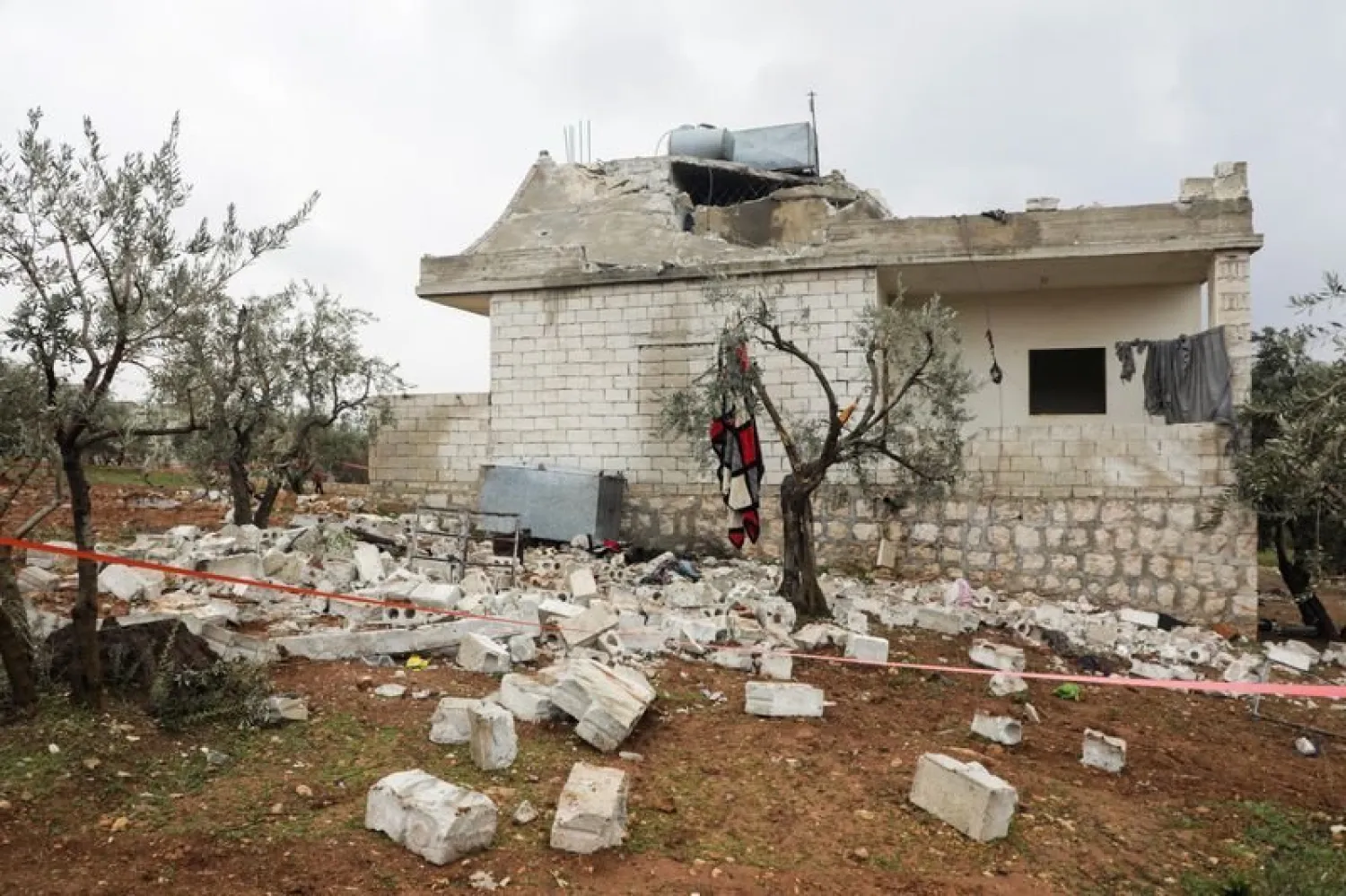
Debris from a building destroyed in the aftermath of a counter-terrorism mission conducted by the US Special Operations Forces is seen in Atmeh, Syria, February 4, 2022. Picture taken with a drone. REUTERS/Mahmoud Hassano
TT

ISIS Leader and Family Blended in among Syrians Uprooted by War

Debris from a building destroyed in the aftermath of a counter-terrorism mission conducted by the US Special Operations Forces is seen in Atmeh, Syria, February 4, 2022. Picture taken with a drone. REUTERS/Mahmoud Hassano

In a corner of Syria crammed with people uprooted by 11 years of civil war, the leader of ISIS and his family hid in plain sight: they kept to themselves, neighbors did not pry into each other's past, the rent was paid on time.

The status quo was shattered on Thursday night, when US special forces swept into the town of Atmeh in northwest Syria to raid his hideout.

Abu Ibrahim al-Hashemi al-Quraishi, head of one of the world's most feared militant groups, blew himself up to evade capture, killing several family members and others in the blast, according to the United States.

His death marks a blow to ISIS as its militants reemerge as a deadly threat in Syria and Iraq.

According to Reuters, until that point, locals believed that Quraishi was a Syrian merchant from Aleppo who had brought his family to the relative safety of Atmeh near the Turkish border, far from the frontlines of the Syrian conflict.

There was little to draw attention to the three-storey building on the edge of town since Quraishi, an Iraqi, rented an apartment there a year ago, taking the first floor initially before expanding to rent the top one too.

The children were generally well behaved and kept out of sight, sometimes accompanying their mother to the shops, said a woman who lived on the ground floor and knew her neighbors as "the family of Abu Ahmed".

"They kept to themselves and our kids played with their kids occasionally outside, but we never socialized with them," the woman, who gave her name as Ameena, said in a phone interview. She declined to give her full name for fear of retribution.

Ameena said she was once invited for tea by one of Quraishi's wives, Um Ahmad. She told Ameena her husband was a trader from Aleppo who had fled the city during the war. With hindsight, Ameena said she was struck by how rarely she saw him.

While the family were not from Atmeh, this did not draw attention in an area where tens of thousands of people have fled from all over the country.

"We thought they could have gone through a lot, but as you know, here everyone has a tragedy and people rarely speak of what happened to them these years and everyone prefers to keep to themselves," Ameena said.

Quraishi took over the leadership of ISIS following the death in 2019 of its founder Abu Bakr al-Baghdadi, who also died during a raid by US commandos when he detonated explosives.

Baghdadi had also been hiding in northwest Syria. Baghdadi's hideout was some 25 km (15 miles) from Atmeh, also in Idlib province.

Quraishi's hideout was close to a checkpoint operated by the armed group that controls most of the Idlib area - Hayat Tahrir al-Sham, a militant faction formerly known as the Nusra Front that has been an ISIS adversary for years.

It was also not far from Turkish troop positions in the nearby Afrin area of northwestern Syria.

Despite the close proximity of hostile forces, this was a relatively good hiding place for Quraishi as he sought to revive the fortunes of ISIS, which controlled a third of Iraq and Syria in 2014 before being beaten into retreat.

Syrians say it is easy for strangers to go unnoticed. Beyond the internally displaced, the area also hosts foreign militants who traveled to the country during the war either as fighters or civilian volunteers.

Last October, another senior ISIS leader, Sami Jasim, was captured in northwestern Syria in an Iraqi operation carried out with Turkish help.

A senior White House official said the blast was believed to have killed Quraishi, his two wives and a child on one floor, and likely a child who was on another floor with Quraishi's lieutenant and his wife, who were killed after firing on US forces.

Syrian rescue workers said 13 people were killed after the raid began, including four women and six children.

Neighbors said four children were rescued after the assault - a 12-year-old girl, boys aged 7 and 4 and an infant. It was not clear if they were related to Quraishi. The badly damaged apartments were strewn with children's toys, witnesses added.

The US official said Quraishi had been using the house and an unwitting family living on the first floor as a "protective shield," a factor that complicated planning for the raid.

The landlord's son told Reuters that each apartment was rented for $160 a month.

"My dad entrusted me to take the rent and if he (Quraishi) had water or electricity or Internet issues we'd help him. We didn't know more about him," the son, who gave his name as Abu Omar, said.

Ahmed al Saloum, a 56-year-old carpenter who lived nearby, said he often saw a woman hanging laundry from a second floor balcony. "They never aroused any suspicion," he said.


Former Syrian Regime Officer Arrested

Syrian Ministry of Interior in Damascus (Official Website)
TT

Former Syrian Regime Officer Arrested

Syrian Ministry of Interior in Damascus (Official Website)

Syria's Interior Ministry announced on Saturday the arrest of a former officer in Bashar al-Assad's regime holding the rank of major general and accused of committing crimes and violations.

In a statement, the ministry said that "based on precise monitoring and surveillance operations, Internal Security Forces carried out a special security operation that resulted in the arrest of criminal Mohammed Mohsen Nayouf."

"The criminal held the rank of major general under the former regime and occupied several prominent military and leadership positions, including service in the Third Corps, command of the 18th Tank Division, chief of staff of the 11th Division in 2020, and commander of the 105th Republican Guard Brigade in 2016."

According to the statement, the detainee was referred to the relevant authorities to complete investigations and take the necessary legal measures before being referred to the judiciary.

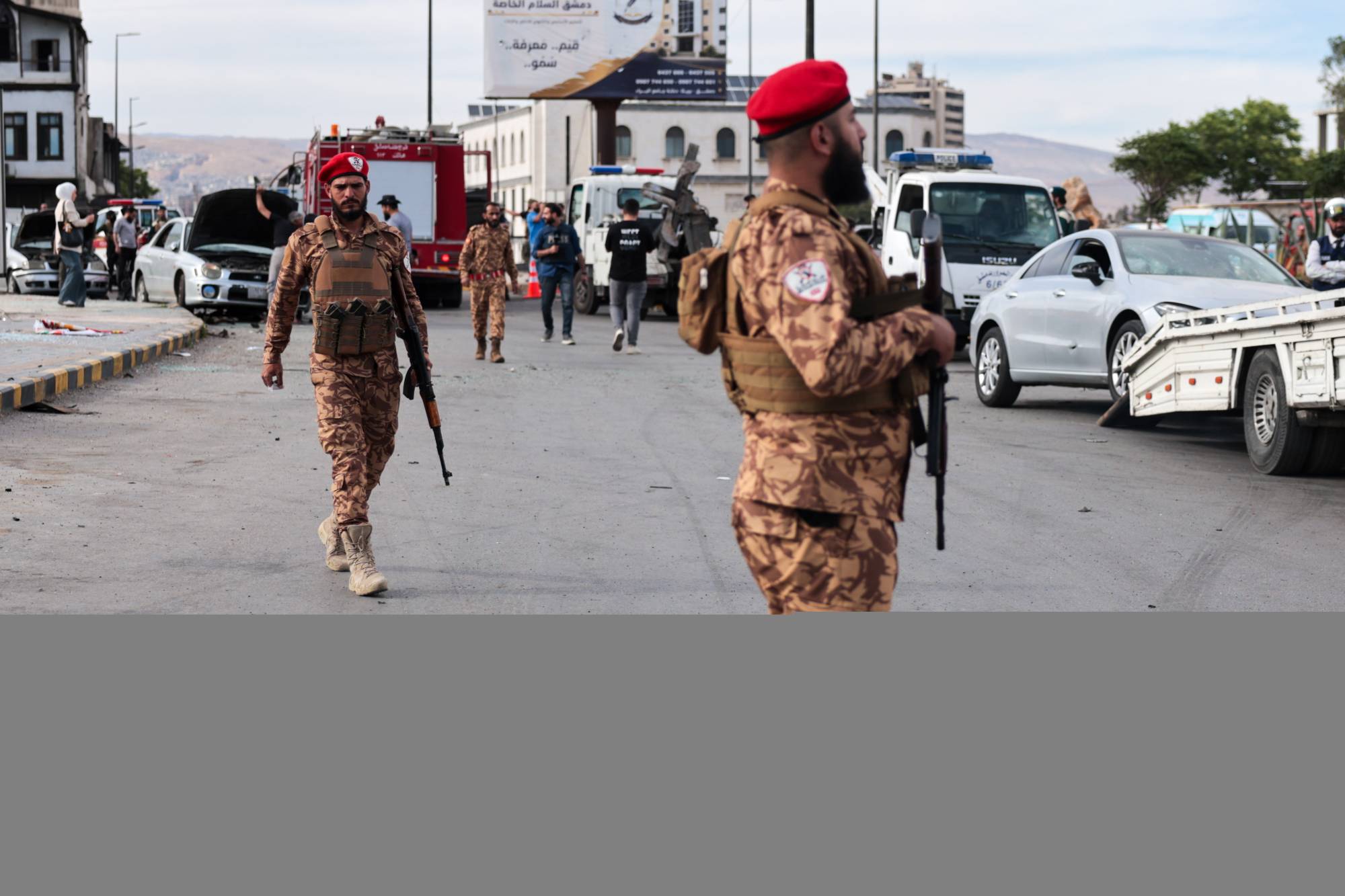
Syrian military police deployed near the explosion site in Bab Sharqi, near the headquarters of the Syrian Defense Ministry in Damascus, Syria, May 19, 2026. EPA/MOHAMMEDALRIFAI

The Syrian Arab News Agency (SANA) reported that the operation, carried out on Friday by the Salamiyah Security Directorate, which is affiliated with the Internal Security Command in Hama, comes "as part of the Interior Ministry's and relevant authorities' efforts to pursue and hold accountable those involved in crimes and violations committed against the Syrian people during the former regime, based on the principle of ending impunity, achieving transitional justice, and guaranteeing the rights of victims and their families."

Earlier on Friday, the Interior Ministry announced the arrest of Mohammed Imad Mahrez, one of the guards at Saydnaya prison during the former regime, making this the second such operation.


Hezbollah Says Message from Iran Shows it 'Will Not Give up' on Group

Displaced residents wave Hezbollah flags, including one bearing a picture of its leader, Naim Qassem, as they pass rubble of destroyed buildings in Dahiyeh, Beirut's southern suburbs, Lebanon, Friday, April 17, 2026, following a ceasefire between Israel and Hezbollah. (AP Photo/Bilal Hussein)
TT

Hezbollah Says Message from Iran Shows it 'Will Not Give up' on Group

Displaced residents wave Hezbollah flags, including one bearing a picture of its leader, Naim Qassem, as they pass rubble of destroyed buildings in Dahiyeh, Beirut's southern suburbs, Lebanon, Friday, April 17, 2026, following a ceasefire between Israel and Hezbollah. (AP Photo/Bilal Hussein)

Hezbollah said Saturday that a message from Tehran showed that Iran would not abandon the Lebanese militant group and that the Islamic republic's latest proposal to end the US-Iran war included a ceasefire in Lebanon.

Iran-backed Hezbollah said in a statement that its chief Naim Qassem had received a message from Tehran's Foreign Minister Abbas Araghchi, which indicated that Iran "will not give up its support for movements demanding justice and freedom, foremost among them Hezbollah".

In Iran's latest proposal through Pakistani mediators aimed at achieving "a permanent and stable end to the war, the demand to include Lebanon in the ceasefire was emphasised", the statement added.


South Lebanon Hospital Damaged in Israeli Strikes

Volunteers from the Lebanese Red Cross rescue a woman in the city of Nabatieh in South Lebanon (AFP)
TT

South Lebanon Hospital Damaged in Israeli Strikes

Volunteers from the Lebanese Red Cross rescue a woman in the city of Nabatieh in South Lebanon (AFP)

Israel kept up strikes on Lebanon on Saturday, hours after overnight raids on the country's south and east, including one that damaged a hospital, its chief executive told AFP.

Lebanon's state-run National News Agency (NNA) reported Israeli airstrikes on around a dozen locations in the south on Saturday including one targeting an agricultural area, "wounding several Syrian workers".

The NNA said an overnight strike in the southern city of Tyre that targeted a site near the hospital caused "severe damage" to the facility.

An AFP correspondent saw shattered glass, ceiling panels blown out and damaged medical equipment at the multi-storey Hiram hospital.

The Israeli military late on Friday night had issued evacuation warnings ahead of strikes on two locations in Tyre, saying it would target "Hezbollah facilities".

Accompanying maps advised people to leave areas within 500 metres (yards) of the target buildings, with the Hiram hospital shown within the advised evacuation area.

The hospital's CEO Dr Salman Aydibi told AFP that around 40 patients were in the facility when the warning was issued, including seven in intensive care.

"We took the patients to a safer location" elsewhere inside the hospital, he said, adding that none were harmed but some 30 staff sustained minor injuries.

He said an evaluation of the damage was ongoing and that the hospital has remained operational, though the emergency department briefly closed.

He said it was the third strike near the facility since the latest Israel-Hezbollah war erupted on March 2.

Israel's army said Saturday that it had targeted "Hezbollah infrastructure sites in Tyre" overnight where operatives from the Iran-backed group worked to "plan and execute attacks" against Israeli soldiers.

"Prior to the strike, steps were taken to mitigate harm to civilians, including the issuing of advance warnings, the use of precise munitions, and aerial surveillance," it added.

Another AFP correspondent saw heavy damage at both targeted sites in Tyre, with a man searching for his belongings among the debris at one location.

Israel's army also targeted east Lebanon overnight, saying it struck a "Hezbollah underground compound" used to manufacture weapons.

Lebanon's Hamas-aligned Islamist group Jamaa Islamiya and its armed wing the Al-Fajr Forces said Saturday in a statement that one of its members was killed in an Israeli strike in east Lebanon.

Under the terms of the ceasefire published by Washington, Israel reserves the right to act against "planned, imminent or ongoing attacks".
