


Scientists Develop Insect-Sized Robots with Flapping Wings

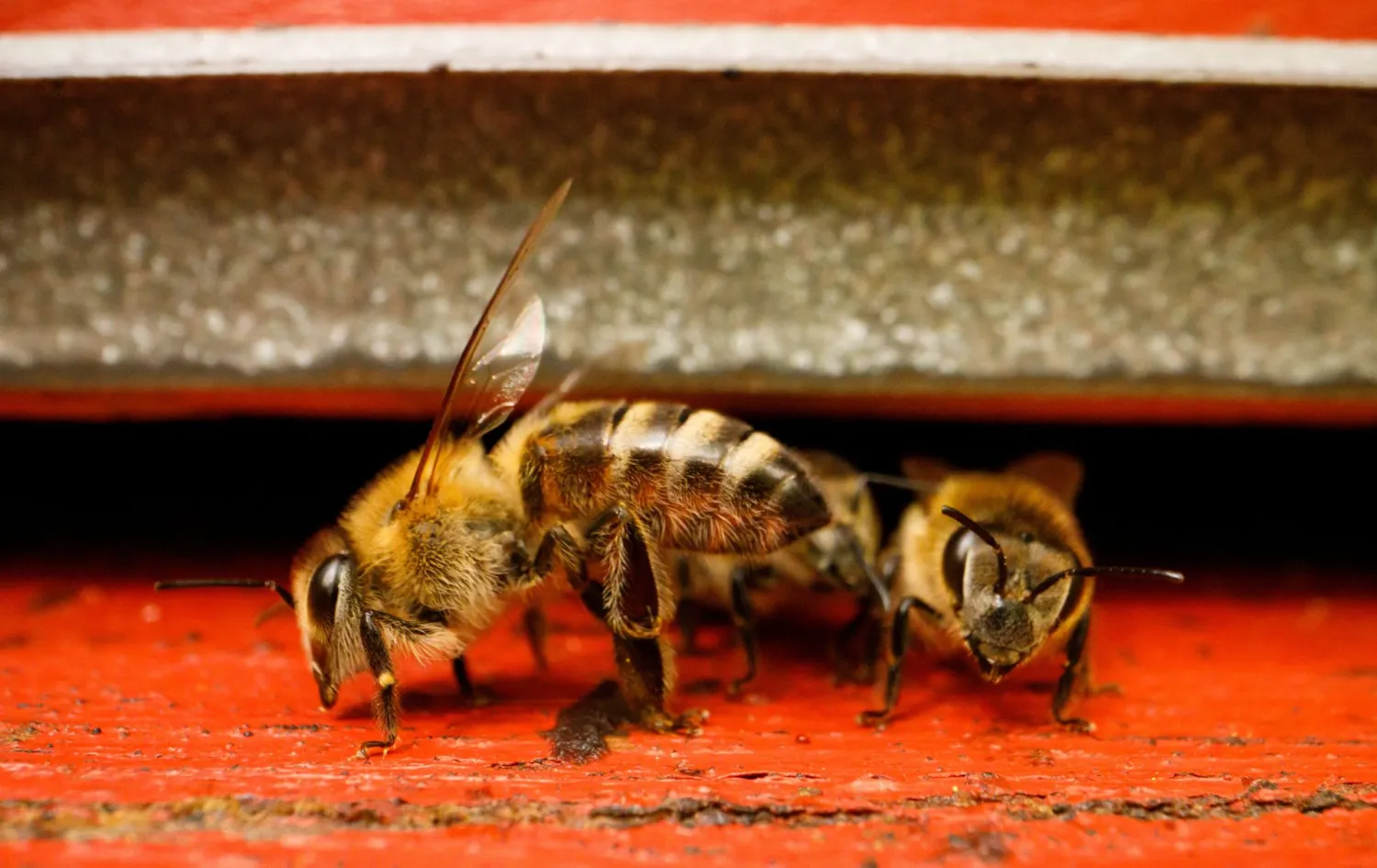
Bees are seen in front of a hive in "Bee hotel with five stars"
in Garesnica, Croatia, August 23, 2021. REUTERS/Antonio Bronic
Bees are seen in front of a hive in "Bee hotel with five stars" in Garesnica, Croatia, August 23, 2021. REUTERS/Antonio Bronic
TT

Scientists Develop Insect-Sized Robots with Flapping Wings

Bees are seen in front of a hive in "Bee hotel with five stars"
in Garesnica, Croatia, August 23, 2021. REUTERS/Antonio Bronic
Bees are seen in front of a hive in "Bee hotel with five stars" in Garesnica, Croatia, August 23, 2021. REUTERS/Antonio Bronic

Inspired by bees and other flying insects, scientists have developed insect-sized robots that can flap their wings to fly, according to a report by Sky News. This new technique could lead to smaller, lighter and more effective micro flying robots, which could be used for environmental measuring, search and rescue, and in dangerous surroundings such as collapsed buildings.

Known as micro air vehicles, the robots are better than other drones at maneuvering in tight spaces and resisting air turbulence. The technology means conventional motors and gears are no longer needed to fly the devices. Until now, similar machines have used motors, gears and other complicated systems to achieve the up-and-down motion of the wings, which added complexity, weight and other unwanted effects.

Jonathan Rossiter, professor of robotics at the University of Bristol, led the team that successfully demonstrated an artificial muscle system, called the Liquid-amplified Zipping Actuator (LAZA).

"Making smaller and better performing, flapping wing, micro robots is a huge challenge,” he explained. LAZA is an important step toward autonomous, flying robots that could be as small as insects and perform environmentally critical tasks such as plant pollination and exciting emerging roles such as finding people in collapsed buildings.

In the study, researchers showed how their cost-effective and easy to construct system provided enough power to fly a robot across a room at 18 body lengths per second, which was more than insect muscle of the same weight.

They also demonstrated how the LAZA can deliver consistent flapping over more than one million cycles, important for making flapping robots that can undertake long-haul flights. The team expect the LAZA to be adopted as a fundamental building block for a range of autonomous insect-like flying robots.



National Wildlife Center Launches 2nd Phase to Regulate Unlicensed Species in Saudi Arabia

National Wildlife Center Launches 2nd Phase to Regulate Unlicensed Species in Saudi Arabia
TT

National Wildlife Center Launches 2nd Phase to Regulate Unlicensed Species in Saudi Arabia

National Wildlife Center Launches 2nd Phase to Regulate Unlicensed Species in Saudi Arabia

The National Center for Wildlife (NCW) has launched the second phase of its initiative to regulate the status of unlicensed wildlife species in the Kingdom, representing one of the most prominent national efforts to control wildlife possession, document ownership, and ensure that all practices related to housing, breeding, and trading comply with the Environmental Law and its implementing regulations, according to SPA.

The regularization period extends until the end of February 2026 and targets those who keep or handle wildlife on a large scale, including private collections (farms) containing more than 10 species, facilities engaged in breeding and housing wildlife, and businesses involved in selling wildlife products or derivatives.

This phase follows the success of the first, which focused on regulating the status of falcons, and reinforces the Kingdom's role in curbing illegal practices that could harm natural environments or threaten the survival of wildlife species. The initiative reflects a growing national commitment to protecting biodiversity and developing a more regulated system for managing wildlife within the Kingdom.

The regulation aims to build an accurate database of wildlife, enhance monitoring, and improve housing standards in accordance with environmental and health considerations.

The NWC emphasizes that this step aligns with national efforts to protect wildlife, support ecosystem sustainability, and address the challenges of illegal wildlife trafficking. It calls on all owners and relevant facilities to take advantage of the grace period, review the regulations through the "Fitri" platform, and contribute to a safer and more balanced ecosystem


Islamabad Puts Drivers on Notice as Smog Crisis Worsens

This picture taken on December 9, 2025, shows buildings engulfed in dense smog due to severe air pollution in Islamabad. (Photo by Aamir QURESHI / AFP)
TT

Islamabad Puts Drivers on Notice as Smog Crisis Worsens

This picture taken on December 9, 2025, shows buildings engulfed in dense smog due to severe air pollution in Islamabad. (Photo by Aamir QURESHI / AFP)

Truck driver Muhammad Afzal was not expecting to be stopped by police, let alone fined, as he drove into Islamabad this week because of the thick diesel fumes emanating from his exhaust pipe.

"This is unfair," he said after being told to pay 1,000 rupees ($3.60), with the threat of having his truck impounded if he did not "fix" the problem.

"I was coming from Lahore after getting my vehicle repaired. They pressed the accelerator to make it release smoke. It's an injustice," he told AFP.

Checkpoints set up this month are part of a crackdown by authorities to combat the city's soaring smog levels, with winter months the worst due to atmospheric inversions that trap pollutants at ground level.

"We have already warned the owners of stern action, and we will stop their entry into the city if they don't comply with the orders," said Dr Zaigham Abbas of Pakistan's Environmental Protection Agency (EPA), as he surveyed the checkpoint at the southeast edge of the capital.

For Waleed Ahmed, a technician inspecting the vehicles at the site, "just like a human being, a vehicle has a life cycle. Those that cross it release smoke that is dangerous to human health".

While not yet at the extreme winter levels of Lahore or the megacity Karachi, where heavy industry and brick kilns spew tons of pollutants each year, Islamabad is steadily closing the gap.

So far in December it has already registered seven "very unhealthy" days for PM2.5 particulates of more than 150 micrograms per cubic meter, according to the Swiss-based monitoring firm IQAir.

Intraday PM2.5 levels in Islamabad often exceed those in Karachi and Lahore, and in 2024 the city's average PM2.5 reading for the year was 52.3 micrograms -- surpassing the 46.2 for Lahore.

Those annual readings are far beyond the safe level of five micrograms recommended by the World Health Organization.

Built from scratch as Pakistan's capital in the 1960s, the city was envisioned as an urban model for the rapidly growing nation, with wide avenues and ample green spaces abutting the Himalayan foothills.

But the expansive layout discourages walking and public transport remains limited, meaning cars -- mostly older models -- are essential for residents to get around.

"The capital region is choked overwhelmingly by its transport sector," which produces 53 percent of its toxic PM2.5 particles, the Pakistan Air Quality Initiative, a research group, said in a recent report.

"The haze over Islamabad... is not the smoke of industry, but the exhaust of a million private journeys -- a self-inflicted crisis," it said.

Announcing the crackdown on December 7, EPA chief Nazia Zaib Ali said over 300 fines were issued at checkpoints in the first week, with 80 vehicles impounded.

"We cannot allow non-compliant vehicles at any cost to poison the city's air and endanger public health," she said in a statement.

The city has also begun setting up stations where drivers can have their emissions inspected, with those passing receiving a green sticker on their windshield.

"We were worried for Lahore, but now it's Islamabad. And that's all because of vehicles emitting pollution," said Iftikhar Sarwar, 51, as he had his car checked on a busy road near an Islamabad park.

"I never needed medicine before but now I get allergies if I don't take a tablet in the morning. The same is happening with my family," he added.

Other residents say they worry the government's measures will not be enough to counter the worsening winter smog.

"This is not the Islamabad I came to 20 years ago," said Sulaman Ijaz, an anthropologist.

"I feel uneasy when I think about what I will say if my daughter asks for clean air -- that is her basic right."


Spider-Like Scar Haunts Jupiter's Moon Europa

A dendritic “lab star” formed by liquid water flowing through Europa ice simulant at NASA JPL, modeling how features like Damhán Alla could form on Jupiter's icy moon, similar to how lake stars form on Earth. (Image credit: Prof. Lauren Mc Keown.)
TT

Spider-Like Scar Haunts Jupiter's Moon Europa

A dendritic “lab star” formed by liquid water flowing through Europa ice simulant at NASA JPL, modeling how features like Damhán Alla could form on Jupiter's icy moon, similar to how lake stars form on Earth. (Image credit: Prof. Lauren Mc Keown.)

Scientists have explored a strange, spider-like scar on Jupiter's icy moon Europa, suggesting the feature might have formed from briny water eruptions beneath the moon's ice.

NASA's Galileo spacecraft, whose mission ended in 2003, spotted the unique feature - officially named Damhán Alla, an Irish word meaning “spider” or “wall demon” - within Europa's Manannán crater.

The starburst-like pattern first appeared in images captured by the spacecraft in the late 1990s, but scientists are only now piecing together how it may have formed, according to a statement from Trinity College Dublin.

“The significance of our research is really exciting,” Lauren Mc Keown, lead author of a study published in The Planetary Science Journal.

“Surface features like these can tell us a lot about what's happening beneath the ice. If we see more of them with Europa Clipper, they could point to local brine pools below the surface.”

On Earth, lake stars emerge when snow falls on frozen lakes and holes form in the ice, allowing water to flow upwards and melt surrounding snow, carving radial, branching channels as it spreads.

Such patterns are common in nature, from lightning scars to tidal channels, illustrating the movement of fluids and energy through different surfaces.

The researchers suggest that Europa's version might form the same way - except the liquid in this case would be salty brine forced upward after an impact disrupted the ice shell.

“Lake stars are really beautiful, and they are pretty common on snow or slush-covered frozen lakes and ponds,” McKeown said in the statement. “It is wonderful to think that they may give us a glimpse into processes occurring on Europa and maybe even other icy ocean worlds in our solar system.”