


Congress Wants Biden to Increase Pressure on Iran

Senate Republican Leader Mitch McConnell (EPA)
TT

Congress Wants Biden to Increase Pressure on Iran

Senate Republican Leader Mitch McConnell (EPA)

The US Senate warned President Joe Biden about the increasing Houthi attacks on US allies, and lawmakers intensified their pressure on the administration to re-designate the militias on the list of terrorism.

In a rare move, Senate Republican Leader Mitch McConnell dedicated his daily inaugural statement to address Iran's proxies in the region, referring to the recent Houthi attacks on the UAE.

McConnell said that for a third straight week, "the UAE was targeted by a Houthi missile attack, made possible by Tehran," adding that the terrorists targeted an airbase that hosts 2,000 US personnel last week.

The Republican leader indicated that the US faces Iranian-backed threats alongside partners like Israel and the UAE. "But you wouldn't know it by looking at President Biden's foreign policy."

He indicated that a year ago, the State Department removed Yemen's Houthi terrorists from its list of foreign terrorist organizations, and since then, "the Iranian proxy terrorists have only increased their attacks, underwritten by Iranian money and technology."

Last month the Biden Administration was reportedly considering reversing its decision.

McConnell warned that if the administration chooses to "shrug or look the other way when Iran targets our friends and our interests," and if they continue to withhold military capabilities from partners threatened by Iran, then they should not pretend to be surprised when traditional US partners in the Middle East start looking to Moscow and Beijing to fill the vacuum.

McConnell's statements reflect the growing concern of lawmakers about the threat of Iran's proxies to the interests of the United States in the region.

Republicans accuse the White House of reluctance to redesignate Houthis on the terrorist list for fear of angering Tehran.

It was reflected in McConnell's statements, who stated that the most significant distraction keeping this administration's attention from protecting its interests in the Middle East "has been its ongoing obsession with returning to the Obama Administration's failed 2015 nuclear agreement."

The Republican Senator made severe accusations against Biden, saying that "by blaming their predecessor's 'maximum pressure' approach and demonstrating an unwillingness to respond forcefully to Iranian-backed terrorist attacks, the administration effectively took the threat of sanctions or military action off the table, neutering their diplomacy at the outset."

Meanwhile, bipartisan representatives are increasing pressure on the US administration in this regard.

Representatives Seth Moulton and Mike Waltz will soon send a letter to Biden urging him to redesignate the Houthis in Yemen as a foreign terrorist organization, a move the president said is under consideration.

In the letter shared by Politico, the two officials said they understand that "removing the designation was meant to help the dire humanitarian situation in Yemen, but it has done little outside of emboldening the Houthis to escalate their attacks and block reconciliation efforts in the country."

The letter discussed the importance of the partnership between the United States and the UAE, saying it is a "critical time to stand shoulder-to-shoulder with an important ally while they are under assault, reiterating our commitment to the US-UAE strategic partnership."

In the face of these efforts, the liberals from the Democratic Party are resisting taking a step of this kind, saying it obstructs humanitarian aid to Yemen.

Democratic Senator Chris Murphy mocked the calls for designating Houthi a terrorist organization.

The Senator said in a tweet: "Designating the Houthis as a terrorist organization" sounds better than "an American blockade of food imports to Yemen to intentionally cause mass civilian starvation." But FYI, under US law, they are the same thing."

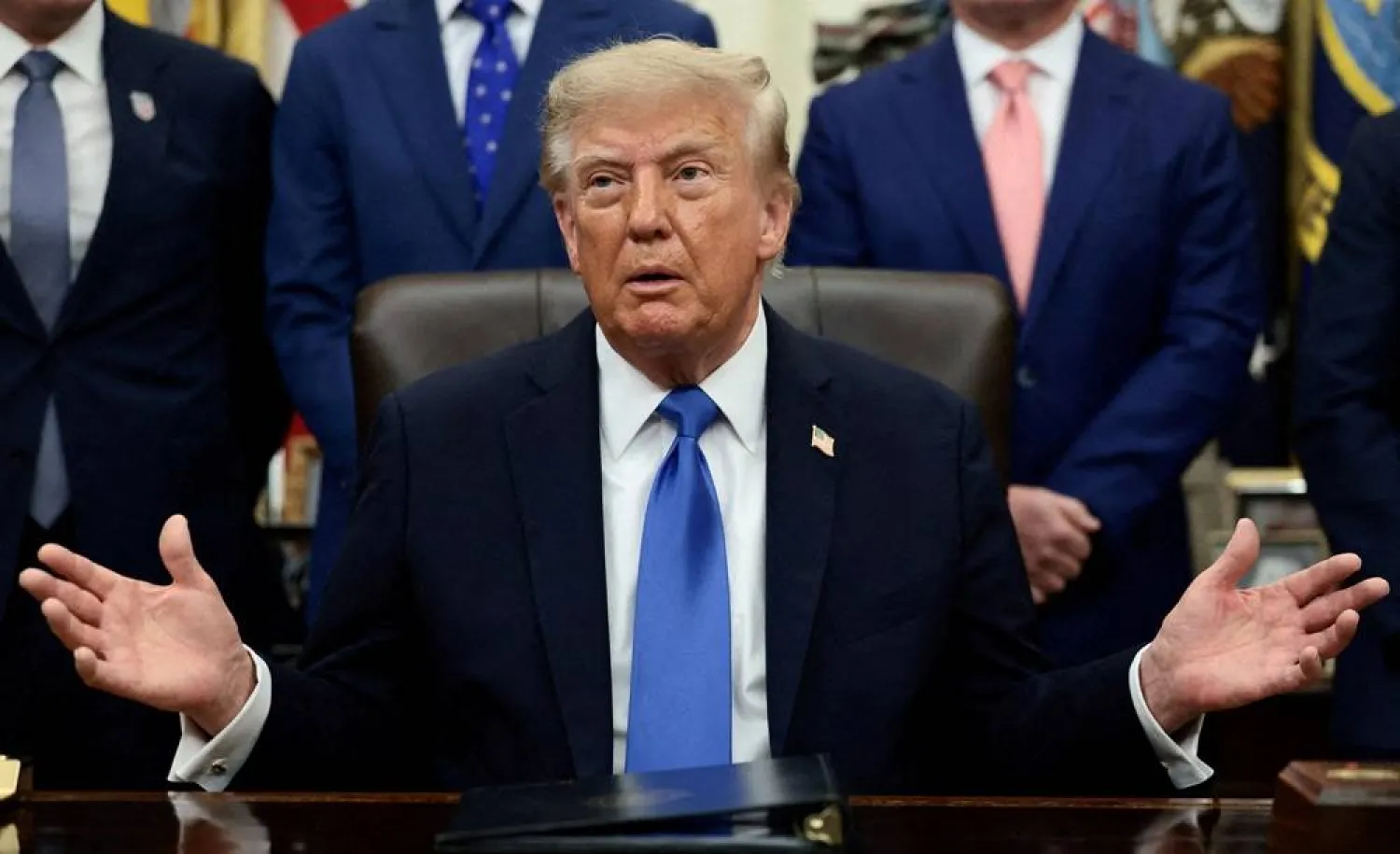


Trump Says US-Iran Talks Will Be Behind Closed Doors

US President Donald Trump, flanked by Secretary of Defense Pete Hegseth, speaks during a press conference in the James S. Brady Press Briefing Room at the White House in Washington, DC, US, April 6, 2026. (Reuters)
TT

Trump Says US-Iran Talks Will Be Behind Closed Doors

US President Donald Trump, flanked by Secretary of Defense Pete Hegseth, speaks during a press conference in the James S. Brady Press Briefing Room at the White House in Washington, DC, US, April 6, 2026. (Reuters)

US President Donald Trump on Wednesday said talks on the Iran crisis would be held behind closed doors, and that "only one group of meaningful 'POINTS'" were acceptable to the United States, ‌but gave ‌no other details about ‌the ⁠negotiations.

"These are the ⁠POINTS that are the basis on which we agreed to a CEASEFIRE. It is something that is reasonable, and can easily be dispensed with," he ⁠said in a social ‌media post.

Trump ‌separately told ABC News in ‌an interview that he expects talks ‌to begin on Friday and to move very quickly.

Pakistan's Prime Minister Shehbaz Sharif earlier on Wednesday said ‌US and Iranian delegations would be arriving in Pakistan ⁠on ⁠Friday after the two nations accepted a two-week ceasefire.

Trump in his online post also threatened a federal probe into unnamed individuals he accused--without providing evidence--of circulating various correspondence that he said were not the basis for the ceasefire agreement.


France Unveils Rearmament Boost to Face Russia Threat

 France's Defense Minister Catherine Vautrin speaks during the press conference following the weekly cabinet meeting at the Elysee Palace in Paris on April 8, 2026. (AFP)
France's Defense Minister Catherine Vautrin speaks during the press conference following the weekly cabinet meeting at the Elysee Palace in Paris on April 8, 2026. (AFP)
TT

France Unveils Rearmament Boost to Face Russia Threat

 France's Defense Minister Catherine Vautrin speaks during the press conference following the weekly cabinet meeting at the Elysee Palace in Paris on April 8, 2026. (AFP)
France's Defense Minister Catherine Vautrin speaks during the press conference following the weekly cabinet meeting at the Elysee Palace in Paris on April 8, 2026. (AFP)

France is to ramp up explosive drone stocks by up to 400 percent by 2030, draft legislation showed Wednesday, as the country seeks to accelerate rearmament to face an aggressive Russia.

The military spending bill was presented after France's top commanders said the country must be ready in the next few years for a clash with Russia and that NATO should adapt to produce more weapons and faster.

The government on Wednesday presented its updated military planning law, adding another 36 billion euros ($42 billion) to France's defense spending between 2024 and 2030, on top of the 413 billion euros ($483 billion) already allocated.

"Our armed forces must be capable of responding to a major engagement within a timeframe that none of us can predict," Defense Minister Catherine Vautrin said following a meeting of top defense and security officials.

According to the revised legislation, which is due to be presented to parliament, the annual budget would reach 76.3 billion euros in 2030, representing 2.5 percent of gross domestic product, compared with 57.1 billion euros for this year.

The legislation does not foresee an increase in the size of France's armed forces, which remains at 210,000 active-duty personnel, 225 combat aircraft and 15 first-rate frigates.

The conflicts in Ukraine and the Middle East have prompted a particular focus on stocks of missiles and shells. NATO commanders say the military bloc must respond to challenges such as Russia and Iran mass-producing drones.

According to the draft legislation, an additional 8.5 billion euros will be allocated to boost stockpiles of ammunition between now and 2030, bringing the total to 26 billion euros.

While stock levels are confidential, they are set to rise by 400 percent for all types of remotely operated munitions such as explosive drones, and by 85 percent for Scalp cruise missiles.

Stocks of torpedoes are to go up by 230 percent and those of surface-to-air missiles by 30 percent.

An additional two billion euros will be allocated to procurement of drones of all types, bringing the total investment to 8.4 billion euros.

The French Institute of International Relations (IFRI), a top think tank, warned in November that Europe could struggle to quickly produce enough weapons in case of a direct confrontation with Russia.


China Says Afghanistan and Pakistan Agree to Explore a ‘Comprehensive Solution’

A general view of Kabul, Afghanistan, 06 April 2026. (EPA)
TT

China Says Afghanistan and Pakistan Agree to Explore a ‘Comprehensive Solution’

A general view of Kabul, Afghanistan, 06 April 2026. (EPA)

China's government said that Afghanistan and Pakistan have agreed not to escalate their conflict and to "explore a comprehensive solution” after several weeks of cross-border fighting between the two countries that has left hundreds of people killed.

Foreign Ministry spokesperson Mao Ning said Wednesday that after seven days of peace talks in the western Chinese city of Urumqi under China mediation, all the parties also agreed to keep the dialogue.

“The three parties agreed to explore a comprehensive solution to the issues in the relations between Afghanistan and Pakistan, and clarified the core and priority issues that need to be addressed,” Mao said during the daily briefing in Beijing.

She said that they acknowledged that “terrorism is the core issue affecting the relationship.”

Afghanistan and Pakistan said that they won't “take actions that would escalate or complicate the situation.”

There was no comment from Islamabad about the weeklong talks.

But Afghanistan’s Foreign Ministry spokesman, Abdul Qahar Balkhi, said on Wednesday that the talks between the Afghan and Pakistani delegations, hosted and mediated by China in Urumqi, have concluded.

In a post on X, he said that the talks were held in a “constructive atmosphere,” with discussions focusing on bilateral relations, security issues and regional stability. Balkhi thanked Beijing for hosting the talks and expressed hope that the process would help strengthen trust, deepen relations and promote effective cooperation in the region.

The talks began last week in Urumqi at the invitation of China, in an effort to stop the conflict that began between the two countries in February.

Pakistan, which declared it was in “open war” with its neighbor, has also carried out airstrikes inside Afghanistan, including in the capital Kabul.

Afghanistan’s Foreign Ministry said Tuesday that the talks had been constructive.

The United Nations’ office for the coordination of humanitarian affairs in Afghanistan said on Tuesday that the conflict had displaced 94,000 people overall, while 100,000 people in two Afghan districts near the border have been completely cut off by the fighting since February.

Even during the talks, Afghanistan has accused Pakistan of carrying out shelling across its border on several occasions.

Pakistan accuses Afghanistan of providing a safe haven to militants who carry out deadly attacks inside Pakistan, especially the Pakistani Taliban, known as Tehrik-e-Taliban Pakistan or TTP. The group is separate from but allied with the Afghan Taliban, which took over Afghanistan in 2021 following the chaotic withdrawal of US-led troops. Kabul denies the charge.