Russian Bombers Fly over Belarus amid Ukraine Tensions

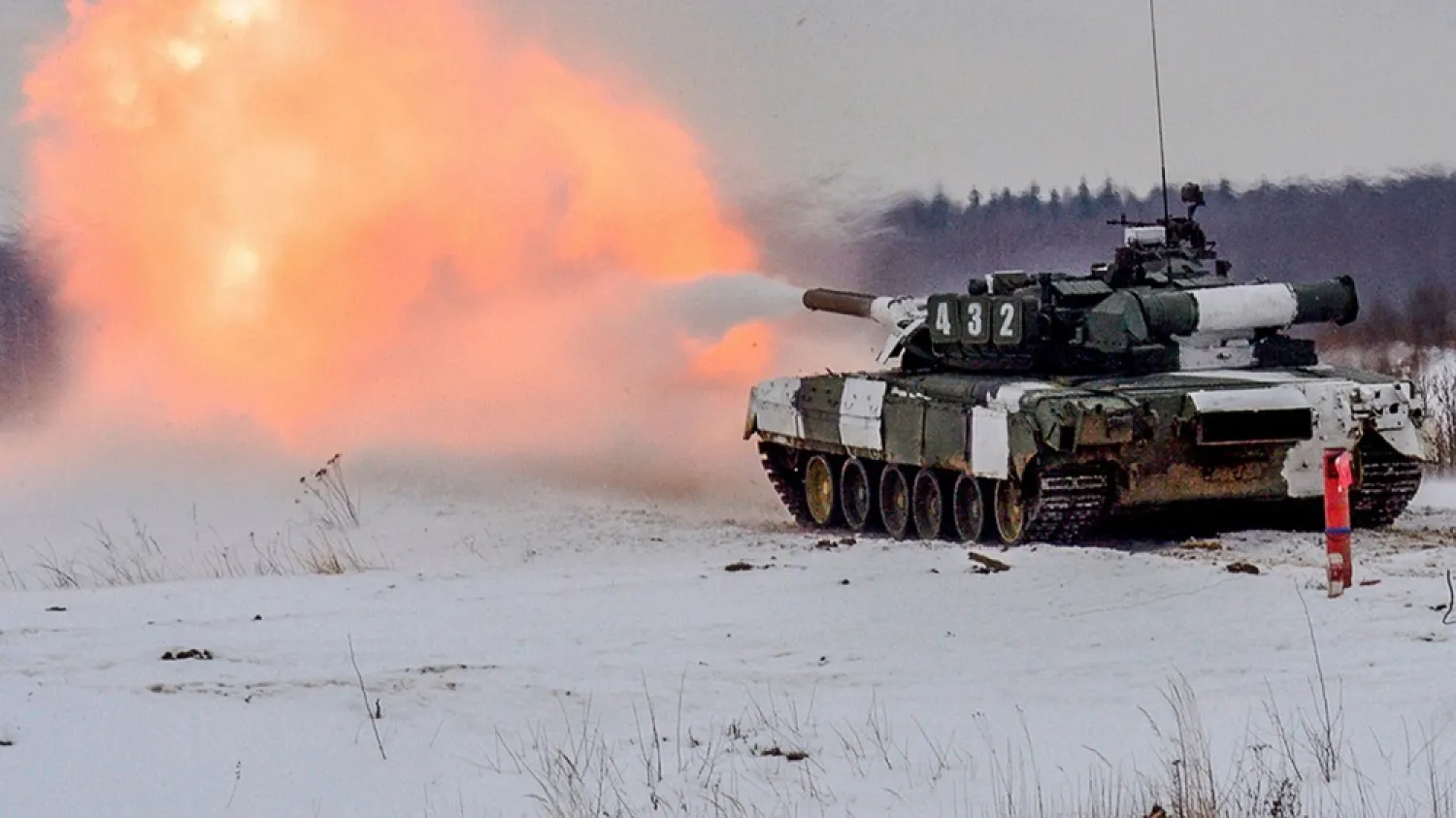
In this photo released by the Russian Defense Ministry Press Service on in Nizhny Novgorod, Russia, Saturday, Feb. 5, 2022, a tank takes part in a military exercise, in Russia. (Russian Defense Ministry Press Service via AP)
TT

Russian Bombers Fly over Belarus amid Ukraine Tensions

In this photo released by the Russian Defense Ministry Press Service on in Nizhny Novgorod, Russia, Saturday, Feb. 5, 2022, a tank takes part in a military exercise, in Russia. (Russian Defense Ministry Press Service via AP)

Russia on Saturday sent a pair of long-range nuclear-capable bombers on patrol over its ally Belarus amid spiraling tensions over Ukraine.

The Russian Defense Ministry said the two Tu-22M3 bombers practiced interacting with the Belarusian air force and air defense during a four-hour mission. The flight followed several similar patrols over Belarus, which borders Ukraine to the north.

The mission came as the Kremlin has moved troops from Siberia and the Far East to Belarus for sweeping joint drills. The deployment added to the Russian military buildup near Ukraine, fueling Western fears of a possible invasion.

Russia has denied any plans of attacking Ukraine, but urged the US and its allies to provide a binding pledge that they won't accept Ukraine into NATO, won't deploy offensive weapons, and will roll back NATO deployments to Eastern Europe. Washington and NATO have rejected the demands.

The West has called on Russia to pull back an estimated 100,000 troops from areas near Ukraine, but the Kremlin has responded by saying it will station troops wherever it needs to on Russian territory. As the tensions over Ukraine soared, the Russian military has launched a series of war games spreading from the Arctic to the Black Sea.

The Russian troop deployment to Belarus raised concerns in the West that Moscow could stage an attack on Ukraine from the north. The Ukrainian capital of Kyiv is just 75 kilometers (50 miles) from the border with Belarus.

In recent months, Russia has conducted a series of joint drills with Belarus and repeatedly sent its nuclear-capable long-range bombers to patrol the skies over Belarus, which borders NATO members Poland, Lithuania and Latvia.

Belarus' authoritarian leader Alexander Lukashenko, who has increasingly relied on the Kremlin's political and financial support amid bruising Western sanctions triggered by his crackdown on domestic protests, has called for closer defense ties with Moscow and recently offered to host Russian nuclear weapons.

On Saturday, the German newspaper Bild published a report alleging that Russia is poised to attack Ukraine from several directions, capture major cities and install a puppet government. Russian Foreign Ministry spokeswoman Maria Zakharova angrily dismissed the allegations.

As war fears mounted, Ukrainian authorities launched a series of drills for civilians to prepare for a possible Russian invasion.

"I am here to learn how to defend myself, defend my relatives and also understand how to act in the situation," Kyiv resident Ilya Goncharov said after taking part in drills on the outskirts of the Ukrainian capital. "I am happy that I came here to learn the basics of self defense and first aid."

In Kharkiv, Ukraine's second-largest city, thousands of people took to the streets Saturday carrying giant yellow-and-blue banners in the colors of the national flag in a show of determination to protect the city.

"We want to show that there are people in Kharkiv who are ready to defend it and fight back," said Svitlana Galashko, one of those who took part in the rally.

Amid the standoff over Ukraine, US President Joe Biden has ordered 2,000 US-based troops to Poland and Germany and shifted 1,000 more from Germany to Romania in a show of the US commitment to NATO's eastern flank.

Earlier this week, Russian President Vladimir Putin has signaled Moscow's readiness for more talks with Washington and its NATO allies. As part of high-level diplomacy to ease the tensions, French President Emmanuel Macron is set to head to Moscow and Kyiv on Monday and Tuesday, while German Chancellor Olaf Scholz will travel to Kyiv and Moscow on Feb. 14-15.

On Saturday, British Prime Minister Boris Johnson had a call with Macron and "they agreed that finding a diplomatic solution to the current tensions must remain the overriding priority."

Johnson's office said he and the French president "also stressed that NATO must be united in the face of Russian aggression" and "agreed to continue to work together to develop a package of sanctions which would come into force immediately should Russia further invade Ukraine."

Ukrainian President Volodymyr Zelenskyy also spoke Saturday with European Council President Charles Michel, saying on Twitter that they discussed the current situation around Ukraine and urged its "de-escalation within all existing formats."

In 2014, Russia annexed Ukraine's Crimean Peninsula after the ouster of its Moscow-friendly leader and threw its weight behind a separatist insurgency in eastern Ukraine, where over 14,000 have been killed in fighting.

Amid the tensions with the West, Putin on Friday attended the opening of the Winter Olympics in Beijing and met with China's leader Xi Jinping to strengthen the two countries' alliance. In a joint statement, Putin and Xi declared their opposition to any expansion of NATO while affirming that the island of Taiwan is a part of China.

Putin and Xi announced that the relations between Moscow and Beijing are "superior to political and military alliances of the Cold War era" and their friendship "has no limits."


Somaliland Briefly Detains Americans Accused of Threatening National Security

Traffic flows along a street in Hargeisa, Somaliland, October 16, 2026. REUTERS/Mohamed Ahmed
TT

Somaliland Briefly Detains Americans Accused of Threatening National Security

Traffic flows along a street in Hargeisa, Somaliland, October 16, 2026. REUTERS/Mohamed Ahmed

The national intelligence agency in the self-declared Republic of Somaliland said it had briefly detained five US nationals who were threatening national security.

The National Intelligence Agency of Somaliland (NIA) said in a post on X late on Sunday that it had been monitoring the US nationals since they arrived and ran a "lengthy investigation" into their activities.

It gave no details of their identities or alleged actions in the Horn of Africa territory.

NIA ⁠Director-General Jama Mohamoud ⁠Egal and Somaliland's Ministry of Foreign Affairs did not immediately respond to requests for comment.

The US State Department said it was aware of the reports but could not comment on specifics because of concerns on privacy and other considerations.

Somaliland, ⁠which declared independence from Somalia in 1991, occupies a strategic location at the juncture of the Indian Ocean and Red Sea. Last December, Israel became the first country to recognize it as a sovereign state, and its government has been lobbying for recognition from additional countries, including the United States.

According to a person familiar with the matter, the five Americans work for a company ⁠called ⁠Parallel Black. A November 4 letter seen by Reuters shows they were invited by Somaliland's Foreign Affairs Minister Abdirahman Dahir Adam to conduct feasibility studies for potential investments.

The person said the five Americans left Somaliland on an Ethiopian Airlines flight on Monday afternoon.

Parallel Black, which was registered less than two months ago in the US state of Delaware, did not immediately respond to requests for comment.


Le Pen Says France Will No Longer Aid Ukraine ‘Financially’ if Elected

Marine Le Pen (C), the far-right National Rally (RN) party's candidate for the 2027 French presidential election, visits the "Made in France" fair at the Porte de Versailles exhibition center in Paris, France, 13 November 2026. (EPA)
TT

Le Pen Says France Will No Longer Aid Ukraine ‘Financially’ if Elected

Marine Le Pen (C), the far-right National Rally (RN) party's candidate for the 2027 French presidential election, visits the "Made in France" fair at the Porte de Versailles exhibition center in Paris, France, 13 November 2026. (EPA)

Marine Le Pen on Monday said that France would provide no further financial aid to Ukraine if she is elected president next year, after a meeting with Kyiv's ambassador in Paris.

"The state of France's public finances would no longer allow the country to provide financial assistance to Ukraine in the coming months," Le Pen said in a statement, while insisting France would honor existing commitments, including toward a 90-billion-euro ($100-billion) European Union loan.

Le Pen is currently ahead in polls in the race to succeed President Emmanuel Macron next year, as the war sparked by Russia's 2022 full-scale invasion of Ukraine grinds towards its fifth anniversary.

She has faced criticism over past links to Russia, which included a 2017 meeting in the Kremlin with President Vladimir Putin and her party taking a loan from a Russian bank that it paid off in full in 2023.

But she has opposed the invasion and, at her talks in Paris with Ukrainian ambassador Vadym Omelchenko, Le Pen made clear her "unwavering support for Ukraine since the beginning of the conflict".

The statement said the talks -- the first such between Le Pen and the Ukrainian ambassador -- were "cordial".

While financial aid would be cut, Le Pen told the ambassador that "France would continue to support Ukraine through donations of equipment, humanitarian aid and much more active diplomacy".

The statement said there was a "frank discussion" on the future of the conflict, with Le Pen stressing that "the pursuit of peace -- though a difficult goal to achieve -- must remain a priority for all".

She also asked the ambassador to tell President Volodymyr Zelensky she is ready to meet in "either Paris or Brussels". However, there was no mention of the candidate making the journey to Kyiv after Zelensky invited her to visit the Ukrainian capital.

Le Pen's opponents have expressed alarm that by emphasizing the importance of ending the war swiftly, she could force Ukraine to capitulate on unfavorable terms.

"If Russia imposes its will on a European nation through brutality, all of Europe is weakened," Macron wrote on Facebook at the weekend.

Taking aim at Le Pen, he said: "Let us be clear: those who seek to limit the resources available to Ukraine are, in effect, pushing for an unjust peace -- one that would leave Ukraine permanently vulnerable, and, by extension, leave Europe vulnerable as well."


Trump Says He Might Meet with North Korea’s Kim Jong Un in China

US President Donald Trump and North Korean leader Kim Jong Un shake hands before their one-on-one chat during the second US-North Korea summit at the Metropole Hotel in Hanoi, Vietnam February 27, 2019. (Reuters)
TT

Trump Says He Might Meet with North Korea’s Kim Jong Un in China

US President Donald Trump and North Korean leader Kim Jong Un shake hands before their one-on-one chat during the second US-North Korea summit at the Metropole Hotel in Hanoi, Vietnam February 27, 2019. (Reuters)

US President Donald Trump said on Monday he might meet with North Korean leader Kim Jong Un in China this week, an announcement that could dramatically reshape his upcoming trip through East Asia if it occurs.

The president, who met the North Korean leader several times during his 2017-2021 term, including once in the Korean Demilitarized Zone, has previously expressed ‌interest in ‌another meeting during his current term. Senior ‌US ⁠officials, however, have previously ⁠said he has no immediate plans to do so.

Moreover, Trump has repeatedly previewed meetings with Kim that never took place, including during a trip to Asia last year. North Korea, whose mission to the United Nations did not immediately respond to a ⁠request for comment, has publicly indicated it ‌has no intention of ‌meeting with the US president at this time.

Trump told reporters ‌while departing the White House en route to ‌the Philippines and China that any meeting would occur in China, and that the North Korean leader's presence was ultimately up to Chinese President Xi Jinping.

"(Xi) was here a ‌month ago, and we're also going to meet with (Russian) President Putin, and we ⁠may ⁠meet with Kim Jong Un also," Trump said.

"So that'll be good. We have a chance to accomplish a lot."

Trump has indicated he will meet with Putin and Xi during his trip, but US officials and analysts have played down the possibility of a meaningful agreement emerging from any trilateral sit-down.

Among the possible topics of conversation, Trump and others have said, are Russia's invasion of Ukraine, counterproliferation and the war in Iran.