


Canada Protests against Covid Measures Gain Steam

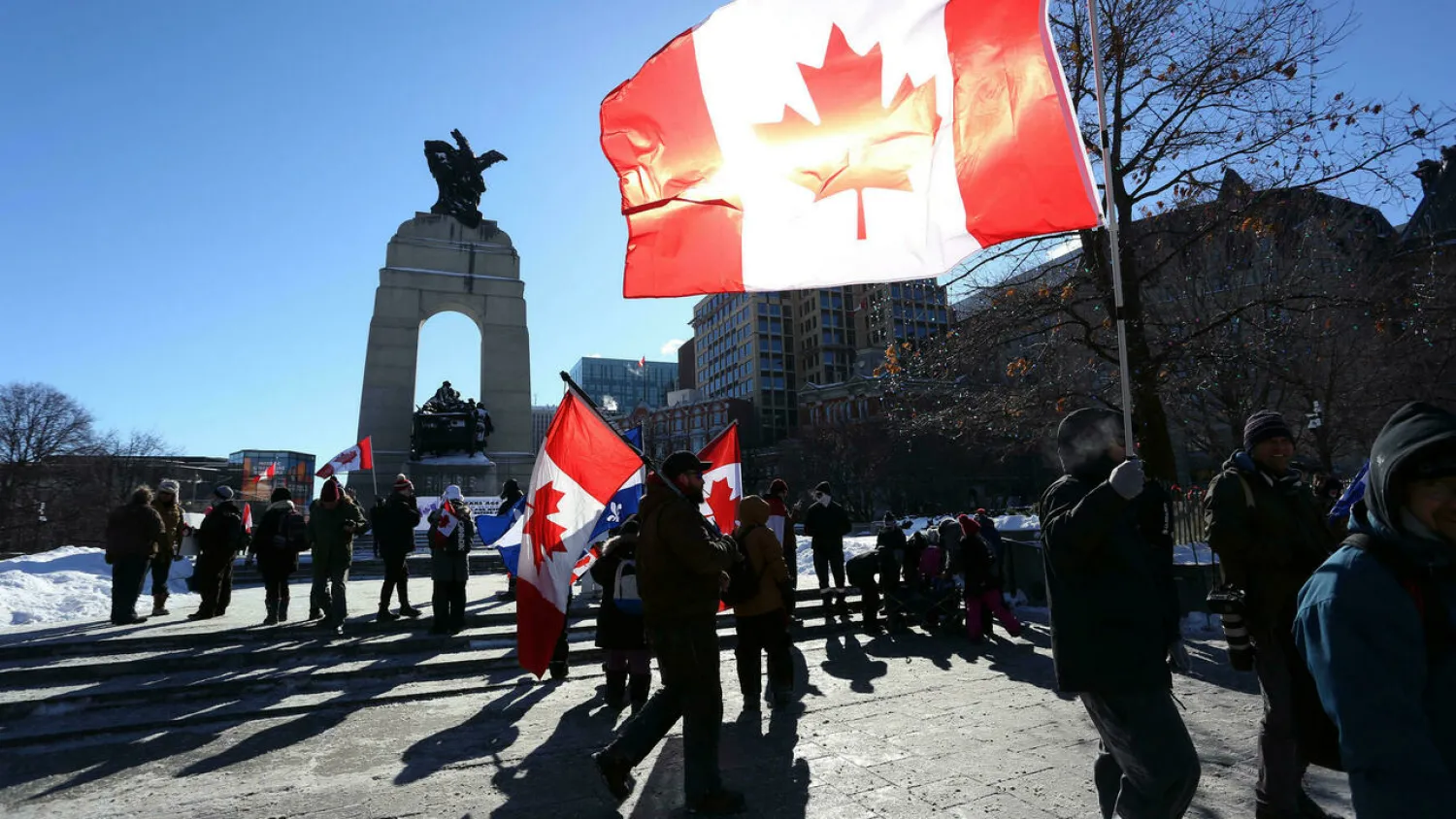
Truckers and supporters opposing Covid-19 vaccine mandates again poured into Ottawa, Canada on February 5, 2022, as the protest entered a second week and spread to other cities Dave Chan AFP
TT

Canada Protests against Covid Measures Gain Steam

Truckers and supporters opposing Covid-19 vaccine mandates again poured into Ottawa, Canada on February 5, 2022, as the protest entered a second week and spread to other cities Dave Chan AFP

More demonstrators poured onto the streets of Ottawa and other Canadian cities on Saturday demanding an end to Covid vaccine mandates, as protests against pandemic restrictions entered their second week.

In the capital, demonstrators huddled around campfires in bone-chilling temperatures and erected portable saunas and bouncy castles for kids outside Parliament, while waving Canadian flags and shouting anti-government slogans.

Their chants of "freedom" were met with cries of "go home" by a smaller group of counter-protestors fed up with the week-long occupation of the capital.

The atmosphere, however, appeared more festive -- with dancing and fireworks -- than a week earlier, when several protesters waved Confederate flags and Nazi symbols and clashed with locals.

The demonstrations, which started out as protests by truckers angry with vaccine requirements when crossing the US-Canadian border, have morphed into broader protests against Covid health restrictions.

Police were out in force and put up barriers to limit vehicle access to the city center, as many thousands of protestors -- including two on horseback -- joined truckers already jamming Ottawa streets.

Similar protests were happening in almost every major Canadian city, including Toronto -- where a man was charged with assault after throwing a smoke bomb into a crowd.

In Winnipeg, a driver was arrested for slamming his SUV into demonstrators. Four people were treated for minor injuries, police said.

And in southern Alberta province, truckers continued to block a major border crossing to the US state of Montana.

- 'Nationwide insurrection' -
At an emergency meeting late Saturday, Ottawa police chief Peter Sloly requested "an additional surge of resources" to bring an end to what police board chair Diane Deans described as a "siege" of the capital.

"This group is a threat to our democracy," Deans said. "What we're seeing is bigger than just a city of Ottawa problem, this is a nationwide insurrection. This is madness."

With public anger rising -- thousands of residents have complained of harassment by protesters, and an online petition demanding action has drawn 40,000 signatures -- Sloly has faced increased pressure to end what he has called an "unlawful" occupation of the city.

Reached for comment by AFP, protest coordinator Jim Torma said the protesters would not back down.

"They're not going to hide us," Torma said. "We're going to be in (politicians') faces as long as it takes" to force an end to public health restrictions aimed at slowing the spread of Covid-19.

Kimberly Ball, who with her husband drove five hours from a small town west of Toronto to join the Ottawa protest, told AFP, "It's about our freedom."

Holding back tears, she said, "A couple of people we know, friends, lost their jobs because of these (vaccine) mandates" and her own parents have disowned her for not getting a jab.

Ball has had Covid and said she questions whether the vaccines are safe and effective.

She is, however, in the minority in Canada, where 90 percent of adults are fully vaccinated.

- A 'fringe minority'? -
The Freedom Convoy started on Canada's Pacific coast in late January and picked up supporters along the long trek to the capital -- as well as millions of dollars in an online fundraiser that GoFundMe cancelled late Friday after receiving reports of "violence and unlawful activity."

The number of protesters in Ottawa had peaked last Saturday at several thousand before dwindling to a few hundred by midweek, officials said.

They received support from tech magnate Elon Musk and former US president Donald Trump, who in a statement Friday called Prime Minister Justin Trudeau a "far left lunatic" for imposing "insane Covid mandates."

Trudeau has said the protesters represent only a "fringe minority," though polls show one-third of Canadians support the call to lift all Covid restrictions.

Vaccine mandates for travelers are set by the federal government, but most other Covid measures are the responsibility of provincial authorities in Canada.

Following a backlash, Quebec last month walked back plans for a health tax on unvaccinated residents, while Saskatchewan this week announced an imminent lifting of all pandemic restrictions, despite pushback from doctors.

"What's necessary is your freedom," Saskatchewan Premier Scott Moe said in a video address. "What's necessary is getting your life back to normal."

Ottawa residents, meanwhile, have had enough of the chaos the protests have brought to their streets and launched a class action seeking almost 10 million Canadian dollars (US$8 million) from organizers.

"The truckers have been terrorizing us for seven, eight days now," university student Saffron Binder told AFP. "The occupation must end."

UN Rights Chief Urges Tennessee Not to Repeat Christa Pike Execution Attempt

A picture taken on December 4, 2007 shows death row inmate Christa Pike entering a Knox County Criminal Court in Knoxville, Tennessee, US., obtained by Reuters on September 30, 2026.
TT

UN Rights Chief Urges Tennessee Not to Repeat Christa Pike Execution Attempt

A picture taken on December 4, 2007 shows death row inmate Christa Pike entering a Knox County Criminal Court in Knoxville, Tennessee, US., obtained by Reuters on September 30, 2026.

UN rights chief Volker Turk on Thursday urged the US state of Tennessee not to make a new attempt to execute Christa Pike after she survived two lethal injection doses.

Convicted murder Pike, 50, was being treated in hospital, her lawyers said, following Tennessee's second failed execution in months.

"The case of Christa Pike lays bare multiple reasons why the death penalty should be abolished," the UN rights office said on X.

"The prolonged suffering -- physical and mental -- arising from multiple failed execution attempts is abhorrent, and cruel. And there are key fair trial questions still unresolved."

On Wednesday, the US Supreme Court cleared the way for Pike to become the first woman to be executed in Tennessee in 200 years -- but the attempt failed.

Turk "calls on the state authorities not to pursue any further attempt to execute Pike", the UN rights office said.

"We are also troubled by the increase in the number of executions in the United States," it added.

"The death penalty has no place in any society."

The failed attempt to execute Pike prompted Tennessee authorities to halt capital punishment for the rest of the year.

Pike was 18 when she and her boyfriend beat and killed Colleen Slemmer, 19, at a job training camp for young people.

The killing gained national attention after Slemmer's body was found with a pentagram, often seen as a satanic symbol, carved in her chest.

Pike's lawyers argued she should be granted clemency due to her young age and mental health issues at the time of the killing.

In the United States, 18 women have been executed since 1976, according to the Death Penalty Information Center.


What Does Activating the 7700, 7600 and 7500 Emergency Codes Mean in Aviation?

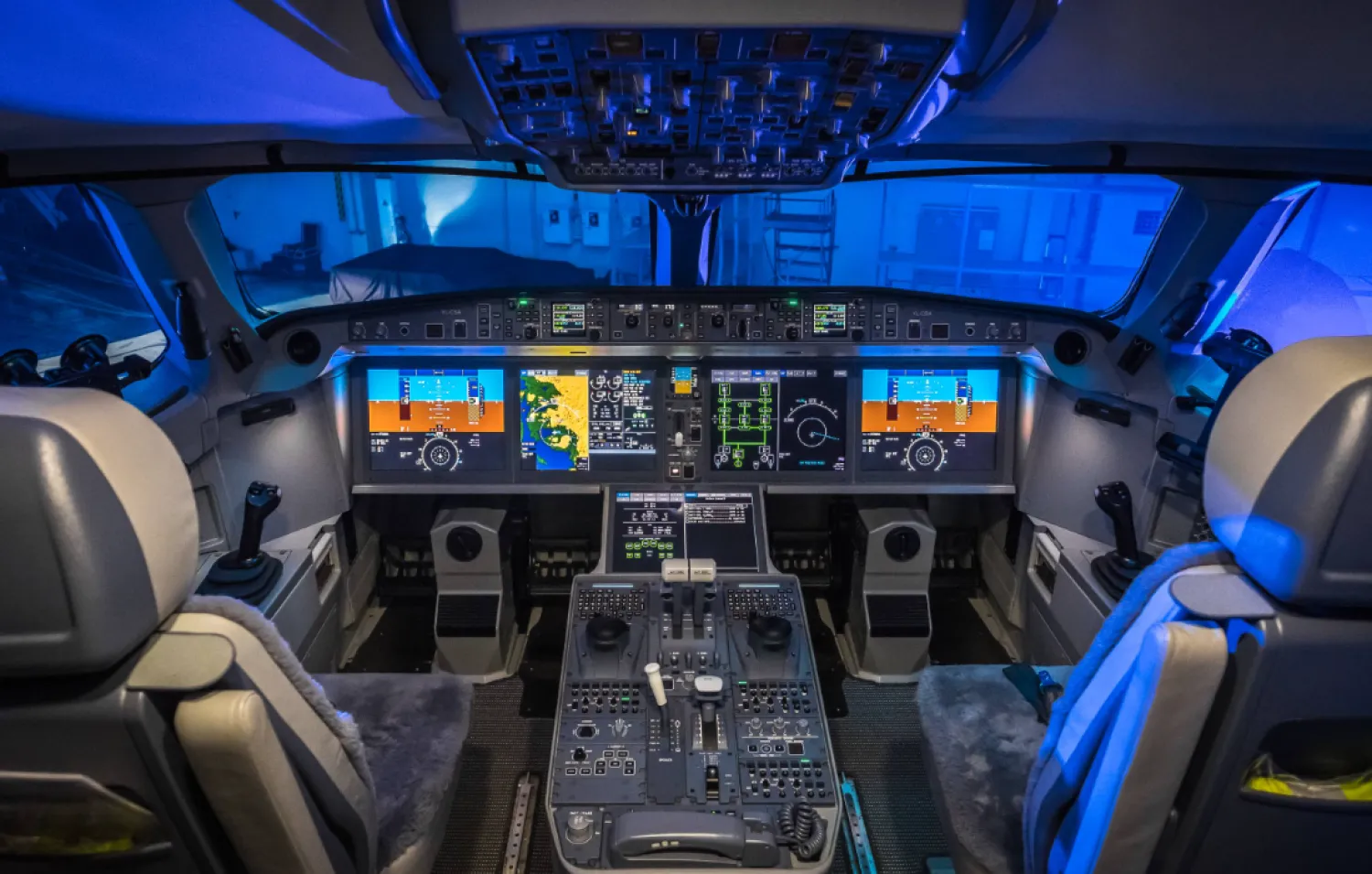
An illustration showing the layout of a modern glass cockpit, with advanced digital displays and the center pedestal located between the captain's and first officer's seats. The transponder used by pilots to enter the three-digit emergency codes 7700, 7600 and 7500 is located in this area. The codes are then displayed on air traffic controllers' radar screens. (Wikipedia)
TT

What Does Activating the 7700, 7600 and 7500 Emergency Codes Mean in Aviation?

An illustration showing the layout of a modern glass cockpit, with advanced digital displays and the center pedestal located between the captain's and first officer's seats. The transponder used by pilots to enter the three-digit emergency codes 7700, 7600 and 7500 is located in this area. The codes are then displayed on air traffic controllers' radar screens. (Wikipedia)

In aviation, flights operate according to carefully defined scenarios, but behind the apparent calm of the cockpit lies a coded digital language capable of changing the situation in the skies within seconds.

The recent incident involving a Flydubai flight, during which the emergency codes 7700 and then 7500 were activated, has again drawn attention to the strict and largely unseen protocols used by air traffic control centers to manage complex emergencies.

Between the emergency signal for a technical failure and the dramatic shift to the code indicating unlawful interference, how do the "shadow soldiers" on the ground manage a crisis involving an aircraft suspended between the sky and the ground until its wheels reach the safety of the runway?

The Silent Code and the Geography of Risk in Air Traffic Control Centers

Air traffic control centers monitor air traffic through continuous radio signals transmitted by the aircraft's transponder. When a cockpit crew faces a serious predicament, words can become a burden, and pressing buttons on the aircraft's equipment becomes the fastest means of signaling for help.

These distress signals appear on ground radar screens as flashing signals with distinctive colors that immediately draw the controller's attention. Internationally, they are known as "squawk codes," as designated by the International Civil Aviation Organization (ICAO).

Code 7700 represents the first technical and operational line of defense. It signals a major general emergency, which may range from critically low fuel or engine failure to serious medical emergencies, requiring an immediate response to secure a landing route.

But the danger takes on a different dimension when the code changes to 7500, the code for unlawful interference and hijacking. This alarming signal tells ground operations that the cockpit may have fallen under the control of an outside party, or that the safety of the aircraft and its passengers is under an imminent threat involving weapons or intimidation.

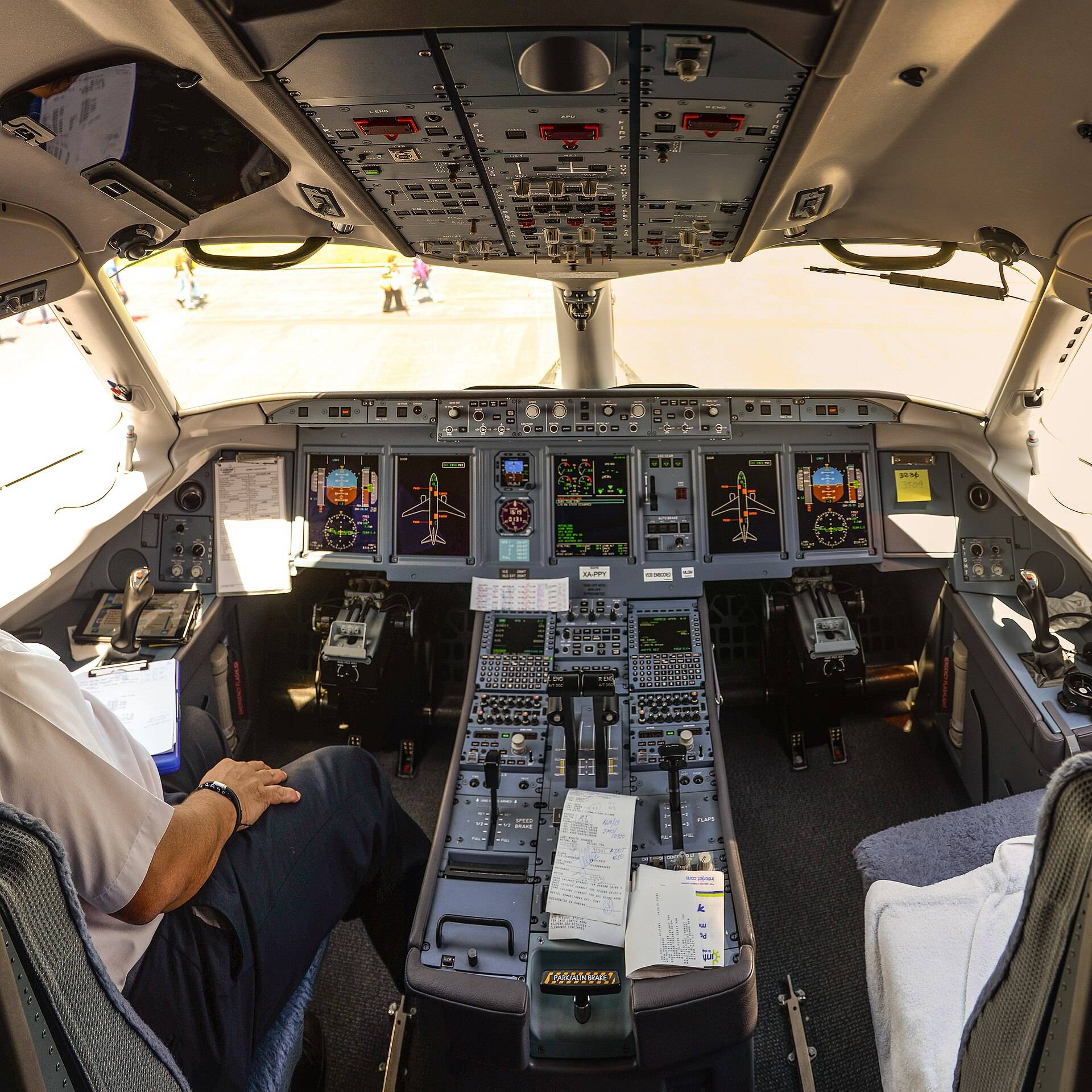
An image showing the layout of aircraft cockpits (Wikipedia)

The Mystery of Radio Silence and Decoding Code 7600

Between these two dangers is the other well-known code, 7600, which is used to indicate a complete failure of the aircraft's radio communications systems.

This code presents a unique challenge. The aircraft becomes "deaf and mute" in the sky, unable to receive instructions from the ground or transmit reports, while remaining visible on radar screens. Air traffic control handles code 7600 based on a clear assumption: controllers assume the pilot will follow the original flight plan precisely and begin clearing the airspace ahead of the aircraft based on its expected route.

The greatest danger lies in the overlap between these codes. Code 7600 may result from an innocent electrical failure, but in other scenarios it could be a deliberate maneuver by hijackers who have disconnected communications equipment to isolate the aircraft. This puts air traffic control centers on maximum alert as they work to resolve the ambiguity and determine that it has not developed into a 7500 situation.

Airspace Surgery and Securing Clear Routes

Once air traffic controllers detect the technical emergency code 7700, they begin what amounts to precise surgery in the surrounding airspace. Controllers immediately stop managing normal commercial traffic flow and focus their full attention on securing a route for the aircraft in distress.

All nearby aircraft receive decisive instructions to change altitude and move away from the affected aircraft's flight path, leaving the surrounding airspace completely clear and protected against any potential collision.

Ground authorities give the aircraft in distress absolute priority over all other flights and completely exempt it from the standard speeds and altitudes normally used in air navigation. Within minutes, control towers coordinate with ground authorities at the destination airport, positioning firefighting and rescue vehicles along the runway in preparation for a landing that may require urgent mechanical intervention.

Concealment Protocol and Management of Security Intervention

The situation inside operations centers changes completely if the alert becomes the hijacking code 7500. At that point, the crisis ceases to be a general aviation event and becomes a national security matter subject to the sovereign laws of the countries involved.

Strict international instructions require air traffic controllers to follow a protocol of radio silence and concealment. They are completely prohibited from using language over open radio frequencies that could indicate a hijacking or the presence of a security threat, in order to avoid provoking the perpetrators inside the cabin if they are listening to air traffic communications.

In such circumstances, the controller resorts to routine, coded messages, asking the pilot to reconfirm the aircraft's squawk code as a verification measure. If the pilot re-enters or confirms code 7500, or is unable to respond while the signal continues, the highest-level security plans are activated, and responsibility for managing the crisis immediately shifts from civilian authorities to air defense and armed forces leadership.

The Military Response and the Possibility of Extreme Measures

Fighter jets are deployed under what is known as an immediate scramble as soon as the 7500 security code is confirmed, to intercept and surround the civilian aircraft in the air.

Military pilots maintain carefully calculated safety distances that allow them to observe the cockpit visually, assess the situation inside, and verify the identity of those flying the aircraft amid the imposed radio silence or a communications failure indicated by code 7600.

This military escort is an extremely sensitive precautionary and sovereign measure intended to prevent the aircraft from approaching vital facilities or densely populated major cities.

Countries also take into account extreme scenarios. When conclusive evidence indicates that an aircraft has been turned into a flying bomb directed at destroying a strategic facility, a military shoot-down remains a last and painful option available to senior leaders to protect national security.

The Isolated Parking Area and the Transfer of Authority on the Ground

An aircraft facing a security threat indicated by code 7500 does not take the usual routes toward the airport's main gates. Instead, air traffic control directs it through completely isolated routes toward a remote area within the airport known as the isolated parking area.

This area is located at the far edges of the airfield, away from passenger terminals, critical infrastructure, and major fuel storage facilities, in order to minimize losses in the event of an explosion or act of sabotage.

Once the aircraft's wheels touch down on this isolated section of the airfield and it comes to a complete stop, the legal and operational authority of air traffic controllers ends.

The control tower closes its operational file, and law enforcement forces, counterterrorism units, and security negotiation teams take over on the ground. They begin dealing directly with the hijackers under tactical plans designed to save lives and take control of the cabin.

The Sequence of Codes: Between the Reality of the Threat and Human Error

The sequence and overlap of emergency codes during a single flight raises a state of heightened alert and deep analysis among aviation experts and investigators.

Under aviation conventions, this sequence has two possible explanations. The first points to a genuine escalation of the incident, in which the situation begins with a mechanical or technical failure indicated by code 7700 or a communications failure indicated by code 7600. A party then exploits the resulting chaos or sudden descent to seize control of the cockpit, forcing the crew to escalate the alert to code 7500.

The second explanation involves a technical human error under extreme pressure. Because the numbers on the control panel are close to one another, a pilot under intense fear and nervous stress could enter the hijacking code instead of the general emergency or communications failure code.

Despite the possibility of error, air traffic control protocols and aviation authorities worldwide require the sequence to be treated as a genuine security threat, and the military and security alert is not lifted until the aircraft has landed, been fully searched, and the safety of its passengers and crew has been confirmed.


A Russian Drone Hits a Kyiv School as Moscow Presses Its Aerial Campaign against Ukraine

A police bomb squad member works at a site of a damaged school hit by a Russian jet-drone strike, amid Russia's attack on Ukraine, in Kyiv, Ukraine October 1, 2026. REUTERS/Gleb Garanich
TT

A Russian Drone Hits a Kyiv School as Moscow Presses Its Aerial Campaign against Ukraine

A police bomb squad member works at a site of a damaged school hit by a Russian jet-drone strike, amid Russia's attack on Ukraine, in Kyiv, Ukraine October 1, 2026. REUTERS/Gleb Garanich

A Russian drone struck a school in Kyiv on Thursday, city officials said, as the Ukrainian capital endured another night and day of relentless aerial attacks.

Children and staff at the school were in shelters when the drone hit, Kyiv Mayor Vitalii Klitschko said, although the drone's warhead didn’t explode. There was no immediate report of casualties. The building’s brick frontage showed a large hole and black burn mark alongside smashed windows.

Kyiv has in recent weeks lived through repeated air raid alerts, punctuated by loud bangs and palls of black smoke as drones and missiles hit, making it feel like a city under siege. The Russian onslaught aims to terrorize civilians, officials and analysts say, and break their will to resist 4 ½ years after Moscow’s full-scale invasion.

The strain is showing among Kyiv residents. Maryna Lystopad, 35, said her hair has started falling out due to the strain of escalating attacks and never knowing where a drone or missile will hit.

"It’s really horrible. I can’t take it anymore. I think, I think that soon we’re all going to leave. I’m really not doing well,” she told The Associated Press.

“I’m constantly anxious. I can’t relax,” she said. “I keep thinking that if something happens, if something hits, one of my relatives could be killed.”

She recently had to go to another part of the city, she said, and was “genuinely stressed the whole way there.”

“I kept checking, like, whether anything was flying in, where it was going, where am I supposed to go? Where am I supposed to run?”

Russia's missiles and drones are stretching Ukraine's air defenses The war on the ground hasn’t seen major shifts since last year, but Ukraine is struggling to fend off Russia’s intensified aerial attacks on cities that include speedy ballistic missiles and high-flying jet-powered drones.

In response, Ukraine has fired its long-range drones at manufacturing plants deep inside Russia and has targeted Russia’s drone launch sites. Ukrainian President Volodymyr Zelenskyy said Thursday that Kyiv’s forces struck a site in Russia’s southwestern Oryol region that is used to store and launch attack drones.

To turn the tide, Ukraine needs US-made Patriot missiles that can effectively defend against ballistic missiles, but they are in short supply since the Iran war began. A plan to produce them inside Ukraine could take years to bear fruit.

Kyiv is currently racing to produce new interceptors that can bring down fast-moving jet-propelled drones as the swift cycle of military innovation during the war continues.

Ukraine also wants tougher sanctions imposed on Russia to prevent it from getting key high-tech components for its arsenal.

Moscow, meanwhile, is pressing its advantage before Ukraine comes up with an answer to the latest challenges.

Russia steps up its campaign against Ukraine's power grid Ukrainian officials didn’t report any energy infrastructure being hit Thursday, a day after what officials said was the biggest Russian attack on the power grid since last spring.

The Institute for the Study of War, a Washington-based think tank, said Wednesday's barrage marked “the beginning of Russia’s strike campaign aimed at degrading Ukraine’s energy security ahead of winter ... and forcing Ukraine to capitulate.”

Russia is expected to step up attacks on the electricity supply as the weather gets colder. It was 19 degrees Celsius (66 F) in Kyiv on Thursday, and mild temperatures were set to continue.

In a surprise development, Russia used a new jet-powered drone for the first time Wednesday, fitting it with a warhead designed to sever high-voltage pylons, said Serhii Beskrestnov, an adviser to Ukraine’s president on defense technology.
