


Lebanon Approves $18 Million to Hold May Election

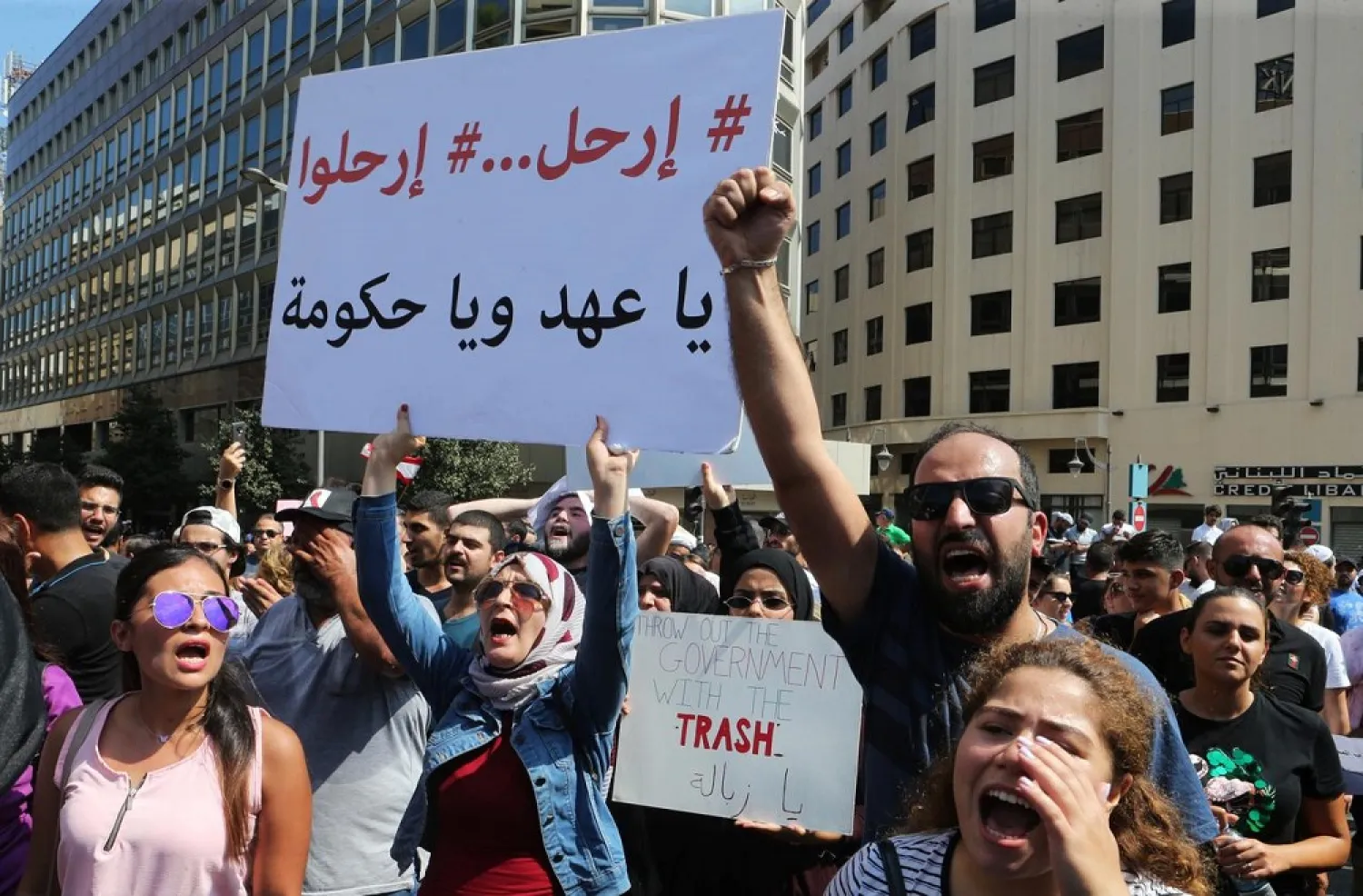
Demonstrators chant slogans and carry banners during a protest against corruption and deteriorating economic conditions, in front of the government palace in Beirut, Lebanon September 29, 2019. Picture taken September 29, 2019. The banner reads: "Government and ruling class, leave". (Reuters)
TT

Lebanon Approves $18 Million to Hold May Election

Demonstrators chant slogans and carry banners during a protest against corruption and deteriorating economic conditions, in front of the government palace in Beirut, Lebanon September 29, 2019. Picture taken September 29, 2019. The banner reads: "Government and ruling class, leave". (Reuters)

Lebanon's government on Tuesday approved the allocation of 360 billion Lebanese pounds ($18 million) to hold a parliamentary election, Telecoms Minister Johnny Corm told Reuters following a cabinet meeting.

Lebanon went into financial meltdown in 2019 and some officials had raised concerns over elections potentially being postponed over financial constraints.

Speaking after the cabinet session, acting Information Minister Abbas Halabi quoted Prime Minister Najib Mikati as saying the last vote in 2018 had cost the state $54 million, but only a much smaller amount was available now.

The United Nations and Western governments have repeatedly urged Lebanese leaders to hold elections on time and allocate the appropriate funding, amid fears that powerful political parties could seek to use the financial crisis as a pretext to postpone the vote.

The May 15 election would be the first for the 128-member legislature since mass protests in October 2019 against political elites widely seen as responsible for decades of corruption and mismanagement.

The United Nations special coordinator for Lebanon, Joanna Wronecka, had earlier on Tuesday "stressed the importance of holding the elections on time," a UN statement said.

"I hope that the Council of Ministers will approve the electoral budget...so that preparations can proceed swiftly and no shadow of uncertainty hangs over the election," Wronecka said, according to the statement.



Israel Condemns Soldier’s Desecration of Crucifix in South Lebanon

Mohammed Ameen walks on the rubble of a building destroyed in a previous Israeli airstrike during a ceasefire between Hezbollah and Israel in the Hosh neighborhood of Tyre, southern Lebanon, on Sunday, April 19, 2026. (AP)
TT

Israel Condemns Soldier’s Desecration of Crucifix in South Lebanon

Mohammed Ameen walks on the rubble of a building destroyed in a previous Israeli airstrike during a ceasefire between Hezbollah and Israel in the Hosh neighborhood of Tyre, southern Lebanon, on Sunday, April 19, 2026. (AP)

Israel's foreign minister and military on Monday condemned the desecration of a crucifix smashed by an Israeli soldier in a southern Lebanese village home to Christians.

A photo that emerged online over the weekend shows a soldier taking the blunt side of an axe to a fallen sculpture of Jesus on the cross. It was posted by Younis Tirawi, who describes himself as a Palestinian reporter and has also posted images of Israeli soldiers' apparent misconduct in Gaza.

Reuters verified the location of the ‌image as Debel, ‌one of the few villages in southern ‌Lebanon ⁠where residents remained through ⁠an Israeli military campaign against the Iranian-backed Hezbollah that began on March 2 after the group fired rockets at Israel in support of Iran.

The cross was part of a small shrine in the garden of a family living on the edge of the village, said Fadi Falfel, a priest in Debel.

"One ⁠of the Israeli soldiers broke the cross ‌and did this horrible thing, this ‌desecration of our holy symbols," he said.

Foreign Minister Gideon Saar said ‌the soldier's actions were disgraceful and shameful. "We apologize for this ‌incident and to every Christian whose feelings were hurt," Saar said on X.

The Israeli military said the incident was being investigated.

"The army views the incident with great severity and emphasizes that the ‌soldier's conduct is wholly inconsistent with the values expected of its troops," the military said. "The army ⁠is working ⁠to assist the community in restoring the statue to its place."

Debel is one of dozens of villages in south Lebanon now under Israeli occupation. Israel and Lebanon on Thursday agreed to a US-brokered ceasefire intended to halt fighting between Israel and Hezbollah.

"We have every kind of crisis," Falfel said.

"We thought the ceasefire would bring us some relief but we’re still surrounded, unable to travel to and from the town. There are some houses on the edge of town that we’re barred from accessing."

Israeli military officials say they are working with aid agencies to meet the humanitarian needs of Debel and other villages.


Israel Army Warns Lebanese Against Returning to South

 Displaced people cross a destroyed bridge as they return to their villages, following a ceasefire between Hezbollah and Israel, in Tayr Felsay village, southern Lebanon, Sunday, April 19, 2026. (AP)
Displaced people cross a destroyed bridge as they return to their villages, following a ceasefire between Hezbollah and Israel, in Tayr Felsay village, southern Lebanon, Sunday, April 19, 2026. (AP)
TT

Israel Army Warns Lebanese Against Returning to South

 Displaced people cross a destroyed bridge as they return to their villages, following a ceasefire between Hezbollah and Israel, in Tayr Felsay village, southern Lebanon, Sunday, April 19, 2026. (AP)
Displaced people cross a destroyed bridge as they return to their villages, following a ceasefire between Hezbollah and Israel, in Tayr Felsay village, southern Lebanon, Sunday, April 19, 2026. (AP)

Israel's military on Monday warned Lebanese civilians against returning to dozens of villages in southern Lebanon, claiming Hezbollah's activities in the area were violating a ceasefire agreement struck last week.

Thousands of displaced residents have begun making their way back to parts of southern Lebanon since the truce between Israel and Lebanon took effect on Friday.

Since the ceasefire began, Lebanon's armed forces have reopened a key road linking the southern city of Nabatiyeh with the Khardali area after it was closed due to Israeli strikes.

They have also partially restored access to the Burj Rahal-Tyre bridge.

But the Israeli military on Monday urged civilians to avoid returning to numerous villages in the south.

"Hezbollah has continued its terrorist activity during the ceasefire in violation of the agreement; accordingly, the army remains deployed in the defensive area," the military's Arabic-language spokesman Colonel Avichay Adraee said on X.

"For your safety and the safety of your families, and until further notice, we urge you not to move south of the Forward Defense Line," he said, referring to a boundary marking an area occupied by Israeli troops.

On Saturday, senior Hezbollah official Mahmud Qamati also warned residents against returning.

"Israeli treachery is expected at any time, and this is a temporary truce," he said.

"Take a breath, relax a little, but do not abandon the places you have taken refuge in until we are completely reassured about your return" to your homes, he said.

Israel's Defense Minister Israel Katz said Sunday that the military had been ordered to use "full force" against any threats in Lebanon even during the ceasefire.

He also vowed to level homes allegedly used by Hezbollah, with Lebanese state media reporting that demolitions were underway.

The military published a map showing its "forward defense line" and an area stretching the length of the Israel-Lebanon border where it said its forces were operating to dismantle Hezbollah infrastructure and "prevent direct threats to communities in northern Israel".


EU Hosts Palestinian Leader in Conference About Security and Peace in Gaza and the West Bank

(L-R) High Representative of the European Union for Foreign Affairs and Security Policy Kaja Kallas, Palestinian Prime Minister Mohamed Mustafa, and Norwegian Foreign Minister Espen Barth Eide during the Global Alliance for the Implementation of the Two-State Solution 9th meeting in Brussels, Belgium, 20 April 2026. (EPA)
TT

EU Hosts Palestinian Leader in Conference About Security and Peace in Gaza and the West Bank

(L-R) High Representative of the European Union for Foreign Affairs and Security Policy Kaja Kallas, Palestinian Prime Minister Mohamed Mustafa, and Norwegian Foreign Minister Espen Barth Eide during the Global Alliance for the Implementation of the Two-State Solution 9th meeting in Brussels, Belgium, 20 April 2026. (EPA)

More than 60 nations are sending representatives to Brussels to discuss with Palestinian Prime Minister Mohamed Mustafa stability, security and long-term peace in Israel, the West Bank and Gaza, as global attention largely remains focused in the Middle East on the ongoing crises in Iran and Lebanon.

Ongoing attacks in the West Bank and continued devastation in Gaza dims the prospect for a two-state solution, said Belgian Foreign Minister Maxime Prévot ahead of the meeting Monday. He is co-hosting the meeting with the EU’s top diplomat, Kaja Kallas.

“We observe without naivety that the two-state solution is being made more difficult by the day," Prévot said. “But Belgium and many European and Arab partners continue to believe that this remains the only realistic path to a lasting peace, for Israelis, for Palestinians and for the stability of the entire region.”

The 27-nation European Union is the largest single donor to the Palestinian Authority, with its 90-year-old president Mahmoud Abbas ruling from Ramallah for two decades. And while the EU has avoided directly joining the Board of Peace created by United States President Donald Trump, preferring the multilateralism of the United Nations and global legal norms, the bloc is eager to not be sidelined in diplomacy in a volatile region just across the Mediterranean.

Outrage in Europe over the humanitarian catastrophe in Gaza drove many EU leaders to condemn Israel’s war conduct and to pressure Prime Minister Benjamin Netanyahu’s government.

With the recent ouster of long-serving Hungarian Prime Minister Viktor Orbán, a close ally of Netanyahu, there might now be enough political support within the bloc for stronger actions like targeted sanctions on Israeli settlers or even the suspension of some ties to Israel.

Palestinians in the West Bank say that Israel has used the cover of the Iran war to tighten its grip over the territory, as settler attacks surge and the military imposes additional wartime restrictions on movement, citing security.

Gaza requires “one state, one government, one law and one goal,” Mustafa said on Monday in Brussels.

“Our common objective of achieving one security structure under the legitimate authority should guide the effective coordination between the International Stabilization Force, the Palestinian Authority, security institutions and other international actors. Security must not be fragmented," he said.

He also called for “the gradual and responsible collection of arms from all armed groups and also the full Israeli withdrawal from Gaza.”