NATO: Russia Misleads World on Troop Movements near Ukraine

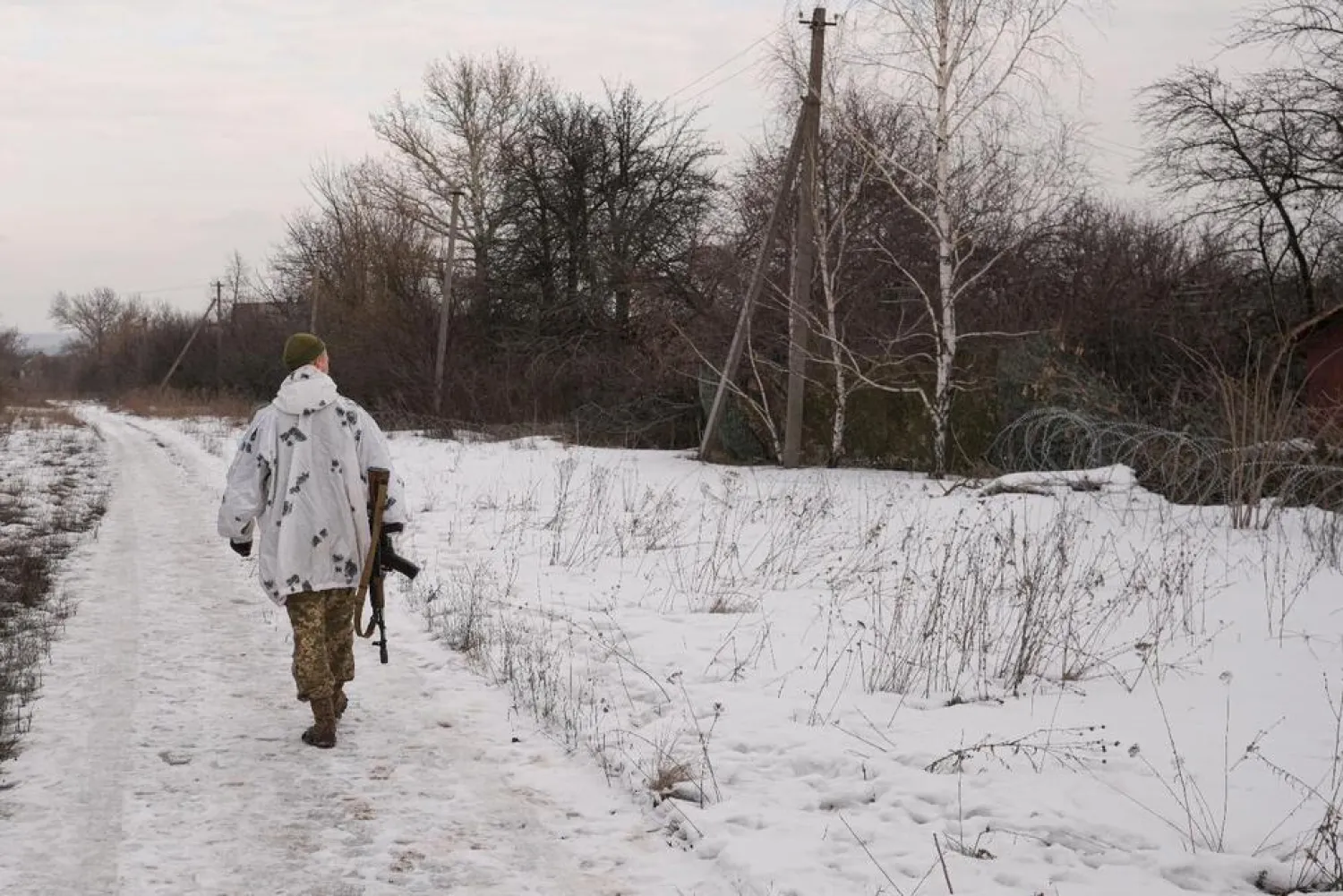
A Ukrainian serviceman walks to a frontline position outside Popasna, the Luhansk region, in eastern Ukraine, Wednesday, Feb. 16, 2022. (AP Photo/Vadim Ghirda) THE ASSOCIATED PRESS
TT

NATO: Russia Misleads World on Troop Movements near Ukraine

A Ukrainian serviceman walks to a frontline position outside Popasna, the Luhansk region, in eastern Ukraine, Wednesday, Feb. 16, 2022. (AP Photo/Vadim Ghirda) THE ASSOCIATED PRESS

NATO allies accused Russia of misleading the world and disseminating “disinformation” by saying it was returning some troops to bases, charging that Moscow has instead added as many as 7,000 more troops near its tense border with Ukraine.

With Western fears high that Russia is planning to invade, tensions also spiked Thursday along the line that separates Ukrainian forces from Russia-backed separatists in the country's east, with the parties accusing each other of intensive shelling.

After a handful of positive signals from Russia that lowered the temperature in the crisis earlier in the week, the pendulum appeared to be swinging in the opposite direction again. With an estimated 150,000-plus troops massed near Ukraine, the Kremlin offered to keep pursuing diplomatic solutions — an overture the NATO chief welcomed, even as he and others warned that the US-led alliance has still seen no sign of the military withdrawal that Moscow announced.

“We have seen the opposite of some of the statements. We have seen an increase of troops over the last 48 hours, up to 7,000," said British Defense Secretary Ben Wallace ahead of a meeting Thursday of the western alliance in Brussels.

That squared with what a US administration official said a day earlier.

British Armed Forces Minister James Heappey even called Russia’s claim to be withdrawing troops “disinformation.”

While the West warned the threat of invasion remains high, no attack materialized Wednesday, as some had feared.

Moscow said several times this week that some forces are pulling back to their bases, but it gave virtually no details that would allow for an independent assessment of the scope and direction of the troop movement, and Western leaders quickly cast doubt on those statements. On Thursday, NATO allies knocked down the Russian assertions again — and warned that they are ready to counter any aggression.

“The consequences of this mass buildup – nearly 60% of Russia’s land combat forces on the border of a sovereign nation – will get you the opposite effect,” Wallace said.
“We are deadly serious,” he added, “and we’re going to face the threat that is currently being posed.”

Already the alliance has moved troops and military equipment into Eastern Europe — in a display of resolve of meant to deter any Russian aggression and underline its intent to defend NATO’s eastern members, in the unlikely event that they too become a target, according to The Associated Press.

The US has started to deploy 5,000 troops to Poland and Romania. A further 8,500 more are on standby. Britain is sending hundreds of soldiers to Poland, offering more warships and planes, and doubling the number of personnel in Estonia. Germany, the Netherlands and Norway are sending additional troops to Lithuania. Denmark and Spain are providing jets for air policing in the Baltic Sea region.

While Ukraine braces for a potential invasion, tensions soared in the conflict in the country’s east where Russian-backed separatists have been fighting Ukrainian troops since 2014.

Separatist authorities in the Luhansk region reported an increase in Ukrainian shelling along the tense line of contact, describing it as a “large-scale provocation.”

Separatist official Rodion Miroshnik said that rebel forces returned fire.

Ukraine disputed the claim, saying that separatists had shelled its forces, but they didn’t fire back. The Ukrainian military command charged that shells hit a kindergarten building in Stanytsia Luhanska, wounding two civilians, and cut power supply to half of the town.

An observer mission of the Organization for Security and Cooperation in Europe is expected to offer its assessment of the situation later Thursday.

Many in the West are concerned that a flare-up in the east could be used by Russia as a pretext for rolling across the border — though there was no sign yet that the latest fighting was larger than what typically happens. Russia, in turn, aired worries that hawkish forces in Ukraine, encouraged by the West, could launch an attack to reclaim control of the rebel areas — plans Ukrainian authorities deny.

A 2015 deal brokered by France and Germany helped end the worst of the fighting in eastern Ukraine, but regular skirmishes have continued and a political settlement has stalled.
The UN Security Council is scheduled to hold its annual meeting on the agreement on Thursday.

Russia denies it is plotting an invasion but says it's free to deploy troops wherever it deems necessary to counter threats from NATO. It wants the West to keep Ukraine and other former Soviet nations out of NATO, halt weapons deployments near Russian borders and roll back forces from Eastern Europe, the demands the allis have flatly rejected.

There have been some suggestions Ukraine could decide to abandon its hope of joining NATO — something written into its constitution — as a way out of the crisis. It's not clear how or if it would do that.
Ukrainian President Volodymyr Zelenskyy noted Thursday that some NATO members don't want the country to join.

“Not all members of the alliance want Ukraine in NATO,” he said without naming specific countries. “It's not the Ukrainian people's choice when we will be there, because it doesn't only depend on us — 30 countries must reach consensus on that decision.”

While the US and its allies have roundly rejected Moscow's demands to bar membership to Ukraine, they offered to engage in talks with Russia on limits on missile deployments in Europe, restrictions on military drills and other confidence-building measures.

Russian President Vladimir Putin charged that Moscow had offered to discuss those issues years ago, but the West only agreed to talk about them now. He said that Russia was ready to talk about them now, but only in conjunction with its main security demands.

Russia's Foreign Minister Sergey Lavrov said that Moscow was sending its formal reply on those issues to the US and NATO later Thursday and will make it public.

Even as Russia seemed to try to ease tensions this week, the Western allies maintained that the threat of an attack remained high.

Maxar Technologies, a commercial satellite imagery company that has been monitoring the Russian buildup, reported continued heightened military activity near Ukraine, including a new pontoon bridge and a new field hospital in Belarus. It also said that some forces had left an airfield in the country, a Russian ally, but it was unclear where they went.

A senior US administration official said some forces arrived only recently and that there had been a marked increase in false claims by Russians that the Kremlin might use as pretext for an invasion. The official said those claims included reports of unmarked graves of civilians allegedly killed by Ukrainian forces, assertions that the US and Ukraine are developing biological or chemical weapons, and claims that the West is funneling in guerrillas to kill Ukrainians.

The official was not authorized to speak publicly about sensitive operations and spoke to The Associated Press on condition of anonymity. The official did not provide underlying evidence for the assertions.

The rebels in eastern Ukraine have made such claims for weeks, and they were featured in some Russian media reports.

US Secretary of State Antony Blinken told ABC News that Russian President Vladimir Putin "can pull the trigger. He can pull it today. He can pull it tomorrow. He can pull it next week. The forces are there if he wants to renew aggression against Ukraine.”


Le Pen Says France Will No Longer Aid Ukraine ‘Financially’ if Elected

Marine Le Pen (C), the far-right National Rally (RN) party's candidate for the 2027 French presidential election, visits the "Made in France" fair at the Porte de Versailles exhibition center in Paris, France, 13 November 2026. (EPA)
TT

Le Pen Says France Will No Longer Aid Ukraine ‘Financially’ if Elected

Marine Le Pen (C), the far-right National Rally (RN) party's candidate for the 2027 French presidential election, visits the "Made in France" fair at the Porte de Versailles exhibition center in Paris, France, 13 November 2026. (EPA)

Marine Le Pen on Monday said that France would provide no further financial aid to Ukraine if she is elected president next year, after a meeting with Kyiv's ambassador in Paris.

"The state of France's public finances would no longer allow the country to provide financial assistance to Ukraine in the coming months," Le Pen said in a statement, while insisting France would honor existing commitments, including toward a 90-billion-euro ($100-billion) European Union loan.

Le Pen is currently ahead in polls in the race to succeed President Emmanuel Macron next year, as the war sparked by Russia's 2022 full-scale invasion of Ukraine grinds towards its fifth anniversary.

She has faced criticism over past links to Russia, which included a 2017 meeting in the Kremlin with President Vladimir Putin and her party taking a loan from a Russian bank that it paid off in full in 2023.

But she has opposed the invasion and, at her talks in Paris with Ukrainian ambassador Vadym Omelchenko, Le Pen made clear her "unwavering support for Ukraine since the beginning of the conflict".

The statement said the talks -- the first such between Le Pen and the Ukrainian ambassador -- were "cordial".

While financial aid would be cut, Le Pen told the ambassador that "France would continue to support Ukraine through donations of equipment, humanitarian aid and much more active diplomacy".

The statement said there was a "frank discussion" on the future of the conflict, with Le Pen stressing that "the pursuit of peace -- though a difficult goal to achieve -- must remain a priority for all".

She also asked the ambassador to tell President Volodymyr Zelensky she is ready to meet in "either Paris or Brussels". However, there was no mention of the candidate making the journey to Kyiv after Zelensky invited her to visit the Ukrainian capital.

Le Pen's opponents have expressed alarm that by emphasizing the importance of ending the war swiftly, she could force Ukraine to capitulate on unfavorable terms.

"If Russia imposes its will on a European nation through brutality, all of Europe is weakened," Macron wrote on Facebook at the weekend.

Taking aim at Le Pen, he said: "Let us be clear: those who seek to limit the resources available to Ukraine are, in effect, pushing for an unjust peace -- one that would leave Ukraine permanently vulnerable, and, by extension, leave Europe vulnerable as well."


Trump Says He Might Meet with North Korea’s Kim Jong Un in China

US President Donald Trump and North Korean leader Kim Jong Un shake hands before their one-on-one chat during the second US-North Korea summit at the Metropole Hotel in Hanoi, Vietnam February 27, 2019. (Reuters)
TT

Trump Says He Might Meet with North Korea’s Kim Jong Un in China

US President Donald Trump and North Korean leader Kim Jong Un shake hands before their one-on-one chat during the second US-North Korea summit at the Metropole Hotel in Hanoi, Vietnam February 27, 2019. (Reuters)

US President Donald Trump said on Monday he might meet with North Korean leader Kim Jong Un in China this week, an announcement that could dramatically reshape his upcoming trip through East Asia if it occurs.

The president, who met the North Korean leader several times during his 2017-2021 term, including once in the Korean Demilitarized Zone, has previously expressed ‌interest in ‌another meeting during his current term. Senior ‌US ⁠officials, however, have previously ⁠said he has no immediate plans to do so.

Moreover, Trump has repeatedly previewed meetings with Kim that never took place, including during a trip to Asia last year. North Korea, whose mission to the United Nations did not immediately respond to a ⁠request for comment, has publicly indicated it ‌has no intention of ‌meeting with the US president at this time.

Trump told reporters ‌while departing the White House en route to ‌the Philippines and China that any meeting would occur in China, and that the North Korean leader's presence was ultimately up to Chinese President Xi Jinping.

"(Xi) was here a ‌month ago, and we're also going to meet with (Russian) President Putin, and we ⁠may ⁠meet with Kim Jong Un also," Trump said.

"So that'll be good. We have a chance to accomplish a lot."

Trump has indicated he will meet with Putin and Xi during his trip, but US officials and analysts have played down the possibility of a meaningful agreement emerging from any trilateral sit-down.

Among the possible topics of conversation, Trump and others have said, are Russia's invasion of Ukraine, counterproliferation and the war in Iran.


Third US Aircraft Carrier Arrives in Middle East

This US Navy handout photograph released by US Naval Forces Central Command on November 4, 2026, shows the Nimitz-class aircraft carrier USS Theodore Roosevelt (CVN 71) sails alongside Royal Australian Navy Supply-class replenishment oiler HMAS Stalwart (A304). (AFP / NAVCENT Public Affairs / US Navy)
TT

Third US Aircraft Carrier Arrives in Middle East

This US Navy handout photograph released by US Naval Forces Central Command on November 4, 2026, shows the Nimitz-class aircraft carrier USS Theodore Roosevelt (CVN 71) sails alongside Royal Australian Navy Supply-class replenishment oiler HMAS Stalwart (A304). (AFP / NAVCENT Public Affairs / US Navy)

The USS Theodore Roosevelt aircraft carrier arrived in the Middle East on Sunday, media reports said, bringing the number of American carrier strike groups in the region to three.

The deployment, which was reported by the National News and Axios journalist Barak Ravid, comes as fighting reignites in the region, with Iran claiming a drone attack on Bahrain on Sunday, ending a lull in strikes in the war.

Iran also fired drones at Bahrain on Friday -- the first strikes since September against countries in the energy-rich Gulf, which has been targeted several times in the conflict that erupted in February.

US President Donald Trump plans to discuss the war at a trilateral meeting with his Chinese and Russian counterparts Xi Jinping and Vladimir Putin this week, an official said Friday.

Months of diplomacy have failed to resolve the war, which began with US-Israeli strikes that killed Iran's supreme leader Ali Khamenei.