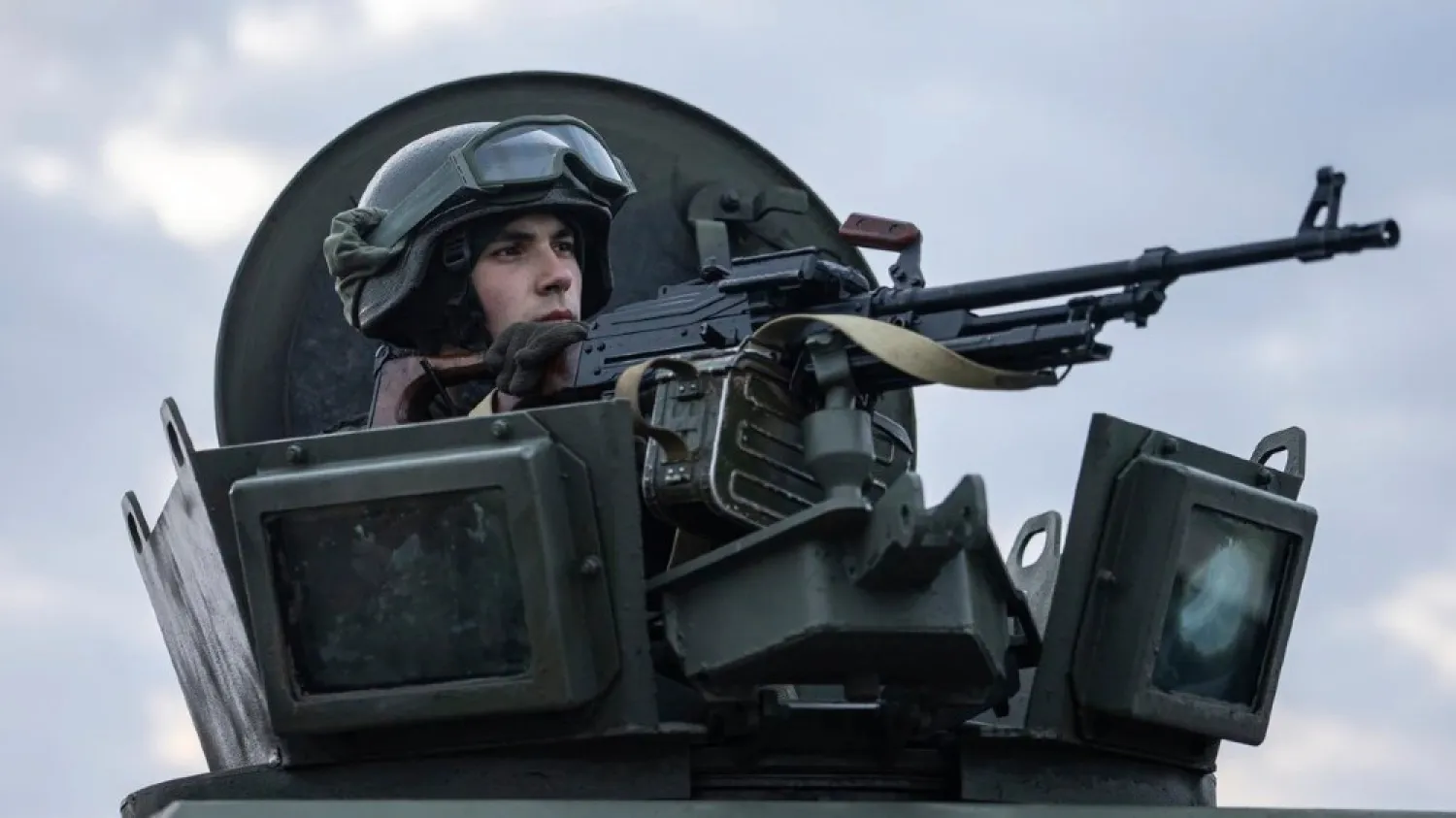
Allies Watch for Kremlin Attempt to Justify Ukraine Invasion

A Ukrainian National guard soldier guards a mobile checkpoint together with the Ukrainian Security Service agents and police officers during a joint operation, in Kharkiv, Ukraine, Thursday, Feb. 17, 2022. (AP Photo/Evgeniy Maloletka)
TT

Allies Watch for Kremlin Attempt to Justify Ukraine Invasion

A Ukrainian National guard soldier guards a mobile checkpoint together with the Ukrainian Security Service agents and police officers during a joint operation, in Kharkiv, Ukraine, Thursday, Feb. 17, 2022. (AP Photo/Evgeniy Maloletka)

The US issued some of its starkest, most detailed warnings yet about how a Russian invasion of Ukraine might unfold, and its Western allies went on high alert for any attempts by the Kremlin to create a false pretext for a new war in Europe.

US President Joe Biden sounded unusually dire Thursday, as he warned that Washington saw no signs of a promised Russian withdrawal — but instead saw more troops moving toward the border with Ukraine, indicating Moscow could invade within days, The Associated Press said.

“Every indication we have is they’re prepared to go into Ukraine, attack Ukraine,” Biden told reporters at the White House. He said the US has “reason to believe” that Russia is “engaged in a false flag operation to have an excuse to go in,” but he did not provide details.

Western fears focus on an estimated 150,000 Russian troops — about 60% of Russia’s overall ground forces — posted around Ukraine’s borders. The Kremlin insists it has no plans to invade, but it has long considered Ukraine part of its sphere of influence and NATO's eastward expansion an existential threat. A key demand in this crisis is that NATO promise never to allow Ukraine to join.

Biden planned to speak by phone Friday with trans-Atlantic leaders about the Russian military buildup and continued efforts at deterrence and diplomacy.

US Secretary of State Antony Blinken revealed some conclusions of US intelligence, part of a strategy designed to expose and pre-empt any invasion planning. The US has declined to reveal much of the evidence underlying its claims.

Blinken told diplomats at the UN Security Council that a sudden, seemingly violent event staged by Russia to justify an invasion would kick off the assault. Blinken mentioned a “so-called terrorist bombing” inside Russia, a staged drone strike, “a fake, even a real attack … using chemical weapons.”

The invasion would open with cyberattacks, along with missile strikes and bombs across Ukraine, he said. Blinken described the entry of Russian troops, advancing on Kyiv, a city of nearly 3 million, and other key targets.

By Thursday evening, US and European officials were on high alert for any Russian attempts to create a pretext for invasion, according to a Western official familiar with intelligence findings. Ukrainian government officials shared intelligence with allies that suggested the Russians might try to shell the Luhansk area in the disputed Donbas region on Friday morning as part of an effort to create a false reason to take military action, according to the official who was not authorized to comment publicly.

Violence spiked in a long-running standoff in that area on Thursday, fueling worries it could provide the spark for wider conflict. The region already has been the site of fighting since 2014 that has killed 14,000.

Separatist authorities in the Luhansk region reported an increase in Ukrainian government shelling along the tense line of contact. Separatist official Rodion Miroshnik said rebel forces returned fire.

Ukraine disputed the claim, saying separatists had shelled its forces but they didn’t fire back. The Ukrainian military command said shells hit a kindergarten in Stanytsia Luhanska, wounding two teachers, and cut power to half the town.

Ukrainian President Volodymyr Zelenskyy tweeted that the kindergarten shelling “by pro-Russian forces is a big provocation.”

Kremlin spokesman Dmitry Peskov countered with the same: ”We have repeatedly warned that the excessive concentration of Ukrainian armed forces in the immediate vicinity of the line of demarcation, coupled with possible provocations, could pose a terrible danger.”

Western powers scrambled to avert, or prepare for, eventual invasion.

NATO's defense ministers discussed ways to bolster defenses in Eastern Europe, while EU leaders huddled over how to punish Russia if it invades. Blinken and Vice President Kamala Harris are among political, military and diplomatic leaders heading to an annual security conference in Munich that will see urgent consultations on the crisis. Blinken also plans to meet his Russian counterpart next week.

China, a key Russian ally, accused Washington of “playing up and sensationalizing the crisis and escalating tensions.” Foreign Ministry spokesman Wang Wenbin said the US should “take seriously and address Russia’s legitimate and reasonable concerns on security assurance.”

At NATO headquarters in Brussels, US Defense Secretary Lloyd Austin questioned the Russian troop pullout claims.

“We’ve seen some of those troops inch closer to that border. We see them fly in more combat and support aircraft,” he said. “We see them sharpen their readiness in the Black Sea. We even see them stocking up their blood supplies. You don’t do these sort of things for no reason, and you certainly don’t do them if you’re getting ready to pack up and go home.”

British Defense Secretary Ben Wallace said the West has seen "an increase of troops over the last 48 hours, up to 7,000." That squared with what a US administration official said a day earlier.

Russia says the pullout, announced earlier this week, will take time. Russia also made a new diplomatic overture Thursday, handing the US a response to offers to engage in talks on limiting missile deployments in Europe, restrictions on military drills and other confidence-building measures.

The response, released by the Foreign Ministry, deplored the West’s refusal to meet the main Russian security demands and reaffirmed that Moscow could take unspecified “military-technical measures” if the US and its allies continue to stonewall its concerns.

At the same time, it said Russia was ready to discuss limits on missile deployments, restrictions on patrol flights by strategic bombers and other steps.


Le Pen Says France Will No Longer Aid Ukraine ‘Financially’ if Elected

Marine Le Pen (C), the far-right National Rally (RN) party's candidate for the 2027 French presidential election, visits the "Made in France" fair at the Porte de Versailles exhibition center in Paris, France, 13 November 2026. (EPA)
TT

Le Pen Says France Will No Longer Aid Ukraine ‘Financially’ if Elected

Marine Le Pen (C), the far-right National Rally (RN) party's candidate for the 2027 French presidential election, visits the "Made in France" fair at the Porte de Versailles exhibition center in Paris, France, 13 November 2026. (EPA)

Marine Le Pen on Monday said that France would provide no further financial aid to Ukraine if she is elected president next year, after a meeting with Kyiv's ambassador in Paris.

"The state of France's public finances would no longer allow the country to provide financial assistance to Ukraine in the coming months," Le Pen said in a statement, while insisting France would honor existing commitments, including toward a 90-billion-euro ($100-billion) European Union loan.

Le Pen is currently ahead in polls in the race to succeed President Emmanuel Macron next year, as the war sparked by Russia's 2022 full-scale invasion of Ukraine grinds towards its fifth anniversary.

She has faced criticism over past links to Russia, which included a 2017 meeting in the Kremlin with President Vladimir Putin and her party taking a loan from a Russian bank that it paid off in full in 2023.

But she has opposed the invasion and, at her talks in Paris with Ukrainian ambassador Vadym Omelchenko, Le Pen made clear her "unwavering support for Ukraine since the beginning of the conflict".

The statement said the talks -- the first such between Le Pen and the Ukrainian ambassador -- were "cordial".

While financial aid would be cut, Le Pen told the ambassador that "France would continue to support Ukraine through donations of equipment, humanitarian aid and much more active diplomacy".

The statement said there was a "frank discussion" on the future of the conflict, with Le Pen stressing that "the pursuit of peace -- though a difficult goal to achieve -- must remain a priority for all".

She also asked the ambassador to tell President Volodymyr Zelensky she is ready to meet in "either Paris or Brussels". However, there was no mention of the candidate making the journey to Kyiv after Zelensky invited her to visit the Ukrainian capital.

Le Pen's opponents have expressed alarm that by emphasizing the importance of ending the war swiftly, she could force Ukraine to capitulate on unfavorable terms.

"If Russia imposes its will on a European nation through brutality, all of Europe is weakened," Macron wrote on Facebook at the weekend.

Taking aim at Le Pen, he said: "Let us be clear: those who seek to limit the resources available to Ukraine are, in effect, pushing for an unjust peace -- one that would leave Ukraine permanently vulnerable, and, by extension, leave Europe vulnerable as well."


Trump Says He Might Meet with North Korea’s Kim Jong Un in China

US President Donald Trump and North Korean leader Kim Jong Un shake hands before their one-on-one chat during the second US-North Korea summit at the Metropole Hotel in Hanoi, Vietnam February 27, 2019. (Reuters)
TT

Trump Says He Might Meet with North Korea’s Kim Jong Un in China

US President Donald Trump and North Korean leader Kim Jong Un shake hands before their one-on-one chat during the second US-North Korea summit at the Metropole Hotel in Hanoi, Vietnam February 27, 2019. (Reuters)

US President Donald Trump said on Monday he might meet with North Korean leader Kim Jong Un in China this week, an announcement that could dramatically reshape his upcoming trip through East Asia if it occurs.

The president, who met the North Korean leader several times during his 2017-2021 term, including once in the Korean Demilitarized Zone, has previously expressed ‌interest in ‌another meeting during his current term. Senior ‌US ⁠officials, however, have previously ⁠said he has no immediate plans to do so.

Moreover, Trump has repeatedly previewed meetings with Kim that never took place, including during a trip to Asia last year. North Korea, whose mission to the United Nations did not immediately respond to a ⁠request for comment, has publicly indicated it ‌has no intention of ‌meeting with the US president at this time.

Trump told reporters ‌while departing the White House en route to ‌the Philippines and China that any meeting would occur in China, and that the North Korean leader's presence was ultimately up to Chinese President Xi Jinping.

"(Xi) was here a ‌month ago, and we're also going to meet with (Russian) President Putin, and we ⁠may ⁠meet with Kim Jong Un also," Trump said.

"So that'll be good. We have a chance to accomplish a lot."

Trump has indicated he will meet with Putin and Xi during his trip, but US officials and analysts have played down the possibility of a meaningful agreement emerging from any trilateral sit-down.

Among the possible topics of conversation, Trump and others have said, are Russia's invasion of Ukraine, counterproliferation and the war in Iran.


Third US Aircraft Carrier Arrives in Middle East

This US Navy handout photograph released by US Naval Forces Central Command on November 4, 2026, shows the Nimitz-class aircraft carrier USS Theodore Roosevelt (CVN 71) sails alongside Royal Australian Navy Supply-class replenishment oiler HMAS Stalwart (A304). (AFP / NAVCENT Public Affairs / US Navy)
TT

Third US Aircraft Carrier Arrives in Middle East

This US Navy handout photograph released by US Naval Forces Central Command on November 4, 2026, shows the Nimitz-class aircraft carrier USS Theodore Roosevelt (CVN 71) sails alongside Royal Australian Navy Supply-class replenishment oiler HMAS Stalwart (A304). (AFP / NAVCENT Public Affairs / US Navy)

The USS Theodore Roosevelt aircraft carrier arrived in the Middle East on Sunday, media reports said, bringing the number of American carrier strike groups in the region to three.

The deployment, which was reported by the National News and Axios journalist Barak Ravid, comes as fighting reignites in the region, with Iran claiming a drone attack on Bahrain on Sunday, ending a lull in strikes in the war.

Iran also fired drones at Bahrain on Friday -- the first strikes since September against countries in the energy-rich Gulf, which has been targeted several times in the conflict that erupted in February.

US President Donald Trump plans to discuss the war at a trilateral meeting with his Chinese and Russian counterparts Xi Jinping and Vladimir Putin this week, an official said Friday.

Months of diplomacy have failed to resolve the war, which began with US-Israeli strikes that killed Iran's supreme leader Ali Khamenei.