


Violence in Sudan’s Darfur Lays Bare Deepening Crisis

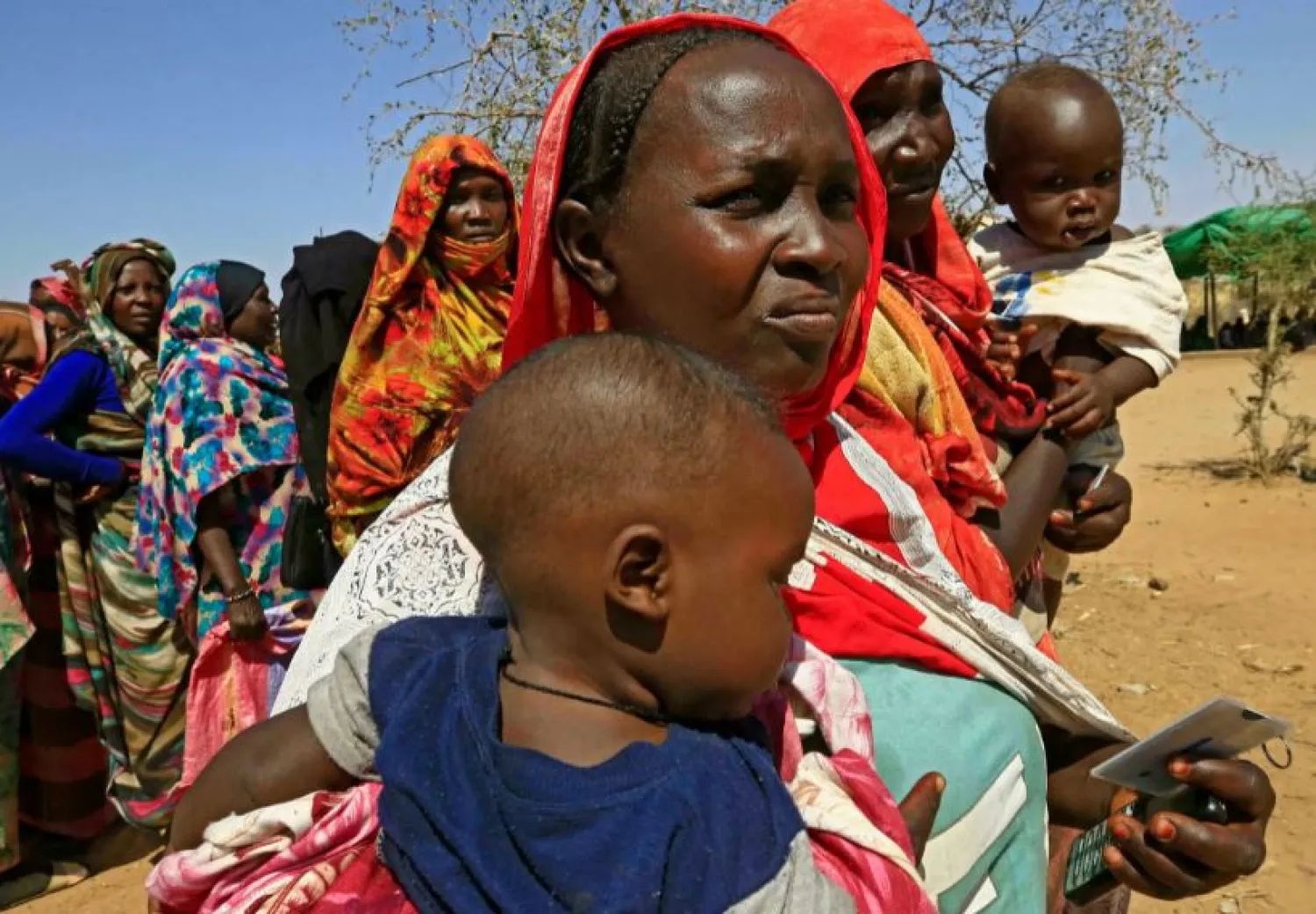
Sudanese women wait on February 1, 2021 for World Food Program (WFP) aid trucks in Darfur's Otash camp for internally displaced people ASHRAF SHAZLY AFP/File
TT

Violence in Sudan’s Darfur Lays Bare Deepening Crisis

Sudanese women wait on February 1, 2021 for World Food Program (WFP) aid trucks in Darfur's Otash camp for internally displaced people ASHRAF SHAZLY AFP/File

Attacks on UN facilities, a surge in tribal clashes, lootings, rape, and anti-coup protests -- Sudan's Darfur region is reeling from a widening security gap after last year's coup.

Sudan is one of the world's poorest countries but the vast, arid Darfur region has for years suffered more than its share of the nation's challenges.

When a coup took place in October hundreds of kilometres (miles) away in the capital Khartoum, Darfur was still reeling from the legacy of a conflict that broke out under former strongman Omar al-Bashir in 2003, and which left hundreds of thousands dead.

Though the main Darfur conflict subsided, the Darfur region bordering Chad is awash with guns and is home to most of Sudan's three million displaced people, AFP reported.

Clashes broke out last week between government forces guarding a former United Nations peacekeeping base in North Darfur and members of an armed group that signed a peace deal with the government in 2020. There were multiple deaths on both sides.

The same facility, which had been a logistics base for the now-disbanded UN and African Union peacekeeping mission, UNAMID, had already been looted in December.

Around the same time, the World Food Program suspended operations following more than a day of looting at its warehouses in North Darfur, an act which "robbed nearly two million people of the food and nutrition support they so desperately need," the agency said.

Disputes over land, livestock, access to water and grazing have since October triggered a spike in conflict that has left around 250 people killed in fighting between herders and farmers.

At the same time Darfuris -- like Sudanese across the country -- held demonstrations against the October military coup in Khartoum led by army chief Abdel Fattah al-Burhan.

"The security situation has become extremely dangerous over the past four months, with armed men often stopping and looting cars and people's belongings," Mohammed Eissa, a Darfur resident, told AFP.

Those living in camps since the 2003 Darfur conflict have again been gripped by fear.

"Lootings and rape of women have also become rampant," said Abdallah Adam, a resident of Zamzam camp for displaced people near North Darfur's El-Fasher town.

Renewed violence since late last year has displaced thousands more people from their homes and forced others -- already uprooted -- to flee once more both within Darfur and over the border to Chad, the United Nations said.

The unrest that began in 2003 pitted ethnic minority rebels, who complained of discrimination, against the Arab-dominated government of Bashir. Khartoum responded by unleashing the Janjaweed militia, blamed for atrocities including murder, rape, looting and burning villages.

Thousands of Janjaweed were later integrated into the paramilitary Rapid Support Forces led by Mohamed Hamdan Daglo, currently the number two in Sudan's post-coup ruling council.

Bashir is wanted by the International Criminal Court on charges of genocide in Darfur. He was ousted by the military and detained in April 2019 after mass protests against his three-decade rule.

- 'No trust' -

In a report early this month, UN experts said several of the main armed groups from Darfur "were receiving payments and logistical support" in return for sending thousands of mercenaries to Libya.

Military officials now running Sudan have blamed the latest spike in Darfur violence on delayed crucial security arrangements stipulated in the 2020 peace deal with rebel groups, including those in Darfur. The deal was hoped to end long-running unrest that occurred in various parts of the country under Bashir. It provided for disarming and demobilization of armed factions, and their integration within the army.

On Thursday, Sudanese authorities said that the worsening economic crisis will not make it possible for such arrangements to be implemented.

"We need the international community to support us," said Abdelrahman Abdelhamid, the general in charge of overseeing disarmament, demobilization and reintegration.

But in response to the coup, the World Bank and United States froze aid. Washington has vowed to apply further pressure if security forces continue to respond violently to anti-coup protesters, dozens of whom have been killed.

Earlier this month, demonstrations broke out against a North Darfur visit by Burhan and his deputy, Daglo.

"There is no trust at all in the coup authorities," said Adam Regal, spokesman for the General Coordination for Refugees and Displaced in Darfur, a local NGO.

"The ones in charge now have committed crimes in Darfur under Bashir. How can they protect the people now?" Regal told AFP, urging a return to the "civilian-led transition" disrupted by the putsch.

"Otherwise it will only get worse."


Portugal Says Israel Undermining Palestinian State Through Settlement Expansion

Palestinian Foreign Affairs and Expatriates Minister Varsin Aghabekian Shahin (L) and Portuguese Foreign Minister Paulo Rangel (R) attend a press conference after a meeting at Necessidades Palace in Lisbon, Portugal, 14 September 2026. (EPA)
TT

Portugal Says Israel Undermining Palestinian State Through Settlement Expansion

Palestinian Foreign Affairs and Expatriates Minister Varsin Aghabekian Shahin (L) and Portuguese Foreign Minister Paulo Rangel (R) attend a press conference after a meeting at Necessidades Palace in Lisbon, Portugal, 14 September 2026. (EPA)

Portugal's ‌foreign minister said on Monday that Israeli settlement expansion and economic pressure in the occupied West Bank and East Jerusalem were undermining prospects for a viable Palestinian state.

Foreign Minister Paulo Rangel said Israel's E1 settlement plan was "extremely pernicious" because ‌it would ‌divide the West Bank, ‌isolate ⁠East Jerusalem and ⁠was incompatible with a two-state solution.

Israel's withholding of Palestinian tax revenues amounted to a "brutal strangulation" of the Palestinian Authority's finances, preventing the economy from ⁠functioning, he said after meeting ‌Palestinian Foreign ‌Minister Varsen Aghabekian Shahin in Lisbon.

‌Rangel also cited the closure ‌of Christian schools in East Jerusalem as evidence of worsening conditions there.

Portugal recognized the State ‌of Palestine a year ago.

Rangel said the two-state ⁠solution ⁠was the only way to guarantee peaceful coexistence between Israelis and Palestinians.

Israel said last week it was closing Britain's consulate in East Jerusalem in response to plans by the UK, France and Canada to block imports from Israeli settlements in the West Bank.


UN Warns Key Humanitarian Network in Sudan Could ‘Collapse within Weeks’

A Sudanese woman, who fled the conflict in Geneina in Sudan's Darfur region, talks to her relative through a fence next to makeshift shelters, in Adre, Chad August 5, 2023. (Reuters)
TT

UN Warns Key Humanitarian Network in Sudan Could ‘Collapse within Weeks’

A Sudanese woman, who fled the conflict in Geneina in Sudan's Darfur region, talks to her relative through a fence next to makeshift shelters, in Adre, Chad August 5, 2023. (Reuters)

The United Nations warned on Monday that a key system for bringing aid into conflict-torn Sudan risked collapsing completely unless it receives more funding immediately.

"The entire humanitarian system could collapse within weeks if we don't act now," said Amy Pope, head of the International Organization for Migration.

"Without new funding, we won't be able to get help where it's needed most."

The war between Sudan's regular army and the paramilitary Rapid Support Forces (RSF) that erupted in April 2023 has killed more than 200,000 people, aid workers estimate, and created the world's largest hunger and displacement crisis.

The IOM stressed that the Common Humanitarian Pipeline logistics system it runs allows a network of more than 100 national and international NGOs to bring desperately needed shelter and other non-food aid into the African country.

Since the start of the war, it said, the system had reached 2.84 million people.

But it warned that the reach had been shrinking due to falling funds, even as the needs remain at an all-time high.

While the pipeline helped get aid to more than one million people in 2024, only 330,000 had received assistance like shelter and emergency support kits through the system so far in 2026, the IOM said.

"Without immediate donor support, current shelter, sanitation and emergency household relief items are expected to be depleted by the end of September," the UN's migration agency said in a statement.

"The warehousing and operational capacity that keeps the pipeline functioning can only be sustained until December 2026," it stressed.

The IOM said it would need $15 million just to maintain the pipeline at its 2026 minimum capacity for the next 12 months, while it would require $42 million to return to its 2024 level.

It said cutting off access to shelter assistance carried far wider risks.

"Prolonged exposure to weather, disease and insecurity can heighten risks of gender-based violence, family separation and eviction in overcrowded sites," it pointed out.

"Shelter is the foundation from which protection, health and recovery can begin," Pope insisted.

"When the pipeline stops, it is not simply warehouses that become empty. The entire humanitarian response becomes harder to deliver."


Lebanon’s Divide Over Israel Talks Reaches Religious Leaders

Lebanese President Joseph Aoun and an accompanying delegation tour the southern city of Nabatieh on Saturday (EPA)
TT

Lebanon’s Divide Over Israel Talks Reaches Religious Leaders

Lebanese President Joseph Aoun and an accompanying delegation tour the southern city of Nabatieh on Saturday (EPA)

Lebanon’s divisions over negotiations with Israel have reached its religious leadership, with Maronite Patriarch Beshara al-Rahi backing state efforts to establish a monopoly on arms and pursue talks, and Jaafari Mufti Sheikh Ahmed Qabalan accusing the state of colluding against South Lebanon.

The split turns political disagreements over the government’s policies into a sectarian dispute as talks stall - with an eighth round of negotiations with Israel in Rome postponed until early next month - and the Israeli army continues strikes in the south.

Lebanon’s Shiite religious establishment, Hezbollah and the Amal Movement have long opposed direct negotiations, but Qabalan’s attack was the strongest since the talks began.

President Joseph Aoun has repeatedly pledged to protect Lebanon’s sovereignty, secure an Israeli withdrawal and return residents to occupied areas in the south through negotiations, which he sees as the only available alternative to war.

On Sunday, on the anniversary of the assassination of President-elect Bachir Gemayel, Aoun renewed his pledge to build “a strong and just state,” capable of safeguarding its independent decision-making, sovereignty and citizens’ dignity.

Christian Support for Official Position

Al-Rahi said in his Sunday sermon that placing all weapons under state control “is not the triumph of one side over another, nor a confrontation with a sect or group, but the affirmation of a single national authority.”

“The state cannot function with two decision-making authorities, nor can sovereignty be complete when there are multiple authorities,” he added.

Backing the presidency’s approach, al-Rahi called for negotiations and mediation to produce tangible results, including an end to attacks, Israeli withdrawal and stability under credible guarantees protecting Lebanon’s rights and sovereignty. Negotiations, he said, should not become “an open-ended process with no horizon.”

Qabalan Attacks the State

Qabalan took the opposite position after Aoun visited Nabatieh and pledged state support for the south, saying Israeli withdrawal, the return of prisoners and displaced residents, and reconstruction were national priorities.

In a message published by the state-run National News Agency (NNA), Qabalan accused the executive branch of “strangling and besieging” the south and “colluding against it.”

He warned of what he called government-driven “sedition,” accusing the executive branch of threatening national partnership and seeking to abandon the southern front, which he described as central to Lebanon’s sovereignty and existence.

“The issue today is not that the executive authority does not want to defend the south,” Qabalan said, “but rather the totality of policies that strangle the south, besiege it, drain it and deprive it of every means of life.”

He added that Lebanon’s security was indivisible and called for national action to prevent what he described as “the worst internal strife,” accusing the authorities of giving Israel enough time to continue destroying the south.
